
The Balm of Gilead Myth Meaning & Symbolism
A legendary healing resin from a sacred land, symbolizing the divine remedy for a wound that no earthly medicine can cure.
The Tale of The Balm of Gilead
Listen. There is a wound that [water](/myths/water “Myth from Chinese culture.”/) cannot cleanse, a fracture that no splint can mend. It lies not in the flesh, but in the spirit’s deep marrow. In the days when prophets walked the dust and kings measured their worth in blood, there was a land east of [the river](/myths/the-river “Myth from Buddhist culture.”/), a land of rolling hills kissed by a different sun. They called it Gilead.
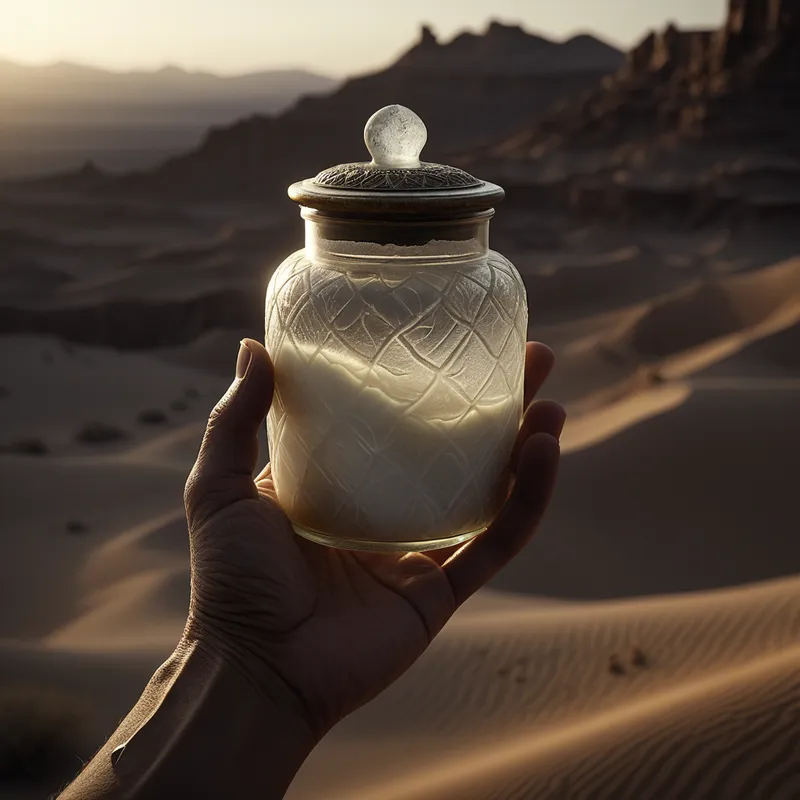
Its soil was not the richest, its rivers not the widest. But from its stony earth grew a tree, gnarled and resilient, that wept a treasure. When the bark was pierced, it bled not sap, but a perfume—a thick, dark, resinous tear that hardened in the air into golden gems. This was the Balm. To harvest it was a sacred craft. Men would make precise incisions at the rising of [the star](/myths/the-star “Myth from Tarot culture.”/), catching the slow, fragrant weep in cups of horn. The scent alone was said to calm fevered brows and quiet restless souls.
Yet, the fame of this Balm spread not for common ailments. Its legend grew in the inverse proportion to the sickness it was said to cure. A rumor traveled on caravan winds and in the laments of poets: In Gilead, there grows the physic for the sickness of the soul. For the wound of betrayal that festers long after the traitor is gone. For the grief that hollows the bones and makes a desert of the heart. For the fracture of a covenant between a people and their God.
The cry went up, a haunting refrain etched into the scrolls: “Is there no balm in Gilead? Is there no physician there?” The question hung in the air, thick with dust and despair. It was the sound of a people examining their own profound sickness, looking toward a distant, almost mythical land of remedy, and wondering if the cure had vanished from [the earth](/myths/the-earth “Myth from Hindu culture.”/), or if they had simply lost [the way](/myths/the-way “Myth from Taoist culture.”/) to it. The Balm was both a tangible hope—a real substance from a real place—and a devastating metaphor for a healing that seemed perpetually out of reach, a promise on the far side of a river of tears.
Cultural Origins & Context
The myth of the Balm of Gilead is woven into the fabric of the Hebrew prophetic tradition, primarily within the books of Jeremiah. It is not a narrative myth with a single hero, but a symbolic myth that permeates the culture’s understanding of catastrophe and hope. Gilead was a real, known region, famed in the ancient Near East for its production of high-quality medicinal resin from the Commiphora species, likely a precursor to what we know as myrrh.
[The prophets](/myths/the-prophets “Myth from Biblical culture.”/), functioning as the nation’s depth psychologists and moral critics, seized upon this well-known commodity. They used it as a poetic device to diagnose a collective spiritual illness. When Jeremiah laments, “Is there no balm in Gilead?” he is performing a cultural autopsy. The question is rhetorical and devastating: We have the remedy (the covenant law, the prophetic word, the presence of God), and we have the physicians (the priests, the prophets). Yet the wound—idolatry, social injustice, ethical decay—remains incurable. The myth was passed down not as a bedtime story, but as a lamentation in sacred text, a haunting refrain meant to provoke self-examination. Its societal function was to hold a mirror to the collective soul, stating: Your sickness is not trivial; it requires the most precious, rare, and divine intervention.
Symbolic Architecture
At its core, the Balm represents the divine remedy that exists but is not applied. It is the potential for healing that remains potential, separated from the wound by [choice](/symbols/choice “Symbol: The concept of choice often embodies decision-making, freedom, and the multitude of paths available in life.”/), circumstance, or a failure of recognition.
The deepest wound is not the absence of a cure, but the presence of an unapplied one.
The Balm itself is a [symbol](/symbols/symbol “Symbol: A symbol can represent an idea, concept, or belief, serving as a powerful tool for communication and understanding.”/) of grace—a healing substance that is given, not earned, exuded from the wounded [tree](/symbols/tree “Symbol: In dreams, the tree often symbolizes growth, stability, and the interconnectedness of life.”/) itself. It is the charis that flows toward the fracture. The Physician represents the applied wisdom, the agency required to administer the cure. The myth’s profound [tension](/symbols/tension “Symbol: A state of mental or emotional strain, often manifesting physically as tightness, pressure, or unease, signaling unresolved conflict or anticipation.”/) lies in the gap between these two. The land of Gilead is the symbolic [axis](/symbols/axis “Symbol: A central line or principle around which things revolve, representing stability, orientation, and the fundamental structure of reality or consciousness.”/) mundi where [heaven](/symbols/heaven “Symbol: A symbolic journey toward ultimate fulfillment, spiritual transcendence, or connection with the divine, often representing life’s highest aspirations.”/)’s remedy touches [earth](/symbols/earth “Symbol: The symbol of Earth often represents grounding, stability, and the physical realm, embodying a connection to nature and the innate support it provides.”/)—it is the [realm](/symbols/realm “Symbol: The symbol of ‘Realm’ often signifies the boundaries of one’s consciousness, experiences, or emotional states, suggesting aspects of reality that are either explored or ignored.”/) of the sacred, the distant, the idealized [source](/symbols/source “Symbol: The origin point of something, often representing beginnings, nourishment, or the fundamental cause behind phenomena.”/) of wholeness.
Psychologically, the “wound” is the core [trauma](/symbols/trauma “Symbol: A deeply distressing or disturbing experience that overwhelms the psyche, often manifesting in dreams as unresolved emotional wounds or psychological injury.”/), the complex, the split within the [personality](/symbols/personality “Symbol: Personality in dreams often symbolizes the traits and characteristics of the dreamer, reflecting how they perceive themselves and how they believe they are perceived by others.”/). The Balm is the latent wholeness of [the Self](/myths/the-self “Myth from Jungian culture.”/), the transcendent function that can reconcile opposites. The anguished question—“Is there no balm?”—is [the ego](/myths/the-ego “Myth from Jungian culture.”/)’s despairing cry when confronted with its own [fragmentation](/symbols/fragmentation “Symbol: The experience of breaking apart, losing cohesion, or being separated into pieces. Often represents disintegration of self, relationships, or reality.”/), doubting if wholeness is even possible.

The Dreamer’s Resonance
When this myth stirs in the modern unconscious, it rarely appears as a literal jar of ointment. It manifests as a profound motif of searching for a specific, elusive cure. One might dream of wandering through a vast, modern pharmacy where every bottle is empty. Or of being handed a beautifully wrapped gift that, when opened, contains only dust. The somatic sensation is often one of acute, localized longing—a tightness in the chest, a phantom ache—paired with the visual of a shining, out-of-reach object.
This dream pattern signals that the dreamer is in a state of recognizing a deep, perhaps long-ignored, psychological or spiritual wound. The ego has exhausted its mundane solutions (the “over-the-counter” fixes of distraction, rationalization, or temporary pleasure). The dream is the soul’s way of asking the prophetic question: “Is there no healing for this?” It marks the critical transition from seeking external, superficial fixes to acknowledging the need for a fundamental, alchemical remedy that must come from the core of one’s own being—the sacred, inner Gilead.

Alchemical Translation
The individuation process modeled by this myth is not one of a heroic quest to find the Balm, but of realizing it has been within the territory of the soul all along, and then undertaking the more difficult work of applying it.
The first alchemical stage ([nigredo](/myths/nigredo “Myth from Alchemical culture.”/)) is the acknowledgment of the incurable wound—the “Is there no balm?” lament. This despair is necessary; it burns away the illusion that the ego can heal itself. The second stage is the discovery that the wound and the remedy share a common source. The sacred tree is wounded to produce the balm.
The psyche heals itself not in spite of its wounds, but through the sacred substance those wounds compel it to produce.
The final transmutation is the albedo—the application. This is the most personal and courageous act: to become both the wounded one and the physician. It is to take the distilled essence of one’s own suffering, insights, and hard-won wisdom—the personal “balm” formed in life’s arid places—and deliberately, gently apply it to the fractured parts of the self. The myth teaches that wholeness is not the absence of wounds, but the state where the wound is no longer a source of sepsis, but the very site where the sacred, healing resin of the soul slowly, fragrantly, wells forth.
Associated Symbols
Explore related symbols from the CaleaDream lexicon: