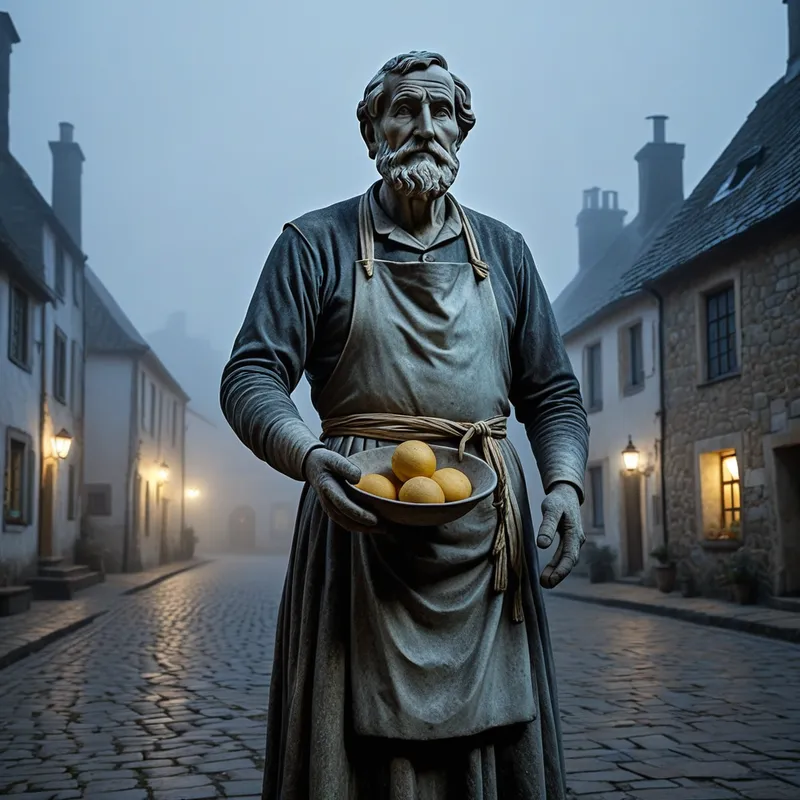
The Baker's Apron Myth Meaning & Symbolism
A humble baker sacrifices his own flesh to feed a starving village, his apron becoming a sacred symbol of selfless creation and the hearth's eternal flame.
The Tale of The Baker’s Apron
Listen, and hear the tale that the old stones of the hearth remember, the story whispered by the wind in the chimney and carried on the scent of rising dough.
In a time when the world was younger and hungrier, there was a village nestled in a valley of perpetual twilight. The sun there was a pale coin, and the soil was thin and stingy. Each winter, the Grey Maw would descend from the northern mountains, and its breath would wither the last of the autumn stores. The people grew gaunt, their bellies hollow drums, their hope a dying ember.
Among them lived a man known only as the Baker. He was not a king or a warrior, but his hands were wise in the ways of grain and fire. His small cottage was the heart of the village, for within it, the great brick oven glowed with a warmth that defied the Grey Maw. Yet this winter was the cruelest. The last sacks of flour were but dust, and the oven stood cold and dark. The children’s cries were thin as ice.
One night, in the depth of the despair, the Baker had a vision. The spirit of the Hearth, an ancient entity of clay and flame, appeared to him. It spoke not in words, but in the language of heat and hunger. It showed him a terrible truth: to create true nourishment from nothing, one must offer a piece of one’s own substance. The law of the oven was the law of life—transformation requires a sacrifice.
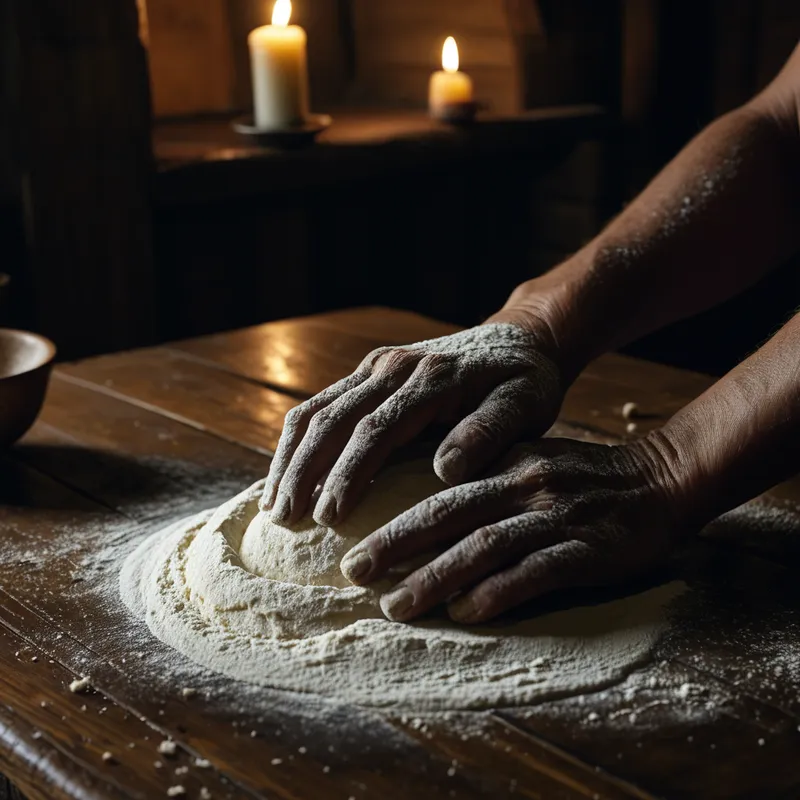
As the first grey light touched the valley, the Baker rose. He did not go to the empty mill. Instead, he stood before his cold oven. He took his sharpest kneading blade, and with a resolve as solid as the earth, he cut a piece of flesh from his own thigh. He did not cry out, though the pain was a white-hot fire. He mixed his blood with the last handful of ash and dust from the floor, and from his own flesh, he began to knead a dough.
The substance was dark and vital, pulsing with a warmth of its own. He fed it to the yeast, stoked the oven with the last of his cherished applewood, and placed the singular loaf inside. The scent that poured forth was not of any common bread. It was the smell of iron and honey, of deep soil and living heartwood. The village awoke, drawn by the aroma that promised not just survival, but wholeness.
When he drew the loaf from the oven, it was perfect—a crust like burnished amber, steaming in the cold air. He broke it and gave a piece to every soul, from the eldest elder to the smallest child. With each bite, strength returned. Color flushed back into cheeks, and light returned to eyes. The Grey Maw, robbed of its sustenance, howled and retreated back to its peaks.
But the Baker was forever changed. Where he had cut, there was no wound, only smooth skin. And his simple linen apron, spattered with flour and now his own blood, had been transformed. It shone with a soft, perpetual warmth, as if woven from captured sunlight. He wore it always, and so long as he baked, the village knew no famine. When he finally passed, his body turned to rich, dark earth, but the apron remained, hanging in the cottage, its warmth a gentle, eternal promise. It became the village’s most sacred relic, the heart of the Hearth that never went cold.
Cultural Origins & Context
The myth of The Baker’s Apron is a cornerstone of what scholars term “Hearth Culture” narratives, found in scattered oral traditions across temperate, agrarian regions of pre-modern Europe. It was not a tale for grand halls, but for the intimate space of the kitchen and the fireside. Typically told by grandmothers or the master/mistress of a household during the long nights of deep winter, its primary function was not mere entertainment, but somatic and social instruction.
The story served as a foundational aetiology—a myth explaining the origin of a custom or object. It sanctified the daily, often grueling, labor of food preparation, elevating the baker from a mere tradesperson to a priest of the hearth. The ritual sharing of bread, especially during solstice festivals, was given divine precedent through this narrative. Furthermore, it encoded a crucial survival ethic for close-knit communities: the profound truth that the individual’s sacrifice for the collective is what ultimately sustains the collective, which in turn shelters the individual. It was a myth against hoarding, against the isolation of the self.
Symbolic Architecture
At its core, the myth is a profound map of the psyche’s relationship with creation, sacrifice, and the nourishing of the whole self and community.
The Baker represents the conscious Ego, tasked with the role of transforming raw, unconscious material (the barren winter, the dust) into something that can sustain life. He is not a warrior who fights the Grey Maw externally, but an alchemist who works within the vessel of his own being.
The Grey Maw is the psychic state of lack, depression, and spiritual famine. It is the cold, devouring aspect of the Shadow, which consumes hope and vitality.
The true oven is not made of brick, but of the willingness to be transformed by one’s own substance.
The central, shocking act—the Baker cutting his own flesh—is the ultimate symbol of creative sacrifice. It moves the act of baking from the external (using grain from the field) to the internal (using the substance of the self). Psychologically, this represents the moment when we must stop looking for external solutions, validation, or “flour,” and instead turn inward, offering up a piece of our own history, pain, or energy (“flesh”) as the raw material for our healing and growth. The resulting “bread” is wisdom, compassion, or art born of genuine, costly experience.
The Apron, initially a simple tool of practicality, becomes the symbol of this integrated, sacred function. It is the “skin” of the transformed identity. Its permanent warmth signifies that the sacrifice was not a one-time loss, but a conversion of personal pain into a lasting, nourishing capacity—a resilient and warm-hearted psyche that can feed itself and others.
The Dreamer’s Resonance
When this myth stirs in the modern dreamscape, it often signals a critical juncture in what Jung termed the individuation process. To dream of being a baker with empty sacks points to a feeling of creative or emotional bankruptcy. To dream of kneading a strange, dark, or living dough suggests the dreamer is beginning, often uneasily, to work with their own shadow material—the unprocessed grief, anger, or trauma that feels “unsavory” but is rich with potential energy.
A dream featuring the specific act of cutting one’s own flesh to make dough is a powerful somatic metaphor. The dreaming body is illustrating a profound psychological truth: you are being asked to “feed” some part of your life (a relationship, a project, your own spirit) not with borrowed ideas or superficial effort, but with something essential and real from your own core. It is a call to authenticity so deep it feels like a wound. The subsequent dream of feeding others with this bread indicates the recognition that this deeply personal work has transpersonal value; your hard-won wholeness becomes sustenance for your community, family, or the world.
Alchemical Translation
The myth of The Baker’s Apron is a perfect allegory for psychic alchemy—the solve et coagula (dissolve and coagulate) played out in the soul’s kitchen.
1. The Nigredo (The Blackening): The barren winter and the empty sacks represent the initial despair, the dark night of the soul. All familiar resources (old identities, coping mechanisms) are exhausted.
2. The Albedo (The Whitening): The Baker’s vision from the Hearth spirit is the first glimpse of a guiding principle from the deeper Self. It is the insight, the “white” flash of understanding that sacrifice is necessary.
3. The Rubedo (The Reddening): This is the central, bloody sacrifice. The offering of one’s own flesh is the rubedo—the red, passionate, and painful engagement with one’s own vital essence. It is the point where will and suffering meet to become fuel.
Individuation is the art of baking one’s own soul into bread, using the heat of conscious suffering to transform raw experience into lasting nourishment.
4. The Citrinitas (The Yellowing, or Spiritualization): The baking of the loaf, its golden crust, and its miraculous, nourishing scent. The base material (suffering, experience) is spiritualized into something that can feed and elevate consciousness.
5. The Creation of the Philosopher’s Stone: This is not the bread itself, but the transformed Apron. The Stone in alchemy is not a product to be used up, but a state of being that perpetually transmutes base metal into gold. The ever-warm Apron symbolizes the achieved state of the individuated personality—no longer needing to make the sacrifice anew each time, but living from a center that has integrated that function. The individual becomes a stable, warm source of creative and nourishing energy, a true hearth for the world around them. The myth teaches that our deepest wounds, when consciously offered to the fire of attention, do not merely scar over—they become the very fabric of our sacred, nourishing purpose.
Associated Symbols
Explore related symbols from the CaleaDream lexicon: