The Baker in Pharaoh's Dream Myth Meaning & Symbolism
A royal baker, imprisoned, dreams of birds eating bread from baskets on his head. Joseph interprets it as a death sentence, revealing forgotten duties.
The Tale of The Baker in Pharaoh’s Dream
The air in the dungeon of Potiphar’s house was thick with the smell of despair and old stone. Among the forgotten men was a baker, his hands once skilled in kneading the finest dough for the Pharaoh’s own table. Now they were idle, stained with the grime of a fallen courtier. In the cell beside him languished a cupbearer, a fellow casualty of royal disfavor. And in the cell beyond, a young Hebrew named Joseph, a man with a strange light in his eyes, to whom the God of his fathers spoke in the night.
One morning, the cupbearer and the baker awoke, their spirits troubled, their faces pale as unbaked dough. “We have had dreams,” they whispered through the bars, “and there is no one to interpret them.” Joseph listened. The cupbearer told of a vine with three branches, bursting into ripe grapes, which he pressed into Pharaoh’s cup. Joseph’s interpretation was a balm: “In three days you will be restored.”
Hearing this hope, the baker’s own heart, a lump of heavy dough, began to rise. Perhaps his fate, too, could be sweet. He leaned forward, the chains on his wrists clinking softly, and poured out the vision that had coiled in his sleep like a serpent.
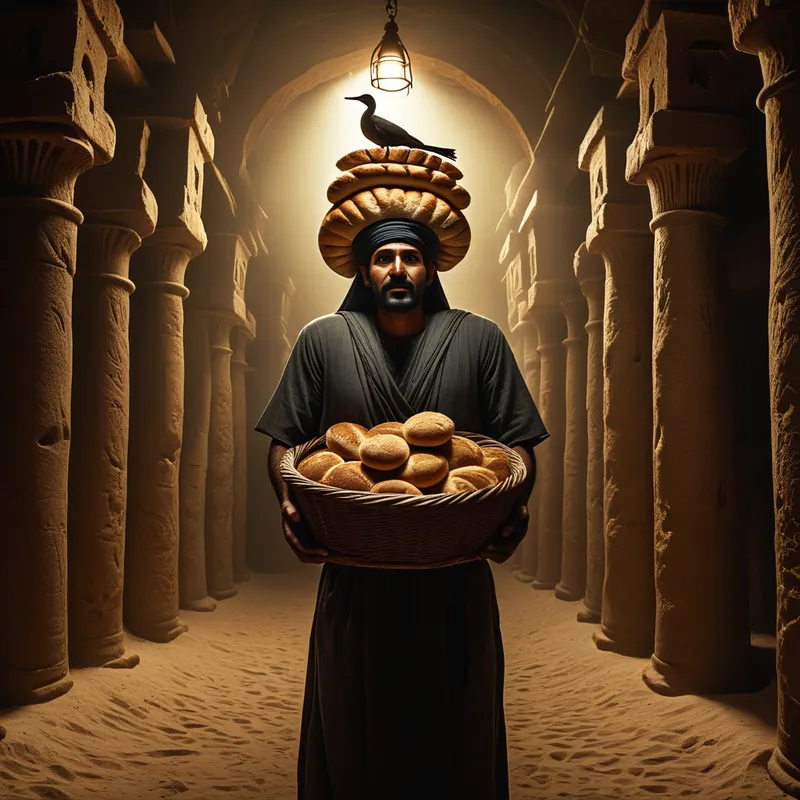
“Listen,” he began, his voice a dry husk. “In my dream, behold, I had three baskets of white bread on my head. In the uppermost basket were all kinds of baked goods for Pharaoh, the work of a baker. But the birds…” he shuddered, “the birds came and ate them out of the basket on my head.”
The words hung in the stagnant air. Joseph’s face, which had been a map of compassion, grew still. The light in his eyes turned from a lamp to a judge’s torch. He did not speak for a long moment, bearing the weight of the truth he must deliver. When he did, his words were clear, cold, and final.
“This is the interpretation,” Joseph said. “The three baskets are three days. Within three days, Pharaoh will lift up your head—from off you—and hang you on a tree. And the birds will eat your flesh from you.”
The dungeon’s chill seeped into the baker’s bones. The hope that had risen now collapsed, a loaf fallen in the oven. The dream was not of restoration, but of exposure; not of offering, but of consumption. The very symbols of his craft—the baskets, the bread—had become the instruments of his doom. Three days later, as the cupbearer was returned to his station, the baker was led out to meet the fate that had already visited him in the world of shadows. The birds of the air attended his final, public accounting.
Cultural Origins & Context
This stark narrative is embedded within the larger epic of Joseph in the Book of Genesis. It functions as a crucial narrative hinge, demonstrating Joseph’s divine gift of dream interpretation, which will soon catapult him from the dungeon to the throne room of Egypt itself. The story was preserved and transmitted orally for generations within the Israelite tradition before being codified in the Torah. Its societal function is multifaceted: it is a morality tale about the courtly world, where favor is fickle and the price of failure is absolute; it is a theological assertion of YHWH’s sovereignty, working through his chosen interpreter; and it is a masterclass in narrative tension, using the paired dreams—one of life, one of death—to highlight the precision and inevitability of divine judgment. The baker and cupbearer represent every person subject to the absolute power of a king, or a god, whose destinies are written in a language they cannot read.
Symbolic Architecture
The myth’s power lies in its devastating economy of symbol. The baker is not an evil man, but a failed one. His symbols are the symbols of his vocation, perverted in the dreamscape.
The three baskets are the burden of his duty, stacked high upon the crown of his head—the seat of thought and identity. They contain not just bread, but all kinds of baked goods for Pharaoh, representing the totality of his skill, his offering, his life’s work. This is the offering that never reached its intended recipient. The bread, meant for divine royalty, is left exposed.
The most profound failure is not in the making, but in the offering. To create a gift and never give it is to invite the shadows to feast upon your soul.
The birds are the key. In ancient symbology, birds are often messengers, but here they are scavengers. They represent the external, public, and inevitable consequences of an internal failure. They are the forces of exposure, decay, and final reckoning that consume what was meant to be sacred. The dream reveals a fundamental law: what is not properly elevated (to Pharaoh, to the divine, to consciousness) will be devoured by the chaotic, unconscious elements of the world. The baker’s “head” is not restored to honor but is utterly removed. His identity, built upon his craft, is consumed, leaving only the bare scaffold of his fate.
The Dreamer’s Resonance
When this mythic pattern stirs in a modern dream, it rarely appears as Egyptian baskets. Instead, one may dream of preparing an elaborate project that never gets presented, of carrying a precious item that crumbles to dust, or of nurturing something only to have it stolen or corrupted by unseen forces. The somatic sensation is often one of dread, of a weight upon the crown of the head or shoulders, coupled with a paralyzing inability to act.
Psychologically, this is the moment when the shadow presents the bill for forgotten obligations. The dreamer is undergoing a process of psychic exposure. Some part of the self—a talent, a responsibility, a debt of gratitude, a creative impulse—has been neglected, hoarded, or performed for the wrong audience (often for the ego’s glory alone). The unconscious, in the form of the scavenging birds, now acts to dismantle this false structure. The dream is a severe warning: the persona built upon un-offered gifts is vulnerable to complete deconstruction. It is the psyche’s ultimatum to integrate one’s true work into the larger order of one’s life, or face its dissolution.
Alchemical Translation
The alchemical process mirrored here is the Nigredo, the blackening, the stage of mortification and decomposition. The baker’s fate is the ultimate Nigredo—the reduction of the individual to their bare, exposed essence. For the modern soul, however, this myth does not have to end at the gallows. It models the necessary death that precedes transmutation.
The first step is Recognition: seeing the baskets on your own head. What bread have you baked but kept? What skill, love, or truth remains ungiven? The second is the brutal Interpretation: confronting the birds. What in your life is already consuming you—anxiety, resentment, a sense of fraud—because you have failed to make the proper offering? This is the shadow feasting.
The alchemical fire is lit not by success, but by the honest confrontation with what has been left to rot in the baskets of neglect.
The triumph, the Albedo, lies in a radical shift in intention. The myth warns us to offer our bread—our creative substance—to the true “Pharaoh,” the highest authority in our psychic hierarchy. This is not an external king, but the Self, the inner center of wholeness. To bake for the Self is to perform one’s duty with integrity, to create for the sake of the sacred act itself, and to offer the results to life, not to the fragile altar of personal prestige. When the offering is true, the baskets are emptied, the head is lightened, and the birds find no purchase. The baker in us must die so that the servant of the soul may live, no longer carrying the burden of his gift, but becoming a conduit for its distribution.
Associated Symbols
Explore related symbols from the CaleaDream lexicon: