The Babylonian Star Catalogues Myth Meaning & Symbolism
Ancient priests, under the gaze of gods, inscribed the celestial patterns onto clay, creating a divine map to navigate fate and time.
The Tale of The Babylonian Star Catalogues
Beneath the vault of Anu, where the breath of Sin paints a path of silver, the world was a whisper of chaos. Rivers flooded without warning, kings rose and fell like reeds in the wind, and the heart of humanity beat to a rhythm it could not comprehend. The gods had written the law of all things—the Mes—not on clay, but in the silent, turning fire of the heavens. But the script was too bright, too vast, a language of scattered embers on a black cloth.
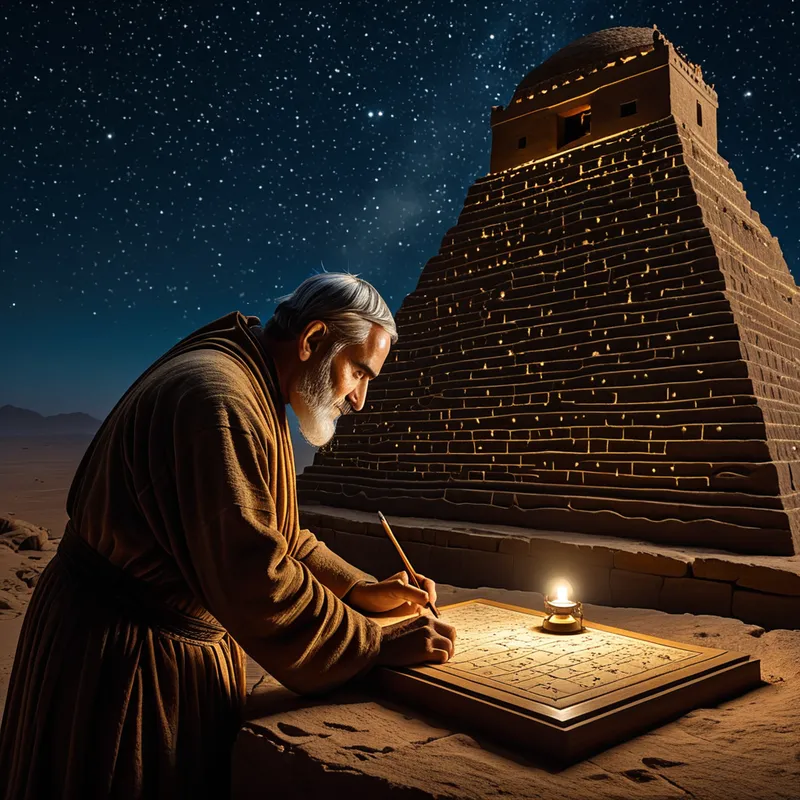
In the high ziggurat of Esagila, the ṭupšar Enūma Anu Enlil—the scribe of the gods Anu and Enlil—felt this chaos as a chill in his bones. His nights were not for sleep, but for a vigil. He would climb to the windswept summit, the reed mat cold beneath his knees, and lift his face to the consuming dark. There, Inanna would blaze her treacherous course, a jewel of warning and desire. The Salbatanu would glow with the dull heat of conflict. They were divine signs, but fleeting, like the tracks of animals in mud after a storm.
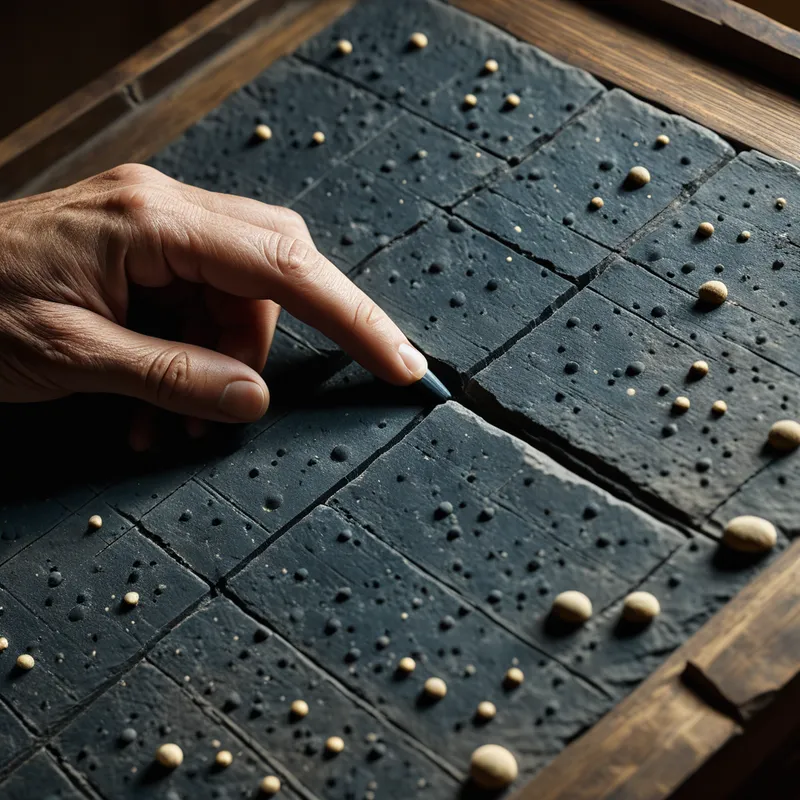
His task, given in the silence of his own spirit and the command of his king, was not to read a single sign, but to map the very grammar of the divine. He began with the fixed soldiers of the sky, the MUL.APIN. With a stylus of river reed, he pressed into the soft, obedient clay: The Plough, APIN, that turns the celestial field. The Jaw of the Bull, MUL.MUL, that charges through the spring. The Great Twins, MAŠ.TAB.BA.GAL.GAL, who stand guard. Each wedge, each line, was an act of profound courage—a human hand attempting to cage a fragment of the infinite.
But the true struggle lay with the wanderers—the bibbu. They were the gods themselves, walking their own secret paths through the houses of the fixed stars. To predict the loop of Marduk, to chart the retrograde dance of Nabu, was to discern the intentions of the divine mind. Night after night, year after year, the scribe recorded. He noted when Kayamanu lingered in The Scales of ZIBANITU, a portent for the weight of law. He tracked Dilbat’s disappearance and triumphant return, a myth of descent and rebirth written in light.
The conflict was the silence, the vast indifference of the cosmos against the fragile, persistent hum of human consciousness. The resolution was not a single moment, but the slow accumulation. One tablet became ten, then a hundred. They were stored in the House of Tablets, a terrestrial echo of the celestial order. The chaos of the night was given a name, a path, a time. The river of fate now had banks, charted in clay. The priest-astronomer had not conquered the heavens, but he had built a ladder of words and numbers by which humanity could, for the first time, begin to climb toward understanding.
Cultural Origins & Context
This was not a myth told in epic verse like šūtur eli šarrī, but a living, breathing practice of sacred science. The catalogues, most famously embodied in texts like the MUL.APIN series and the later Enūma Anu Enlil, originated in the temple complexes of Assyria and Babylonia from the second millennium BCE onward. They were the work of a scholarly elite—the ummânu—who served as priests, scribes, and advisors to the king.
Their function was profoundly pragmatic and deeply spiritual. In the Mesopotamian worldview, the macrocosm (heaven) and the microcosm (earth, the state, the individual) were inextricably linked through a system of correspondences. A celestial event was not merely an astronomical occurrence; it was a divine sentence, a piece of the gods' communicated will. By cataloging the stars and planetary motions, the scribes were creating a predictive manual of divine intention. This knowledge was power—the power to advise the king on matters of war, agriculture, and ritual, to avert calamity, and to align human activity with the cosmic order (kittum). The catalogues were thus a cornerstone of statecraft and a sacred duty, a way to navigate the terrifying and magnificent uncertainty of a universe governed by willful deities.
Symbolic Architecture
At its core, the myth of the Star Catalogues is the human psyche confronting the sublime, overwhelming pattern of the Self and the unconscious. The star-strewn heaven represents the totality of the psyche—the archetypal realm of the gods, the unknown depths of the collective unconscious, teeming with autonomous, powerful forces (the planets/gods). It is beautiful, terrifying, and initially incoherent.
The act of cataloguing is the birth of consciousness itself—the ego's heroic, patient effort to differentiate, name, and relate the contents of the unconscious.
The fixed stars symbolize the foundational, eternal archetypes—the core patterns of existence like the Mother, the Sage, the Hero. The wandering planets are the dynamic, disruptive, and transformative archetypal energies as they move through and influence the structures of the personality. The scribe, the ego-consciousness, sits at the boundary (the ziggurat). His tools—observation, measurement, recording—symbolize the cognitive functions: perception, thinking, and the ordering principle of logic. The resulting clay tablet is the nascent structure of the conscious personality, a fragile but necessary map by which the individual can orient themselves within the vast inner cosmos.
The Dreamer's Resonance
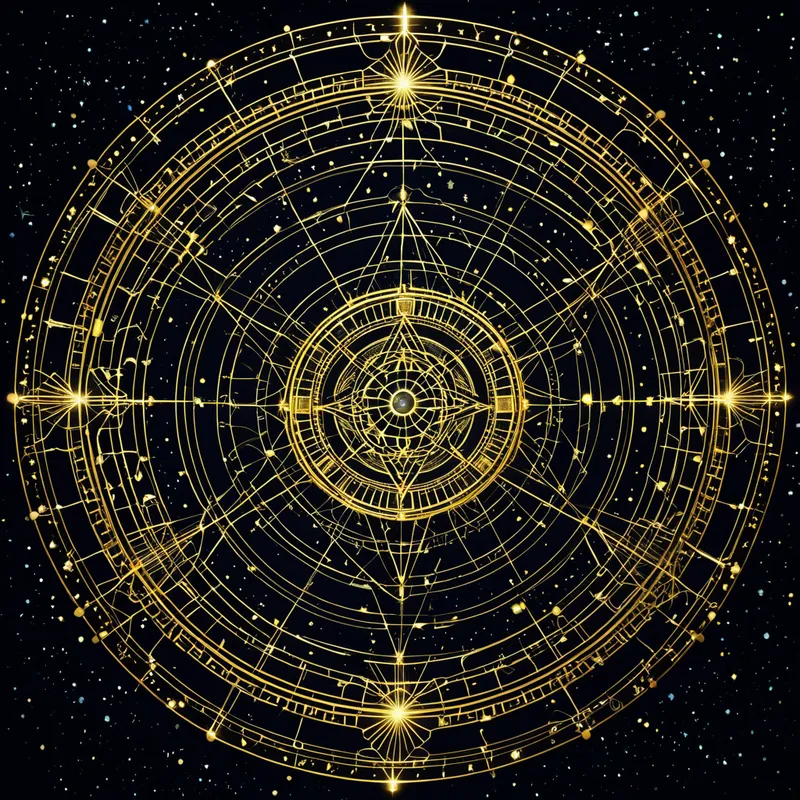
When this myth stirs in the modern dreamer, it often manifests as dreams of overwhelming, intricate systems. One might dream of a vast, incomprehensible library; a control room with countless unlabeled switches and screens displaying alien data; or a night sky where the stars are mathematical symbols or lines of code. The somatic feeling is one of awe mixed with anxiety—the "sublime" in its classical sense.
Psychologically, this signals a process of psychic integration at a systemic level. The dreamer is not grappling with a single complex (like a shadow figure) but is being presented with the sheer scale and complexity of their own inner world. The dream-ego's struggle to "catalogue" or "understand the system" reflects a conscious effort, often during a period of intense self-analysis or life review, to find patterns in one's history, behaviors, and motivations. It is the psyche's way of demanding a higher-order synthesis, pushing beyond anecdotal self-knowledge toward a more unified, almost theoretical understanding of one's own nature.

Alchemical Translation
The alchemical process mirrored here is coagulatio—the bringing of the volatile and spiritual (the starry heavens) into a fixed, tangible form (the clay tablet). It is the stage of the Magnum Opus where insights must be grounded, where numinous experience must be translated into usable knowledge.
For the individual on the path of individuation, the myth models the transition from being passively subject to the unconscious to actively engaging with it as a cartographer. Our moods, compulsions, projections, and synchronicities are the "wandering stars" and "celestial omens" of our personal psyche. The "Babylonian" task is to become the scribe of one's own soul: to observe these inner phenomena without immediate judgment, to record their patterns (perhaps through journaling, therapy, or active imagination), and to slowly discern the "divine laws"—the core archetypal patterns—that govern them.
This is not an attempt to control the inner gods, but to understand their language, to align one's conscious life with their deeper rhythms, and thus to transform a life of chaotic suffering into one of meaningful, if often fateful, participation.
The triumph is not in mastering destiny, but in developing a dialogue with it. The completed catalogue is not the end of the journey, but the beginning of a more conscious, respectful, and purposeful navigation through the mysterious cosmos of the self. The individual becomes, like the ancient priest-astronomer, a humble steward standing at the interface between the timeless heavens and the clay of earthly existence.
Associated Symbols
Explore related symbols from the CaleaDream lexicon: