The Augurs of Rome Myth Meaning & Symbolism
The myth of priests who read the will of the gods in the flight of birds, shaping the destiny of Rome through sacred observation.
The Tale of The Augurs of Rome
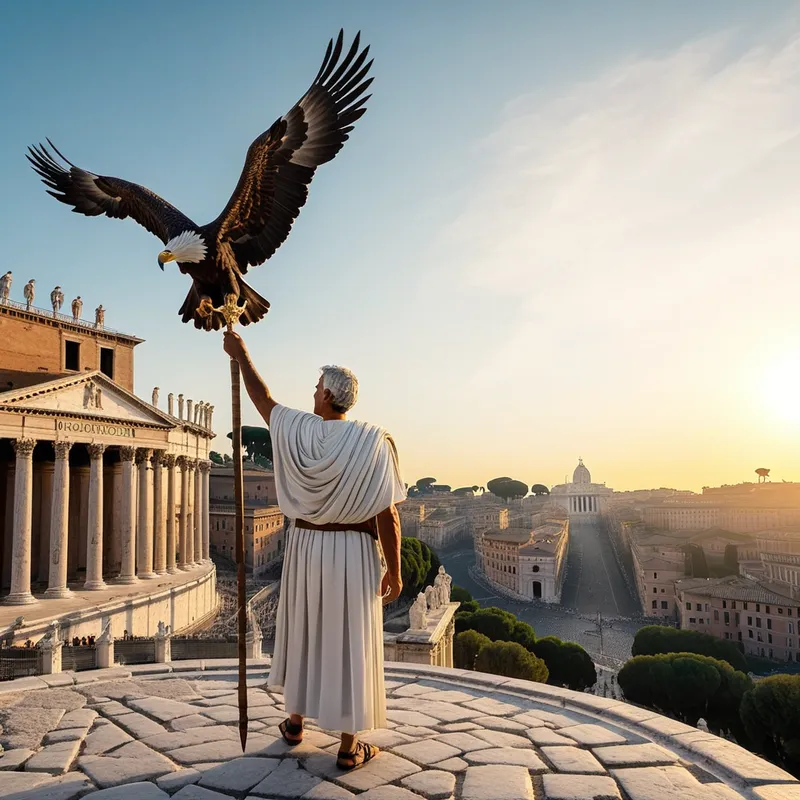
Before the legions marched, before the Senate debated, Rome listened to [the sky](/myths/the-sky “Myth from Persian culture.”/). In the grey light of dawn, when [the world](/myths/the-world “Myth from Tarot culture.”/) held its breath between night and day, the Augur would ascend the high place. His feet were bare upon the sacred earth of the Capitolium. In his hand, he carried not a sword, but the lituus, a staff of seasoned wood, its crook a question posed to the heavens.
He would stand facing south, the rising sun warming his back. With a voice that carried the weight of the city’s fate, he would invoke Jupiter, [Janus](/myths/janus “Myth from Global/Universal culture.”/), and the ancestral spirits. Then, with a slow, deliberate sweep of the lituus, he would carve the invisible templum upon the air—a perfect quadrant of the firmament, his divine viewing chamber. The bustling forum below fell silent. The consul, poised to call for war or peace, waited. All of Rome waited.
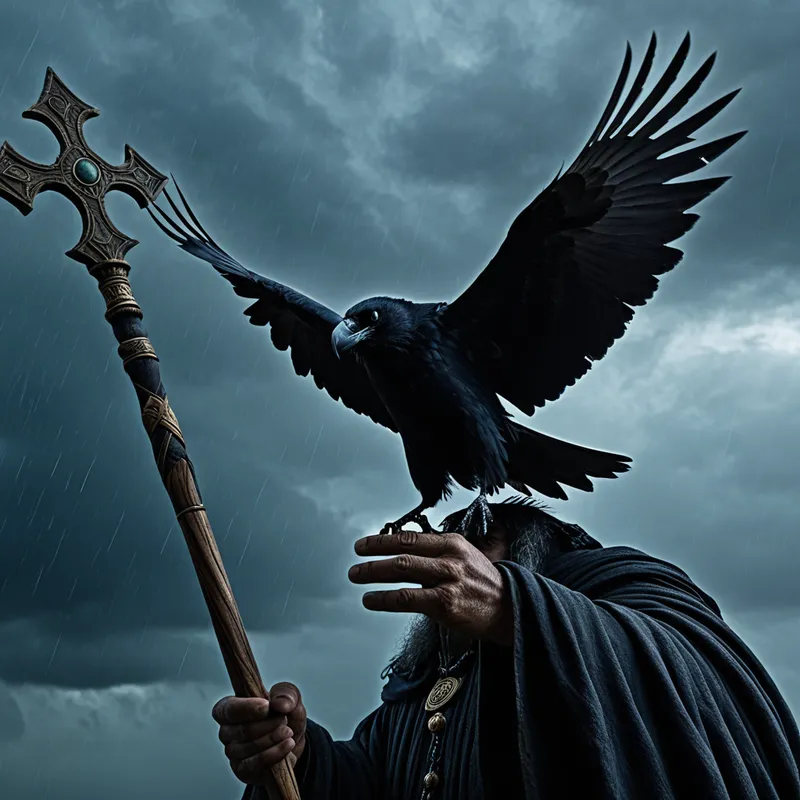
The Augur’s world narrowed to [the wind](/myths/the-wind “Myth from Various culture.”/) on his cheek, the scent of rain in the distance, and the vast, empty blue of his templum. His art was not one of command, but of profound, agonizing receptivity. He was the ear of the state, tuned to a frequency beyond human speech. Then—a movement. A dark speck from the east. The flight of a bird, most often the eagle, messenger of Jupiter, or the wise crow, sacred to Apollo.
He did not see a mere bird. He saw a grammar of destiny. Did it enter from the left, the auspicious side of the gods, or the right, the side of men? Was its flight steady and direct, or frantic and circling? Did it cry out, and what was the timbre of that cry? A single, sharp call could sanction a battle that would forge an empire. A flock scattering in panic could halt the foundation of a temple, leaving the project to molder for a year.
The most legendary of them, Attus Navius, was challenged by a skeptical king who mocked the art. “Divine for me,” the king sneered, “whether what I am thinking of can be done.” Navius, unflinching, took the auspices and declared it could. The king, thinking he had conceived an impossibility, said, “I was thinking you could cut a whetstone with a razor.” In the hushed silence, Navius took the blade, prayed, and sliced the stone clean through. The whetstone, it is said, was kept for generations in the Comitium, a testament that the will of the gods, read aright, could make the solid fluid and the impossible mundane.
This was their power. They translated the chaotic poetry of nature—the wingbeat, the cloud, the [thunderclap](/myths/thunderclap “Myth from Various culture.”/)—into the prose of human action. They built a bridge of meaning between the roaring, inscrutable cosmos and the ordered stones of the city. Through their eyes, Rome was not a solitary actor on a blind stage, but a participant in a vast, divine dialogue. Every major undertaking—the founding of a colony, the election of a magistrate, the declaration of war—was first a question whispered to the sky, awaiting an answer written in the flight of birds.
Cultural Origins & Context
The practice of augury was not a mere superstition of the Roman state; it was its constitutional nervous system. Its origins are shrouded in the mists of Italic and Etruscan tradition, older than Rome itself. The Romans, pragmatic builders and fierce warriors, were also a people deeply anxious about divine favor. Theirs was a religion of contract (do ut des—“I give so that you might give”) and precise ritual. Augury provided the critical feedback mechanism.
The College of Augurs was one of the most prestigious priestly colleges, its membership a pinnacle of political and social life. Yet their authority was not to predict a fixed future, but to ascertain whether the gods approved of a proposed human action at that specific moment. This made them fundamental to the concept of pax deorum, the “peace of the gods.” A state acting without auspices risked divine wrath. Thus, the Augur was a check on raw power, a reminder that even the consul’s imperium was subject to a higher, natural law.
The myths surrounding figures like Attus Navius served a crucial societal function: they were foundational stories legitimizing the entire system. They answered the skeptic not with philosophy, but with miraculous proof. They established that the art was real, its practitioners genuinely connected to the divine, and that Rome’s staggering success was direct evidence of its efficacy. The myth was told in histories, enacted in public ceremonies, and embedded in the very language—[the word](/myths/the-word “Myth from Biblical culture.”/) “inauguration” derives from the Augur’s act of taking the auspices.
Symbolic Architecture
At its core, the myth of the Augur is a profound [symbol](/symbols/symbol “Symbol: A symbol can represent an idea, concept, or belief, serving as a powerful tool for communication and understanding.”/) of the [human](/symbols/human “Symbol: The symbol of a human represents individuality, complexity of emotions, and social relationships.”/) confrontation with a seemingly random [universe](/symbols/universe “Symbol: The universe symbolizes vastness, interconnectedness, and the mysteries of existence beyond the individual self.”/) and the [psyche](/myths/psyche “Myth from Greek culture.”/)’s innate drive to find meaning within it.
The Augur does not control the birds; he learns the language of their freedom. True power lies not in command, but in correct interpretation.
The templum is the ultimate symbol of conscious focus. It is the act of drawing a [boundary](/symbols/boundary “Symbol: A conceptual or physical limit defining separation, protection, or identity between entities, spaces, or states of being.”/) around the boundless, of creating a frame through which the infinite can be perceived. Psychologically, this represents [the ego](/myths/the-ego “Myth from Jungian culture.”/)’s necessary function: to create a stable point of observation (the “I”) from which to view the chaotic contents of the unconscious (the sky). Without this templum, the individual is overwhelmed by undifferentiated psychic [noise](/symbols/noise “Symbol: Noise in dreams signifies distraction, confusion, and the need for clarity amidst chaos.”/).
The [flight](/symbols/flight “Symbol: Flight symbolizes freedom, escape, and the pursuit of one’s aspirations, reflecting a desire to transcend limitations.”/) of the birds symbolizes the autonomous, living movements of the psyche—intuitions, synchronicities, dreams, and affective impulses that arise from beyond the ego’s control. They are not “random.” They follow their own innate, instinctual patterns. The Augur’s skill is to observe these patterns without [projection](/symbols/projection “Symbol: The unconscious act of attributing one’s own internal qualities, emotions, or shadow aspects onto external entities, people, or situations.”/), to discern their intrinsic [direction](/symbols/direction “Symbol: Direction in dreams often relates to life choices, guidance, and the path one is following, emphasizing the importance of navigation in personal journeys.”/) and quality. Is this [impulse](/symbols/impulse “Symbol: A sudden, powerful urge or drive that arises without conscious deliberation, often linked to primal instincts or emotional surges.”/) (this “[bird](/symbols/bird “Symbol: Birds symbolize freedom, perspective, and the connection between the earthly and spiritual realms, often representing the soul’s aspirations or personal growth.”/)”) coming from a positive, guiding [source](/symbols/source “Symbol: The origin point of something, often representing beginnings, nourishment, or the fundamental cause behind phenomena.”/) (Jupiter’s [eagle](/symbols/eagle “Symbol: The eagle is a symbol of power, freedom, and transcendence, often representing a person’s aspirations and higher self.”/)), or from a tricksterish, complicating one (the crow)? The answer dictates whether the ego should align with it or hold firm.
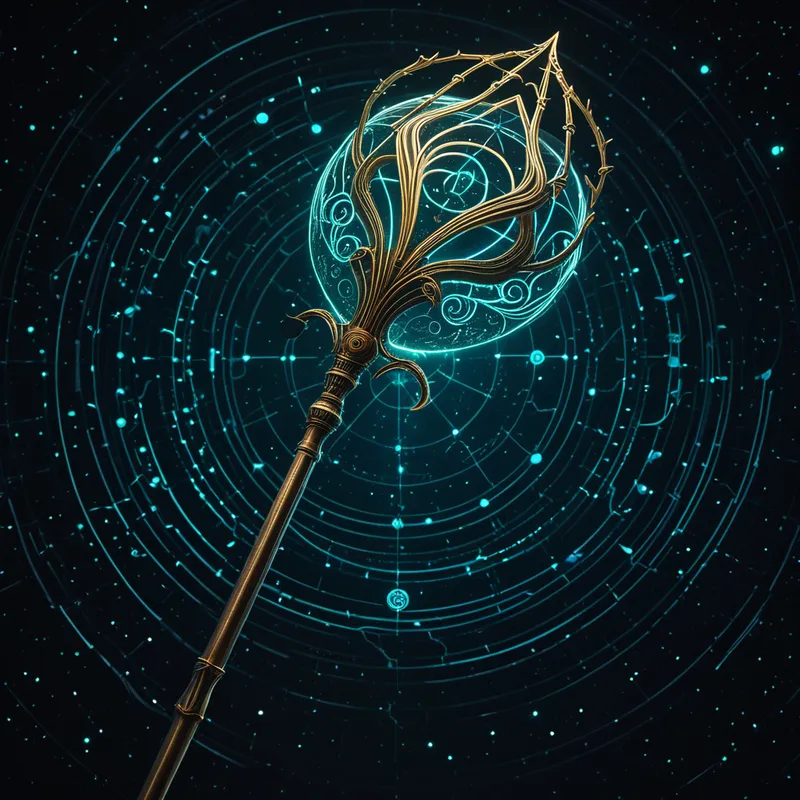
The lituus is the tool of [connection](/symbols/connection “Symbol: Connection symbolizes relationships, communication, and bonds among individuals.”/). It is not a [weapon](/symbols/weapon “Symbol: A weapon in dreams often symbolizes power, aggression, and the need for protection or defense.”/) but an [instrument](/symbols/instrument “Symbol: An instrument symbolizes creativity, communication, and the means by which one expresses oneself or influences the world.”/) of demarcation and linkage. It touches the [earth](/symbols/earth “Symbol: The symbol of Earth often represents grounding, stability, and the physical realm, embodying a connection to nature and the innate support it provides.”/) and points to the sky, a [axis](/symbols/axis “Symbol: A central line or principle around which things revolve, representing stability, orientation, and the fundamental structure of reality or consciousness.”/) mundi connecting the human [realm](/symbols/realm “Symbol: The symbol of ‘Realm’ often signifies the boundaries of one’s consciousness, experiences, or emotional states, suggesting aspects of reality that are either explored or ignored.”/) with the divine. It represents the focused [attention](/symbols/attention “Symbol: Attention in dreams signifies focus, awareness, and the priorities in one’s life, often indicating where the dreamer’s energy is invested.”/) and ritualized [attitude](/symbols/attitude “Symbol: Attitude symbolizes one’s mental state, perception, and posture towards life, influencing emotions and actions significantly.”/) required to mediate between the inner and outer worlds, between instinct and [intention](/symbols/intention “Symbol: Intention represents the clarity of purpose and direction in one’s life and can symbolize motivation and commitment within a dream context.”/).
The Dreamer’s Resonance
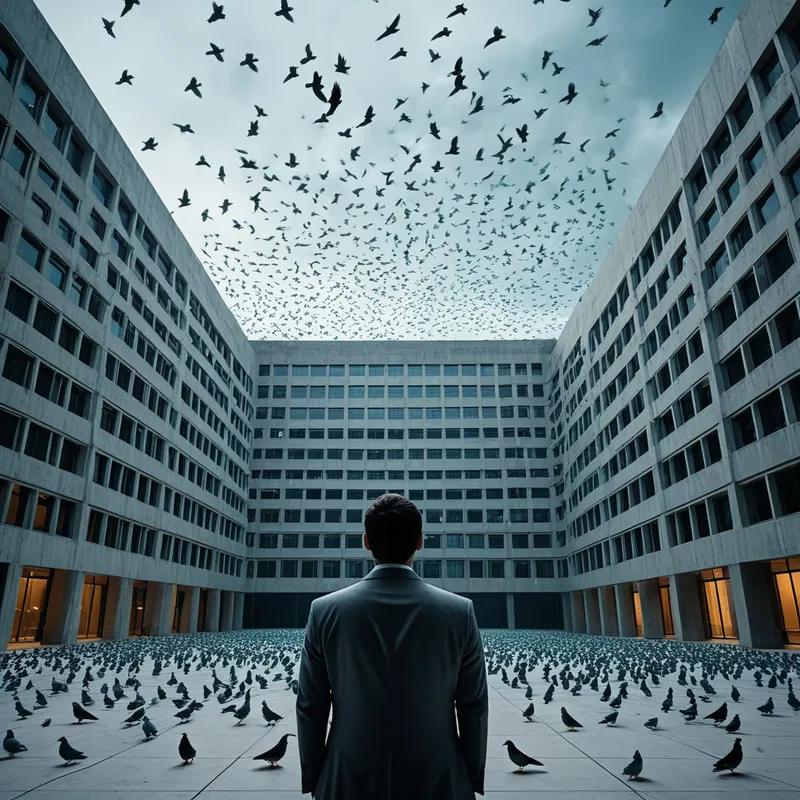
When this mythic pattern stirs in the modern dreamer, it often manifests as a profound preoccupation with signs. The dreamer may find themselves in a dream, anxiously scanning a chaotic sky—not for birds, but for airplanes, drones, or strange symbols—desperate to discern a pattern. They may dream of being handed an important message written in an indecipherable language, or of hearing a crucial piece of advice drowned out by static.
Somatically, this process feels like a tense, watchful anticipation—a holding of the breath. Psychologically, it is the soul’s version of the Augur on the hill. The dreamer is at a crossroads, facing a significant life decision (a “proposed action” like the consul’s). The conscious mind has weighed the options, but the decision feels incomplete, lacking a vital sanction. The unconscious is now presenting its raw, symbolic data—the “birds” in the form of dream images, emotional weather, and synchronicities.
The anxiety in the dream mirrors the Augur’s sacred tension. The dreamer is being called to perform the inner augury: to create a quiet, focused templum within themselves, to observe the flight of their own psychic contents without forcing them, and to have the courage to interpret what they see. The dream warns against acting without taking these inner auspices, lest one violate their own internal pax deorum and bring psychic discord upon themselves.
Alchemical Translation
The alchemical process modeled here is the transmutation of random event into meaningful omen, of chance into synchronicity. It is a core operation in the journey of individuation—moving from being a passive victim of fate to an active participant in a co-creative dialogue with the deeper Self.
[The first stage](/myths/the-first-stage “Myth from Alchemical culture.”/) is [Nigredo](/myths/nigredo “Myth from Alchemical culture.”/): the black, chaotic sky. This is the modern condition of information overload, existential uncertainty, and the silencing of intuition. The ego feels lost, unable to discern a path forward. The call is to become the Augur: to cease frantic searching and to deliberately establish the templum. In psychological terms, this is the creation of a daily ritual of introspection—journaling, active imagination, or meditation—a dedicated space and time to “watch the sky.”
The second stage is Albedo: the clear, focused observation. This is the difficult work of non-interference. The ego must learn to hold the lituus—its attention—steady, without chasing after every passing thought (bird) or imposing its own desired narrative on their flight. It must simply observe the patterns of emotion, the recurrences in dreams, the “chance” encounters that keep happening.
The miracle of Attus Navius cutting stone with a razor is the alchemical moment when perfect alignment with the deeper will dissolves apparent impossibilities. The hard, resistant problem becomes malleable.
The final stage is [Rubedo](/myths/rubedo “Myth from Alchemical culture.”/): the interpretation and integration. The red dawn of understanding. The observed pattern coalesces into a “yes” or “no,” a direction, a quality. This is not a logical conclusion, but a felt sense of rightness, a sanction from [the Self](/myths/the-self “Myth from Jungian culture.”/). The ego, having received this auspice, can now act with a conviction that is both personal and transpersonal. The individual action is now in harmony with a larger pattern. The stone is cut. The city is founded. The battle is joined, not with blind aggression, but with the solemn certainty of divine favor. The psyche has moved from chaos to cosmos, building its inner Rome on the interpretation of sacred signs.
Associated Symbols
Explore related symbols from the CaleaDream lexicon: