The Athenian Assembly Myth Meaning & Symbolism
A myth of divine contest and mortal choice, where the city's soul is forged through the sacred gifts of wisdom and sustenance.
The Tale of The Athenian Assembly
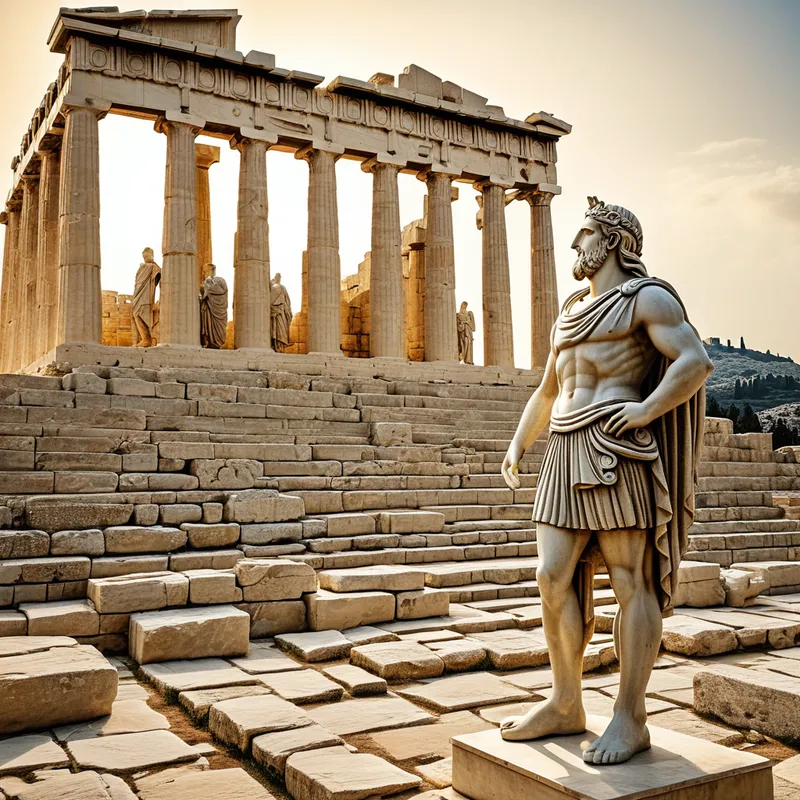
Hear now, you who dwell in the dust of ages, of the day the very soul of a city was decided. The sun was a hammer on the bare rock of Attica, a land thirsty and waiting. No mighty walls stood then, only the high hill we now call the Acropolis, and upon it, the first king, Kekrops, whose heart beat in time with the dry earth.
A stillness fell, heavier than stone. The air grew thick, charged with the scent of ozone and distant seas. From the west came a roar that shook the bones of the hills. [Poseidon](/myths/poseidon “Myth from Greek culture.”/) emerged, not from the waves, but from the very rock itself, his trident a bolt of cold sea-iron, his beard frothing with phantom brine. The ground trembled at his footfall. Without a word to the awestruck mortals, he raised his trident high and brought it down upon the bare limestone with a crack that echoed in the skull. The rock split, not in ruin, but in offering. From the deep fissure, a spring burst forth. But the [water](/myths/water “Myth from Chinese culture.”/) that pooled was not sweet; it was the bitter, undrinkable salt of the open sea, a glittering, useless gift that spoke of boundless power, but not of home.
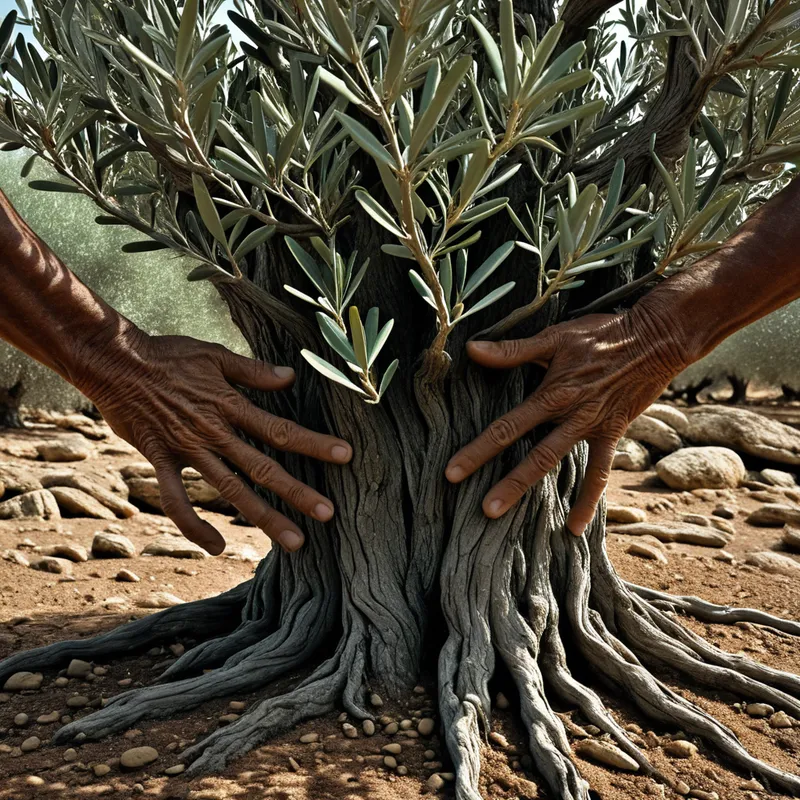
Before the salt could crust the stone, a new presence gentled the air. A grey light, cool and clear as a dawn thought, settled upon the hill. There stood Athena, her gaze not on the king, but on the barren ground beside the briny spring. She knelt, her fingers pressing into the dry soil. Where she touched, [the earth](/myths/the-earth “Myth from Hindu culture.”/) softened, darkened. She planted a seed—a small, hard [thing](/myths/thing “Myth from Norse culture.”/) of infinite potential. All watched, breath held. From that spot, the earth swelled, split, and gave birth. Not a flower, but a shoot; the shoot became a sapling; the sapling, in the space of a heartbeat, a full-grown, silver-green olive tree. Its leaves whispered secrets of peace, its branches promised oil for light and healing, and its fruit spoke of sustenance through the long years.
The assembly of early Athenians, their faces etched with sun and need, turned as one to Kekrops. The king tasted the salt on [the wind](/myths/the-wind “Myth from Various culture.”/) from Poseidon’s spring. He then walked to Athena’s tree, placing his hand upon its bark, feeling the slow, deep pulse of life within. He plucked a single olive, its flesh firm and promising. The choice was not between gods, but between futures: the dazzling, untamable roar of [the sea](/myths/the-sea “Myth from Greek culture.”/), or the deep, patient rootedness of the cultivated earth.
Kekrops lifted the olive. The city had its patron. And in that moment, the hill was no longer just a rock; it was a [temenos](/myths/temenos “Myth from Greek culture.”/), a foundry where divine will was weighed by mortal hands, and the name Athenai was born from the silence after the decision.
Cultural Origins & Context
This foundational myth, central to Athenian identity, was not a single text but a living story woven into the city’s ritual fabric. It was recounted during the Panathenaia, embroidered on the sacred [peplos](/myths/peplos “Myth from Greek culture.”/), and evoked every time a citizen cast a vote in the Pnyx. Its primary function was etiological—explaining why Athens was named for Athena and not Poseidon—but its deeper purpose was civic pedagogy.
The tale served as the psychic charter for the Athenian polis. It established the primacy of reasoned choice (Kekrops’s judgment) over autocratic force, of cultivated wisdom over raw, untamed nature. In a culture navigating the tension between aristocratic power (often aligned with maritime interests) and agrarian, artisanal stability, the myth provided a divine sanction for a particular civic order: one that valued the arts of peace, strategic intelligence, and the slow, fruitful work of civilization. It was a story told to remind Athenians that their collective identity was born from a conscious act of discernment.
Symbolic Architecture
The myth presents a profound [drama](/symbols/drama “Symbol: Drama signifies narratives, emotional expression, and the exploration of human experiences.”/) of psychic [differentiation](/symbols/differentiation “Symbol: The process of distinguishing or separating parts of the self, emotions, or identity from a whole, often marking a developmental or psychological milestone.”/). [The Acropolis](/myths/the-acropolis “Myth from Greek culture.”/) itself is the nascent ego, a [promontory](/symbols/promontory “Symbol: A high point of land jutting into a body of water, symbolizing a vantage point, transition, or isolated decision-making space between land and sea.”/) of [awareness](/symbols/awareness “Symbol: Conscious perception of self, surroundings, or internal states. Often signifies awakening, insight, or heightened sensitivity.”/) rising from the unconscious plain. The two deities represent archetypal forces vying to [structure](/symbols/structure “Symbol: Structure in dreams often symbolizes stability, organization, and the framework of one’s life, reflecting how one perceives their environment and personal life.”/) this new [consciousness](/symbols/consciousness “Symbol: Consciousness represents the state of awareness and perception, encompassing thoughts, feelings, and experiences.”/).
Poseidon’s saltwater spring symbolizes the primal, emotional, and chaotic unconscious. It is impressive, powerful, and instantly manifest, but ultimately sterile for sustaining conscious [life](/symbols/life “Symbol: The symbol of ‘Life’ represents a journey of growth, interconnectedness, and existential meaning, encompassing both the joys and challenges that define human experience.”/). It represents the unintegrated flood of instinct, [emotion](/symbols/emotion “Symbol: Emotion symbolizes our inner feelings and responses to experiences, often guiding our actions and choices.”/), and raw potential that, without [vessel](/symbols/vessel “Symbol: A container or structure that holds, transports, or protects something essential, representing the self, emotions, or life journey.”/) or [purpose](/symbols/purpose “Symbol: Purpose signifies direction, meaning, and intention in life, often reflecting personal ambitions and core values.”/), cannot nourish.
Athena’s olive tree is the archetype of the logos—the structuring principle. It does not erupt; it grows. It requires time, cultivation, and yields its gifts through process. The olive represents wisdom, but not as abstract knowledge. It is practical wisdom: technology (oil for lamps), healing (oil for medicine), sustenance (food), and peace (the olive branch).
Kekrops, the mediating [king](/symbols/king “Symbol: A symbol of ultimate authority, leadership, and societal order, often representing the dreamer’s inner power or external control figures.”/), embodies the nascent ego’s [capacity](/symbols/capacity “Symbol: A measure of one’s potential, limits, or ability to contain, process, or achieve something, often reflecting self-assessment or external demands.”/) for judgment. His [choice](/symbols/choice “Symbol: The concept of choice often embodies decision-making, freedom, and the multitude of paths available in life.”/) is the critical [moment](/symbols/moment “Symbol: The symbol of a ‘moment’ embodies the significance of transient experiences that encapsulate emotional depth or pivotal transformations in life.”/) of [separation](/symbols/separation “Symbol: A spiritual or mythic division between realms, states of being, or consciousness, often marking a transition or loss of connection.”/). By choosing the olive, consciousness aligns itself with [the principle](/symbols/the-principle “Symbol: A fundamental truth, law, or doctrine that serves as a foundation for a system of belief, behavior, or reasoning, often representing moral or ethical standards.”/) of sustainable order, turning away from identification with the overwhelming, if majestic, forces of the inner sea.
The Dreamer’s Resonance
When this myth stirs in the modern soul, it often manifests in dreams of weighty decisions at a crossroads. One might dream of being asked to choose between two gifts: one flashy, immediate, and emotionally charged (a roaring sports car, a bag of gold), the other humble, slow-growing, and requiring care (a seed, a tool, a book). The setting is often a high place—a cliff, a rooftop, a boardroom at the top of a tower—mirroring the Acropolis.
Somatically, the dreamer may feel the tension between a racing heart (Poseidon’s tumult) and a need for deep, calming breath (Athena’s rooted presence). Psychologically, this is the process of discerning between an enactment (the dramatic, identity-defining splash) and an investment (the slow, often unseen work that builds a lasting foundation for [the self](/myths/the-self “Myth from Jungian culture.”/)). The dream asks: Are you being seduced by the spectacle of your own power, or are you committing to the disciplined cultivation of your life?

Alchemical Translation
The alchemical journey mirrored here is the transition from massa confusa—the primal, undifferentiated sea of the unconscious—to the [prima materia](/myths/prima-materia “Myth from Alchemical culture.”/) ready for the work of individuation. Poseidon’s spring is the [nigredo](/myths/nigredo “Myth from Alchemical culture.”/), the initial, chaotic blackening. Athena’s planting is the albedo, the whitening, the introduction of a germinating spirit.
The assembly—the witnessing and choosing—is the rubedo, the reddening, where the heat of conscious decision transmutes potential into committed form.
For the modern individual, the “Athenian Assembly” is an internal council. The contest plays out whenever we must choose between reacting from a place of inflamed emotion (the saltwater of bitterness or grandiosity) and responding from a place of cultivated insight (the olive oil of clarity and nourishment). To “found the city” within is to repeatedly choose the archetype of the Ruler, establishing laws and boundaries for the inner populace of drives and desires.
The ultimate alchemical product is not the city of Athens, but the civitas dei of the integrated [psyche](/myths/psyche “Myth from Greek culture.”/)—a self-governed, fertile inner realm where the roaring seas of emotion are acknowledged but do not flood the fields, and where the fruits of conscious labor provide lasting light and sustenance. The myth teaches that sovereignty begins with a single, discerning vote cast in the silent assembly of one’s own soul.
Associated Symbols
Explore related symbols from the CaleaDream lexicon: