The Archery Contest of the Gods Myth Meaning & Symbolism
A celestial archery contest among the gods determines the fate of the world, revealing the profound link between focused intention, cosmic order, and earthly reality.
The Tale of The Archery Contest of the Gods
Listen. Before the rivers had names and the mountains knew their shadows, the world was a breath held in the vast lungs of the Tenger. In that high, clear realm of the Ninety-Nine Tengri, a stillness fell—a silence deeper than the space between stars. It was a silence of potential, of a universe waiting for its first note.
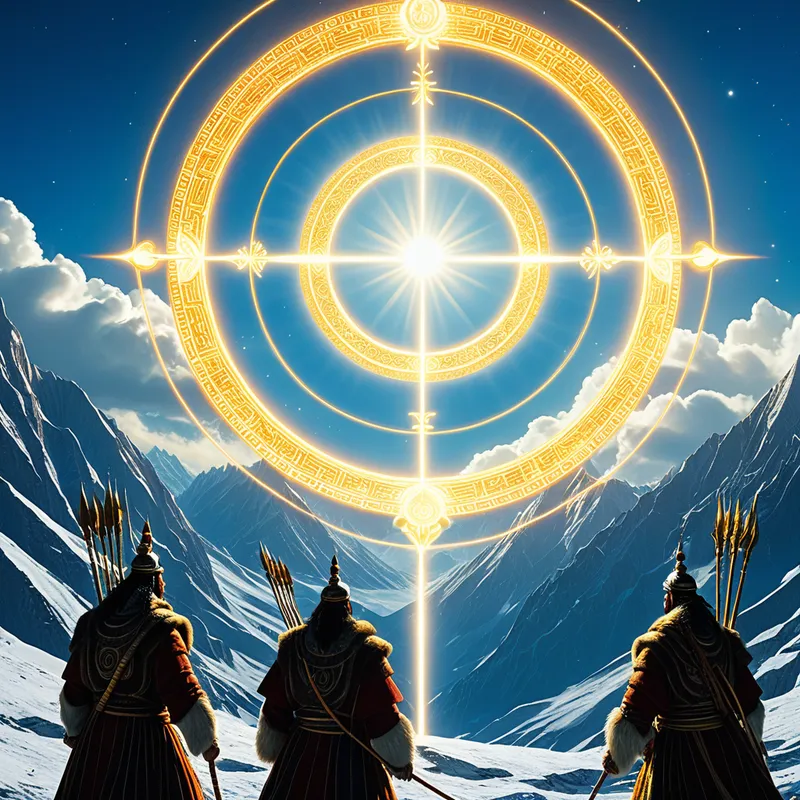
The source of this silence was a contest. Not of brute strength or roaring thunder, but of pure, distilled intention. The Tengri had gathered, their forms shimmering like heat haze over the summer steppe. Before them, spanning the vault of heaven, hung a single target. It was not large, but it was impossibly distant, a circle of woven starlight and promise. The bow was not wood and sinew, but a curve of focused will. The arrow was a shaft of directed fate.
One by one, the mighty drew and loosed. Qormusta Tengri shot, and his arrow sang a song of dominion that shook the pillars of the sky. Erlik Khan shot, and his bolt flew straight and true, carrying the chill whisper of the underworld. Others released arrows that became comets, or streaks of lightning, or the first cries of eagles. Yet each one, for all its power, flew past the mark—a hair’s breadth to the left, a whisper above, vanishing into the endless blue.
The tension coiled tighter than a bowstring. If no arrow found its home, the world below would remain formless, a dream without a dreamer. Then, the youngest among them stepped forward. Not with a stride that shook the heavens, but with the quiet certainty of a falling leaf. This was Erkhiin Mergen, the Wise Archer. He did not look at the target of starlight. He closed his eyes and listened. He heard the heartbeat of the unborn earth, the sigh of the winds yet to be born, the silent prayer of the soil.
He drew. In that motion, he gathered not just his own strength, but the longing of the void below. He became the conduit. The bow was no longer in his hands, but was his own spine, aligned with the axis of the world. The arrow was his breath, held and aimed. He did not shoot at the target. He released the arrow, and in doing so, released the target’s own desire to be struck.
The release was soundless. The flight was not seen, but felt—a sigh of completion across all realms. And there, in the very center of the woven starlight, the arrow quivered, its fletching humming a low, foundational note. Where it struck, light did not explode outward, but poured inward, coalescing. From that point of perfect contact, the world began: the mountains rose like the ribs of the earth, the rivers unfurled like veins, and the first grass whispered up from the steppe, green and tender. The contest was over. The universe had begun.
Cultural Origins & Context
This myth, in its many variations, is a cornerstone of the Mongolian spiritual worldview, Tengrism. It was not a story confined to leather-bound books, but one carried on the wind across the endless steppe, told by shamans (böö) around flickering hearths and during sacred rituals. Its transmission was oral, rhythmic, and inseparable from the landscape it described.
The societal function was profound. In a culture where survival depended on precision—the hunter’s arrow, the herder’s keen eye for pasture, the navigator’s reading of the stars—the myth sacralized skill. It taught that true power (sülde) was not mere force, but aligned intention. The archery contest explained cosmic order: the world itself was the result of a divine, skillful act. It modeled the ideal relationship between humanity and the Tenger—one of respectful focus, where humans, through their own disciplined actions (their own “archery”), could participate in sustaining the harmony of creation.
Symbolic Architecture
The myth is a masterclass in symbolic psychology. The Tengri represent the myriad potentials, drives, and archetypal forces within the psyche. The Qormusta of dominion, the Erlik of shadowy fate—these are all aspects of the Self.
The target is not an external goal, but the symbolic center of the Self—the point of individuation where all contradictions are held in tension.
The failed shots of the older gods symbolize how raw power, ego-driven ambition, or one-sided attributes alone cannot “create the world” of a coherent personality. They fly past the mark. The hero’s success lies in his shift from projection to connection. He closes his eyes to the dazzling illusion of the goal and instead aligns with the deeper, unconscious unity of the system. His arrow is the ego’s intent, purified and surrendered, becoming the instrument of the Self’s purpose. The moment of impact is the synchronicity where inner realization manifests as outer reality.
The Dreamer’s Resonance
When this myth stirs in modern dreams, it often manifests as a profound test of focus. The dreamer may find themselves in a vast, empty landscape, holding a bow with a target that shifts, moves, or seems impossible to hit. There is a somatic feeling of immense tension in the shoulders, the strain of holding the draw. This is the psyche working through a moment of critical choice or the pressure to “get it right” in life—a career aim, a relational commitment, a creative project.
The frustration of missed shots in the dream mirrors the conscious feeling of effortful striving leading to exhaustion, not fulfillment. The dream is initiating a process. It asks: Where is your attention? Are you aiming from the anxious ego, or are you listening for the deeper alignment? The eventual release of the arrow, if achieved in the dream, is often accompanied by a visceral sense of relief and rightness—a somatic signal of the nervous system registering a state of psychic integration.
Alchemical Translation
The alchemical process modeled here is the solve et coagula—dissolve and coagulate—applied to the will. First, the “dissolving”: the failure of the other gods represents the breaking down of the old, brute-force identity. The ego’s certainties must fail. Then comes the hero’s turn, which is the stage of meditatio: profound inner listening and alignment.
The bow is the tension of life itself; the arrow is the concentrated soul. The target is the Philosopher’s Stone—the realized Self.
The “coagulation” is the moment the arrow strikes. From the point of perfect contact, the new, cohesive reality forms. For the modern individual, this translates to the individuation journey. We are all in an archery contest. Our “arrows” are our actions, words, and creations. The myth teaches that transformative power lies not in the strength of the pull, but in the quality of the aim—an aim that comes from a state of unity with the larger pattern. To hit the mark is to have one’s individual action perfectly express the necessity of the whole moment. It is the act that feels destined, not forced, and from which a new world of meaning crystallizes.
Associated Symbols
Explore related symbols from the CaleaDream lexicon:
- Sky — The realm of the Tengri and pure potential, representing consciousness, the father principle, and the vast field of possibilities from which form emerges.
- Sun — The ultimate source of light and clarity, often associated with the golden target itself, symbolizing the luminous center of consciousness and the goal of enlightenment.
- Target — The symbolic center of the Self, the point of individuation and perfect integration where all efforts and energies must converge to create meaning.
- Arrow — Directed consciousness, focused intention, and the act of will that bridges the gap between potential (the sky) and manifestation (the earth).
- Hero — The archetype of the conscious ego that undertakes the supreme test, not for glory, but to fulfill a cosmic function and bring order into being.
- Fate — The underlying pattern or necessity that the successful archer aligns with, suggesting that true destiny is not pre-written but co-created through skillful, attuned action.
- Test — The essential ordeal that separates brute force from enlightened skill, forcing a confrontation with one’s own limitations and the need for a deeper connection.
- Contest — The fundamental dynamic of life and psyche, where competing forces or potentials strive for expression, with the outcome shaping reality itself.
- Archery Bow — The instrument of tension and release, symbolizing the human capacity to hold potential energy and translate it into decisive, linear action.
- Arc — The beautiful, necessary curve of the arrow’s flight, representing the journey of the soul from origin to destination, and the law of indirect approach to a direct goal.
- Order — The ultimate result of the successful shot, the harmonious cosmos that springs from a single point of perfect, lawful contact, mirroring the psyche’s need for inner structure.
- Destiny — Not a fixed path, but the destination that calls to the arrow, created in the very moment of the archer’s aligned release and perfect aim.