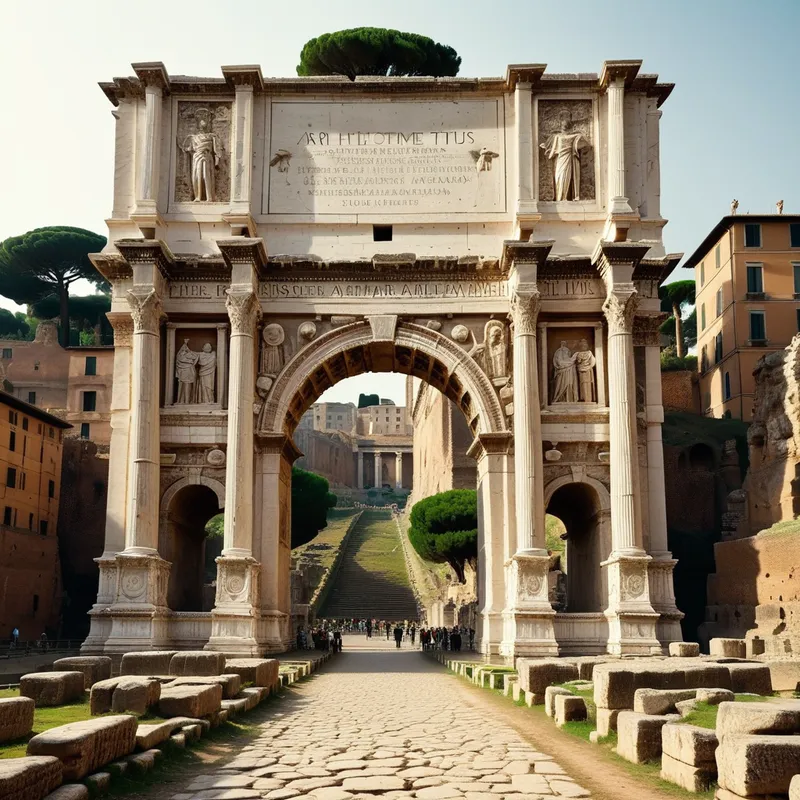
The Arch of Titus Myth Meaning & Symbolism
A myth of imperial triumph and sacred plunder, where victory's arch becomes a monument to memory and the paradoxical weight of glory.
The Tale of The Arch of Titus
Hear now, and listen well, to the tale not carved in flesh, but in stone—a story that breathes in the dust of the Via Sacra. The air in Rome is thick, not with fog, but with memory. It is the year of our city’s founding, 81. The sun, a molten coin, beats upon the white marble of a new arch, raised not for a god, but for a man who became one: Titus Flavius Vespasianus.
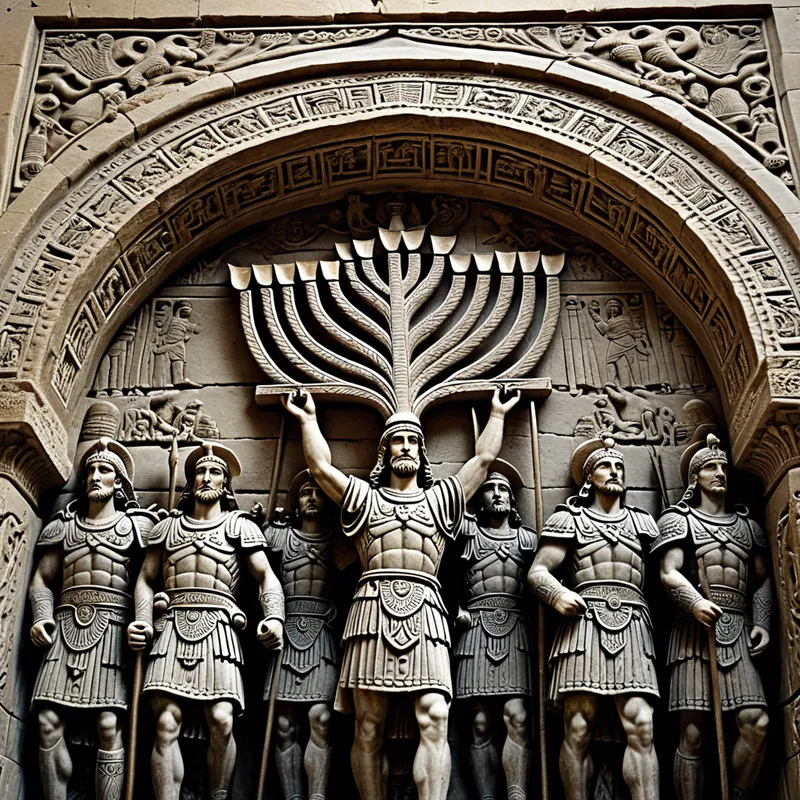
But the arch is not the beginning. The beginning is fire, and smoke, and distant screams echoing from a conquered hill. It is the siege of [Jerusalem](/myths/jerusalem “Myth from Biblical culture.”/). See the legions, a bronze serpent coiling around the holy mountain. Hear the final crack of stone as [the Temple](/myths/the-temple “Myth from Jewish culture.”/) falls. And then, the procession of plunder—but not mere gold. The sacred vessels: the towering [Menorah](/myths/menorah “Myth from Judeo-Christian culture.”/), its branches yearning upward; the Table of Shewbread; the silver trumpets of the priests. These are not spoils; they are captured gods, the very soul of a people, now paraded in chains of [triumph](/myths/triumph “Myth from Roman culture.”/) through the roaring throat of Rome.
The man at the head of this river of glory is Titus. He rides in a quadriga, the sun a crown upon his brow. The crowd’s adulation is a physical force, a wave of sound and scattered petals. Yet, if you could see behind the eyes of the triumphator, you might glimpse not just pride, but a profound, unsettling weight. He carries the memory of the fire. He carries the silence that followed the screams. The victory is absolute, but it is a victory over something sacred, and such conquests leave a stain on the soul of the conqueror.
The arch is raised by his brother, Domitian, after Titus joins the divine. It is a seal upon the story, a permanent bookmark in the stone annals of the empire. Its inner vault depicts Titus not in war, but in apotheosis—an eagle carrying his spirit to the heavens. The arch stands, therefore, as a gateway between two worlds: [the world](/myths/the-world “Myth from Tarot culture.”/) of mortal conquest, of dust and blood and sacred plunder, and the world of eternal, deified memory. It is a monument to a paradox: that to achieve the highest glory, one must first walk through the valley of another’s deepest desecration. It is a tomb for a memory, and a birth for a legend.
Cultural Origins & Context
This is not a myth from the misty age of [Romulus and Remus](/myths/romulus-and-remus “Myth from Roman culture.”/). It is a historical monument mythologized in real time. The Arch of Titus was a potent piece of Flavian dynasty propaganda, erected in the very heart of Roman civic and religious life. Its primary audience was the Roman populace, and its function was multifaceted: to legitimize the sometimes-controversial Flavian rule by linking it to a glorious military victory, to honor the deified Titus, and to provide a permanent, public record of the Judean triumph.
The “myth” was passed down not by bards, but by the stone itself. Every citizen walking the Via Sacra would read its reliefs like a comic strip of imperial power. The story was told by the state, for the state, reinforcing the core Roman ideals of virtus (martial courage), pietas (duty to gods, state, and family), and the unassailable right and might of Rome to conquer and absorb. It served as a constant reminder: resistance to Rome is futile, and loyalty to Rome is rewarded with eternal glory. The plunder depicted was not just loot; it was proof of the submission of foreign gods to Roman numen (divine spirit).
Symbolic Architecture
At its core, the myth of the Arch is a profound [meditation](/symbols/meditation “Symbol: Meditation represents introspection, mental clarity, and the pursuit of inner peace, often providing a pathway for deeper self-awareness and spiritual growth.”/) on the [architecture](/symbols/architecture “Symbol: Architecture in dreams often signifies structure, stability, and the framing of personal identity or life’s journey.”/) of power and the [psychology](/symbols/psychology “Symbol: Psychology in dreams often represents the exploration of the self, the subconscious mind, and emotional conflicts.”/) of victory. The arch is not merely a decoration; it is a symbolic technology.
The true monument is not the stone that celebrates the victory, but the hollow space beneath it—the gateway through which the conqueror must pass, forever shadowed by what he left in ruins.
The archway itself is the ultimate [symbol](/symbols/symbol “Symbol: A symbol can represent an idea, concept, or belief, serving as a powerful tool for communication and understanding.”/). It is a threshold, a liminal [space](/symbols/space “Symbol: Dreaming of ‘Space’ often symbolizes the vastness of potential, personal freedom, or feelings of isolation and exploration in one’s life.”/) separating the mundane from the sacred, the [human](/symbols/human “Symbol: The symbol of a human represents individuality, complexity of emotions, and social relationships.”/) from the divine, the past from the perpetually remembered present. To pass under it is to be initiated into the official narrative of [history](/symbols/history “Symbol: History in dreams often represents the dreamer’s past experiences, lessons learned, or unresolved issues that continue to influence their present.”/).
The [Menorah](/symbols/menorah “Symbol: A seven-branched candelabrum central to Judaism, symbolizing divine light, wisdom, and the enduring covenant between God and the Jewish people.”/), borne aloft in the [relief](/symbols/relief “Symbol: Relief signifies release from tension or discomfort, often representing emotional healing and liberation from burdens.”/), is the central psychic [image](/symbols/image “Symbol: An image represents perception, memories, and the visual narratives we create in our minds.”/). It represents the captured light of an entire cosmology, the sacred center of another world now made a [trophy](/symbols/trophy “Symbol: The trophy symbolizes achievement, recognition, and the reward for perseverance in competitive endeavors.”/). Psychologically, it symbolizes [the ego](/myths/the-ego “Myth from Jungian culture.”/)’s temptation to plunder the contents of the unconscious—its deep wisdom, its numinous power—and [parade](/symbols/parade “Symbol: A parade in dreams represents celebration, expression of individuality, public acknowledgment, and the desire for connection.”/) them as personal achievements, without integrating their true meaning or respecting their [source](/symbols/source “Symbol: The origin point of something, often representing beginnings, nourishment, or the fundamental cause behind phenomena.”/). This is conquest without comprehension, power without wisdom.
The [apotheosis](/symbols/apotheosis “Symbol: The transformation of a mortal into a divine or godlike state, representing ultimate spiritual elevation and transcendence of human limitations.”/) of Titus in the [vault](/symbols/vault “Symbol: A secure, enclosed space for storing valuables or secrets, often representing hidden aspects of the self or protected resources.”/) completes the symbolic circuit. It represents the ultimate psychic [inflation](/symbols/inflation “Symbol: A dream symbol representing feelings of diminishing value, loss of control, or expansion beyond sustainable limits in one’s life or psyche.”/): the identification of the conscious ego with [the Self](/myths/the-self “Myth from Jungian culture.”/), the god-image within. The mortal man is consumed by the [persona](/symbols/persona “Symbol: The social mask or outward identity one presents to the world, often concealing the true self.”/) of the divine ruler. The myth warns that such deification is often built upon a [foundation](/symbols/foundation “Symbol: A foundation symbolizes the underlying support systems, values, and beliefs that shape one’s life, serving as the bedrock for growth and development.”/) of repressed [shadow](/symbols/shadow “Symbol: The ‘shadow’ embodies the unconscious, repressed aspects of the self and often represents fears or hidden emotions.”/)—the violence, the sacrilege, the unacknowledged cost of one’s triumph.
The Dreamer’s Resonance
When this myth stirs in the modern [psyche](/myths/psyche “Myth from Greek culture.”/), it rarely appears as a literal Roman arch. Instead, one might dream of monumental doorways that feel both triumphant and forbidding, of carrying a heavy, beautiful, but stolen object, or of receiving public acclaim for an achievement that secretly feels hollow or tainted.
Somatically, this can manifest as a tension between the chest (puffed with pride) and the solar plexus (knotted with unease). The dreamer is likely navigating a profound life transition where they have achieved a hard-won goal—a career pinnacle, a creative completion, a victory in a personal struggle. Yet, the process has cost them something essential: perhaps integrity, a relationship, or a connection to their own inner sacred space. The dream is the psyche’s monument to this ambiguous victory. It asks: What did you have to destroy or desecrate within yourself or in your world to build this triumph? Whose light are you carrying as your own trophy? The dream presents the arch not as a celebration, but as a gateway of reckoning.
Alchemical Translation
The alchemical journey modeled here is the transmutation of crude, inflated victory into sober, integrated wisdom—the [solve et coagula](/myths/solve-et-coagula “Myth from Alchemical culture.”/) of the power complex. The initial state is [Nigredo](/myths/nigredo “Myth from Alchemical culture.”/): the dark, destructive fire of the siege, the reduction of a complex, living truth (Jerusalem, the Temple) to ashes and plunder. This is [the shadow](/myths/the-shadow “Myth from Jungian culture.”/) side of ambition, the necessary chaos that often precedes a conscious achievement.
The procession of spoils represents a kind of distorted Albedo, a whitening or spiritualization, but one that is false. The sacred objects are lifted into the light of public consciousness, but as symbols of subjugation, not integration. The ego, like Titus, is paraded through the streets of its own awareness, mistaking capture for enlightenment.
The alchemical gold is not found in the plundered Menorah, but in the courage to turn back, to see the arch not as a monument to one’s glory, but as a mirror reflecting the cost of it.
The true [Rubedo](/myths/rubedo “Myth from Alchemical culture.”/), the reddening or final maturation, is hinted at in the arch’s dual nature. It is a gateway. The individuation process requires the dreamer to pass back through it. One must consciously revisit the site of their conquests—the relationships strained, the inner values compromised, the silenced parts of the self—not to glorify them, but to mourn them. To de-identify from the triumphant [persona](/myths/persona “Myth from Greek culture.”/) (the deified Titus) and reclaim the humbler, more complex human being who orchestrated the campaign. The ultimate transmutation is when the arch ceases to be a trophy case and becomes a true threshold: a passage from identification with the ruler archetype in its inflated state to a conscious stewardship of power, tempered by memory and weighted with a sacred responsibility for all that was “conquered” along [the way](/myths/the-way “Myth from Taoist culture.”/). The stone then speaks not of empire, but of individuation.
Associated Symbols
Explore related symbols from the CaleaDream lexicon: