The Arab Horse Legend Myth Meaning & Symbolism
A sacred myth of the Bedouin telling of the South Wind's creation of the first Arabian horse from a handful of wind, a gift of spirit and nobility to humanity.
The Tale of The Arab Horse Legend
Listen, and let the wind carry you back. Before the great tribes were named, when the desert was a younger, wilder god, there existed a silence so profound it was a presence. The people of the sands, the Bedouin, were strong, but their world was one of relentless sun and shifting dunes. They had camels for burden, but their souls yearned for a companion of speed, a spirit as untamed and enduring as the land itself.
From the vast emptiness of the Rub’ al Khali, the Empty Quarter, a whisper began. It was the voice of the Janub, the South Wind, who had watched the children of Adam struggle. Moved by a compassion as deep as the wells of Iram, the Wind gathered itself. It did not seek clay or water, the stuff of mortal making. Instead, it swept across the cosmos, collecting the essence of things unseen yet potent: the courage of the noonday sun, the faithfulness of the North Star, the strength of the tempest, the gentleness of the dawn zephyr, and the swiftness of a shooting star.
On a night when the moon was a sliver and the stars pressed close, the Janub descended to a sacred, hidden valley. There, with the desert as its crucible and the sky as its dome, it kneaded these virtues together. It spun and compressed, not earth, but spirit. From its hands—which were gusts and currents—it formed a creature. First, the arch of a neck, proud as a palm tree against the sky. Then, a deep chest to hold the wind it was born from. Legs fine yet strong, like tempered lance-shafts. A tail that would flow like the banner of a king.
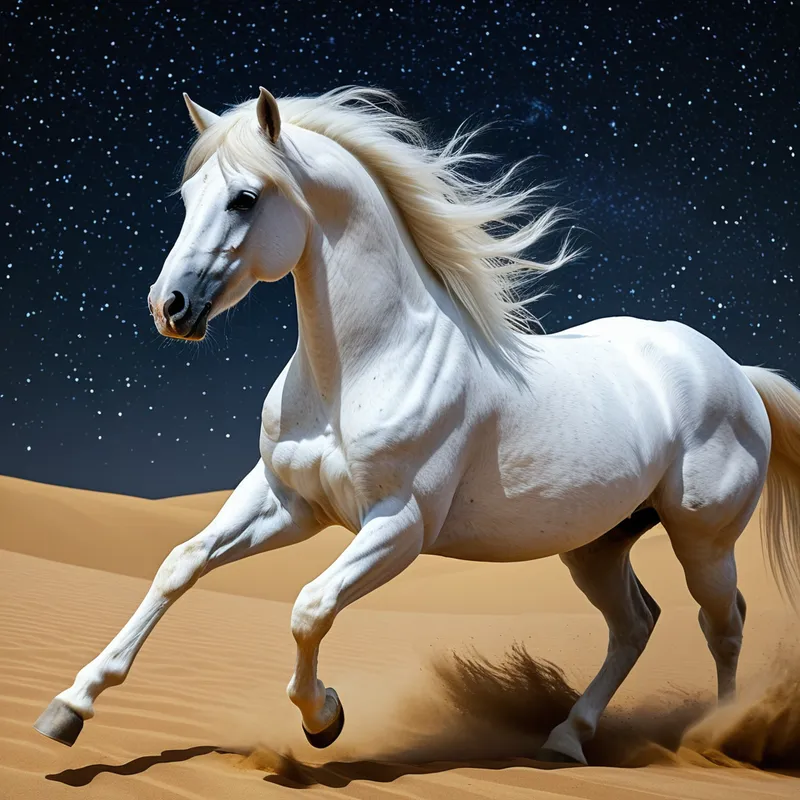
And then, the Wind breathed into it. Not the breath of life, but the breath of being—a soul forged from loyalty, an intelligence born of the land’s ancient memory. The creature stirred. It opened eyes that held the deep, liquid darkness of a desert well, mirroring the stars above. Its coat was not a color of the earth, but of light itself—a dazzling, impossible white that gleamed like a pearl in the deep. This was the first Kuhaylan.
It stood, trembling not from fear, but from the potency of its own creation. It let out a sound that was neither whinny nor roar, but the very sigh of the wind through canyon walls. The Janub spoke, its voice the rustle of a million sand grains: “You are of the wind, and to the wind you shall return. But walk now with the children of the desert. Be their strength in journey, their partner in raid, their solace in solitude. Your speed shall be their thought made action; your endurance, their will made flesh. This is the covenant.”
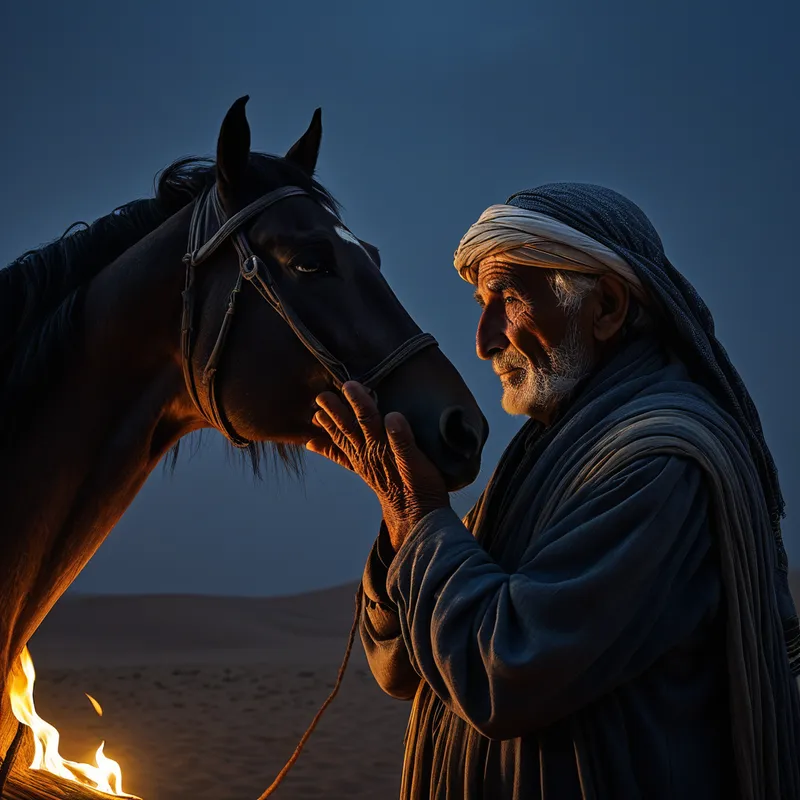
The first Bedouin to see it fell to his knees, not in submission, but in recognition. Here was not a beast to be broken, but a brother to be befriended. The horse approached, and the man laid his hand upon its neck, feeling not just warmth, but a current, a living pulse of the storm and the calm. From that touch, a bond was sealed—not of master and slave, but of mutual destiny. The desert had given its greatest secret: a piece of its own wild, noble soul, shaped into a form that could carry the human heart across the impossible expanse.
Cultural Origins & Context
This legend is not a single, codified text, but a living breath within the oral tradition of the Bedouin tribes of the Arabian Peninsula. Passed down through generations around campfires, in the shade of goat-hair tents, it served as a sacred genealogy. For a people whose survival and social standing were intimately tied to their horses, the myth provided a divine origin story that elevated the relationship beyond utility. It answered the profound question: How did we come to have this creature, so unlike any other?
The tale was often recounted by tribal elders and poets, the rawi, who were the custodians of lineage and honor. Its function was multifaceted: it instilled a deep respect for the horse, dictating its care and breeding as a sacred trust. It reinforced tribal identity and purity—just as the horse was born of unadulterated elements, so too should its bloodlines be kept pure. The myth was a cornerstone of cultural pride, explaining the superior qualities of the Arabian breed—its stamina, intelligence, and “dish” face (said to allow it to breathe the wind of its creation)—as gifts from the divine itself, literally woven into its spiritual fabric.
Symbolic Architecture
At its [heart](/symbols/heart “Symbol: The heart symbolizes love, emotion, and the core of one’s existence, representing deep connections with others and self.”/), the myth is not about animal husbandry, but about the incarnation of abstract [virtue](/symbols/virtue “Symbol: A moral excellence or quality considered good, often representing inner character, ethical principles, or spiritual ideals in dreams.”/) into tangible, living form. The horse is a psychopomp of the desert’s own [spirit](/symbols/spirit “Symbol: Spirit symbolizes the essence of life, vitality, and the spiritual journey of the individual.”/).
The horse is the desert’s dream of itself—a dream of motion, endurance, and loyal companionship given flesh and bone.
The Janub represents the creative, animating principle of the unconscious world. It is the archetypal demiurge, but one whose materials are psychic qualities: courage, faithfulness, [strength](/symbols/strength “Symbol: ‘Strength’ symbolizes resilience, courage, and the ability to overcome challenges.”/). The horse, therefore, is a complex [symbol](/symbols/symbol “Symbol: A symbol can represent an idea, concept, or belief, serving as a powerful tool for communication and understanding.”/) of the animated Self. Its creation from wind speaks to the ethereal, non-[material](/symbols/material “Symbol: Material signifies the tangible aspects of life, often representing physical resources, desires, and the physical world’s influence on our existence.”/) origins of true nobility and power. [The covenant](/symbols/the-covenant “Symbol: A sacred, binding agreement between parties, often with divine or societal significance, representing commitment, obligation, and mutual responsibility.”/) between the Wind, the horse, and humanity models a sacred triangular [relationship](/symbols/relationship “Symbol: A representation of connections we have with others in our lives, often reflecting our emotional state.”/): the divine (unconscious) gives a perfected instinctual form (the horse) to [consciousness](/symbols/consciousness “Symbol: Consciousness represents the state of awareness and perception, encompassing thoughts, feelings, and experiences.”/) (the [human](/symbols/human “Symbol: The symbol of a human represents individuality, complexity of emotions, and social relationships.”/)), with the stipulation of mutual respect and preservation.
The horse’s legendary loyalty and [ability](/symbols/ability “Symbol: In dreams, ‘ability’ often denotes a recognition of skills or potential that one possesses, whether acknowledged or suppressed.”/) to return home (‘asil) symbolize the psyche’s innate orientation toward wholeness and [origin](/symbols/origin “Symbol: The starting point of a journey, often representing one’s roots, source, or initial state before transformation.”/). Its speed is the swiftness of [intuition](/symbols/intuition “Symbol: The immediate, non-rational understanding of truth or insight, often described as a ‘gut feeling’ or inner knowing that bypasses conscious reasoning.”/); its endurance is the persistence of the [life](/symbols/life “Symbol: The symbol of ‘Life’ represents a journey of growth, interconnectedness, and existential meaning, encompassing both the joys and challenges that define human experience.”/) force.
The Dreamer’s Resonance
When this myth stirs in the modern dreamscape, it often signals a profound encounter with one’s own instinctual, noble nature. To dream of such a horse—especially one that is luminous, wind-born, or overwhelmingly majestic—is to meet the animus or anima in its most potent, positive form. It is the Self appearing as a dynamic, living force.
The somatic experience can be one of exhilarating awe, a feeling of being in the presence of something vastly greater yet intimately connected. The dreamer may feel a call to “ride” this energy—to harness their own latent courage, faithfulness, and strength in service of a life journey. Conversely, if the horse is distant, untouchable, or wild, it may reflect a sense of disconnection from one’s own vital instincts and inner nobility, a feeling that one’s purest spirit is out of reach, still part of the unconscious “wind.”
Alchemical Translation
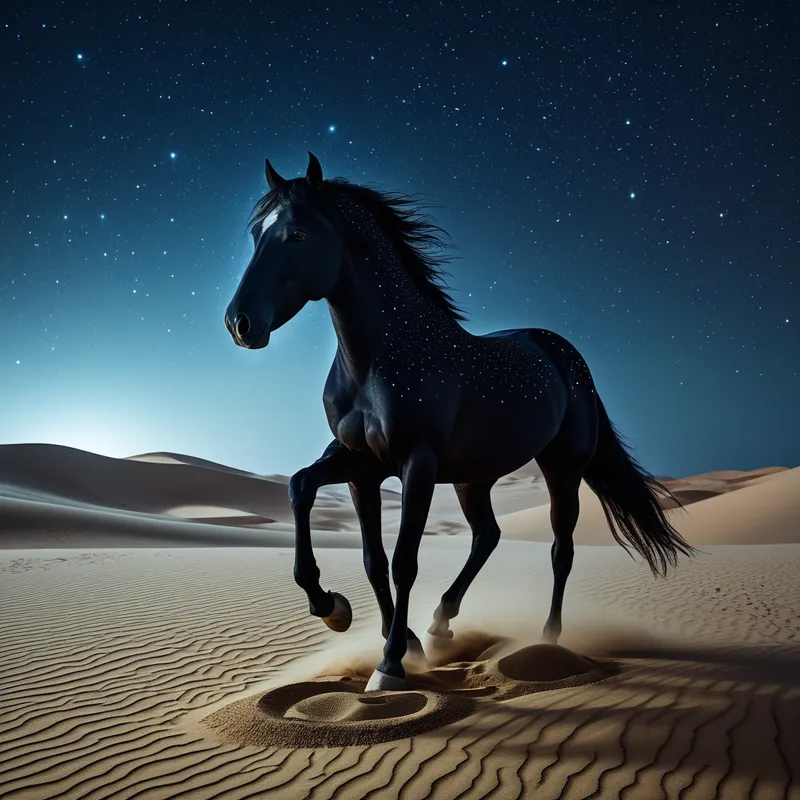
The myth perfectly models the alchemical process of individuation. The initial state is the prima materia: the scattered, potent virtues (courage, faithfulness) existing as unconscious potentials in the “wind” of the psyche. The Janub represents the organizing, synthesizing function of the Self, which gathers these disparate elements.
The creation of the horse is the conjunctio oppositorum—the marriage of spirit (wind) and form (living creature), resulting in the filius philosophorum, the divine child of the process, which is the integrated personality.
The sacred valley is the vessel of transformation, the protected inner space where this psychic gestation occurs. The final act—the breathing of the soul and the covenant—is the crucial integration into conscious life. The horse is not meant to remain a solitary, divine marvel; it is meant for relationship, for the journey. For the modern individual, this translates to the hard work of taking one’s refined inner qualities—forged in solitude and introspection—and bringing them into covenant with the world. It is the promise to use one’s strength with gentleness, one’s speed with direction, one’s spirit in loyal partnership with life’s demands. The myth warns that this noble creation requires care; to neglect or corrupt it (through impurity of intent or action) is to break the covenant with one’s own deepest Self.
Associated Symbols
Explore related symbols from the CaleaDream lexicon:
- Horse — The central symbol of animated spirit, nobility, and the bridge between unconscious instinct and conscious will, born from the elements of virtue.
- Wind — The creative, formless spirit of the unconscious from which all specific qualities and forms are gathered and shaped.
- Journey — The fundamental purpose of the horse, representing the soul’s path across the inner and outer landscapes of life, requiring endurance and a guide.
- Covenant — The sacred, binding agreement between the divine, the instinctual self (horse), and the conscious ego, mandating mutual respect and preservation of purity.
- Desert — The crucible of transformation, representing the stark, challenging, yet purifying environment where true spirit is tested and revealed.
- Star — Symbolizes the faithfulness and guiding light inherent in the horse’s nature, its ability to navigate by inner certainty.
- Spirit — The essential, non-material essence from which the horse is created, distinguishing it as a being of soul rather than mere flesh.
- Purity — The core theme of the myth, represented by the horse’s unmixed, divine origin and the imperative to maintain the integrity of one’s inner nature.
- Goddess — The creative, animating force of the South Wind (Janub) can be seen as a feminine generative power, birthing form from the womb of the atmosphere.
- Light — Embodied in the horse’s dazzling white coat, representing consciousness, revelation, and the illuminated Self emerging from the darkness of the unknown.
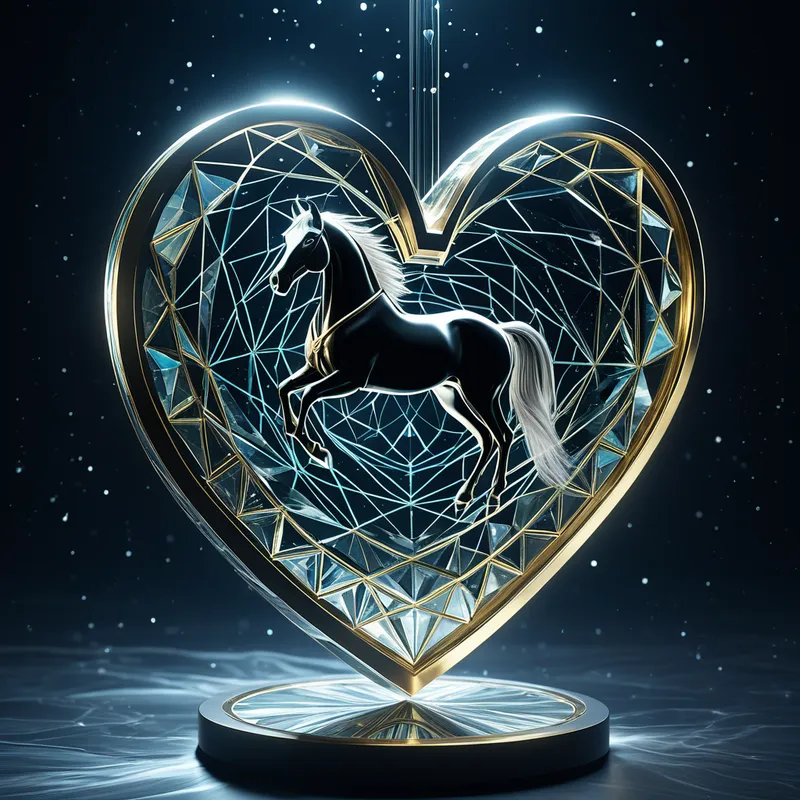
- Heart — The deep chest of the horse, designed to hold the wind, symbolizes the capacity to contain and circulate the vital spirit, the center of courage and life.