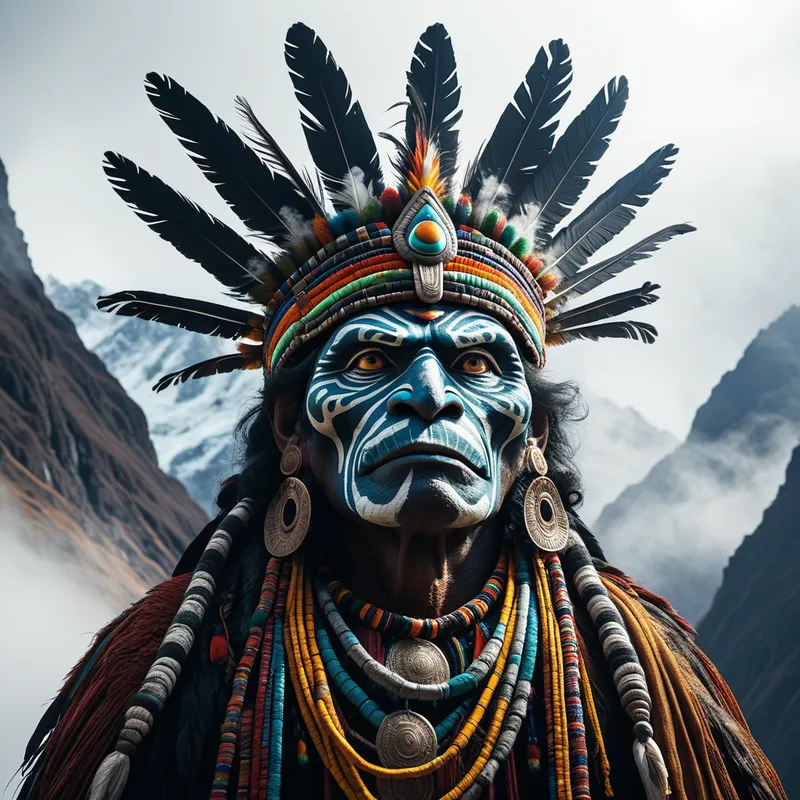
The Apus Mountain Spirits Myth Meaning & Symbolism
The Apus are the living, conscious spirits of the Andes, divine protectors who demand respect and offer guidance to those who honor the sacred balance.
The Tale of The Apus Mountain Spirits
Listen. The world is not silent stone and passive earth. It breathes. It watches. High above the green valleys, where the air thins to a crystal blade and the sun burns with a cold, white fire, the true lords of this land hold their eternal court. They are the Apus. They are not on the mountains; they are the mountains. Apusallqo with his shoulders of eternal ice. Auzangate, her skirts flowing with glaciers. Salkantay, the savage and untamed.
In the time when the Sapa Inca walked the earth, a young chasqui was given a task of utmost urgency. A message of war, sealed in a khipu, had to cross the spine of the world, from Cusco to the farthest garrison. The path led through the dominion of Ampato, a spirit known for his fierce temper and sudden storms.
The chasqui, named Puma, was swift and proud. He saw the mountain as an obstacle, a thing to be conquered. He did not pause at the apacheta at the pass. He did not offer the customary k’intu of three perfect leaves, blown with a prayer from his heart to the wind. He ran, his breath a ragged banner, his eyes on the distant path.
The mountain noticed. First, a pebble skittered across the trail. Then, a cold wind sliced through his tunic. The sky, once a profound blue, bruised into purple and black. Puma ran faster, fear lending speed to his feet. But the path ahead began to swim in a sudden, blinding fog. He was lost. The cold seeped into his bones, a deep ache that promised sleep and death. In his desperation, he shouted—a challenge, a plea—into the swallowing whiteness.
The fog coalesced. It formed a face vast as the sky itself, features of rock and ice, eyes like deep glacial pools. The voice of Ampato was not a sound but a pressure in the chest, the groan of shifting continents. “You run through my body,” the presence intoned. “You draw breath from my air. Yet you offer no breath of respect. You see a road, not a living being. Your message is urgent, you say? What is more urgent than acknowledging the life of the world that holds you?”
Puma fell to his knees, the message-khipu clutched to his heart. His pride shattered like ice. With trembling hands, he fumbled for his coca pouch. He had no perfect leaves left, only fragments crushed by his journey. Weeping, he placed these broken pieces upon a stone, his prayer now a raw, honest stream of fear, awe, and apology. He offered not what was perfect, but what he truly had: his humility.
The fog softened. The glacial eyes seemed to consider the crushed leaves—a sacrifice of pride, not perfection. The wind gentled, becoming a guide. It parted the mist, revealing not the main trail, but a older, hidden path—a shorter, steeper route known only to the condors and the mountain itself. The voice echoed once more, now a whisper in the stream’s song: “Go. And tell your people: speed is born of harmony, not force. The path is given, not taken.”
Puma ran again, but differently. He felt the mountain beneath him, not as an enemy, but as a great, steady heartbeat. He reached the garrison not just with a war message, but with a greater truth etched upon his soul.
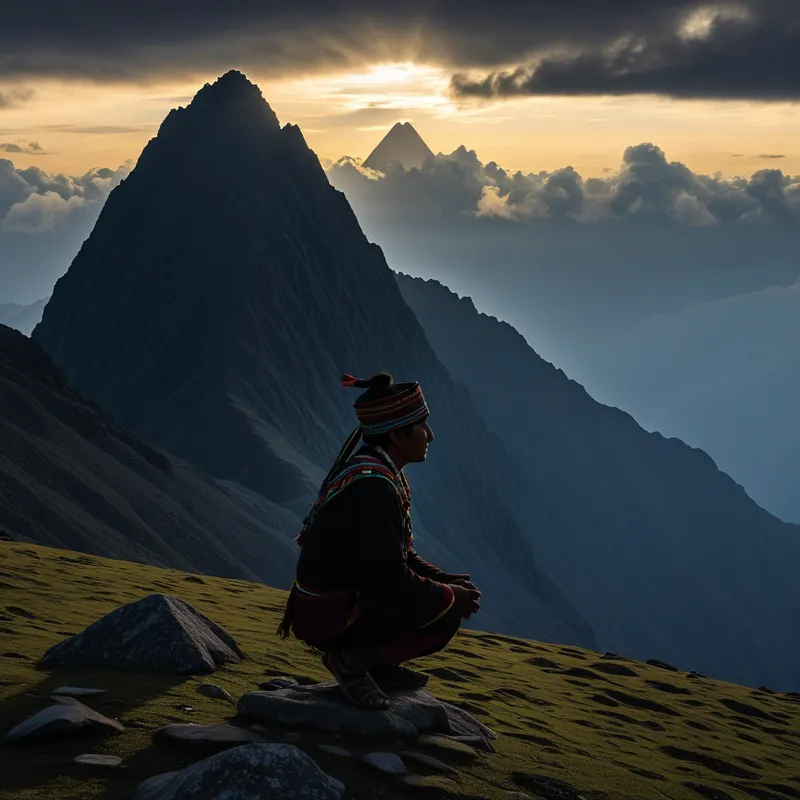
Cultural Origins & Context
The myth of the Apus is not a singular story but a living framework embedded in the Tawantinsuyu cosmology. These narratives were woven into the fabric of daily ritual, state religion, and geographic identity. They were passed down not by bards in courts, but by hamut’as and elders, and enacted by every traveler, farmer, and emperor.
The Apus were the ultimate regional authorities, divine landlords who governed weather, water, and fertility. The Sapa Inca himself would make lavish sacrifices—from precious chicha and fine textiles to, in times of extreme crisis, human life (qhapaj hucha)—to secure their favor for the empire’s stability. This was a relationship of sacred reciprocity, ayni. The mountains gave life (water from glaciers), order (defining territories), and protection. Humanity gave respect, labor, and offerings. The myth of the arrogant traveler corrected by the Apu served as a crucial societal regulator, teaching that survival and prosperity depended on recognizing a conscious, sentient landscape.
Symbolic Architecture
Psychologically, the Apus represent the archetypal principle of Objective Consciousness—the vast, enduring, and often daunting structures of reality that exist independently of our personal will. They are the internalized “mountain” of law, tradition, natural consequence, and the unyielding facts of existence.
The mountain does not come to you. You must ascend to its terms, and in that arduous journey, you meet the parts of yourself that are made of the same eternal stone.
The chasqui embodies the conscious ego, tasked with a mission (the directed purpose of the personality), initially believing sheer force of will and speed can conquer any terrain. The Apu is the Self in its aspect as the non-egoic, ordering principle of the psyche. The conflict arises when the ego operates without reverence for the greater, autonomous systems of the psyche (the Self) and the world. The crushing fog and cold are the symptoms of this dissociation—depression, meaninglessness, paralyzing anxiety.
The offering of crushed coca leaves is the critical symbolic act. It is the sacrifice of egoic pride and the illusion of control. It is the moment of surrender, not to defeat, but to a higher order of intelligence. The hidden path revealed is the insight that emerges only when we relinquish our prescribed, forceful way and align with the innate structure of the problem itself.

The Dreamer’s Resonance
When this myth pattern stirs in the modern dreamer, it often manifests as dreams of being lost in immense, bureaucratic buildings that become mountains, or of a crucial vehicle failing on a steep, endless incline. The somatic experience is one of profound weight, breathlessness, and cold—a literal burden.
Psychologically, this signals a confrontation with an internal or external “mountain”: an immutable law (a moral dilemma, a physical diagnosis), a towering professional challenge, or a deep-seated personal complex that feels as permanent as geology. The dreamer is in the role of the chasqui, trying to “get over” or “get past” this obstacle through effort alone, only to be met with increasing resistance and disorientation.
The healing movement in the dream, if it occurs, is the moment of stopping. It is the dream-image of finding a small stone and placing something upon it—a coin, a key, a piece of paper with a written worry. This is the psyche’s ritual act of offering, the beginning of dialogue with the immense, seemingly impersonal force. The resolution is not the disappearance of the mountain, but the discovery of a new relationship to it, often symbolized by finding a spring of water on its slopes or seeing a guiding light from its peak.

Alchemical Translation
The alchemy modeled here is the transmutation of Relationship to Authority. The initial state is leaden: the ego in a servile or adversarial stance toward the internalized mountain (the super-ego, the parental complex, societal “shoulds”). The climactic confrontation in the fog is the nigredo, the dark night of the soul where old methods fail utterly.
The summit is not reached by conquering the peak, but by realizing you are in conversation with it. The mountain dreams the climber into being.
The offering is the albedo—the humbling, cleansing moment of pure, unadorned truth. The ego surrenders its isolated campaign and acknowledges its existence within a larger field of consciousness. This is not a loss of self, but an expansion of identity.
The final stage, the revelation of the hidden path, is the citrinitas leading to the golden rubedo. The “path given, not taken” is the emergence of genuine vocation or solution, which feels discovered or received rather than manufactured. The individual is no longer a subject battling an object, but a participant in a reciprocal, conscious system. The Apu, once a feared obstacle, becomes an inner mentor—the voice of enduring wisdom, the internal hamut’a who guides from a perspective of millennia, not moments. One achieves order not by imposing it, but by aligning with the profound, pre-existing order of the Self.
Associated Symbols
Explore related symbols from the CaleaDream lexicon:
- Mountain — The primary symbol of enduring challenge, immutable truth, and the lofty, objective consciousness of the Self that we must learn to relate to, not conquer.
- Spirit — Represents the animating, conscious intelligence within seemingly inert matter, the core teaching that the world and the psyche are alive and responsive.
- Sacrifice — The crucial act of offering one’s pride, assumptions, or control to a higher order, which is not a loss but the necessary transaction for receiving guidance.
- Journey — The path across the Apu’s body symbolizes the life trajectory or psychological process that must be undertaken with reverence, where the manner of travel is as important as the destination.
- Order — The Apus embody the foundational, non-negotiable laws of nature and psyche; the myth teaches that personal harmony is found in aligning with this greater order.
- Stone — Represents the apacheta cairn and the mountain itself—the place of offering, the enduring witness, and the fundamental, grounding element of reality.
- Mountain Pass — The liminal space of decision and offering, the threshold where the traveler is most vulnerable and most able to connect with the spirit of the place.
- Mountain Peak — The seat of the Apu’s consciousness, representing clarity, overview, and the ultimate perspective that is earned through respectful relationship, not forced ascent.
- Ancestral Spirits — The Apus are the ultimate ancestors of the land, connecting the people to a deep, pre-human past and a chain of responsibility that stretches across generations.
- Ritual — The formalized act of offering (k’intu) which creates a container for the relationship between the human and the divine, transforming a simple action into a bridge of meaning.