The Apples of the Hesperides Myth Meaning & Symbolism
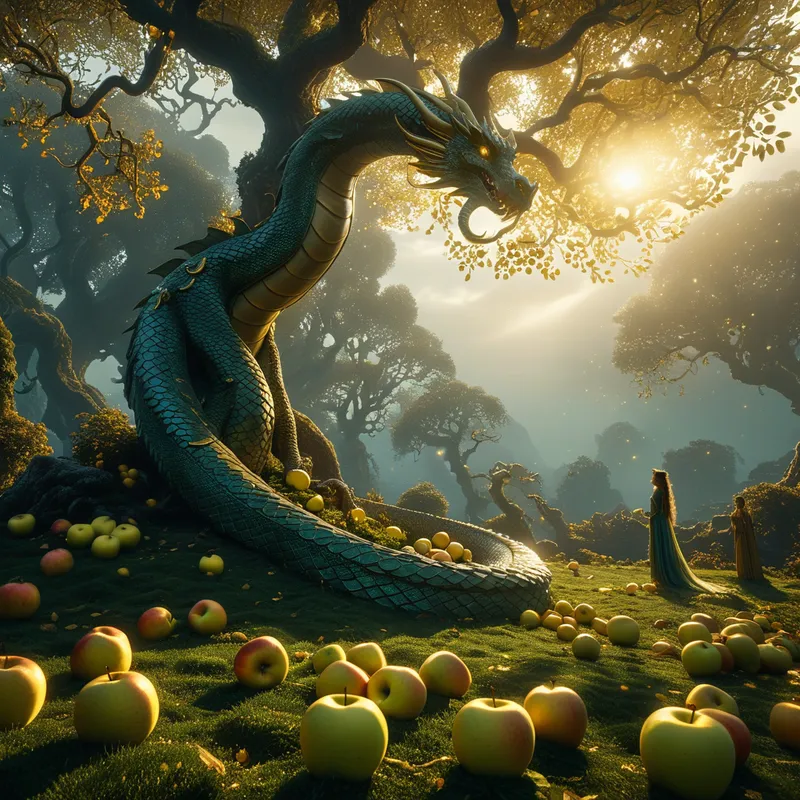
Hercules' final labor: to steal golden apples of immortality from a garden at world's end, guarded by a dragon and the daughters of night.
The Tale of The Apples of the Hesperides
Listen, and hear of the last and most impossible task. After eleven labors that had scarred the earth and cleansed it of horrors, Heracles was given one final command: to bring back the golden apples from the garden at the very edge of the world.
These were no ordinary fruit. They were the apples of immortality, a wedding gift from the primordial Earth Mother, Gaia, to the great goddess Hera. And Hera, in her divine suspicion, placed them in a secret orchard where the sun sets, a land of perpetual twilight. She set as their guardians the Hesperides, her own radiant daughters, and, for good measure, the hundred-headed dragon Ladon, whose every eye was a watchful star and whose every mouth held a venomous whisper.
No mortal knew the path. Heracles wandered, a mountain of muscle and doubt, from the whispering oak of Zeus at Dodona to the salt-sprayed shores of distant seas. He wrestled the shape-shifting sea god Nereus, holding him fast through seal, serpent, and torrent, until the old god of the deep, exhausted, sighed the secret location: the garden lay in the far west, where the Titan Atlas bore the weight of the celestial sphere upon his aching shoulders.
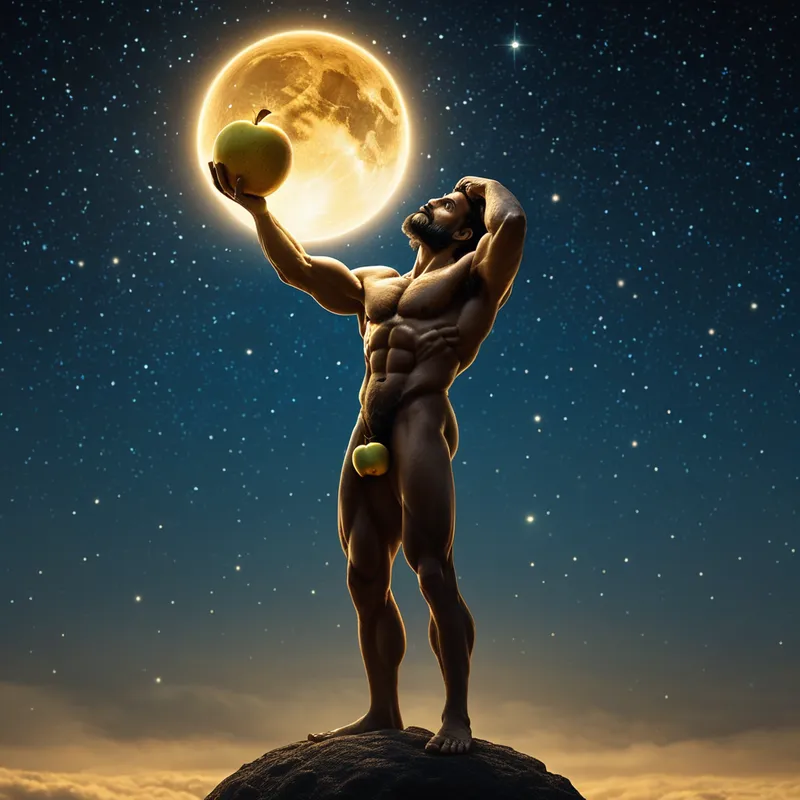
There, at the threshold of the world, Heracles found Atlas, the very pillar between heaven and earth, his form etched with eternal strain. Seeing a chance for respite, the Titan proposed a bargain: he would fetch the apples himself from his daughters’ garden, if Heracles would take the sky onto his own back. The hero agreed. The transfer was a cataclysm of groaning sinew and cosmic pressure, but Heracles held, the vault of heaven pressing down on his lion-skin cloak.
Atlas returned, the apples glowing in his hand like captured suns. But freedom is a sweet draught. The Titan declared he would deliver the apples to Eurystheus himself, leaving Heracles to his eternal duty. Trapped, the hero employed the only weapon left to him: cunning. He asked Atlas to take the sky back for just a moment, so he could pad his shoulders with a cushion. The Titan, flush with his simple victory, agreed. The moment the weight returned to him, Heracles seized the apples, and with the speed of a man unburdened, he fled, leaving Atlas once more bowed under the immutable dome of stars.
Cultural Origins & Context
This myth, one of the twelve canonical labors of Heracles, is a late and complex addition to the hero’s cycle, reflecting the Greek fascination with edges and origins. The story synthesizes older, disparate elements: the universal motif of a magical, life-giving fruit guarded by a serpent; the poetic concept of the Hesperides as personifications of the beautiful, dying light of day; and the geopolitical imagination of the “Far West” as a land of wonder and peril, perhaps echoing faint memories of trade routes to North Africa.
It was a story told not just to glorify Heracles, but to map the metaphysical boundaries of the world. The garden exists in a liminal space—not quite part of the human realm, not quite part of Olympus. It was passed down by poets like Hesiod and tragedians, serving a societal function of illustrating the ultimate test. The final labor is not about brute strength, but endurance, cleverness, and confronting the very architecture of the cosmos, represented by Atlas. It reinforced the Greek ideal of metis (cunning intelligence) as necessary even for the strongest of heroes to complete a task against the direct will of the gods.
Symbolic Architecture
The myth is a dense symbolic ecosystem. The Apples represent the ultimate prize: unearned immortality, divine knowledge, or a state of perfection that is not meant for mortal hands. They are the psychic “treasure hard to attain,” often synonymous with the integrated Self.
The serpent-guarded treasure is never merely possessed; it must be understood, and the understanding changes the seeker utterly.
Ladon is the ultimate guardian of the threshold, the personification of relentless, multifaceted awareness that protects the sacred from profane acquisition. He is not evil, but necessary. The Hesperides represent the alluring, yet passive, aspect of the treasure—its beauty and its connection to the cyclical, setting sun, a reminder that all things, even immortality, have their place in a cycle.
Most crucially, Atlas represents the burden of cosmic order, the weight of the world itself. Heracles’s interaction with him is the core alchemy of the tale. The hero does not slay this Titan; he temporarily relieves him, and then cleverly gives the burden back. This signifies that some cosmic orders or profound burdens are not to be destroyed, but understood, shouldered when necessary, and rightfully returned to their place.
The Dreamer’s Resonance
When this myth stirs in the modern dreamer, it often signals a confrontation with an “impossible” final task in one’s psychic development. The dreamer may find themselves in a lush, walled garden they cannot enter, or see a radiant fruit they cannot touch. The guardian serpent or dragon may appear not as a monster, but as a coiled anxiety, a depression, or a dense, intricate problem that seems to have “a hundred heads,” each voicing a different worry or critique.
Somatically, this can feel like the “weight of the world” on one’s shoulders—a literal tension in the neck and back, the burden of Atlas. The dream is pointing to a treasure (wholeness, a career goal, self-acceptance) that feels just beyond reach, protected by one’s own deepest defenses and the overwhelming scale of the responsibility its acquisition seems to entail. The psychological process is one of approaching the final guardian of one’s own growth, realizing that brute force (old ways of coping) will not work, and that a moment of profound, cunning surrender—accepting the burden to ultimately transcend it—is required.
Alchemical Translation
The labor of the Apples is a masterful map for the stage of individuation where one must retrieve a core, golden aspect of the Self from the far western edge of the unconscious, where it has been placed under the guardianship of Hera (the archetypal Great Mother, representing both the nurturing and the punishing aspects of the superego).
To gain the golden apple, one must first consent to hold up the sky—to fully accept the crushing weight of one’s own reality and responsibility.
The hero’s journey is not a straight fight. He must first wrestle with Nereus (the fluid, prophetic unconscious) to get direction. Then, he must go to the very source of his burden—the Atlas complex within, the ingrained structure that says “you must carry this alone.” The alchemical transmutation occurs in the trick. Heracles does shoulder the cosmic weight, proving he can. But his salvation is in his willingness to ask for the burden to be taken back, not to martyr himself to it. He uses metis (individuated consciousness) to escape an eternal fate.
For the modern individual, this translates to the final stage of a transformative journey. The “apples” are the integrated personality, the fruit of one’s labors. To claim them, one must confront the ultimate internal guardian (self-sabotage, pride, fear), and, most importantly, negotiate with the “Atlas”—the foundational burden or story one has carried since childhood. One must learn to hold it, then, through wisdom and not force, set it down in its proper place. The treasure is not taken by storm, but earned through a sublime and cunning exchange with the deepest structures of one’s own soul.
Associated Symbols
Explore related symbols from the CaleaDream lexicon: