The Apple of Discord Myth Meaning & Symbolism
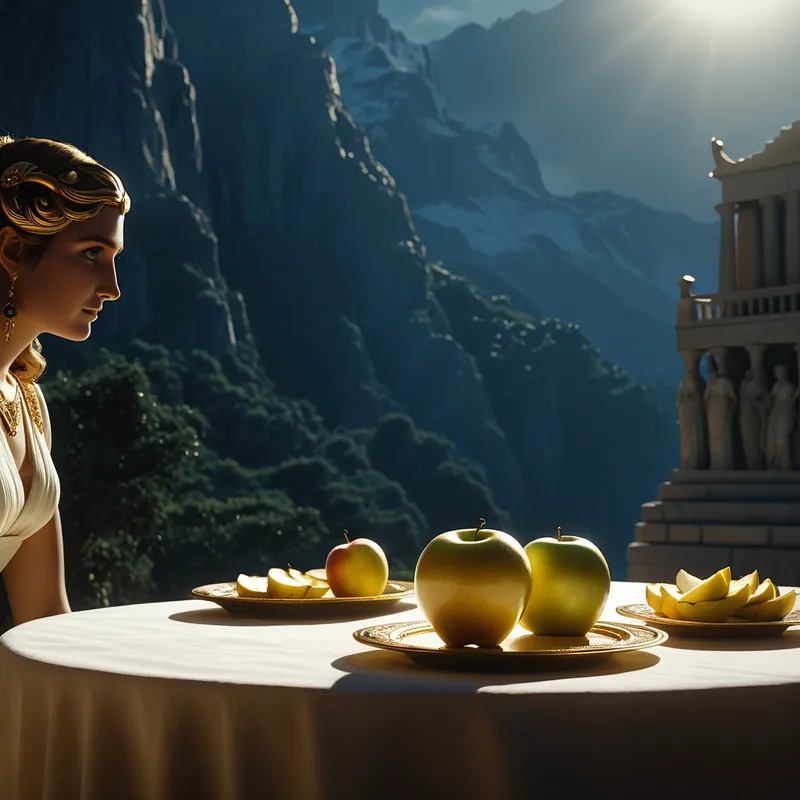
A golden apple inscribed 'for the fairest' is thrown among goddesses, igniting divine rivalry and setting the stage for the Trojan War.
The Tale of The Apple of Discord
The air on [Mount Olympus](/myths/mount-olympus “Myth from Global/Universal culture.”/) was thick with the scent of ambrosia and the low hum of immortal merriment. All the gods and goddesses were gathered, their laughter like distant thunder, their forms casting long, shifting shadows in the eternal light. All, that is, save for one. Eris, whose very presence soured wine and turned song to argument, had been pointedly omitted from the guest list for the wedding of [Thetis](/myths/thetis “Myth from Greek culture.”/) and Peleus. Her exclusion was a deliberate silence, a vacuum into which spite rushed to fill.
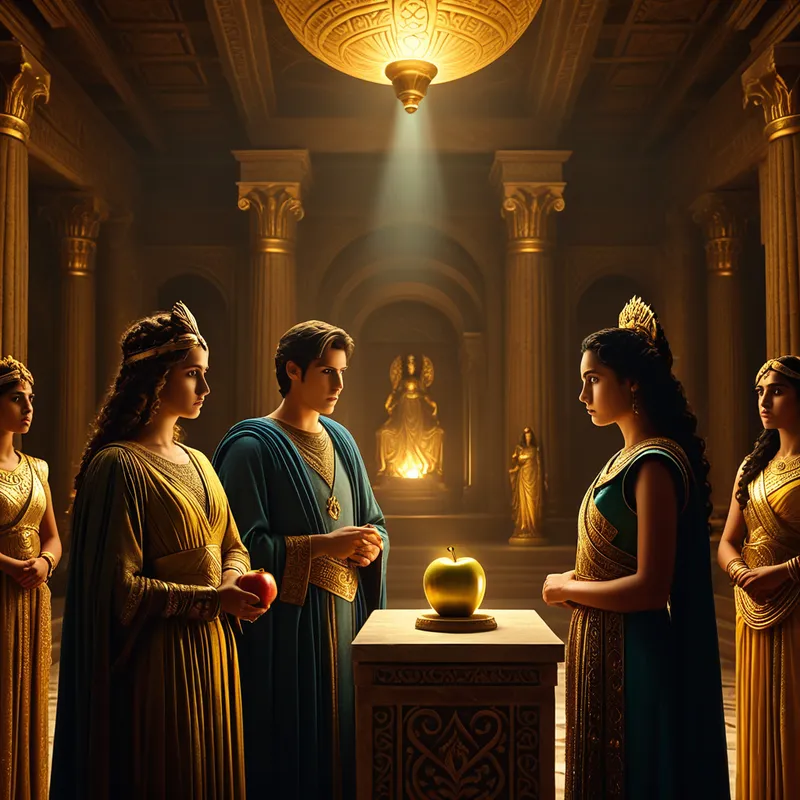
And so she came uninvited. Not through the grand gates, but like a cold draft through a sealed window. Into the midst of the revelry, where Hera, Athena, and Aphrodite sat in a circle of supreme power, Eris cast her single weapon. It was not a spear or a curse, but an object of pure, simple perfection: a apple of solid, shimmering gold. It rolled with a heavy, fateful sound across the marble floor, coming to rest at the feet of the three great goddesses. Upon its flawless skin, etched as if by lightning, were three words: ΤΗΙ ΚΑΛΛΙΣΤΗΙ—For the Fairest.
The music died. The laughter choked off. In that instant, the unity of the divine gathering shattered. Three pairs of immortal eyes locked onto the fruit, and then onto each other. A question, silent and devastating, hung in the air: Which of them was worthy of the title? Hera, the majestic queen, drew herself up, her authority a palpable force. Athena, grey-eyed and formidable, rested a hand near where her spear would be, her intellect already calculating. Aphrodite, from whom radiance flowed like a perfume, smiled a slow, knowing smile. Each claimed the apple. Each demanded the judgment of their own supreme beauty.
The argument that erupted was not a mortal squabble; it was a tectonic shifting of divine will, threatening to crack the foundations of Olympus itself. No god, not even Zeus in all his might, dared to judge between his wife, his daughter, and the power that binds the universe itself. With the wisdom of a ruler who knows when to deflect catastrophe, Zeus decreed the decision must fall to a mortal, one untouched by the immediate politics of heaven. His gaze fell to the idyllic slopes of Mount Ida, where a young shepherd prince, Paris, tended his flocks in blissful ignorance of the storm gathering above him.
The three goddesses descended to the green meadow, not as supplicants, but as sovereigns offering treaties. They stood before the awestruck youth, and they did not merely ask for his opinion. They offered kingdoms. Hera promised him boundless political power and lordship over all Asia. Athena vowed to grant him unparalleled wisdom and victory in every battle. Aphrodite, however, leaned close and whispered of a love that would eclipse all tales, the love of the most beautiful woman in [the world](/myths/the-world “Myth from Tarot culture.”/): Helen.
Paris, a creature of heart and instinct, not statecraft or strategy, reached out. His hand closed around the cool, heavy gold. He did not give the apple to the most powerful, or the wisest. He gave it to the one who promised the sweetest, most immediate desire. He gave it to Aphrodite. In that moment, the shepherd sealed his fate, and the fate of a city yet unburned. The goddess of strife had won without striking a blow. The apple had done its work, and the long, bloody road to Troy was now open, paved with gold and human longing.
Cultural Origins & Context
This foundational myth, often called the Judgment of Paris, is the essential prelude to the entire Epic Cycle, most famously [Homer](/myths/homer “Myth from Greek culture.”/)’s Iliad. It was not a standalone folktale but the crucial divine catalyst for the greatest conflict in Greek legendary history: [the Trojan War](/myths/the-trojan-war “Myth from Greek culture.”/). The story was passed down through the oral tradition of epic poetry, performed by bards (aoidoi) who would have used this episode to immediately establish the cosmic scale and deeply personal origins of the coming cataclysm. Its societal function was multifaceted. On one level, it explained the ultimate cause of a war that defined heroic culture. On another, it served as a profound ethical and theological lesson about the capriciousness of the gods and the vulnerability of mortals caught in divine disputes. It framed human history as a plaything for immortal egos, where a single moment of mortal choice, swayed by desire, could unleash decades of suffering. The myth reinforced the Greek concept of ate—a ruinous folly or delusion sent by the gods—that clouds judgment and leads to disaster.
Symbolic Architecture
The [Apple](/symbols/apple “Symbol: An apple symbolizes knowledge, temptation, and the duality of good and evil, often representing the pursuit of wisdom with potential consequences.”/) of Discord is perhaps one of the most potent and concise symbolic objects in all of mythology. It is not merely a [fruit](/symbols/fruit “Symbol: Fruit symbolizes abundance, nourishment, and the fruits of one’s labor in dreams.”/); it is a perfect [vessel](/symbols/vessel “Symbol: A container or structure that holds, transports, or protects something essential, representing the self, emotions, or life journey.”/) for [projection](/symbols/projection “Symbol: The unconscious act of attributing one’s own internal qualities, emotions, or shadow aspects onto external entities, people, or situations.”/).
The apple is the unclaimed value, the unresolved question thrown into the psyche’s communal feast. It does not create discord; it reveals it.
Eris represents the inevitable force of [differentiation](/symbols/differentiation “Symbol: The process of distinguishing or separating parts of the self, emotions, or identity from a whole, often marking a developmental or psychological milestone.”/), the [shadow](/symbols/shadow “Symbol: The ‘shadow’ embodies the unconscious, repressed aspects of the self and often represents fears or hidden emotions.”/) that insists upon comparison and [choice](/symbols/choice “Symbol: The concept of choice often embodies decision-making, freedom, and the multitude of paths available in life.”/) where unity was assumed. She is the excluded part of [the Self](/myths/the-self “Myth from Jungian culture.”/) that returns, demanding recognition. The Golden Apple itself symbolizes the ultimate object of desire, but a desire defined by comparison—“the fairest.” Its value is entirely relational and subjective, making it a perfect trigger for envy (phthonos), a powerful and dangerous force in the Greek moral [universe](/symbols/universe “Symbol: The universe symbolizes vastness, interconnectedness, and the mysteries of existence beyond the individual self.”/).
The Three Goddesses present the archetypal tripartite dilemma of the [human](/symbols/human “Symbol: The symbol of a human represents individuality, complexity of emotions, and social relationships.”/) [soul](/symbols/soul “Symbol: The soul represents the essence of a person, encompassing their spirit, identity, and connection to the universe.”/): Power (Hera, the ruler), Wisdom (Athena, the strategist), and Love/[Beauty](/symbols/beauty “Symbol: This symbol embodies aesthetics, harmony, and the appreciation of life’s finer qualities.”/) (Aphrodite, the [lover](/symbols/lover “Symbol: A lover in dreams often represents intimacy, connection, and the emotional aspects of relationships.”/)). They are not just individuals but fundamental [life](/symbols/life “Symbol: The symbol of ‘Life’ represents a journey of growth, interconnectedness, and existential meaning, encompassing both the joys and challenges that define human experience.”/) values in [competition](/symbols/competition “Symbol: Competition in dreams often symbolizes conflict, ambition, and the drive to succeed, reflecting personal goals and challenges.”/) for our primary allegiance. Paris, the “judge,” represents the immature ego-[consciousness](/symbols/consciousness “Symbol: Consciousness represents the state of awareness and perception, encompassing thoughts, feelings, and experiences.”/), the part of us that must make [life](/symbols/life “Symbol: The symbol of ‘Life’ represents a journey of growth, interconnectedness, and existential meaning, encompassing both the joys and challenges that define human experience.”/)-defining choices based on incomplete understanding, often swayed by immediate gratification and the most seductive promise, unaware of the long-chain consequences. His choice for Aphrodite is the choice of the personal, the sensual, and the immediate over the collective, the intellectual, or the strategic.

The Dreamer’s Resonance
When this myth pattern emerges in modern dreams, it rarely appears as a classical tableau. Instead, the dreamer may find themselves in a tense meeting, a family gathering, or a social situation where they are forced to choose between three seemingly equal but compelling options—a job offer, a relationship, a path in life. The somatic feeling is one of acute anxiety, of being put on the spot with high stakes. There may be a sense of three powerful internal “voices” or figures pressuring them, each offering a different version of success or happiness.
This dream signals a critical point of differentiation in the [psyche](/myths/psyche “Myth from Greek culture.”/). The “discord” is internal. The dreamer is confronting a triad of competing values, drives, or life potentials (often reflecting the Hera-Athena-Aphrodite archetypes: commitment vs. achievement vs. passion). The golden apple is the prize of self-definition: “Which value is fairest? Which will I crown as my ruling principle?” The dream highlights the impossibility of having it all simultaneously and the painful, necessary act of choosing one path, thereby temporarily “abandoning” the others. The ensuing “war” in waking life may be the internal conflict, regret, or fallout from that necessary, ego-defining choice.

Alchemical Translation
The alchemical process modeled here is not one of heroic integration, but of the [nigredo](/myths/nigredo “Myth from Alchemical culture.”/)—the initial blackening, the necessary chaos that precedes any transformation. The Apple of Discord is the [prima materia](/myths/prima-materia “Myth from Alchemical culture.”/), the base matter of the psyche thrown into [the vessel](/myths/the-vessel “Myth from Alchemical culture.”/) of life. Its inscription, “for the fairest,” is the question that initiates the work: “What is of supreme value to me?”
The alchemical fire is not lit under the apple, but within the space of tension between the three goddesses. The heat is generated by their rivalry, by the soul’s own agonizing comparison.
The conscious ego (Paris) is tasked with the [separatio](/myths/separatio “Myth from Alchemical culture.”/), the initial separation of qualities. This is a perilous, often “unconscious” operation. Choosing Aphrodite, as Paris does, represents a primal commitment to the principle of Eros—connection, desire, and relatedness—as the foundational stone for one’s individuation journey. It is a choice that inevitably leads to conflict (the Trojan War), because to fully pursue one’s deep desire is to declare war on the status quo, on other obligations, and on parts of oneself that represent other values.
The individuation lesson is brutal but clear: Consciousness is born from choice, and choice is born from discord. We must invite our own inner Eris to the feast, acknowledge the competing gods within, and make a fateful, flawed, human judgment. The ensuing “war” is the long, painful process of living out that choice, integrating its consequences, and ultimately, through that suffering, discovering what “fairest” truly meant—not in the eyes of the gods, but in the depths of one’s own, now battle-tested, soul. The gold of the apple is not won by possessing it, but by surviving the fire its inscription ignites.
Associated Symbols
Explore related symbols from the CaleaDream lexicon: