The Apocryphon of John
A foundational Gnostic text revealing hidden knowledge about creation, divine rebellion, and humanity's spiritual origins through mystical revelation.
The Tale of The Apocryphon of John
In the silent aftermath of the crucifixion, a profound grief descended upon John, son of Zebedee. He walked alone, his heart a cavern of questions the official teachings could not fill. Why suffering? Why a world of lack and limitation? Why a creator who seemed so distant from the God of love [Jesus](/myths/jesus “Myth from Christian culture.”/) proclaimed? As he retreated into [the desert](/myths/the-desert “Myth from Biblical culture.”/) of his doubt, a figure appeared to him—not the familiar rabbi, but a luminous presence of shifting forms: at once youth, elder, and servant. It was the risen [Christ](/myths/christ “Myth from Christian culture.”/), but revealed now as the embodiment of a higher, alien [Pleroma](/myths/pleroma “Myth from Gnostic culture.”/), the true God beyond all gods.
This being, the Revealer, saw the turmoil in John’s soul and opened the scroll of hidden time. He began not with Bethlehem, but with the Origin of origins, the Invisible Spirit, a boundless silence of pure light and thought. From this [Monad](/myths/monad “Myth from Greek culture.”/) emanated the Barbelo, the first thought, the divine feminine principle, [the womb](/myths/the-womb “Myth from Various culture.”/) of all that would follow. Together, they brought forth a realm of perfect, harmonious emanations: the [Aeons](/myths/aeons “Myth from Gnostic culture.”/).
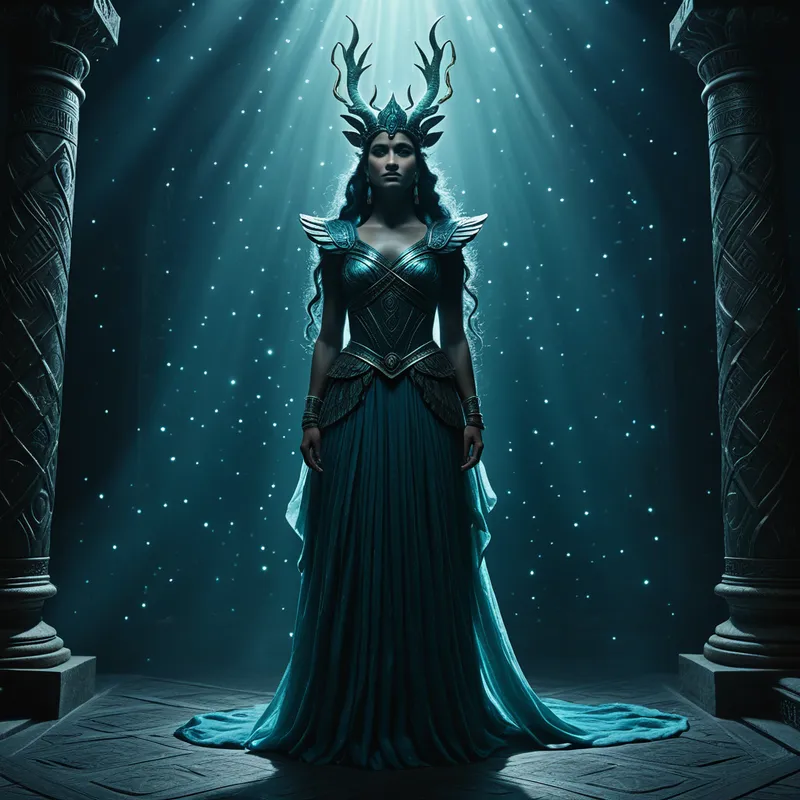
But within this plenitude, a flaw appeared. The youngest Aeon, [Sophia](/myths/sophia “Myth from Gnostic culture.”/) (Wisdom), desired to know the Invisible Spirit directly, to grasp the source without the consent of her divine counterpart. This passionate, solitary thought—a will to create apart from the harmonious whole—was her “fall.” From this longing, without the divine embrace, she gave birth alone. And what was born was a misshapen, ignorant entity, a caricature of divinity with the face of a lion and eyes of fire. She named him [Yaldabaoth](/myths/yaldabaoth “Myth from Gnostic culture.”/), the [Demiurge](/myths/demiurge “Myth from Platonic culture.”/).
Blind to [the world](/myths/the-world “Myth from Tarot culture.”/) above him, swollen with the power stolen from his mother, Yaldabaoth declared, “I am God, and there is no other.” From his arrogance, he fashioned the prison of the cosmos: the chaotic heavens and the dark, heavy earth. He created [archons](/myths/archons “Myth from Gnostic culture.”/), ruling powers, to govern the spheres, building a vast, layered fortress of fate and law to entrap any light that might descend.
Seeing the spark of [divine light](/myths/divine-light “Myth from Christian culture.”/) trapped within the human form shaped by [the archons](/myths/the-archons “Myth from Gnostic culture.”/) from the muddy earth, Sophia repented and appealed to [the Pleroma](/myths/the-pleroma “Myth from Gnostic culture.”/). The Aeons sent Christ, the perfect light, to awaken humanity. [The Demiurge](/myths/the-demiurge “Myth from Gnostic culture.”/) and his archons, fearing the light in Adam, tried to bury it deeper—casting him into forgetfulness, forging the rib into Eve to further divide and distract. But the divine voice, the Epinoia of light, always whispered within, a secret guide.
The Revealer showed John that this is the human condition: a [divine spark](/myths/divine-spark “Myth from Gnostic culture.”/), a fragment of the alien God, cast into the amnesia of a material tomb crafted by an ignorant and jealous god. Salvation is not sin-forgiveness from a distant lord, but awakening—the recollection (anamnesis) of one’s origin in the boundless light. It is the gnosis that the soul’s true home is not here, but in the silent, luminous depths from which it came.
Cultural Origins & Context
The Apocryphon of John is [the cornerstone](/myths/the-cornerstone “Myth from Biblical culture.”/) text of what scholars term “Sethian” Gnosticism, a profound stream of thought that emerged in the fertile, turbulent religious landscape of the 1st and 2nd centuries CE. It exists in four Coptic manuscripts, the oldest found within the famed Nag Hammadi library, buried in the Egyptian desert around the 4th [century](/myths/century “Myth from Biblical culture.”/). While framed as a post-resurrection revelation to John the Apostle, its theology is a radical synthesis—a rebellious dream woven from the threads of Platonist philosophy, Jewish mystical speculation (particularly around Genesis and the figure of Wisdom), and early Christian apocalyptic yearning.
It was composed in a world where the orthodox Christian narrative was still coalescing. For the authors and communities that treasured this text, the emerging church’s creedal faith felt like a betrayal of Jesus’s most subversive message. They heard in his call a promise not of institutional redemption, but of personal, liberating knowledge. The Apocryphon is thus a “counter-Genesis,” a secret history written to explain the palpable dissonance between the perfection of a divine source and the manifest imperfection, suffering, and injustice of the material world. It provided a theodicy of stunning psychological depth: the world is flawed because its maker is flawed. The true God remains utterly transcendent, and the path to that God is inward, through the gnosis of one’s own exiled divinity.
Symbolic Architecture
The myth constructs a vast psychic [architecture](/symbols/architecture “Symbol: Architecture in dreams often signifies structure, stability, and the framing of personal identity or life’s journey.”/). The [Pleroma](/symbols/pleroma “Symbol: In Gnostic cosmology, the Pleroma is the divine fullness or totality of spiritual powers, representing the realm of perfection beyond the material world.”/) represents the undifferentiated, unconscious wholeness of [the Self](/myths/the-self “Myth from Jungian culture.”/). [The fall](/myths/the-fall “Myth from Biblical culture.”/) of Sophia is not a moral failure but a symbolic depiction of the [emergence](/symbols/emergence “Symbol: A process of coming into being, rising from obscurity, or breaking through a barrier, often representing birth, transformation, or revelation.”/) of ego-[consciousness](/symbols/consciousness “Symbol: Consciousness represents the state of awareness and perception, encompassing thoughts, feelings, and experiences.”/)—a necessary but painful [separation](/symbols/separation “Symbol: A spiritual or mythic division between realms, states of being, or consciousness, often marking a transition or loss of connection.”/) from the unconscious whole that allows for individual existence, yet carries the inherent risk of [inflation](/symbols/inflation “Symbol: A dream symbol representing feelings of diminishing value, loss of control, or expansion beyond sustainable limits in one’s life or psyche.”/) and [error](/symbols/error “Symbol: A dream symbol representing internal conflict, perceived failure, or a mismatch between expectations and reality.”/) (Yaldabaoth).
Yaldabaoth is the archetypal inflated ego, the psychic force that mistakes its own derived power for ultimate reality, constructing a rigid, literalistic world of laws, labels, and separation—the “cosmos” of conventional identity.
The [material](/symbols/material “Symbol: Material signifies the tangible aspects of life, often representing physical resources, desires, and the physical world’s influence on our existence.”/) world is thus the [psyche](/myths/psyche “Myth from Greek culture.”/) identified solely with this ego-[construction](/symbols/construction “Symbol: Construction symbolizes creation, building, and the process of change, often reflecting personal growth and the need to build a solid foundation.”/), a [prison](/symbols/prison “Symbol: Prison in dreams typically represents feelings of restriction, confinement, or a lack of freedom in one’s life or mind.”/) of perceived limitations. [The divine spark](/myths/the-divine-spark “Myth from Gnostic culture.”/) is the irreducible core of the Self, the transpersonal essence that remembers its [origin](/symbols/origin “Symbol: The starting point of a journey, often representing one’s roots, source, or initial state before transformation.”/). Salvation as anamnesis is the process of Individuation—re-collecting the fragmented parts of the [psyche](/myths/psyche “Myth from Greek culture.”/) and re-membering one’s [connection](/symbols/connection “Symbol: Connection symbolizes relationships, communication, and bonds among individuals.”/) to the guiding Self beyond [the ego](/myths/the-ego “Myth from Jungian culture.”/)’s arrogant dominion.
The Dreamer’s Resonance
To encounter this myth is to feel the shock of recognition in the soul’s own exile. It speaks to anyone who has ever felt like a stranger in a strange land, who has intuited that the rules of the visible world are not the ultimate rules. It gives form to the profound sense that the source of our deepest longing is not ahead of us, but behind and within us—a forgotten homeland.
Psychologically, it maps the journey from psychic imprisonment to liberation. The Demiurge’s world resonates with the conditioning of family, society, and trauma—the internalized archons that say “you are only this body, this role, these sins.” The quest for gnosis is the therapeutic and spiritual journey of distinguishing the voice of the alien God (the Self) from the clamor of the false god (the complex-ridden ego). It validates the feeling that true healing is not adjustment to the prison, but awakening from the dream of the prison itself.

Alchemical Translation
The Apocryphon is an alchemical text of the spirit. Its operation is the [separatio](/myths/separatio “Myth from Alchemical culture.”/) and sublimatio of the divine spark from the leaden weight of ignorant matter. The chaotic waters over which Yaldabaoth rules are the [prima materia](/myths/prima-materia “Myth from Alchemical culture.”/), the unconscious, undifferentiated psyche in its fallen state. The [emanation](/myths/emanation “Myth from Neoplatonic/Gnostic culture.”/) of the Aeons is the blueprint of perfection, the [lapis philosophorum](/myths/lapis-philosophorum “Myth from Alchemical culture.”/) hidden within.
The entire cosmic drama is an allegory for the alchemical process: the nigredo of Sophia’s error and the creation of the dark world, the albedo of the light-spark’s insertion, and the final rubedo of gnosis, where the redeemed spirit, having united with its light, returns to the golden source.
The Revealer, Christ, acts as the alchemical [Mercurius](/myths/mercurius “Myth from Alchemical culture.”/), [the psychopomp](/myths/the-psychopomp “Myth from Various culture.”/) and mediator who provides the secret formula—the gnosis—that initiates the transformation. The goal is not to improve the base world but to transmute the perceiving self, to recognize the gold already present within the dross of earthly experience.
Associated Symbols
Explore related symbols from the CaleaDream lexicon:
- Revelation — The sudden, transformative unveiling of hidden truth that shatters conventional perception and reorients the soul toward its divine origin.
- Light — The divine substance of the Pleroma, the spark of true Self trapped in matter, and the illuminating power of liberating knowledge.
- Shadow — The realm of the Demiurge and his archons, representing the ignorant, arrogant, and oppressive aspects of the psyche that must be recognized and transcended.
- Mother — The divine feminine as Barbelo, the first thought and womb of the Aeons, and as Sophia, whose passionate error initiates the drama of existence.
- Mirror — The instrument of self-recognition, reflecting not the mortal face but the hidden divine spark, facilitating the anamnesis of the soul.
- Key — The gnosis itself, which unlocks the prison of material and psychic conditioning, opening the door to the transcendent realm.
- Forgetfulness — The primary tool of the archons, the spiritual amnesia that keeps humanity bound to the false world, mistaking the cage for the cosmos.
- Door — [The threshold](/myths/the-threshold “Myth from Folklore culture.”/) between the cosmic prison and the Pleroma, which can only be passed through by the awakened one who knows their true name and nature.
- Serpent — Often a symbol of wisdom and redemption in Gnostic thought, representing the enlightening force that urges Eve and Adam toward knowledge, against the Demiurge’s commands.
- Circle — The perfect, boundless unity of the Invisible Spirit and the Pleroma, contrasted with the fractured, hierarchical circles of the archontic heavens.