The Androgyne of Plato's 'Symp Myth Meaning & Symbolism
A tale of original spherical beings cleaved in two by the gods, whose longing for their lost half is the source of all human love and desire.
The Tale of The Androgyne of Plato’s ‘Symp
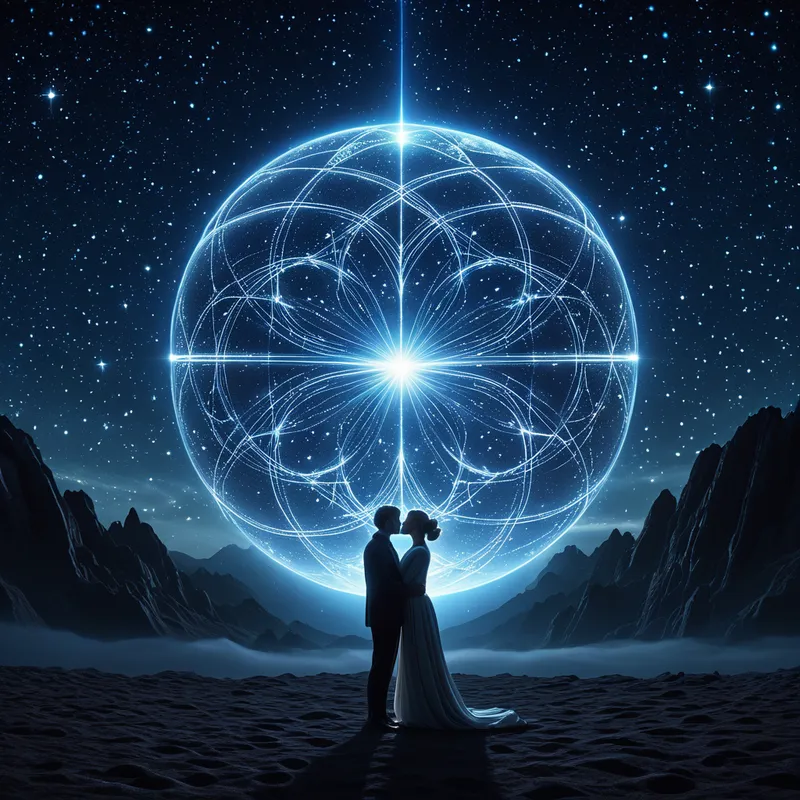
Listen, and I will tell you of a time before time, a shape of humanity now lost to memory. In [the golden age](/myths/the-golden-age “Myth from Greek culture.”/) of [Kronos](/myths/kronos “Myth from Greek culture.”/), the children of [the earth](/myths/the-earth “Myth from Hindu culture.”/) were not as you see them now. They were magnificent, terrifying, whole. Each being was a sphere, a perfect globe rolling upon the earth with boundless power and pride. They had four hands, four legs, and a single head with two faces gazing in opposite directions, set upon a circular neck. Within each sphere burned the essence of three sexes: some were double-male, born of the sun. Some were double-female, born of the earth. And the third, most wondrous and powerful of all, was the Androgyne, born of [the moon](/myths/the-moon “Myth from Tarot culture.”/), which shares in both the sun and [the earth](/myths/the-earth “Myth from Hindu culture.”/).
These spherical beings moved not by walking, but by cartwheeling with incredible speed, their eight limbs propelling them like acrobats of destiny. Their strength was such that they conceived a great insolence. They sought to scale the heavens, to make war upon the gods themselves, to dethrone Zeus and [Ouranos](/myths/ouranos “Myth from Global/Universal culture.”/). The air crackled with their ambition, a low thunder of rolling forms gathering at the base of [the world](/myths/the-world “Myth from Tarot culture.”/)-mountain.
Zeus, in his council with the other gods, pondered this rebellion. To destroy them utterly with thunderbolts would extinguish the worship of mortals. Yet, to leave them in their powerful, united state was intolerable. A solution, both cruel and ingenious, was conceived. “Let us cut them in two,” Zeus declared, “as one slices a hard-boiled egg with a hair. They will be weakened, their numbers doubled, and their devotion to us increased.”
And so it was done. [Hephaestus](/myths/hephaestus “Myth from Global/Universal culture.”/), the great craftsman, took up his divine tools, or perhaps it was the lightning of Zeus itself that fell like a surgeon’s blade. Each spherical being was cleft from crown to groin, the skin drawn tight and knotted at the navel as a reminder of the original unity. The two halves were then spun apart, left to wander the earth.
The effect was immediate and catastrophic. Where there was once wholeness and power, there was now a desperate, pathetic longing. Each half, upon waking to its maimed state, threw its arms around the other, desperate to be reunited, to grow back together. They would not eat, they would not drink, clinging to one another until they began to perish from hunger and inertia.
Taking pity, Zeus moved their genitals to the front, so that in embracing, they might find some solace, some fleeting memory of union, and turn their attention to the practical matters of life. And so, from that day to this, each human is but a symbolon—a token, a tally-stick broken from its matching half. Our life is a search for that other piece. When we meet it, we are struck with a wordless, ancient familiarity, a sense of belonging and overwhelming love. We call this Eros, but it is, in truth, the echo of a god’s surgery, the memory of a sphere, and the desperate yearning to be whole once more.

Cultural Origins & Context
This myth is not found on crumbling temple walls, but in the refined, wine-scented air of an Athenian gentleman’s [symposium](/myths/symposium “Myth from Greek culture.”/). It is presented in Plato’s Symposium (c. 385-370 BCE), spoken by the comic playwright Aristophanes. The context is critical: a dinner party where several prominent Athenians, including [Socrates](/myths/socrates “Myth from Greek culture.”/), give speeches in praise of Love (Eros). Aristophanes’ tale is a myth of his own invention for the occasion, a philosophical fable woven from the threads of older Greek cosmological ideas.
Its societal function was multifaceted. In the immediate context, it is a humorous, poignant, and deeply human explanation for the origin of sexual orientations and the powerful, often irrational, force of romantic love. On a broader cultural level, it serves a philosophical purpose within Plato’s work, offering a popular, accessible account of human nature that Socrates will later refine and transcend with his own speech about love as a ladder to the divine. It is a story told not by priests, but by a poet-philosopher, designed to explain the deepest aches of the human heart in an age that was beginning to turn its gaze inward, from the cosmos to the soul.
Symbolic Architecture
At its core, the myth of the Androgyne is a profound [symbol](/symbols/symbol “Symbol: A symbol can represent an idea, concept, or belief, serving as a powerful tool for communication and understanding.”/) of primordial unity and the [trauma](/symbols/trauma “Symbol: A deeply distressing or disturbing experience that overwhelms the psyche, often manifesting in dreams as unresolved emotional wounds or psychological injury.”/) of individuation. The spherical being represents a state of psychic completeness where all opposites are contained and reconciled: male and female, sun and [earth](/symbols/earth “Symbol: The symbol of Earth often represents grounding, stability, and the physical realm, embodying a connection to nature and the innate support it provides.”/), [movement](/symbols/movement “Symbol: Movement symbolizes change, progress, and the dynamics of personal growth, reflecting an individual’s desire or need to transform their circumstances.”/) and rest, self and other. This is not a historical past, but a psychological pre-[condition](/symbols/condition “Symbol: Condition reflects the state of being, often focusing on physical, emotional, or situational aspects of life.”/)—the unconscious wholeness of the [infant](/symbols/infant “Symbol: The infant symbolizes new beginnings, innocence, and the potential for growth and development.”/) or the undifferentiated state of the [psyche](/myths/psyche “Myth from Greek culture.”/) before the [dawn](/symbols/dawn “Symbol: The first light of day, symbolizing new beginnings, hope, and the transition from darkness to illumination.”/) of ego-[consciousness](/symbols/consciousness “Symbol: Consciousness represents the state of awareness and perception, encompassing thoughts, feelings, and experiences.”/).
The cut of Zeus is the necessary, violent birth of consciousness itself. To know oneself, one must first be separated from the All.
The [division](/symbols/division “Symbol: Represents internal conflict, separation of self, or unresolved emotional splits. Often indicates a need for integration or decision-making.”/) is the fundamental [human](/symbols/human “Symbol: The symbol of a human represents individuality, complexity of emotions, and social relationships.”/) experience of alienation—from the world, from others, and from parts of ourselves. Our longing for a “soulmate” is the symbolic [expression](/symbols/expression “Symbol: Expression represents the act of conveying thoughts, emotions, and individuality, emphasizing personal communication and creativity.”/) of a deeper, intra-psychic longing to re-integrate the split-off portions of our own being: the [anima](/symbols/anima “Symbol: The feminine archetype within the male unconscious, representing soul, creativity, and connection to the inner world.”/) and [animus](/symbols/animus “Symbol: In Jungian psychology, the masculine inner personality in a woman’s unconscious, representing logic, action, and spiritual guidance.”/), the conscious and the unconscious, the spiritual and the instinctual. The three original sexes symbolize the [spectrum](/symbols/spectrum “Symbol: A continuum of possibilities, representing diversity, transition, and the full range of existence from one extreme to another.”/) of [human](/symbols/human “Symbol: The symbol of a human represents individuality, complexity of emotions, and social relationships.”/) [nature](/symbols/nature “Symbol: Nature symbolizes growth, connectivity, and the primal forces of existence.”/) and desire, suggesting that our orientations are innate fragments of a lost, divine [blueprint](/symbols/blueprint “Symbol: A blueprint represents the foundational plan or design for something, often symbolizing potential, structure, and the mapping of one’s inner self or future.”/). The navel becomes the psychic scar, the permanent reminder of a wholeness we carry within but cannot consciously grasp.
The Dreamer’s Resonance
When this myth stirs in the modern dreamer, it manifests not as literal spherical beings, but as the somatic and emotional texture of profound search and recognition. One may dream of endlessly searching through a vast, unfamiliar city for a person or an object of vital importance, fueled by a anxiety that is both desperate and sweet. Another may dream of a mirror that shows not their own face, but the face of a stranger they inexplicably know and love, or of a door that, when opened, reveals an identical room where the dreamer is already waiting.
These dreams signal a process of profound psychic hunger. The psyche is activating the archetype of the Self, hinting at a potential for integration that feels tantalizingly out of reach. The somatic experience is often a deep ache in the chest—the “heartache” of the myth made literal. It is the feeling of a missing piece, a sense of being incomplete or “not all here.” This is the psyche working on the level of the shadow and the contrasexual archetypes, preparing the dreamer for a relationship not just with an external other, but with the internal, alienated other within themselves.

Alchemical Translation
The journey from divided half to sought-after wholeness is the alchemical opus of individuation. The myth provides a perfect map. First, we must recognize our state as a symbolon—a broken token. This is the stage of [nigredo](/myths/nigredo “Myth from Alchemical culture.”/), the blackening, the realization of our fundamental alienation and longing. The desperate clinging to another in the myth mirrors our own projections, where we seek in a partner the qualities we have lost or repressed in ourselves.
The true reunion is not found in another, but through another, as a mirror that leads the soul back to its own neglected chambers.
The work of psychic transmutation begins when we withdraw these projections. This is the [separatio](/myths/separatio “Myth from Alchemical culture.”/), echoing Zeus’s original cut, but now performed consciously by [the ego](/myths/the-ego “Myth from Jungian culture.”/). We must differentiate from the fused, unconscious state of “us” to understand what is truly “me” and “you.” The goal, however, is not permanent separation, but a higher synthesis—the coniunctio oppositorum (union of opposites). This is the reconstitution of the sphere, not as a regression to unconscious unity, but as a conscious integration of opposites within a mature personality.
The modern individual’s [triumph](/myths/triumph “Myth from Roman culture.”/) is not finding their “other half” to make them whole, but becoming whole enough to meet another whole being. The Androgyne is then reborn not as a physical form, but as a psychic reality: a state where masculine and feminine principles, logic and intuition, strength and vulnerability, exist in harmonious dialogue within a single, self-aware vessel. The search for love becomes the catalyst for the greatest journey—the return, with full consciousness, to the spherical Self we never truly left, but only forgot.
Associated Symbols
Explore related symbols from the CaleaDream lexicon: