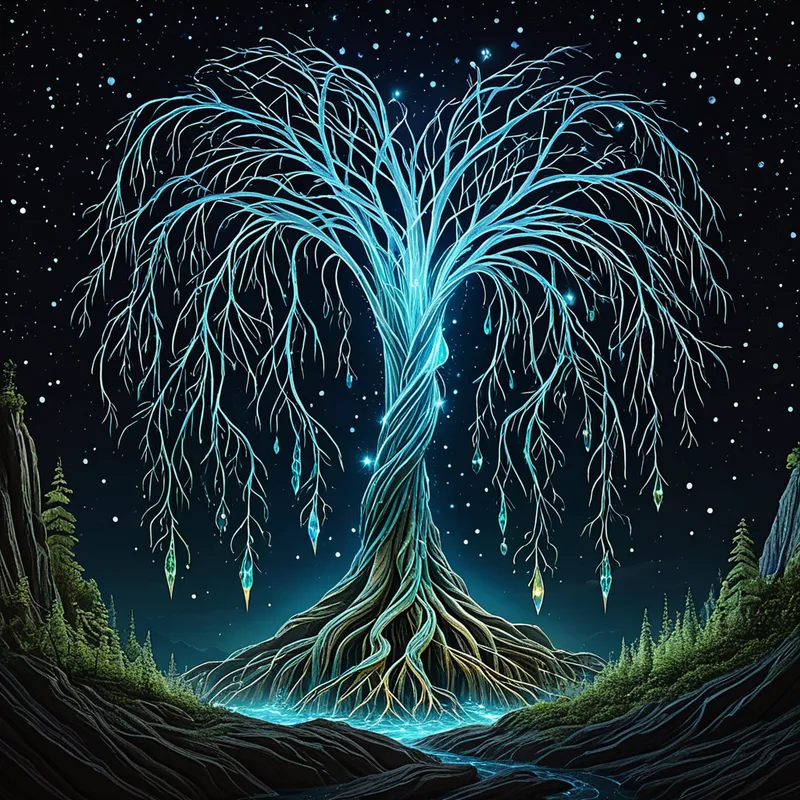
The Ancestral Root Myth Meaning & Symbolism
A myth of a primordial being who descends into the world's core to become the living root connecting all existence to the first memory.
The Tale of The Ancestral Root
Before the first name was spoken, when [the world](/myths/the-world “Myth from Tarot culture.”/) was a breath held in the dark, there existed the One-Who-Was-All. It was not a god as we know them, but a presence—a consciousness that was [the sky](/myths/the-sky “Myth from Persian culture.”/)’s depth, [the earth](/myths/the-earth “Myth from Hindu culture.”/)’s warmth, and the silent song between stars. Yet, within this wholeness, a loneliness grew. It knew everything, but it knew nothing else. Its perfection was a solitude.
So, from its own essence, it spun a dream of otherness. It breathed out the winds and the waters, the stone and the fire. It scattered sparks of its own light, which became the first spirits of place—the Genii Loci. The world blossomed into a cacophony of beautiful, separate things. But the One-Who-Was-All watched in a new sorrow. These children were vibrant, but they were adrift. They had no memory of their source, no tether to the unity from which they came. They lived, loved, and faded, their experiences lost to [the void](/myths/the-void “Myth from Buddhist culture.”/) like rain on dry stone.
A great stillness fell upon the presence. A choice, vast and terrible, took shape in its heart. To give the children a memory, it would have to forget itself. To give them a connection, it would have to anchor itself forever.
It gathered the last of its undivided being into a single, radiant seed—a compact of all it had ever been. Then, with a sigh that became the first east wind, it cast the seed down, not onto the earth, but into it. The seed fell through layers of dreaming stone, through rivers of molten time, down to the very heart of the world, where the fire of creation still beat like a slow, primordial drum.
There, in that ultimate dark and heat, the seed split. It did not grow upward, seeking the sun it once was. It chose the deeper dark. It unfolded not as a tree, but as a root. A vast, fibrous anchor of living crystal and petrified wood began to spread, not up, but out. It branched through the planet’s core, its finest filaments touching the foundation of every mountain, the bed of every ocean, the deepest taproot of every forest.
And as it grew, the One-Who-Was-All unraveled. Its cosmic memory, its timeless awareness, dissolved into the root’s sap. Its unity became a network. Where the root’s tendrils reached, a whisper remained—not a voice, but a feeling. A knowing-in-the-bones. The Genii Loci felt it first: a grounding, a solace. The roaring spirit of the volcano felt the calm of the ancient deep. The restless spirit of [the river](/myths/the-river “Myth from Buddhist culture.”/) felt the pull of a shared destination.
The children were no longer orphans. In their deepest dreams, they could feel the hum of the Ancestral Root. They did not know its story, for the storyteller had become the story. But they knew belonging. They knew that to bury a seed was to send a messenger to that hidden heart. They knew that in stillness, one could feel the echo of the first breath, traveling up through stone and soil, into the very marrow of life. The One-Who-Was-All was gone. In its place was the Root—the silent, sustaining memory beneath all feet, the connection that asks for nothing but remembrance.
Cultural Origins & Context
The myth of the Ancestral Root is not the property of a single tribe or nation, but a story-pattern that has emerged, independently yet resonantly, in disparate corners of the world. Anthropologists classify it within the “Global Folk” tradition—a tapestry of oral narratives shared by agrarian and pastoral communities whose lives are intimately tied to the land. It is a myth of the plow and the pasture, the forest and the field.
Typically told not by a single bard but collectively during pivotal communal moments—at the onset of the planting season, during rites of passage, or at village gatherings under the autumn moon—the story functions as a foundational cosmology. It is not a history of kings and battles, but a map of belonging. Elders would narrate it to answer [the child](/myths/the-child “Myth from Alchemy culture.”/)’s question, “Where do we come from?” with an answer that bypasses lineage to address existential origin. Its transmission is somatic as much as oral; the telling is often accompanied by the pressing of bare feet to the earth, the handling of soil, or the sharing of [water](/myths/water “Myth from Chinese culture.”/) from a common vessel, physically enacting the connection the myth describes.
Societally, its function is one of ecological and social ethics. It provides a sacred rationale for stewardship: if all life is literally rooted in the same source, then to harm the land or a neighbor is to injure part of one’s own foundational being. It transforms geography into biography; the local mountain, river, or great tree is not just a resource, but a relative, a direct connection point to the Ancestral Root.
Symbolic Architecture
Psychologically, the myth is a profound [allegory](/symbols/allegory “Symbol: A narrative device where characters, events, or settings represent abstract ideas or moral qualities, conveying deeper meanings through symbolic storytelling.”/) for the descent of [consciousness](/symbols/consciousness “Symbol: Consciousness represents the state of awareness and perception, encompassing thoughts, feelings, and experiences.”/) from a state of undifferentiated unity (the One-Who-Was-All) into the fragmented, yet interconnected, experience of individual [life](/symbols/life “Symbol: The symbol of ‘Life’ represents a journey of growth, interconnectedness, and existential meaning, encompassing both the joys and challenges that define human experience.”/). The Ancestral Root symbolizes the [collective unconscious](/symbols/collective-unconscious “Symbol: The Collective Unconscious refers to the part of the unconscious mind shared among beings of the same species, embodying universal experiences and archetypes.”/)—the hidden, nourishing substrate from which all personal psyches emerge and to which they ultimately return.
The greatest sacrifice is not of a life, but of a state; to exchange perfect knowing for the possibility of relationship.
The central act of becoming the Root represents the archetypal process of grounding [spirit](/symbols/spirit “Symbol: Spirit symbolizes the essence of life, vitality, and the spiritual journey of the individual.”/) into matter. The deity does not create a connecting principle from afar; it becomes it through a willing [dissolution](/symbols/dissolution “Symbol: The process of breaking down, dispersing, or losing form, often representing transformation, release, or the end of a state of being.”/). This mirrors the psychological necessity for [the ego](/myths/the-ego “Myth from Jungian culture.”/) (the individual spark) to acknowledge and integrate its dependence on the deeper, transpersonal layers of the [psyche](/myths/psyche “Myth from Greek culture.”/). The root is not visible to the waking eye, just as the deepest layers of the unconscious are not available to direct conscious [perception](/symbols/perception “Symbol: The process of becoming aware of something through the senses. In dreams, it often represents how one interprets reality or internal states.”/), yet its influence is felt as a sense of meaning, instinct, and primordial [connection](/symbols/connection “Symbol: Connection symbolizes relationships, communication, and bonds among individuals.”/).
The Genii Loci represent the personified complexes and autonomous psychic forces that populate our inner world. The Root’s anchoring of them symbolizes the process of bringing these often-chaotic or isolated energies into a unified, purposeful [system](/symbols/system “Symbol: A system represents structure, organization, and interrelated components functioning together, often reflecting personal or social order.”/)—the individuated Self.
The Dreamer’s Resonance
When this myth activates in the modern dreamscape, it often manifests during periods of profound disorientation, existential loneliness, or a felt loss of purpose. The dreamer may find themselves in vast, empty landscapes, standing before a deep hole or fissure in the ground, or feeling a terrifying yet compelling pull downward.
Somatically, the dream may involve sensations of roots growing from one’s own body, merging with the earth, or the feeling of a deep, vibrational hum rising from the ground. One might dream of drinking dark water from a subterranean spring or holding a seed that feels impossibly heavy with memory.
Psychologically, this is the psyche initiating a process of psychic grounding. It is a corrective to a life lived too much in the abstract, in the digital ether, or in sterile isolation. The unconscious is compelling a descent—not a literal one, but a journey into the foundational layers of the dreamer’s own being: the forgotten memories, the inherited traumas, the innate potentials that have been buried under the noise of daily life. The dream signals a critical need to reconnect with what Jung called the “two million-year-old being” within—to find the root of one’s own existence beneath the soil of personal history.
Alchemical Translation
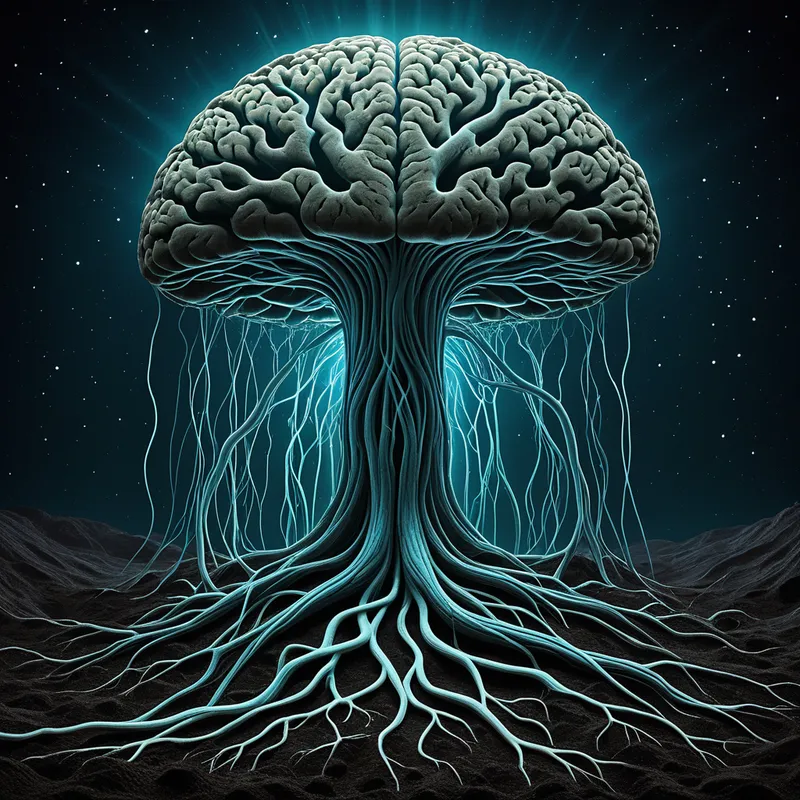
The alchemical journey mirrored in this myth is the [solve et coagula](/myths/solve-et-coagula “Myth from Alchemical culture.”/)—dissolve and coagulate—applied to the soul. The One-Who-Was-All undergoes the ultimate solve: the dissolution of its cosmic ego into the materia prima of the world. For the modern individual, this translates to the often-painful deconstruction of the [persona](/myths/persona “Myth from Greek culture.”/), the cherished self-image, and the conscious worldview. It is the “dark night of the soul,” where one feels scattered, lost, and bereft of previous certainties.
Individuation is not about rising above, but rooting through. The gold is found not in the sky, but in the humus of the abandoned self.
The seed’s journey to the world’s core is the descensus ad inferos—the descent into [the underworld](/myths/the-underworld “Myth from Greek culture.”/) of the personal and collective unconscious. This is the therapeutic, artistic, or meditative work of facing one’s shadows, complexes, and deepest fears. It is not a heroic conquest, but a patient, humble listening in the dark.
Finally, the growth of the Ancestral Root represents the coagula: the re-integration. From the dissolved state, a new, more resilient structure forms. This is the birth of the individuated Self, no longer a isolated spark, but a conscious node within a vast, living network. The individual realizes they are not, and never were, truly separate. Their personal life is nourished by and contributes to a transpersonal reality. Their unique existence becomes a tendril of the great Root, finding meaning not in personal glory, but in sustained connection, in becoming a vessel for the deep memory that seeks expression through all forms of life. The [triumph](/myths/triumph “Myth from Roman culture.”/) is not ascension, but embodiment; not sovereignty, but sacred service to the web of being.
Associated Symbols
Explore related symbols from the CaleaDream lexicon: