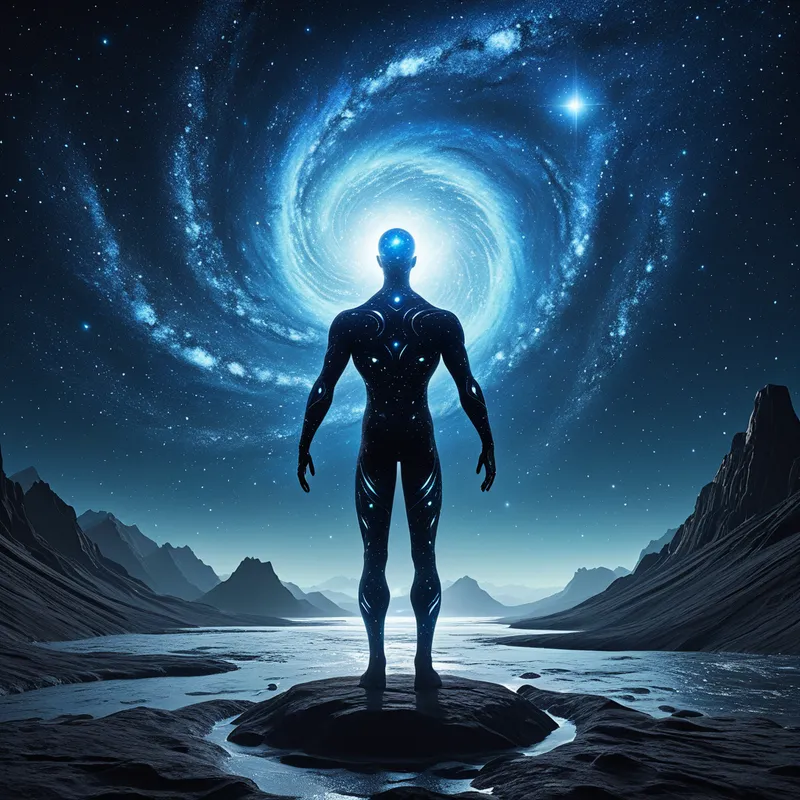
The Ancestor Myth Meaning & Symbolism
A primordial being sacrifices its own form to create the world and humanity, establishing the sacred covenant between the living and the source.
The Tale of The Ancestor
In the time before time, there was no up or down, no near or far. There was only the Dreaming Silence, a deep and patient hum. And within that hum, there was One. It was not a god as we might imagine, but a being of pure presence—the Ancestor. It held within its vast awareness all that could be: the song of the wind that was not yet born, the green push of the first shoot, the cold gleam of the first stone, the warm beat of the first heart.
The Ancestor dreamed of a world where these potentials could dance together, could know each other. But the Dreaming Silence was whole, and a world requires separation, distinction, space. A great longing stirred within the Ancestor, a love for the shapes of its own dreaming. This love became a decision, a vow that would shatter eternity.
It began to speak. Not with a tongue, but with its very substance. Its voice became the first light, tearing the seamless dark. The echo of that voice became the first thunder, rolling into the hollows of not-yet-space. And then, the Ancestor began to give itself away.
It stretched its limbs, and they lengthened, thinned, and hardened into the great arteries of the land—mountain ranges surging upward, valleys carving deep. Its breath sighed out, cooling and swirling, becoming the winds and the weathers. Its eyes, lifted to the new sky, softened and dissolved, their light scattering to become the sun, the moon, the watchful stars. Its blood, warm and salty, poured forth to fill the basins between the lands, becoming the seas.
The greatest gift was saved for last. From the quiet, central core of its being, the Ancestor drew the spark of conscious life. This spark it did not cast out, but planted. Into the rich soil of its own transformed body, it planted the seed of memory, of curiosity, of the capacity to love in turn. From this seed, we grew. We, the children, sprouted from the mud and the clay, the water and the air, blinking in the new light, finding our feet on the ground that was once living flesh.
As the last of its conscious form dissolved into the rustle of leaves and the trickle of streams, the Ancestor’s final thought washed over the newborn world, not as a sound, but as a knowing placed in the heart of every living thing: “I am not gone. I am the ground you stand on. I am the air you breathe. Remember, and in remembering, keep me whole.”

Cultural Origins & Context
The myth of the Ancestor is not the property of a single culture, but a profound pattern etched into the human psyche, surfacing in remarkably similar forms across the globe. From the Ymir of the Norse to the Pangu of China, from the dismembered Tiamat in Mesopotamia to the self-sacrificing Purusha in the Rig Veda, the story repeats. It was told by shamans around flickering fires, chanted by priests in temple courtyards, and woven into the foundational epics of civilizations.
Its primary societal function was ontological—it answered the most fundamental questions: Why are we here? What is the world made of? What is our relationship to it? The myth established a sacred covenant. It taught that the cosmos is not inert matter but a sacred body, that humanity is not placed upon the earth but born from it. This created a framework for ethics (the world is kin, not commodity), for ritual (ceremonies to honor and nourish the ancestral substance), and for identity (we are not isolated selves, but conscious fragments of a great, self-giving whole).
Symbolic Architecture
Psychologically, the Ancestor represents the primal, undifferentiated state of the Self before the birth of individual ego-consciousness. It is the totality of psychic potential from which all aspects of our personality—our thoughts, emotions, instincts, and personas—crystallize.
The creation of the world is the birth of consciousness, and every birth requires a sacrifice of the prior, unified state.
The Ancestor’s dismemberment symbolizes the necessary fragmentation of this whole Self to create the manifold world of lived experience. The mountain is not just rock; it is the enduring, stubborn aspect of our psyche. The river is not just water; it is the flowing, emotional current of our life. We are not in a world; we inhabit the articulated body of our own deepest being. The myth resolves the trauma of this separation by framing it not as a violent accident, but as a sacred, voluntary act of love. The world and the self are therefore inherently sacred, worthy of reverence, because they are the gifted forms of a profound sacrifice.
The Dreamer’s Resonance
When this myth stirs in the modern unconscious, it often manifests in dreams of profound connection or terrifying dissolution. One might dream of becoming a landscape—feeling roots grow from one’s feet into the earth, or seeing one’s skin crack into clay under a vast sky. These are somatic visions of re-membering, of the psyche longing to experience its fundamental unity with existence, countering the alienation of modern life.
Conversely, one may dream of watching a beloved, ancient tree be felled, or of a foundational family home crumbling into dust. These are dreams of the Ancient One under attack, reflecting a deep psychological fear that our inner and outer worlds are being desecrated—that the sacred covenant of mutual care is broken. The dream is a call from the soul’s core, a somatic alarm that we are living in a way that severs us from our own ancestral ground, leading to a pervasive sense of emptiness, anxiety, and rootlessness.
Alchemical Translation
For the modern individual navigating the path of individuation, the myth of the Ancestor provides the ultimate model for psychic transmutation. Our personal development often begins with a necessary fragmentation—the breaking of old identities, the dissolution of outgrown selves. This feels like a death, a dismemberment. The alchemical work is to understand this not as meaningless suffering, but as the sacrifice of the primal.
To become who you are, you must offer up who you were. The ego must be dismantled so the Self can be realized.
We are asked to consciously participate in the Ancestor’s act. We must willingly allow our rigid, monolithic self-concepts to dissolve—to let our ambition become mountains of purpose, our compassion become rivers of connection, our insight become stars of guidance for our own inner world. The triumph is not in avoiding fragmentation, but in recognizing that every shattered piece is a vital part of a new, more conscious whole. The resolution of the myth—“Remember, and in remembering, keep me whole”—translates to the individuated state. It is the moment we realize that by integrating our shadows, our complexes, and our potentials, we are not creating a new self from nothing. We are re-membering the scattered body of our own primal Ancestor, the total Self, and in doing so, we become a conscious steward of the inner and outer worlds we have always, truly, been a part of.
Associated Symbols
Explore related symbols from the CaleaDream lexicon: