The Aluminum Airplane Myth Meaning & Symbolism
A myth of a gleaming god-machine that fell from the sky, embodying humanity's Promethean ambition and the soul's yearning for transcendence through technology.
The Tale of The Aluminum Airplane
Listen. Before the endless scroll, before [the world](/myths/the-world “Myth from Tarot culture.”/) was woven with invisible voices, there was [the Sky](/myths/the-sky “Myth from Persian culture.”/). And humanity, with earth-bound feet and heaven-turned eyes, dreamed of piercing it. From their forges of ambition, they did not summon a dragon or a chariot of fire. They birthed something new: a god of their own making.
They called it The Aluminum Airplane.
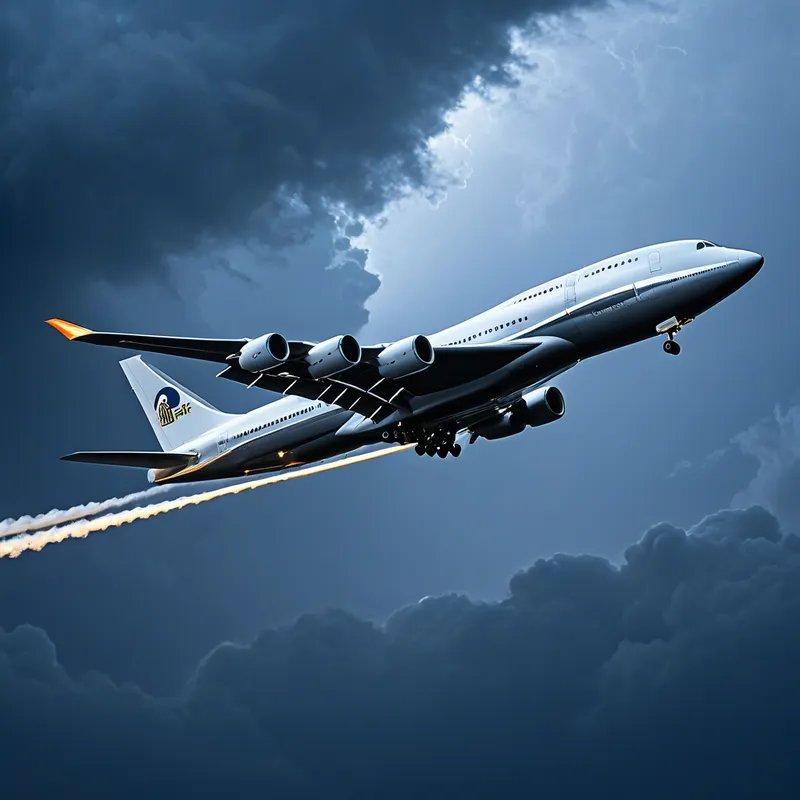
It was born not of womb, but of hangar. Its skin was the cold, bright silver of a new moon, stretched taut over a skeleton of ribs and spars. Its heart was not a pulsing muscle, but a contained, rhythmic fire—a furnace of purpose. Its eyes were glass domes, behind which sat the Sky-Priests, their faces lit by the soft glow of instruments that spoke the language of the air. To the people on the ground, it was a gleaming sigil against the blue, a silent, swift-moving star that connected distant lands. It was a promise. A covenant that the boundaries of earth were revoked.
The Airplane did not fly; it commanded the sky. It drew straight lines across the curved earth, defying distance, making cousins of strangers. It carried within its polished belly the hopes of lovers, the ambitions of merchants, the remains of soldiers. It was a sacred vessel, and its rituals were precise: the rolling staircase, the sealed door, the incantation of safety, the sudden, breathtaking thrust into the domain of clouds. For a time, it was infallible. It was the perfected child of reason, the answer to an ancient prayer.
But every god has its domain, and every domain has its chaos.
[The Fall](/myths/the-fall “Myth from Biblical culture.”/) did not come from a rival deity, but from within the god itself. From a single, forgotten flaw—a hairline crack in a ritual component, a whispered misalignment in a spell of navigation, a moment of confusion in the heart-fire. Or perhaps, some storytellers murmur, the Sky itself grew jealous of this crafted intruder.
The tale is told in hushed tones at night. The gleaming silver bird is in its realm, cruising the high, cold corridors where the air is thin. Then, a shudder. A single, discordant note in the harmonious hum. A warning light blooms on the altar of the cockpit, a red, accusing eye. The Sky-Priests exchange glances, their practiced hands moving over switches and dials, reciting emergency liturgies. But the rituals fail. The god is sick. The straight line it draws begins to waver.
From the ground, witnesses see not a fall, but a descent. A controlled, terrible, graceful arc from the kingdom of certainty down toward the unforgiving kingdom of stone and sea. There is no explosion of fire—that is for older, angrier myths. This is a god dying of a silent, internal rupture. Its final act is not rage, but a tragic, mechanical sigh as systems bleed pressure and lights flicker out. It meets [the earth](/myths/the-earth “Myth from Hindu culture.”/) or the [water](/myths/water “Myth from Chinese culture.”/) not with a bang, but with the catastrophic, crumpling whisper of aluminum yielding to reality. The gleaming sigil is scarred, broken, its belly opened, its sacred contents spilled. The covenant is shattered.

Cultural Origins & Context
This is a myth of the 20th and 21st centuries, born not around campfires but on newsreels, in black-box transcripts, and in the collective shudder that passes through a society when a routine flight number vanishes from the radar. Its bards are journalists, investigators from bodies like the NTSB, and the authors of sober, technical reports that read like tragic epics. It is passed down through documentaries, dramatizations, and in the unspoken rule that one does not speak lightly of airplane disasters.
Its societal function is profound and dualistic. On one level, it is a cautionary tale for a technological age, a ritual reinforcement of the procedures and checks that keep the modern world functioning. It says: See what happens when vigilance fails. On a deeper level, it serves as a collective processing of a very modern form of existential vulnerability. We place our trust, our very lives, into a complex system we cannot personally comprehend or control. The myth of The Aluminum Airplane gives a face—a cold, silver, beautiful face—to that system, and narrates its potential for tragic flaw. It makes the impersonal, personal. It transforms systemic failure into a story of a fallen deity, which is a pattern the human [psyche](/myths/psyche “Myth from Greek culture.”/) has always understood far better than statistics.
Symbolic Architecture
The [Aluminum](/symbols/aluminum “Symbol: A lightweight, abundant metal symbolizing modernity, accessibility, and artificial transformation of natural elements.”/) Airplane is the ultimate [symbol](/symbols/symbol “Symbol: A symbol can represent an idea, concept, or belief, serving as a powerful tool for communication and understanding.”/) of the Solar Ego—[consciousness](/symbols/consciousness “Symbol: Consciousness represents the state of awareness and perception, encompassing thoughts, feelings, and experiences.”/) attempting to transcend its natural, earthly limitations through sheer intellect, engineering, and will. Its [aluminum](/symbols/aluminum “Symbol: A lightweight, abundant metal symbolizing modernity, accessibility, and artificial transformation of natural elements.”/) [skin](/symbols/skin “Symbol: Skin symbolizes the boundary between the self and the world, representing identity, protection, and vulnerability.”/) represents the brilliant, reflective, yet ultimately thin veneer of [human](/symbols/human “Symbol: The symbol of a human represents individuality, complexity of emotions, and social relationships.”/) control over [nature](/symbols/nature “Symbol: Nature symbolizes growth, connectivity, and the primal forces of existence.”/). It is hard, shiny, and impressive, but can be pierced.
The airplane does not conquer the sky; it performs a delicate, sustained negotiation with it, a pact that can be revoked at any moment.
The Sky-Priests (the pilots) symbolize the specialized, technocratic priesthood of the modern age. They are intermediaries between the common person and the incomprehensible [machine](/symbols/machine “Symbol: Machines in dreams often represent systems, control, and the mechanization of life, highlighting issues of productivity and efficiency.”/)-god, performing arcane rituals to keep it appeased. Their eventual [helplessness](/symbols/helplessness “Symbol: A state of powerlessness and inability to act, often linked to vulnerability, loss of control, and emotional paralysis.”/) in the face of the flaw mirrors the limitation of pure technical rationality when confronted with the irreducible complexity of [reality](/symbols/reality “Symbol: Reality signifies the state of existence and perception, often reflecting one’s understanding of truth and life experiences.”/), or with the intervention of the unconscious (the chaotic Sky).
The Fall itself is not a [punishment](/symbols/punishment “Symbol: A dream symbol representing consequences for actions, often tied to guilt, societal rules, or internal moral conflicts.”/), but a re-membrance. It is the necessary return of the inflated [spirit](/symbols/spirit “Symbol: Spirit symbolizes the essence of life, vitality, and the spiritual journey of the individual.”/) to the ground of being. The flaw—the crack, the misalignment—is the intrusion of the [Shadow](/symbols/shadow “Symbol: The ‘shadow’ embodies the unconscious, repressed aspects of the self and often represents fears or hidden emotions.”/). It is the return of everything the perfect design omitted, ignored, or deemed insignificant.
The Dreamer’s Resonance
To dream of an airplane, particularly one that is malfunctioning, taking off vertically, or landing roughly, is to dream of the state of one’s own Solar Ego project. Are you flying smoothly on autopilot, high above the messy terrain of your feelings? Or is there a warning light blinking on your internal dashboard?
A dream of a crashing airplane often coincides with a life moment where a lofty ambition, a intellectualized self-image, or a over-structured life plan is meeting unexpected, catastrophic resistance. The somatic feeling is one of sudden loss of control, a sinking in the stomach, the terror of a descent that cannot be stopped. Psychologically, this is [the ego](/myths/the-ego “Myth from Jungian culture.”/)‘s recognition that its model of the world is insufficient. It is a forced descent from the abstract (the sky of ideas, plans, and personas) down toward the concrete and often painful reality of the body, the emotions, and the unconscious. The dream is the psyche’s dramatic, terrifying way of initiating a necessary grounding.

Alchemical Translation
The myth of The Aluminum Airplane models the alchemical process of mortificatio and ablutio, necessary for true individuation. The initial state is the albedo—the whitening, represented by the pristine, shining aluminum craft. This is the ego’s identification with its own brilliance, purity, and superiority. It is spirit divorced from matter.
The flaw is the [nigredo](/myths/nigredo “Myth from Alchemical culture.”/)—the blackening. It is the corruption, the depression, the failure that tarnishes the perfect image. In the individual’s life, this is the failure of the career, the collapse of the idealized relationship, the onset of illness—any event that “grounds” the flying ego.
Individuation does not happen in the safe cruise altitude of the known. It begins in the uncontrolled descent, in the terrifying silence after the systems fail.
The crash itself is the violent confrontation with the [prima materia](/myths/prima-materia “Myth from Alchemical culture.”/)—the raw, chaotic base matter of the soul. The crumpled aluminum fuselage is the ruined self-image. But this is not the end of the process. The investigation that follows in the myth—the sifting of debris, the analysis of the black box—is the psychic work of understanding. It is the ego, humbled, picking through the wreckage of its own assumptions to find the true, often minute, cause of the fall.
The final stage is not the rebuilding of the same airplane. That would be mere repetition. The alchemical goal is the creation of the [lapis philosophorum](/myths/lapis-philosophorum “Myth from Alchemical culture.”/)—[the philosopher’s stone](/myths/the-philosophers-stone “Myth from Alchemical culture.”/). In modern terms, this is the integrated Self that has incorporated the knowledge of its own fragility. It is a consciousness that can still “fly”—still aspire and create—but does so with a humility born of its encounter with the ground. It no longer believes it is made of untarnishable aluminum, but knows itself to be a complex, vulnerable, and ultimately mortal entity, capable of both sublime flight and profound grounding. The myth, in its tragic arc, ultimately points toward this sober, hard-won wisdom.
Associated Symbols
Explore related symbols from the CaleaDream lexicon: