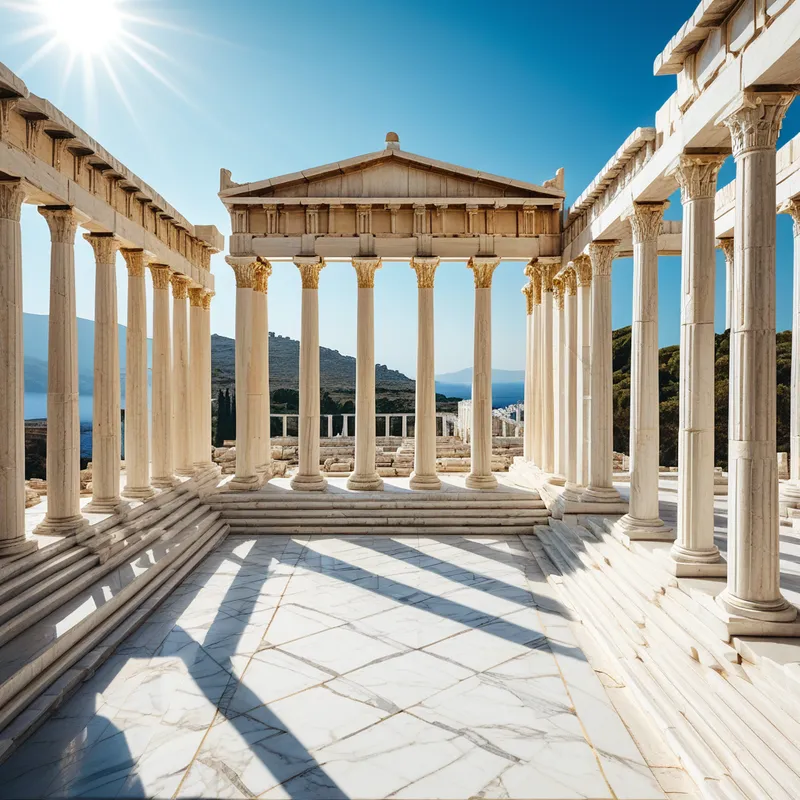
The Agora Myth Meaning & Symbolism
The myth of the sacred marketplace where divine order and human chaos met to forge the first society, a crucible of speech, exchange, and soul.
The Tale of The Agora
Listen, and hear the tale not of a hero, but of a space. Before the first city, there was only the scatter of huts, the lonely hearth, and the suspicion in a neighbor’s eye. Words were barbs or flatteries, trade was a wary clutch of goods in the forest gloom, and [justice](/myths/justice “Myth from Tarot culture.”/) was the sharp, hot law of the stronger arm. [The world](/myths/the-world “Myth from Tarot culture.”/) was a field of isolated sparks, each dying in its own small darkness.
Then came the whisper on [the wind](/myths/the-wind “Myth from Various culture.”/), not from one god, but from the very breath of order itself. It stirred in the heart of Zeus, who saw the chaos and knew it could not stand. It echoed in the shrewd mind of [Hermes](/myths/hermes “Myth from Global/Universal culture.”/), the patron of thresholds and tricksters. And it settled in the stern gaze of Athena, she who sprung fully formed from the divine mind. Together, they did not send a monster or a flood. They dreamed a place into the world.
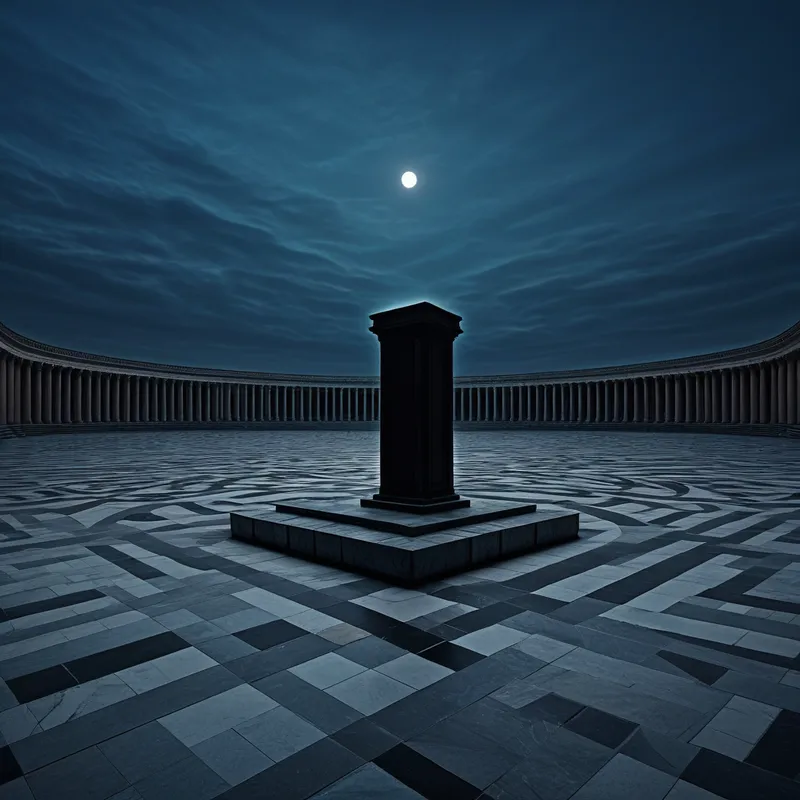
On a sun-baked plain between hill and shore, where paths naturally crossed, the air began to hum. The scent of [thyme](/myths/thyme “Myth from Greek culture.”/) and dry earth was joined by the scent of possibility. First, they set the boundary stone, imbued by Hermes with the unspoken law: within this circle, your dagger stays sheathed, your wrath is cooled to words. Then, Athena caused a simple, flat stone to rise from [the earth](/myths/the-earth “Myth from Hindu culture.”/)—the bema, the speaker’s platform. To stand upon it was to be granted a voice that all must hear, a fragment of divine clarity.
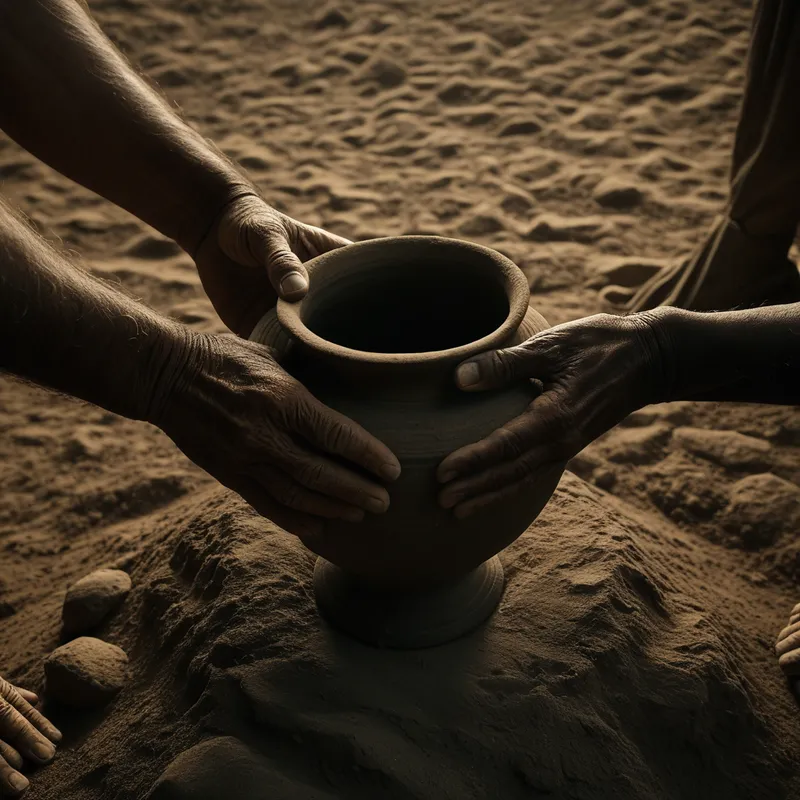
The people came, drawn by a pull they could not name. At first, they stood at the edges, clutching their wares—a clay pot, a bundle of wool, a bronze blade. Silence reigned, thick with old grievances and fear. Then, a farmer, wronged by a stronger man, felt the stone pull at his feet. Trembling, he stepped onto the bema. His voice, usually a rough grunt, emerged clear. He spoke not of violence, but of the stolen goat, the trampled field. The accused, compelled by the sacred space, mounted the stone beside him. And there, before the gathered eyes, the first argument was made. Not with fists, but with reasons. The crowd murmured, became jury. A judgment was spoken, and a measure of grain changed hands as restitution.
This was the magic. The Agora was born. Soon, the space brimmed with a sacred cacophony: the clink of obols against scale, the rhythmic cadence of a poet reciting tales of heroes, the heated debate over the building of a wall, the smell of roasting meat from vendor’s stalls mingling with incense from a small altar to [Hestia](/myths/hestia “Myth from Global/Universal culture.”/). It was a living organism. The isolated sparks had been gathered, and in their meeting, they kindled a new fire—the fire of the polis, the city-soul. The conflict was not slain; it was invited in, given a stage, and transformed into the stuff of society itself.
Cultural Origins & Context
The myth of the Agora is not found in a single epic like the Iliad. It is a foundational myth written in stone and daily practice, emerging from the very heart of the Greek polis from the 8th century BCE onward. Its “bards” were the city planners, the lawmakers like Draco and Solon, and the philosophers who would later walk its porticoes.
Its societal function was paramount. The Agora was the physical and symbolic center of Athenian life—marketplace, political forum, religious precinct, and social hub. The myth surrounding its divine inauguration served to sanctify this human invention. It declared that commerce, debate, and collective decision-making were not merely practical affairs but activities under the direct patronage of the gods, particularly Hermes (god of trade and communication) and Athena (goddess of wisdom and the city). This sacred framing elevated the messy business of human interaction to a cosmic principle, encouraging participation and enforcing the social contract through divine awe.
Symbolic Architecture
The Agora is the archetypal [vessel](/symbols/vessel “Symbol: A container or structure that holds, transports, or protects something essential, representing the self, emotions, or life journey.”/) of the vas, the container. Its primary [symbol](/symbols/symbol “Symbol: A symbol can represent an idea, concept, or belief, serving as a powerful tool for communication and understanding.”/) is not an object, but a bounded [space](/symbols/space “Symbol: Dreaming of ‘Space’ often symbolizes the vastness of potential, personal freedom, or feelings of isolation and exploration in one’s life.”/). The [boundary](/symbols/boundary “Symbol: A conceptual or physical limit defining separation, protection, or identity between entities, spaces, or states of being.”/) stones (hermai) represent the crucial psychological act of creating a [temenos](/myths/temenos “Myth from Greek culture.”/)—a sacred precinct within the [psyche](/myths/psyche “Myth from Greek culture.”/) where normally warring elements agree to a temporary truce.
The Agora is the psyche’s parliament, where the disparate voices of the soul are granted a recognized seat and a lawful voice.
The bema, the [speaker](/symbols/speaker “Symbol: A speaker often represents communication, self-expression, and the conveying of ideas or emotions.”/)’s [stone](/symbols/stone “Symbol: In dreams, a stone often symbolizes strength, stability, and permanence, but it may also represent emotional burdens or obstacles that need to be acknowledged and processed.”/), symbolizes the [emergence](/symbols/emergence “Symbol: A process of coming into being, rising from obscurity, or breaking through a barrier, often representing birth, transformation, or revelation.”/) of conscious articulation. It represents [the ego](/myths/the-ego “Myth from Jungian culture.”/)’s [capacity](/symbols/capacity “Symbol: A measure of one’s potential, limits, or ability to contain, process, or achieve something, often reflecting self-assessment or external demands.”/) to step forward, to give form to the clamor of complexes, desires, and fears, and to present them to the inner [community](/symbols/community “Symbol: Community in dreams symbolizes connection, support, and the need for belonging.”/) for witness. The bustling exchange of goods mirrors the internal exchange of psychic [energy](/symbols/energy “Symbol: Energy symbolizes vitality, motivation, and the drive that fuels actions and ambitions.”/)—libido moving from one complex to another, transforming raw instinct (the [clay pot](/symbols/clay-pot “Symbol: Clay pots symbolize creativity, fertility, and the process of nurturing life through crafting and tending to one’s environment.”/), the raw [wool](/symbols/wool “Symbol: A natural fiber representing warmth, protection, and connection to tradition. Often symbolizes comfort, labor, or spiritual purity.”/)) into valued meaning (the traded coin, the crafted garment).
The divine patrons are internal archetypes: Zeus provides the initial [impulse](/symbols/impulse “Symbol: A sudden, powerful urge or drive that arises without conscious deliberation, often linked to primal instincts or emotional surges.”/) for order; Hermes facilitates the exchange and the setting of inner boundaries; Athena grants the capacity for wise judgment and the [architecture](/symbols/architecture “Symbol: Architecture in dreams often signifies structure, stability, and the framing of personal identity or life’s journey.”/) of a coherent self.

The Dreamer’s Resonance
To dream of an Agora is to dream of a critical phase of inner integration. A vast, empty Agora suggests a psyche yearning for, or avoiding, this necessary congress. The dreamer may feel isolated in their thoughts, unable to connect internal parts or communicate needs effectively.
A bustling, chaotic Agora where one is lost or cannot find a voice points to the overwhelm of competing inner demands—the critic, [the child](/myths/the-child “Myth from Alchemy culture.”/), the achiever, the lover—all shouting without a bema from which to speak orderly. Dreaming of standing on the bema but being mute signifies a blocked capacity for self-expression or fear of one’s own authority. Conversely, speaking clearly from it heralds a moment of powerful self-advocacy or clarity.
Somatically, this process can feel like a gathering tension in the chest or throat—the pressure of unspoken truths—before a release into a more regulated, “circulatory” state where energy (breath, voice, feeling) moves freely again. The dream-Agora is the psyche building its own container for the alchemy of selfhood.
Alchemical Translation
The myth of the Agora models the individuation process as the construction of an internal civic space. The initial state is massa confusa—the scattered huts of disparate impulses and unintegrated complexes.
Individuation is not the silencing of the inner crowd, but the development of a just and spacious polity to hear it.
The first alchemical operation is circumscriptio (circumscription), mirrored by the setting of the boundary stone. The ego must define a conscious space, a “working area” within [the self](/myths/the-self “Myth from Jungian culture.”/), separate from the undifferentiated unconscious. This is the commitment to self-observation.
The second operation is sublimatio (sublimation), embodied by the bema. Raw, base emotions (rage, envy, desire) are raised up onto the platform of consciousness. They are not acted out blindly but are given voice, examined, and thereby transformed into usable psychological material—the “currency” of self-knowledge.
The constant exchange in the marketplace is the circulatio, the circulation of psychic energy. Insights from one area (a memory, a dream) are traded for understanding in another (a relationship pattern, a professional block). The divine patrons represent the transcendent function—Zeus the drive toward wholeness, Hermes the mediating symbol, Athena the synthesizing insight—that guides this process.
The final result is not a silent, monolithic self, but a vibrant, well-governed inner polis. Conflict and diversity remain, but they have become the engines of a dynamic, adaptive, and coherent identity. The individual becomes, like the Agora itself, a sacred container where the chaos of human experience is perpetually transmuted into the gold of meaningful life.
Associated Symbols
Explore related symbols from the CaleaDream lexicon: