The Agony in the Garden Myth Meaning & Symbolism
A solitary figure wrestles with divine destiny under ancient olive trees, embodying the ultimate human struggle between will and surrender.
The Tale of The Agony in the Garden
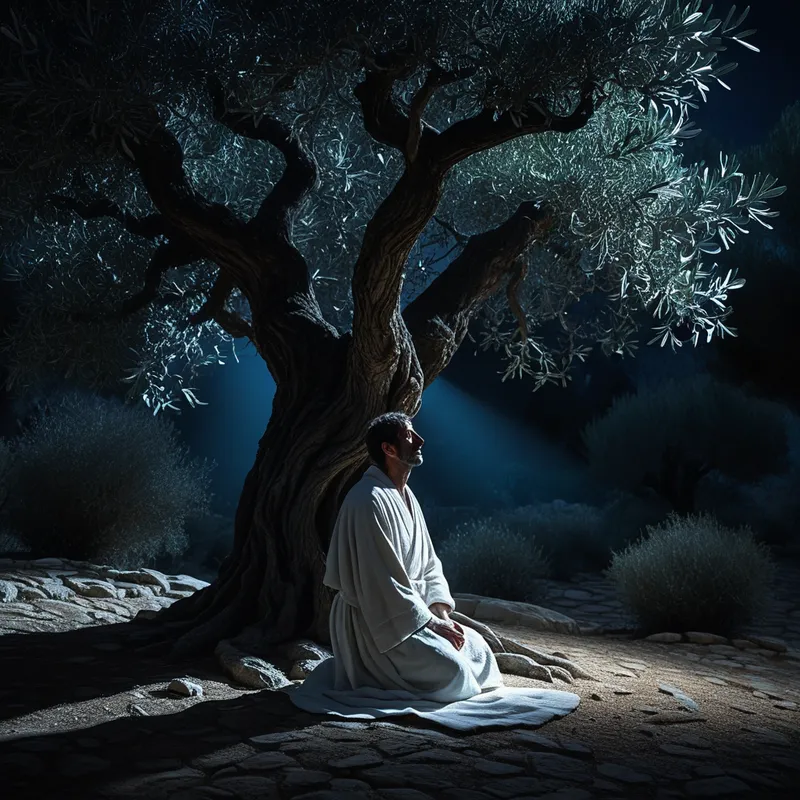
The night was a cloak of cold velvet, pierced only by the indifferent silver of a waning moon. Beyond the city walls, in a place of ancient, gnarled olive trees known as [Gethsemane](/myths/gethsemane “Myth from Christian culture.”/), a man walked with heavy steps. His name was [Jesus of Nazareth](/myths/jesus-of-nazareth “Myth from Christian culture.”/), and the weight upon him was not of this earth. It was the weight of a story hurtling toward its brutal, pre-ordained end.
He left his closest companions—[Peter](/myths/peter “Myth from Biblical culture.”/), James, and John—with a plea that echoed with a loneliness so vast it chilled the air. “My soul is overwhelmed with sorrow to the point of death. Stay here and keep watch.” Then he went a little farther, until the shadows of the ancient trees swallowed him whole. The ground was hard, the stones sharp. He fell to his knees, then onto his face, pressing his forehead into the cool, unyielding earth.
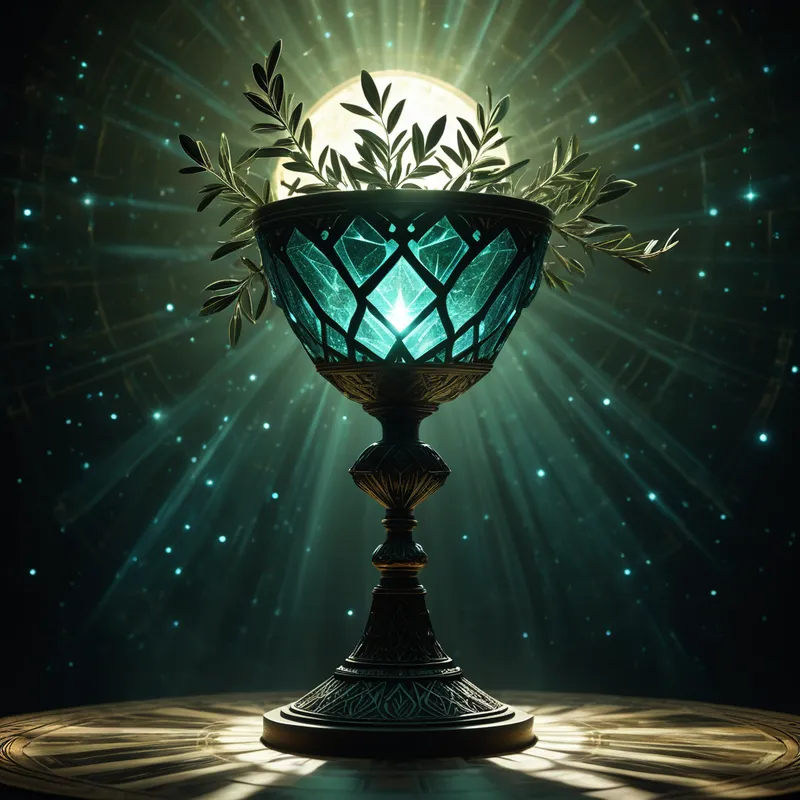
And there, in that sacred solitude, the storm broke. “Abba, Father,” he cried out, his voice a raw tear in the fabric of the night. “Everything is possible for you. Take this cup from me.” The cup—it was not of wine, but of a coming torrent: of betrayal, of scourging, of the cruel wood of the cross, of a suffocating abandonment. He could taste its bitterness on his tongue, a metallic dread. His human heart recoiled, screaming for another path, any path but this.
The conflict was not with an external enemy, but with the very fabric of his own being. The sweat on his brow grew thick, falling to the dark soil not as mere perspiration, but as great drops of blood—a somatic testament to a [psyche](/myths/psyche “Myth from Greek culture.”/) under impossible pressure. He returned to his friends, seeking a sliver of human solace, and found them asleep, their spirits willing but their flesh achingly weak. The isolation deepened.
Three times he prayed. Three times he returned to find his human anchors adrift in slumber. And with each return to prayer, a subtle, terrible shift occurred. The plea did not vanish, but it was joined, then overtaken, by another force. The raw terror began to be woven with threads of a surrender so complete it became a kind of power. “Yet not what I will,” the words finally formed, a whisper that carried the gravity of a world, “but what you will.”
When he rose from the ground for the last time, his face was etched with a profound exhaustion, but his step held a new, grim resolution. The inner war was over. The surrender was absolute. The peace that followed was not the absence of torment, but the stillness found in its very eye. He woke his disciples gently. “Rise! Let us go! Here comes my betrayer.” And into the garden marched the torchlight and the swords, led by the kiss of a friend. The hero walked toward them, not away, having drunk the first, most bitter draft of the cup in the silent company of the olives and [the moon](/myths/the-moon “Myth from Tarot culture.”/).
Cultural Origins & Context
This story is anchored in the Gospel narratives of Matthew, Mark, and Luke, written in the decades following [Jesus](/myths/jesus “Myth from Christian culture.”/)‘s death. It served a critical function for early Christian communities facing persecution and existential dread. This was not a story of a stoic, unmoved god, but of a figure who fully entered the human condition of terror, loneliness, and the desperate desire to avoid suffering.
Told and retold in clandestine house churches and later in majestic cathedrals, the Agony provided a sacred template for understanding profound inner crisis. It answered the unspoken question: “If our master felt this, what does that mean for our own despair?” It legitimized spiritual struggle, framing it not as a failure of faith, but as its necessary prelude. The story was passed down as the ultimate model of discernment, showing that true obedience is not blind submission, but a choice forged in the fire of honest confrontation with one’s deepest fears.
Symbolic Architecture
The Garden of Gethsemane is itself a profound [symbol](/symbols/symbol “Symbol: A symbol can represent an idea, concept, or belief, serving as a powerful tool for communication and understanding.”/). Its name means “oil press.” Here, the [soul](/symbols/soul “Symbol: The soul represents the essence of a person, encompassing their spirit, identity, and connection to the universe.”/) of the [hero](/symbols/hero “Symbol: A hero embodies strength, courage, and the ability to overcome significant challenges.”/) is pressed, like an olive, between the millstones of divine will and [human](/symbols/human “Symbol: The symbol of a human represents individuality, complexity of emotions, and social relationships.”/) instinct, to yield the oil of anointment for a sacred, sacrificial [purpose](/symbols/purpose “Symbol: Purpose signifies direction, meaning, and intention in life, often reflecting personal ambitions and core values.”/).
The cup is not merely a fate to be drunk, but the concentrated essence of the Self one is asked to become. To refuse it is to remain fragmented; to accept it is to consent to wholeness, however painful its forging.
The sleeping disciples represent the parts of our own psyche—our supportive ego structures, our good intentions—that inevitably fail us at the critical [hour](/symbols/hour “Symbol: Represents the measurement and passage of time, often symbolizing urgency, mortality, or a specific moment of significance.”/) of our deepest transformation. They cannot accompany us all [the way](/myths/the-way “Myth from Taoist culture.”/) into the dark [night](/symbols/night “Symbol: Night often symbolizes the unconscious, mystery, and the unknown, representing the realm of dreams and intuition.”/) of the soul. We must go on alone. The “sweat like great drops of [blood](/symbols/blood “Symbol: Blood often symbolizes life force, vitality, and deep emotional connections, but it can also evoke themes of sacrifice, trauma, and mortality.”/)” is the ultimate symbol of psychosomatic unity, where an inner conflict becomes so intense it manifests physically, breaking the arbitrary [barrier](/symbols/barrier “Symbol: A barrier symbolizes obstacles, limitations, and boundaries that prevent progression in various aspects of life.”/) between mind and [body](/symbols/body “Symbol: The body in dreams often symbolizes the dreamer’s self-identity, personal health, and the relationship they have with their physical existence.”/), [spirit](/symbols/spirit “Symbol: Spirit symbolizes the essence of life, vitality, and the spiritual journey of the individual.”/) and matter.
The Dreamer’s Resonance
When this myth stirs in the modern unconscious, it often manifests in dreams of excruciating decision-making. The dreamer may find themselves paralyzed before a doorway, unable to move forward or back. They may be holding a heavy, ominous object (a cup, a stone, a book) they are compelled to carry but desperately wish to put down. There is a palpable atmosphere of being watched, of a deadline approaching, coupled with a feeling of profound isolation—friends in the dream are absent, asleep, or turned away.
Somatically, this is the psyche processing what psychologist Carl Jung called the “numinous,” an overwhelming encounter with a transpersonal reality that shatters comfortable ego boundaries. The dreamer is in the grip of a necessary but terrifying evolution. The agony is the somatic signature of the old self dying—the anxiety, the insomnia, the feeling of being pressed upon from all sides. The dream is not a prophecy of doom, but a map showing the dreamer they are in the garden phase: the crisis before [the crucible](/myths/the-crucible “Myth from Alchemical culture.”/).
Alchemical Translation
In the alchemy of individuation, The Agony in the Garden represents the stage of [nigredo](/myths/nigredo “Myth from Alchemical culture.”/). It is the necessary descent into the blackness, the confrontation with [the shadow](/myths/the-shadow “Myth from Jungian culture.”/) of one’s own destiny. The conscious ego (Jesus as the aware self) must engage in a brutal dialogue with [the Self](/myths/the-self “Myth from Jungian culture.”/) (the Abba), represented by the prayer.
The transmutation occurs not in the removal of the cup, but in the change of the prayer. The movement from “Take this from me” to “Your will be done” is the precise moment of alchemical conversion. The lead of personal fear is not discarded; it is embraced as the essential ingredient for making the gold of authentic being.
The hero archetype here completes its most critical, least glamorous task: not slaying [the dragon](/myths/the-dragon “Myth from Chinese culture.”/), but surrendering to a process larger than victory or defeat. For the modern individual, this myth models that our deepest transformations are never merely chosen; they are consented to. We do not heroically conquer our fate; we kneel before it, wrestle with it, and in the exhausted aftermath of that struggle, find the strength to say “yes.” This “yes” is the birth of a consciousness that has looked into [the abyss](/myths/the-abyss “Myth from Kabbalistic culture.”/) of its own will and chosen to align with a pattern of meaning beyond it. The garden is where the [persona](/myths/persona “Myth from Greek culture.”/) is shattered, so the individual may begin to be born.
Associated Symbols
Explore related symbols from the CaleaDream lexicon: