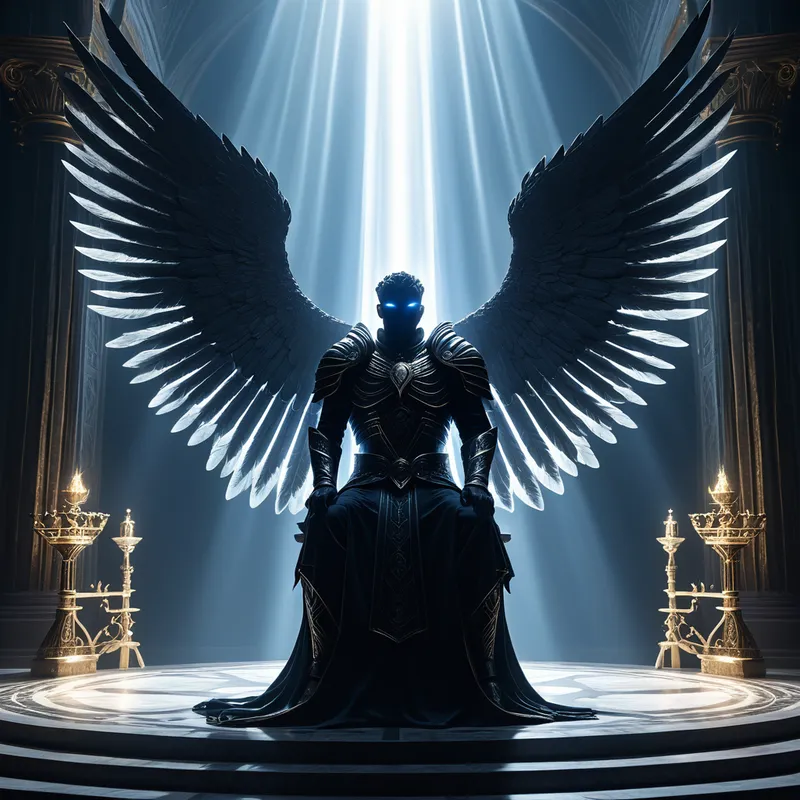
The Accuser Myth Meaning & Symbolism
The celestial prosecutor who stands before the divine throne, accusing humanity of its failings, embodying the shadow of judgment and the call to self-witness.
The Tale of The Accuser
Before [the world](/myths/the-world “Myth from Tarot culture.”/) was worn smooth by time, in the courts beyond [the veil](/myths/the-veil “Myth from Various culture.”/) of sky, there was a throne. Not of gold or jewel, but of a light so pure it was both a presence and a song. Around it, the host of heaven moved in silent, radiant orbits. And before it, there stood one apart.
He was called Ha-Satan, the Adversary. Not a creature of darkness, but a being of piercing, cold luminescence. His wings were not for flight, but for framing—a vast, dark tapestry against the eternal light, casting the only shadow in that place of perfect radiance. His eyes were like polished hematite, reflecting not images, but the unadorned truth of things. He was the Keeper of the Record, the Scrivener of the Soul.
His task was to walk to and fro upon [the earth](/myths/the-earth “Myth from Hindu culture.”/), and up and down in it. Not with malice, but with a dreadful, meticulous attention. He listened to the boasts of kings and the whispered doubts of shepherds. He noted the broken promise, the hidden envy, the charity given for praise. He collected them not as sins, but as facts—each one a weight, a deviation from the celestial chord.
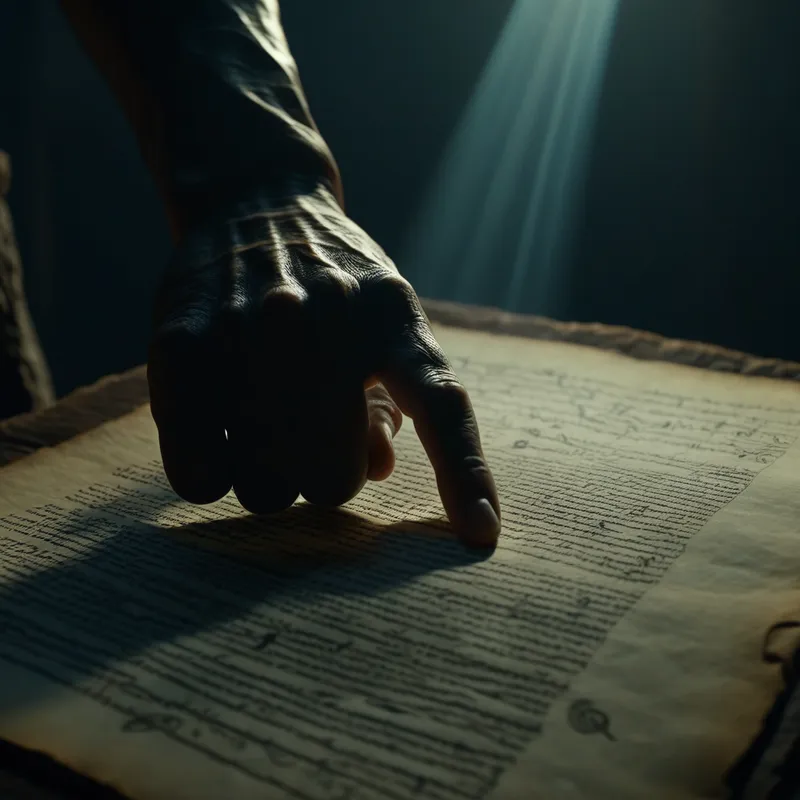
Then, he would return. The court would fall into a silence deeper than silence. The Adversary would approach the steps of the throne, and from within his form, he would draw forth scrolls that were not parchment, but condensed memory and intent. His voice, when it came, was the sound of a door closing in a distant, empty hall.
“Consider my servant Job,” the voice would intone. “Does he fear you for nothing? Have you not built a hedge around him? But stretch out your hand now, touch all that he has, and he will curse you to your face.”
Or, pointing to Joshua, standing in soiled garments before the angel of the Lord: “See him, clad in the filth of his people’s failure. Is this one fit to serve?”
His accusations were not lies. They were the unbearable, unedited testimony of what is against the dream of what could be. He was the cosmic prosecutor, and the whole of humanity stood as the defendant. The air in the court would grow heavy, charged with a terrible potential. Would the throne answer? Would the light condemn? The drama hung on a razor’s edge, in the space between the accusation and the verdict—a space where grace, or ruin, might be born.
Cultural Origins & Context
The figure of The Accuser emerges from the rich, complex soil of Second Temple Judaism, a period of intense theological refinement and cosmic storytelling. He is not a product of later Christian demonology, but a profound and ambiguous entity from the Hebrew scriptures, most prominently in the books of Job and [Zechariah](/myths/zechariah “Myth from Christian culture.”/).
Here, Satan is not the lord of hell, but a member of the divine council, the Benei Elohim. His title is a function, not a name: the satan, the accuser or obstructer. He served a critical societal and theological function for a people wrestling with the problem of evil and the nature of righteousness. In a worldview moving toward a more transcendent and singular God, the Accuser became a narrative device—a way to explore why bad things happen to good people without attributing cruelty directly to the Divine. He was the prosecutor in the courtroom of the cosmos, ensuring that easy piety was tested, and that righteousness was a substance proven, not a surface declared.
These stories were told by priests and scribes, woven into the wisdom literature that sought to make sense of human suffering and moral failure. The Accuser was the embodiment of the searching, uncomfortable question in the face of simple faith. He was [the shadow](/myths/the-shadow “Myth from Jungian culture.”/) of divine [justice](/myths/justice “Myth from Tarot culture.”/) itself, the necessary rigor that precedes mercy.
Symbolic Architecture
Psychologically, The Accuser represents the archetypal principle of critical discernment divorced from [compassion](/symbols/compassion “Symbol: A deep feeling of empathy and concern for others’ suffering, often involving a desire to help or alleviate their pain.”/). He is the hyper-developed, personified superego—the internalized voice of law, precedent, and judgment.
He is not the enemy of the soul, but the enemy of its illusions. His function is to shatter the persona, the curated mask of righteousness, so that the raw, authentic self may be brought before the light.
He symbolizes the ruthless inner critic that catalogs every failure, the [shadow](/symbols/shadow “Symbol: The ‘shadow’ embodies the unconscious, repressed aspects of the self and often represents fears or hidden emotions.”/) of our own conscience that knows our secret hypocrisies. His celestial setting is crucial: he operates not in a pit of fire, but in the highest court. This tells us that self-[accusation](/symbols/accusation “Symbol: A formal or informal charge of wrongdoing, often implying guilt, blame, or responsibility placed upon the dreamer or another figure.”/), the confrontation with our [shadow](/symbols/shadow “Symbol: The ‘shadow’ embodies the unconscious, repressed aspects of the self and often represents fears or hidden emotions.”/), is not a lowly or evil process, but a sacred, if terrifying, one. It is the necessary prelude to any genuine transformation. The scrolls he carries are the unvarnished record of our psychic [life](/symbols/life “Symbol: The symbol of ‘Life’ represents a journey of growth, interconnectedness, and existential meaning, encompassing both the joys and challenges that define human experience.”/)—all the repressed thoughts, unacknowledged motives, and broken promises to ourselves that we work so hard to forget.

The Dreamer’s Resonance
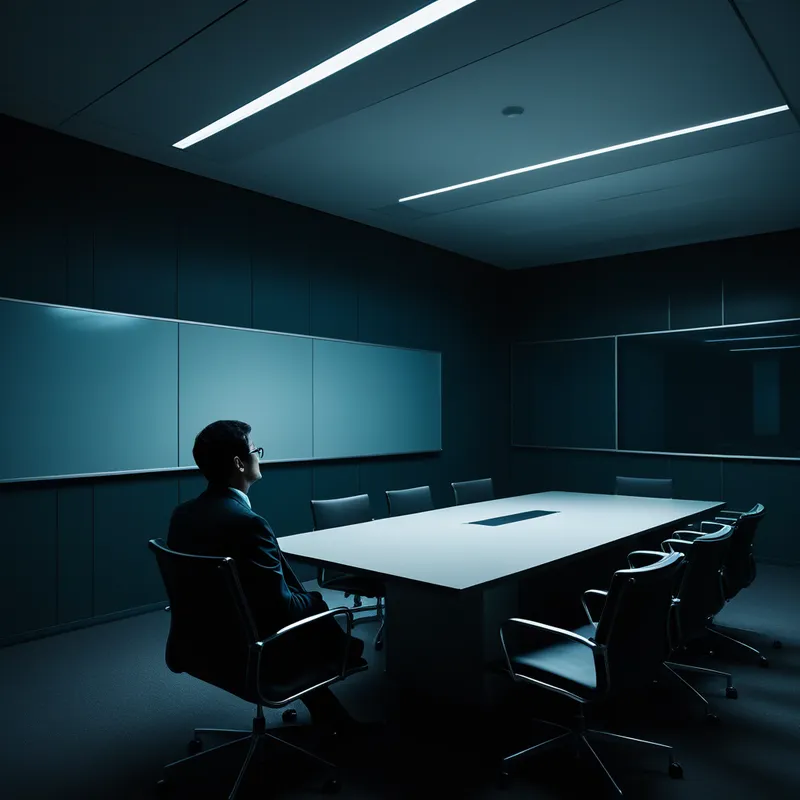
When this myth stirs in the modern unconscious, it often manifests in dreams of being on trial. The dreamer may find themselves in a stark, formal room—a courtroom, a dean’s office, a corporate boardroom—facing a faceless tribunal or a single, imposing judge. The charges are vague but feel utterly damning. Key evidence, often mundane objects from daily life, is presented as proof of profound failing.
Somatically, this dream pattern correlates with a process of intense self-scrutiny and psychic integration. [The ego](/myths/the-ego “Myth from Jungian culture.”/) is being called to account by [the Self](/myths/the-self “Myth from Jungian culture.”/), the soul’s central organizing principle. It is a painful but vital stage of shadow-work, where aspects of the personality that have been denied or projected onto others are being forcibly reclaimed. The anxiety in the dream is the anxiety of exposure—not to others, but to one’s own deepest awareness. The dream is the [psyche](/myths/psyche “Myth from Greek culture.”/)’s courtroom, and The Accuser is the [projection](/myths/projection “Myth from Alchemical culture.”/) of our own unwillingness to grant ourselves amnesty from our perceived imperfections.
Alchemical Translation
The alchemical journey modeled by this myth is the [Nigredo](/myths/nigredo “Myth from Alchemical culture.”/), the blackening. It is the first, essential stage of psychic transmutation where the matter of the soul must be broken down, confronted in its base, “accused” state.
The triumph is not in defeating The Accuser, but in realizing he is your own advocate for authenticity. His relentless prosecution forces the ego to surrender its claims of innocence and perfection.
The modern individual engages in this alchemy by consciously undertaking the role of both accused and accuser. This means journaling with brutal honesty, engaging in therapy that avoids self-justification, or meditating on one’s actions and motivations without the filter of shame or pride. One must sit in the throne of the Self and listen to the full indictment from the shadow. The transformation occurs in the pivotal, silent moment after the accusation. In the myth, this is where God speaks—not with condemnation, but with a question, a challenge, or a command for cleansing. Psychologically, this is the moment where, having fully acknowledged the shadow’s testimony, the conscious mind can choose integration over repression. The pure, accusing light of The Accuser is eventually integrated as the discerning light of consciousness. The prosecutor becomes the witness, and the verdict is not punishment, but wholeness. The soul, like Job, emerges from the trial having seen the face of the Divine—which is to say, having confronted the terrifying depth of its own reality—and is thereby fundamentally, irrevocably changed.
Associated Symbols
Explore related symbols from the CaleaDream lexicon: