The Academy of Plato Myth Meaning & Symbolism
A sacred grove where philosophy was a divine rite, transforming seekers through dialogue with the eternal Forms, guided by the daimon of reason.
The Tale of The Academy of Plato
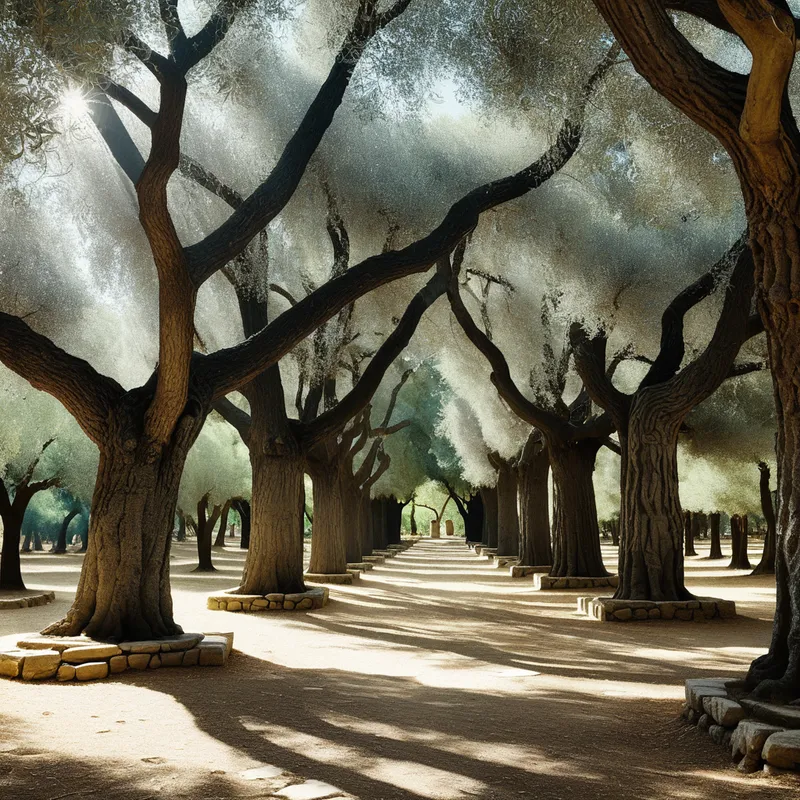
Let the clamor of the Agora fade. Follow the road beyond the city wall, past the potters’ kilns and the dust of common life. Here, where the earth remembers the touch of the hero Academus, the air grows still and fragrant. This is no mere park, but a temenos, a sacred precinct. The olive trees, gnarled and silver-leaved, are whispers from the age of Athena herself. Their branches form a living colonnade, a roof against the harsh sun, dappling the ground with ever-shifting coins of light and shadow.
Into this green sanctuary walks a man whose soul is a city at war. He is Plato, and he carries within him the poison of a cup, the memory of his teacher’s unjust death. The chaos of the democratic mob, the fickleness of opinion, the shadows on the cave wall—these are his Furies. He does not come to build a school as we understand it. He comes to plant a seed in hallowed ground, to found a thiasos, a sacred band dedicated not to a god of wine or mystery, but to the daimon of relentless questioning.
He gathers around him not students, but companions in a pilgrimage. They do not sit in rows, but in a circle beneath the ancient trees. The conflict here is not with monsters of legend, but with the hydra-headed beast of ignorance. The rising action is not a battle cry, but a question posed into the afternoon stillness: “What is courage? What is justice? What is the Good?” The air hums with the tension of thought. You can hear the rustle of scrolls, the slow tap of a sandal as a man paces, wrestling with an idea. You can smell the dry earth, the resinous olive wood, the faint scent of ink.
The resolution is never final, never a simple answer carved in stone. It is the moment when the chaotic swirl of opinion (doxa) begins, like the stars at the dawn of creation, to arrange itself into the fixed patterns of true knowledge (episteme). It is the silent, awe-struck recognition when the mind’s eye glimpses, just for a heartbeat, the perfect Form of the Circle behind all drawn circles, the perfect Justice behind all flawed laws. The ritual is dialogue. The sacrifice is certainty. The offering is the unexamined life. And the divine presence felt is Nous, the ordering mind of the cosmos, echoing in the ordered minds of those who seek.
Cultural Origins & Context
The Academy was a historical institution, founded by Plato around 387 BCE in a gymnasium and grove dedicated to the hero Academus, northwest of Athens. It operated for nearly nine centuries, making it the Western world’s first enduring center of higher learning and research. Yet, from the very beginning, it was mythologized.
Its societal function was dual. Outwardly, it was a practical school for statesmen, mathematicians, and philosophers, aiming to produce “philosopher-kings” who could steer the polis with wisdom. Inwardly, and more profoundly, it was a spiritual and intellectual refuge. In the turbulent aftermath of the Peloponnesian War and the execution of Socrates, it represented a conscious turn away from the corruptible, sensational world of politics toward the eternal, unchanging realm of principles. The myth was passed down not by epic poets, but by philosophers, historians, and the students who walked its paths. It was a living story, told and retold in every dialectical exchange, its “plot” being the very journey of the soul from the darkness of the cave to the light of the sun.
Symbolic Architecture
The Academy is not merely a place, but a supreme symbol of the psyche’s own structured potential. The sacred grove (alsos) represents the unconscious—fertile, ancient, and instinctual, the chthonic realm of life and memory. The simple architectural space within it—the exedra or colonnade—symbolizes the emergent structure of consciousness, the logos that imposes order on the wilderness of raw experience.
The Academy is the psyche’s own temenos: a protected space where the chaos of inner experience can be confronted, named, and ordered through the sacred ritual of dialogue.
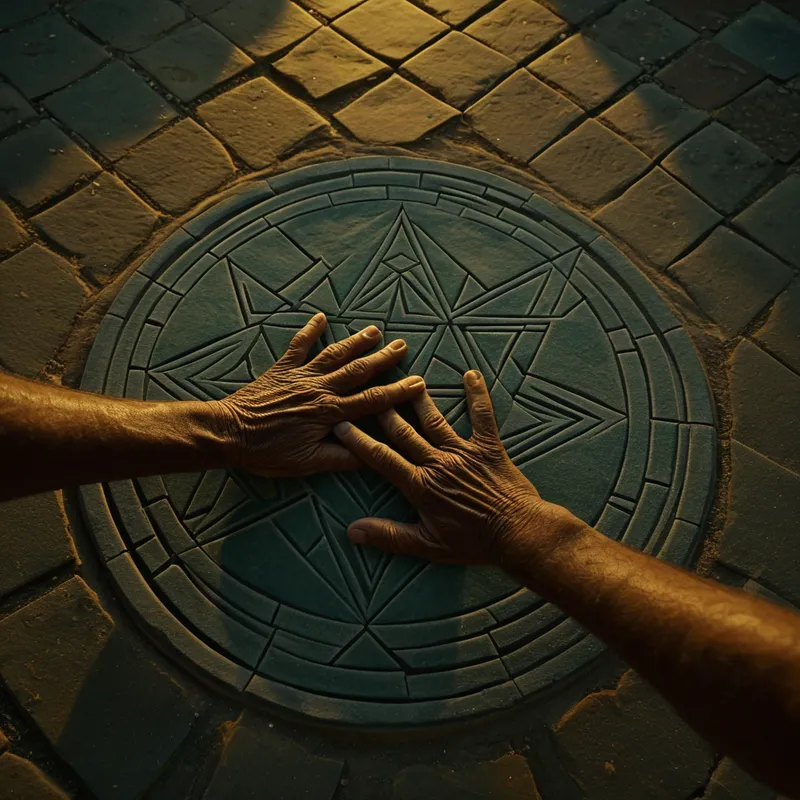
The central ritual, the Socratic dialogue, is the symbolic act of psychic integration. The questioner represents the active, discriminating intellect. The respondent embodies the passive, often confused or contradictory contents of the personal and collective unconscious. Through their interplay—the agon of reason—a third, transcendent thing is born: understanding. The geometric forms studied there—the perfect sphere, the ideal triangle—are symbols of the Forms or Ideas, the innate, archetypal patterns of the collective unconscious that structure all perception and value. To know them is to remember the soul’s divine origin.

The Dreamer's Resonance
When the motif of the Academy appears in a modern dream, it signals a profound process of inner reorganization. The dreamer is not necessarily an academic, but someone whose psyche is calling for a foundational education of the soul.
Dreaming of wandering into a serene, sunlit grove with classical buildings may indicate a nascent longing for inner peace and intellectual or spiritual clarity amidst life’s chaos. To dream of sitting in a circle, engaged in or listening to a deep, urgent conversation, often points to the ego’s readiness to engage with autonomous complexes or archetypal voices within—to finally “have it out” with an inner critic, a neglected passion, or a guiding wisdom figure. A dream of struggling to understand a geometric proof or a philosophical text reflects the somatic tension of integration; the mind/body is laboring to grasp a new, more coherent pattern of meaning that will resolve a previously fragmented life situation. The dream Academy is the temenos of the modern soul, where the shadow is not fought, but questioned, and where the persona is not performed, but examined.

Alchemical Translation
The myth of the Academy models the alchemical opus of individuation with stunning clarity. The base material, the prima materia, is the unexamined life—a chaotic mixture of inherited opinions, unconscious drives, and societal pressures (the shadows in the cave). The sacred grove itself is the vas, the sealed vessel, where this material can be safely contained and transformed away from the corrosive influences of the collective (the city’s politics).
The dialectical process is the alchemical solutio and coagulatio—the relentless dissolving of fixed assumptions (doxa) through questioning, followed by the coagulation of new, more stable insights (episteme). The teacher, the Socrates or Plato figure, represents the archetype of the Senex or Wise Old Man, the guiding principle of the Self that orchestrates the process from within.
The ultimate goal is not a diploma, but the lapis philosophorum: the fully realized, integrated Self, symbolized by the perfect dodecahedron, the shape Plato assigned to the cosmos itself.
For the modern individual, the “Academy” is any disciplined practice of self-reflection that creates a temenos in daily life—journaling, therapy, meditation, or deep conversation with a trusted other. It is the commitment to leave the marketplace of external validation and enter the inner grove, to submit the lead of one’s confused suffering to the fire of honest inquiry, until it transmutes into the gold of self-knowledge and cosmic belonging. One does not graduate from this Academy; one becomes it—an ordered universe within, reflecting the greater Kosmos without.
Associated Symbols
Explore related symbols from the CaleaDream lexicon: