The Abrahamic Covenant Myth Meaning & Symbolism
A nomadic man receives a staggering divine promise of land and descendants, a covenant sealed by faith, tested by sacrifice, and echoing through millennia.
The Tale of The Abrahamic Covenant
Listen. In the beginning of this tale, there was only dust and the whisper of the wind through the tamarisk trees. The man was called Abram, a son of the moon-worshippers from Ur, now a wanderer in the land of Canaan. His wealth was counted in flocks and herds, but his tent was silent, his heart a hollow vessel for the memory of a child’s laughter that never was. He and his wife Sarai carried the heavy silence of barrenness with them like a second skin.
Then, the Voice came. It was not in the thunder, but in the deep quiet after. It spoke into the hollow places of Abram’s soul. “Go from your country… to the land I will show you. I will make of you a great nation.” The promise was absurd, a laugh in the face of the desert’s indifference. Yet, Abram went. He packed his tents, gathered his people, and stepped into the unknown, following a sound only he could hear.
Years bled into years. The promise hung in the air, unfulfilled. The land was before him, but it was filled with other peoples. He was a sojourner, a ghost in his own promised inheritance. In the deep of a terrifying night, the Voice returned. “Do not be afraid, Abram. I am your shield; your reward shall be very great.” And Abram, his faith worn thin, spoke the ache of his life: “O Lord GOD, what will you give me, for I continue childless?”
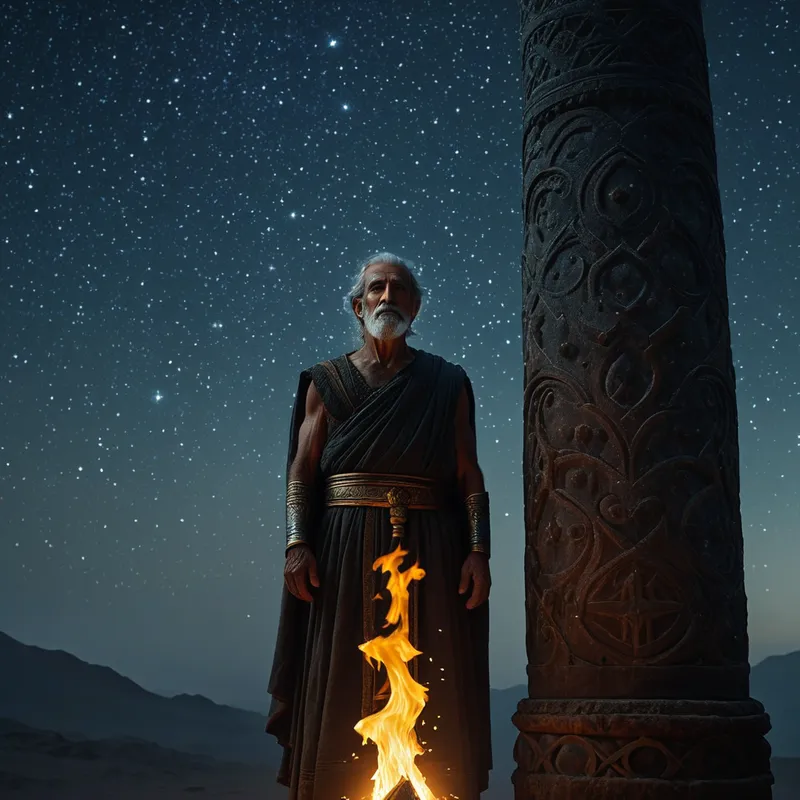
He was led outside his tent. The desert night was a black velvet cloak, pierced by a million diamond stars. “Look toward heaven, and number the stars, if you are able to number them. So shall your offspring be.” In that moment, beneath that impossible, star-shattered sky, Abram believed. And the Voice reckoned that belief as righteousness. A covenant was cut—not with ink, but with ritual. A heifer, a goat, a ram, each split in two, laid opposite each other, a path of blood and flesh. As a deep sleep fell upon Abram, a smoking fire pot and a flaming torch—the very presence of the Divine—passed between the pieces. A terrible, sacred oath: this land, to your descendants.
But the silence in Sarai’s tent remained. Desperation bred a shadow-solution: Hagar, who bore Ishmael. The promise was fractured, a family split by jealousy and grief. More years. The hollow vessel of Abram’s hope grew brittle.
Then, visitors came to his tent at Mamre. Three men. He offered them hospitality—water, bread, the choice calf. And as they ate, one spoke: “I will surely return to you about this time next year, and Sarah your wife shall have a son.” Sarah, listening from the tent door, laughed within herself, the dry, bitter laugh of a womb turned to dust. “Is anything too wonderful for the LORD?” the visitor asked. The promise was renewed, now with a new name: Abraham. Sarah. And a sign: the covenant carved into their very flesh through circumcision.
The laugh of disbelief became the laugh of joy. Isaac was born. The promise was flesh, a living, breathing child. The story should have ended there, in the golden light of a fulfilled oath.
But the final, severest test was yet to come. The Voice spoke once more, a command that tore the universe in two: “Take your son, your only son Isaac, whom you love, and go to the land of Moriah, and offer him there as a burnt offering.” Every star of the promise seemed to go dark. Yet, in a silence more profound than any before, Abraham rose. He split the wood, took the fire, and with his son—the living covenant—walked for three days toward the mountain.
“Father?” Isaac asked, as they climbed, the wood for the sacrifice on his own back. “Here I am, my son,” Abraham replied. The altar was built. The wood arranged. The boy bound. The knife raised, catching the terrible sun. And in that suspended moment, the Voice cried from heaven: “Abraham, Abraham! Do not lay your hand on the boy.” A ram, caught in a thicket, became the substitute. “Now I know that you fear God,” the Voice said, and the promise was sworn once more, by an oath on the Divine Self: “I will indeed bless you, and I will multiply your offspring as the stars of heaven and as the sand that is on the seashore… and by your offspring shall all the nations of the earth gain blessing for themselves.”
The covenant was sealed not in Abraham’s obedience alone, but in the agonizing space between the raised knife and the provided ram. It was sealed in the sacrifice that was given, and the sacrifice that was stayed.
Cultural Origins & Context
This myth is the foundational bedrock of the Abrahamic traditions. It emerged from the oral traditions of nomadic pastoralists and clan chiefs in the second millennium BCE, a time of tribal identity, ancestral lineage, and territorial struggle. The story was not mere history but sacred ethnogenesis—it explained why a particular people were tied to a particular land, and how they were chosen for a unique destiny.
It was preserved and refined by the priestly and prophetic lineages of ancient Israel, likely reaching its canonical form during the Babylonian Exile (6th century BCE). In this context of national trauma and displacement, the myth of the Covenant served a crucial societal function: it was a story of hope and identity against the void. It reminded a scattered people that their existence was not an accident but the result of a primordial, unbreakable divine promise. The tellers were bards, priests, and fathers at Passover, passing down the tale of “our father Abraham” as the source of law, land, and lineage.
Symbolic Architecture
At its core, the Abrahamic Covenant is a myth about the terrifying burden and glorious promise of a call that re-orients an entire life—and lineage—around a future that defies present reality.
The covenant is the archetypal pattern of a promise that hollows you out before it fills you. It demands the sacrifice of the known world to gain a world you can only glimpse in stars and whispers.
Abraham represents the psyche that hears the call. His journey is one of faith ( emunah in Hebrew, meaning steadfastness, loyalty) which is not blind belief, but a precarious, lived commitment to a reality not yet manifest. His periods of doubt and his taking of Hagar are not mere moral failures; they are the psyche’s desperate attempts to materialize the promise through its own will, creating a “shadow lineage” (Ishmael) that must be acknowledged and integrated.
The Land and The Stars are the twin symbols of the promise’s substance: the concrete, earthly reality (land, nationhood) and the infinite, spiritual potential (countless descendants, a blessing to all nations). One is horizontal and territorial, the other vertical and cosmic.
The Binding of Isaac (Akedah) is the myth’s terrifying heart. Psychologically, it represents the ultimate test: are you attached to the gift (Isaac, the fulfilled promise), or to the Giver and the process itself? It is the demand to surrender the very thing your identity is built upon, to hold it in open hands. The provided ram signifies the alchemical turn: when one is willing to sacrifice one’s most cherished possession—a son, a dream, an identity—the psyche often provides a symbolic substitute, a new form in which the essence is preserved but transformed.
The Dreamer’s Resonance
When this myth stirs in the modern dreamer, it often manifests as dreams of profound promises and impossible tasks. You may dream of being given a sacred, life-altering mission by an authoritative voice or figure, yet the path is obscured. You may dream of climbing a stark, barren mountain with a heavy burden, representing the weight of a destiny or commitment you have accepted.
Somatically, this can feel like a tension between a hollow, empty feeling (the barrenness) and a thrilling, anxious pressure in the chest (the call). Dreams of signing unreadable contracts, of searching for a “promised land” in familiar yet alien cityscapes, or of being tested in a way that feels cosmically unjust all echo the Covenant pattern. The dream is asking: What have you sworn yourself to, perhaps without fully understanding? What future-self are you being called to father, and what present attachments must you be willing to bind to the altar?

Alchemical Translation
The psychic transmutation modeled here is the journey from a life of circumstance to a life of covenant. It is the individuation process of forging a conscious relationship with the Self, which often begins as a disruptive, calling voice.
The alchemy occurs in the desert between the promise and its fulfillment. There, the old identity (Abram of Ur) dies of exposure, and the new one (Abraham, father of multitudes) is born in the dark night of faithful waiting.
First, the Call and Severance (Leaving Ur): The ego must separate from collective norms, family expectations, and the “old land” of familiar identity. This is a necessary alienation.
Second, the Barrenness and the Shadow (The Hagar Episode): When the promise tarries, the psyche, impatient, will often try to produce an answer through unconscious, instinctual means (the “maidservant” solution). This creates a complex—a “Ishmael”—a capable, wild part of the self that is part of your lineage but not the heir to the central promise. It must be acknowledged and its place recognized.
Third, the Circumcision of the Heart: The covenant is made physical. This symbolizes the painful, permanent commitment to the process, a cutting away of the protective coverings of the heart to make it vulnerable and receptive to the divine will.
Finally, the Akedah and Substitution: The pinnacle of the work. The ego’s most prized achievement—its spiritual success, its “Isaac”—must be offered back. This is the sacrifice of ego-attachment to the fruits of the work itself. Only in that utter surrender is the true transformation secured. The ram appears, symbolizing that the sacrifice required is not the destruction of the beloved, but the death of one’s possessiveness of it. The promise is then received anew, no longer as a contract with the ego, but as an eternal oath from the Self to the Self.
Thus, the Covenant myth maps the path from being a wanderer in your own life to becoming a conscious participant in a story larger than yourself, a story written in stars and sealed in the terrifying, liberating act of faithful surrender.
Associated Symbols
Explore related symbols from the CaleaDream lexicon: