The 23 Netersof the Cairo Calendar Myth Meaning & Symbolism
A celestial court of 23 gods judges the soul's fate, weighing deeds against cosmic law in a myth of divine justice and karmic reckoning.
The Tale of The 23 Netersof the Cairo Calendar
Hear now the tale whispered on the dry winds that blow from the west, the story of the judgment that awaits in the silent land. It is not a story of the living sun, but of the cool, impartial stars and the deep, patient earth.
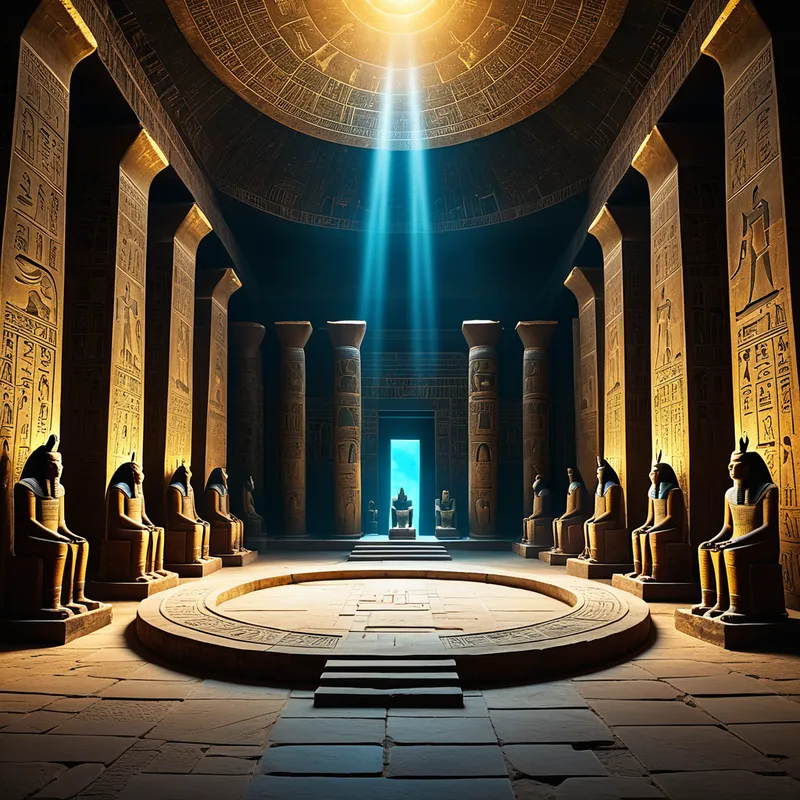
When the last breath leaves the body—a sigh like [papyrus](/myths/papyrus “Myth from Egyptian culture.”/) crumbling to dust—the Ba takes flight. It does not soar toward the sun, not yet. First, it must descend, drawn by an unseen current into the belly of [the world](/myths/the-world “Myth from Tarot culture.”/), into the Duat. [The way](/myths/the-way “Myth from Taoist culture.”/) is dark, a river of black silt, lined with watchers who are neither hostile nor welcoming. They are simply… present. [The Ba](/myths/the-ba “Myth from Egyptian culture.”/) travels until the darkness gives way to a hall so vast its ceiling is the night sky inverted, its floor polished obsidian reflecting cold constellations.
This is the Hall of [Ma’at](/myths/maat “Myth from Egyptian culture.”/). And here, they are waiting.
They are the Twenty-Three. The Neters of the Cairo Calendar, the assessors of fate. They do not stand as a mob, but are seated in a terrible, perfect semicircle. Their forms are not always clear—sometimes they have the heads of beasts upon human bodies, sometimes they are pillars of light, sometimes they are simply a profound and focused attention. You feel their gaze before you see them: the piercing eye of [Horus](/myths/horus “Myth from Egyptian culture.”/), the calculating stillness of [Thoth](/myths/thoth “Myth from Global/Universal culture.”/), the hungry potential of Apep held in check. Each one represents a law of the cosmos, a facet of reality itself—[justice](/myths/justice “Myth from Tarot culture.”/), wrath, mercy, decay, growth, silence.
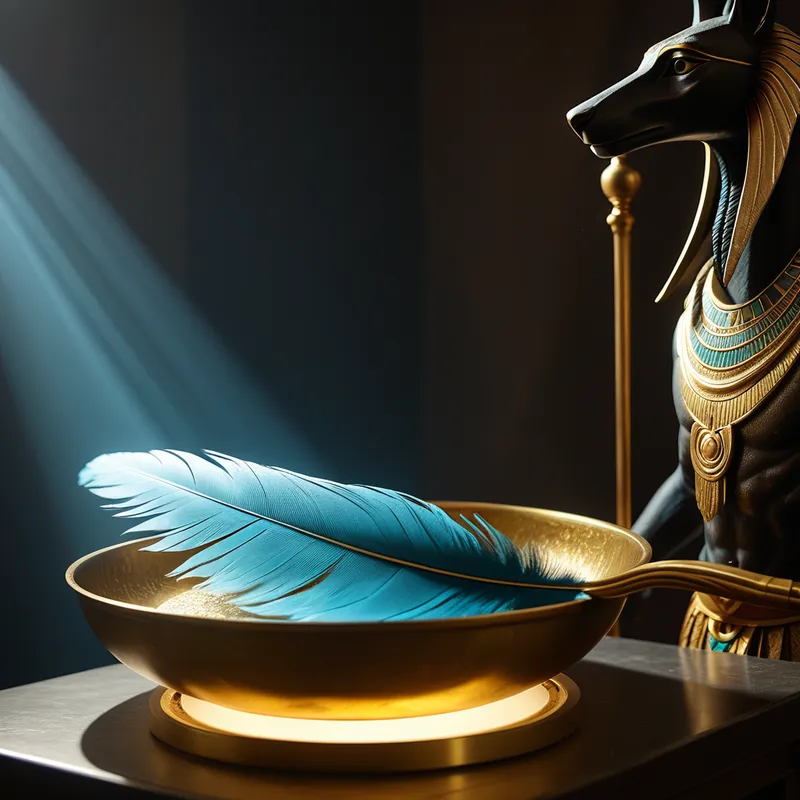
In the center of the hall stands a scale, wrought of gold and shadow. The Anubis, his ears pricked, his movements fluid and precise, approaches the trembling Ba. Without a word, he reaches into the center of its luminous form and removes the heart—the Ib. It beats with a light that holds every laugh, every tear, every secret cruelty, every act of unnoticed kindness. Anubis places it with infinite care upon one pan of the scale.
Upon the other, he places [the Feather of Ma’at](/myths/the-feather-of-maat “Myth from Egyptian culture.”/). It is not a simple feather. It is the weight of “what is right.” It is the mass of a star in equilibrium, the silence of a perfectly balanced equation, the lightness of a truth that needs no defense.
The hall holds its breath. The Twenty-Three lean forward. Thoth, ibis-headed, raises his stylus and tablet, ready to record. The scale begins to move.
This is the moment of truth. If the heart, heavy with deceit and chaos, sinks below the feather, a fate awaits that the tales do not describe in detail—only a final, merciful oblivion, consumed by the waiting beast Ammit. But if the heart is light, if it balances or rises against the feather’s perfect measure… then the Ra himself, present as the light now filling the hall, speaks. The Twenty-Three nod in unison, a verdict rendered not by vote, but by cosmic accord. The Ba is declared “true of voice.” It is now ready to join the sun in its eternal barque, to become an Akh, an everlasting star in [the field of reeds](/myths/the-field-of-reeds “Myth from Egyptian culture.”/).
The trial is not a punishment. It is a revelation. It is the universe looking into its own reflection, found within a single human heart.
Cultural Origins & Context
The so-called “Cairo Calendar” (Papyrus Cairo 86637) is not a calendar in the modern sense, but a complex religious and astrological almanac from the New Kingdom period (c. 1200 BCE). It designates each day of the year as either “favorable” or “unfavorable” based on mythological events, and it is here we find the specific invocation of the “23 Neters” who “judge.” This places the myth firmly within a practical, daily-life context. It was not merely a story for the afterlife, but a principle governing the present.
The myth was likely part of the broader “Book of the Dead” tradition—a collection of spells, prayers, and maps for the deceased’s journey. Scribes and priests were its custodians, but its audience was every Egyptian who could afford a burial papyrus. Its societal function was profound: it was the ultimate ethical engine of the culture. The promise of the 23 Neters made Ma’at not an abstract ideal, but a tangible, inevitable force. Every contract, every act of governance, every personal relationship was lived under [the shadow](/myths/the-shadow “Myth from Jungian culture.”/) of that future scale. It created a culture deeply concerned with right action, not solely out of fear, but from a desire to be in harmony with the very structure of creation.
Symbolic Architecture
At its core, this myth is about the [psyche](/myths/psyche “Myth from Greek culture.”/)‘s innate drive for self-assessment and [integration](/symbols/integration “Symbol: The process of unifying disparate parts of the self or experience into a cohesive whole, often representing psychological wholeness or resolution of internal conflict.”/). The 23 Neters are not external judges; they are the internalized totality of the archetypal forces that govern [human](/symbols/human “Symbol: The symbol of a human represents individuality, complexity of emotions, and social relationships.”/) experience.
The Hall of Judgment is not a place you go to, but a state of being you arrive at when the noise of the ego falls silent.
The [heart](/symbols/heart “Symbol: The heart symbolizes love, emotion, and the core of one’s existence, representing deep connections with others and self.”/) (Ib) represents the total content of the conscious [personality](/symbols/personality “Symbol: Personality in dreams often symbolizes the traits and characteristics of the dreamer, reflecting how they perceive themselves and how they believe they are perceived by others.”/)—all our actions, intentions, and self-deceptions. The [Feather](/symbols/feather “Symbol: A feather represents spiritual elevation, lightness, and the freedom of the spirit. It often symbolizes messages from the divine and connection to ancient wisdom.”/) of Ma’at symbolizes the objective, impersonal standard of [the Self](/myths/the-self “Myth from Jungian culture.”/)—the central [archetype](/symbols/archetype “Symbol: A universal, primordial pattern or prototype in the collective unconscious that shapes human experience, behavior, and creative expression.”/) of wholeness in Jungian terms. The scale is the function of [consciousness](/symbols/consciousness “Symbol: Consciousness represents the state of awareness and perception, encompassing thoughts, feelings, and experiences.”/) itself, capable of weighing and discriminating.
The 23 Neters represent the complex, often contradictory, [council](/symbols/council “Symbol: A council represents collective decision-making and guidance, embodying communal wisdom and authority.”/) of voices within the unconscious: the inner critic (a Thoth), the wounded [child](/symbols/child “Symbol: The child symbolizes innocence, vulnerability, and potential growth, often representing the dreamer’s inner child or unresolved issues from childhood.”/) (perhaps a form of [Osiris](/myths/osiris “Myth from Global/Universal culture.”/)), the fierce protector (a [Sekhmet](/myths/sekhmet “Myth from Egyptian culture.”/)), the chaotic [shadow](/symbols/shadow “Symbol: The ‘shadow’ embodies the unconscious, repressed aspects of the self and often represents fears or hidden emotions.”/) (the contained Apep). A successful “judgment” occurs when the conscious personality (the heart) aligns with the deeper, transpersonal [pattern](/symbols/pattern “Symbol: A ‘Pattern’ in dreams often signifies the underlying structure of experiences and thoughts, representing both order and the repetitiveness of life’s situations.”/) of the Self (Ma’at). Failure is not damnation, but a failure of integration—the psyche remaining in a state of unreconciled conflict, “eaten” by its own unacknowledged aspects (Ammit).
The Dreamer’s Resonance
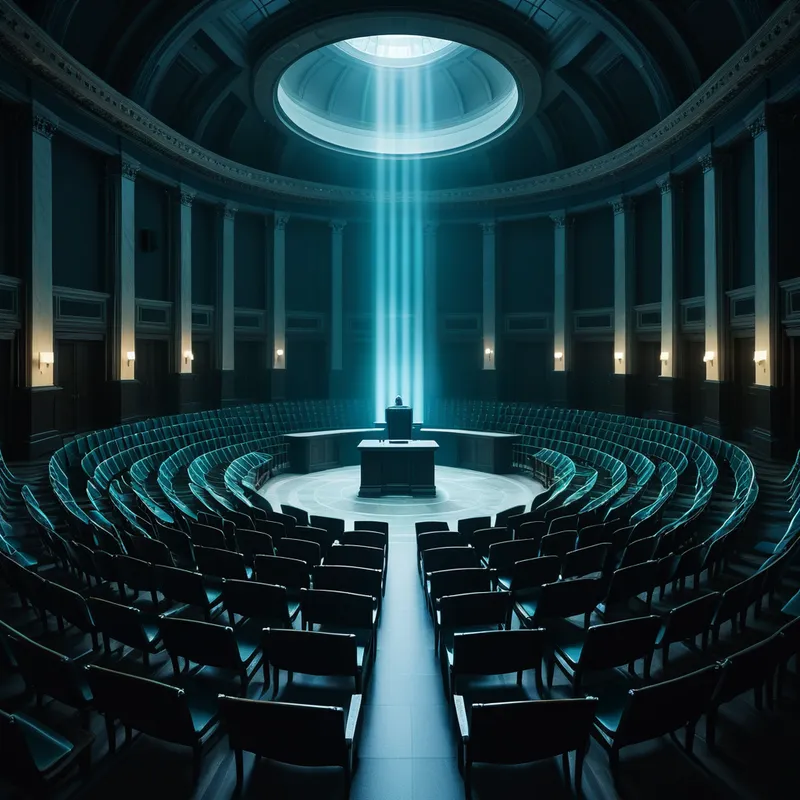
When this myth pattern surfaces in modern dreams, it rarely appears as an Egyptian tableau. Instead, the dreamer may find themselves in a sterile boardroom facing a panel of silent interviewers, or standing trial in a surreal court where the laws are unknown. The somatic feeling is one of profound exposure, nakedness, and anxious anticipation.
Psychologically, this signals a critical moment of self-evaluation. The “23 Neters” are constellated when life forces a reckoning—after a moral failure, at the end of a significant life chapter, or during deep therapy. The psyche is assembling its own internal jury to assess: “Have I been true? Have I lived according to my own deepest values, or according to the borrowed scripts of others?” The dream is the process of the unconscious presenting the bill for a life of self-betrayal or, conversely, preparing to certify a hard-won integrity. The anxiety is [the ego](/myths/the-ego “Myth from Jungian culture.”/)‘s resistance to this utterly honest, non-negotiable audit.
Alchemical Translation
The alchemical process mirrored here is [separatio](/myths/separatio “Myth from Alchemical culture.”/) followed by coniunctio—the separation of the pure from the impure, leading to a sacred union. The myth models the pinnacle of individuation: the integration of the personality under [the aegis](/myths/the-aegis “Myth from Global/Universal culture.”/) of the Self.
The journey to the hall is the [nigredo](/myths/nigredo “Myth from Alchemical culture.”/), the descent into the darkness of the unconscious. The weighing is the albedo, the washing and whitening, where things are clarified and seen in the stark, neutral light of truth. The presence of the 23 Neters ensures this is not a simple, binary test, but a multi-faceted assessment acknowledging the full complexity of a human life.
To be “true of voice” is to have achieved inner congruence, where speech, action, and being are one. It is the state where the persona no longer contradicts the shadow, and the ego serves the Self.
For the modern individual, the “alchemical translation” is a daily, lifelong practice. It is the internalization of the scale. We perform micro-judgments whenever we pause to ask: “Is this action in alignment with my truth? Does this decision make my heart heavier or lighter?” The ultimate [triumph](/myths/triumph “Myth from Roman culture.”/) is not avoiding the hall, but building it within oneself. To become, gradually, both the heart being weighed and the impartial Neter observing it. In that self-awareness, the need for a final, dramatic external judgment dissolves. One lives in a state of ongoing justification, where life itself is the Field of Reeds, and every moment lived in integrity is a step with the sun.
Associated Symbols
Explore related symbols from the CaleaDream lexicon: