Terpsichore Myth Meaning & Symbolism
The myth of Terpsichore, Muse of dance, reveals rhythm as the sacred language that binds the human form to cosmic order and divine inspiration.
The Tale of Terpsichore
Listen. Before the first word was carved into stone, before the first city raised its walls to the sun, there was a sound. It was not a melody, not yet. It was the deep, resonant hum of the Chaos settling into form. From this hum, [the world](/myths/the-world “Myth from Tarot culture.”/) was born. And from the world, nine breaths were drawn, nine daughters of memory and light: the Muses.
Among them was one whose essence was not in [the word](/myths/the-word “Myth from Biblical culture.”/) or the number, but in the space between. Her name was Terpsichore, “She Who Delights in the Dance.” Where her sister Calliope commanded the epic line, and Erato whispered the lyric, Terpsichore spoke with her whole being. She did not merely sing of the world; she became its rhythm.
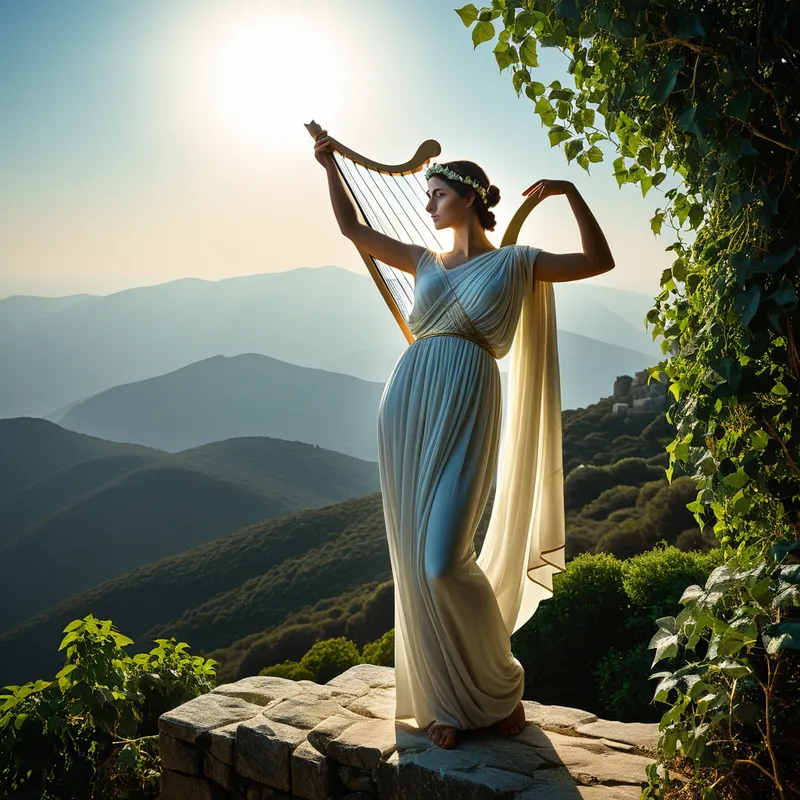
Her home was the slopes of Mount Helicon, where the spring of [Hippocrene](/myths/hippocrene “Myth from Greek culture.”/), struck by the hoof of [Pegasus](/myths/pegasus “Myth from Global/Universal culture.”/), bubbled forth. Here, the air itself was thick with potential. Terpsichore would take her place, a simple lyre in her hands. She would pluck a single string—a clear, pure note that hung in the pine-scented air.
And then, she would move.
It began with a shift of weight, a tilt of the head. Her foot, bare upon the mossy earth, would press down, and the ground seemed to answer. The rustle of leaves synchronized with her step. The chatter of the spring found a counter-rhythm. As her arms swept upward, tracing arcs against [the sky](/myths/the-sky “Myth from Persian culture.”/), the clouds slowed their drift to watch. This was no performance for an audience of mortals. This was the universe remembering, through her body, the perfect order from which it sprang.
She was the choreographer of the cosmos. When the stars were set in their courses by the Titans, it was the pattern of her dance they followed. When the Apollo led [the chorus](/myths/the-chorus “Myth from Theater culture.”/) of [the Muses](/myths/the-muses “Myth from Greek culture.”/), it was Terpsichore who gave their song its feet, who transformed harmonious sound into sacred geometry in motion. To witness her was to understand that the turning of the seasons, the ebb and flow of the tide, the very pulse in your wrist, were all part of her endless, silent composition.
Mortals who stumbled upon her grove did not see a goddess dancing. They felt a resonance in their bones. The weary shepherd would straighten his back, his trudging gait suddenly lighter. The grieving mother would feel a strange compulsion to sway, the tight knot of sorrow in her chest beginning to unravel into a slower, deeper rhythm. They left not with a memory of a face or a form, but with an echo—a somatic ghost of a pattern that could, if nurtured, grow into a harvest dance, a funeral dirge, or a hymn of victory. Terpsichore gave them the grammar of ecstasy and lament, written not on scrolls, but in the marrow.
Cultural Origins & Context
The myth of Terpsichore emerges from the oral, performative heart of ancient Greek culture. She is one of the nine canonical Muses, a classification solidified by poets like Hesiod in his Theogony. Unlike Olympian gods entangled in epic dramas of power and passion, the Muses represent distilled, deified principles of cultural creation. Terpsichore’s domain—choral song and dance—was not mere entertainment; it was a fundamental pillar of civic, religious, and educational life.
In a society without written scripture as we know it, ritual was the primary vessel for myth. Terpsichore presided over the dithyramb, the ecstatic choruses for Dionysus, and the stately paeans for Apollo. Her myth was “told” every time a chorus moved in unison during a tragedy at the Theatre of Dionysus. The choreography was a living text, a physical invocation of order, fate, and communal identity. The myth was passed down not just in bardic recitation, but in the muscle memory of generations of dancers. Her societal function was to provide the archetypal template for kosmos—a word meaning both “order” and “adornment”—applied to the human community through synchronized, meaningful movement.
Symbolic Architecture
Terpsichore is the [archetype](/symbols/archetype “Symbol: A universal, primordial pattern or prototype in the collective unconscious that shapes human experience, behavior, and creative expression.”/) of embodied [harmony](/symbols/harmony “Symbol: A state of balance, agreement, and pleasing combination of elements, often associated with musical consonance and visual or social unity.”/). She symbolizes the critical bridge between the intangible inspiration of the mind (the other Muses) and its manifestation in the physical, communal world.
The dance is the visible form of the invisible music that structures the world.
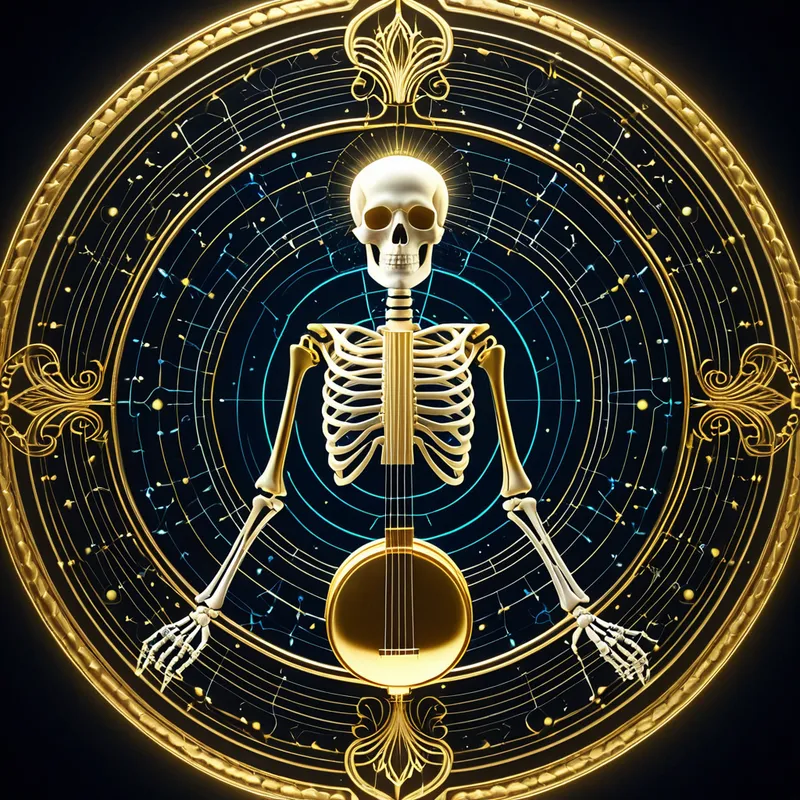
Her primary [symbol](/symbols/symbol “Symbol: A symbol can represent an idea, concept, or belief, serving as a powerful tool for communication and understanding.”/), the [lyre](/symbols/lyre “Symbol: The lyre symbolizes harmony, creativity, and the connection between the divine and human experiences.”/), is not merely an [instrument](/symbols/instrument “Symbol: An instrument symbolizes creativity, communication, and the means by which one expresses oneself or influences the world.”/). It is a map of proportional harmony, its strings representing fixed mathematical ratios. Her dance is the living [expression](/symbols/expression “Symbol: Expression represents the act of conveying thoughts, emotions, and individuality, emphasizing personal communication and creativity.”/) of those ratios. She represents [the principle](/symbols/the-principle “Symbol: A fundamental truth, law, or doctrine that serves as a foundation for a system of belief, behavior, or reasoning, often representing moral or ethical standards.”/) that true creation is not a disembodied [idea](/symbols/idea “Symbol: An ‘Idea’ represents a spark of creativity, innovation, or realization, often emerging as a solution to a problem or a new outlook on life.”/), but a [pattern](/symbols/pattern “Symbol: A ‘Pattern’ in dreams often signifies the underlying structure of experiences and thoughts, representing both order and the repetitiveness of life’s situations.”/) enacted. Psychologically, she symbolizes the [integration](/symbols/integration “Symbol: The process of unifying disparate parts of the self or experience into a cohesive whole, often representing psychological wholeness or resolution of internal conflict.”/) of instinct and order, [emotion](/symbols/emotion “Symbol: Emotion symbolizes our inner feelings and responses to experiences, often guiding our actions and choices.”/) and form. The chaotic [energy](/symbols/energy “Symbol: Energy symbolizes vitality, motivation, and the drive that fuels actions and ambitions.”/) of Dionysian [ecstasy](/symbols/ecstasy “Symbol: A state of overwhelming joy, rapture, or intense emotional/spiritual transcendence, often involving a loss of self-awareness.”/) finds its Apollonian [structure](/symbols/structure “Symbol: Structure in dreams often symbolizes stability, organization, and the framework of one’s life, reflecting how one perceives their environment and personal life.”/) through her. She is the [rhythm](/symbols/rhythm “Symbol: A fundamental pattern of movement or sound in time, representing life’s cycles, emotional flow, and universal order.”/) that organizes raw [life](/symbols/life “Symbol: The symbol of ‘Life’ represents a journey of growth, interconnectedness, and existential meaning, encompassing both the joys and challenges that define human experience.”/) force into something communicable and beautiful—be it a [ritual](/symbols/ritual “Symbol: Rituals signify structured, meaningful actions carried out regularly, reflecting cultural beliefs and emotional needs.”/), a work of art, or a coherent sense of self.
In a deeper sense, Terpsichore symbolizes the [body](/symbols/body “Symbol: The body in dreams often symbolizes the dreamer’s self-identity, personal health, and the relationship they have with their physical existence.”/) as a medium of knowing. Before we analyze, we move. Our first understanding of rhythm comes from the maternal [heartbeat](/symbols/heartbeat “Symbol: The heartbeat represents life, vitality, and the essence of being alive, symbolizing emotional connectivity and personal integrity.”/). She represents this pre-verbal, somatic intelligence—the wisdom held in the [gesture](/symbols/gesture “Symbol: A non-verbal bodily movement conveying meaning, emotion, or intention, often symbolic in communication and artistic expression.”/), the [posture](/symbols/posture “Symbol: Posture in dreams represents one’s stance in life, social presentation, and inner confidence or submission. It reflects how one carries themselves through challenges and relationships.”/), the [breath](/symbols/breath “Symbol: Breath symbolizes life, vitality, and the connection between the physical and spiritual realms.”/). To invoke Terpsichore is to seek not just to think about harmony, but to inhabit it.
The Dreamer’s Resonance
When the pattern of Terpsichore stirs in the modern unconscious, it often manifests in dreams of compelling, inexplicable movement. One might dream of feet that move of their own accord, tracing intricate patterns on the ground. Another might dream of being part of a vast, silent chorus, where the synchronization of breath and step creates a profound sense of belonging and power. Conversely, her absence may be felt: dreams of being paralyzed while music plays, or of limbs moving out of sync, jerky and uncoordinated.
These dreams point to a psychological process of somatic integration. The dreamer may be intellectually aware of an insight or a creative impulse (the “song” of the other Muses), but is struggling to embody it, to give it a functional rhythm in daily life. The body in the dream becomes the theater where this integration succeeds or fails. A dream of graceful, effortless dance suggests the unconscious is successfully orchestrating disparate parts of the [psyche](/myths/psyche “Myth from Greek culture.”/) into a harmonious whole. A dream of clumsy or restricted movement often signals a disconnect between mind and body, idea and action, or a repression of instinctual energy that needs to find its proper form.
Alchemical Translation
The individuation process, the journey toward psychic wholeness, is not a purely cerebral affair. Terpsichore’s myth provides the model for its alchemical choreography. The “[prima materia](/myths/prima-materia “Myth from Alchemical culture.”/)” of the soul is often chaotic, a jumble of conflicting impulses, traumas held in the body, and lofty ideals. The work of transmutation requires giving this chaos a rhythm, a container in which it can move and be transformed.
Individuation is the dance we learn when we listen to the music of our own nature.
First, one must “hear the lyre”—identify the innate, often hidden pattern or calling that wants to express itself ([the Self](/myths/the-self “Myth from Jungian culture.”/)). This is the inspiring note. Then comes the difficult, practical work of the dance: aligning one’s actions, habits, and relationships (the complex steps) with that inner rhythm. This is the stage of practice, of stumbling, of learning the steps. It involves honoring the body as a sacred instrument, attending to its tensions and releases as manifestations of psychic states.
Terpsichore’s ultimate gift is the realization that the goal is not a static state of perfection, but a dynamic, ever-unfolding balance. The “gold” produced is not a finished product, but the capacity for graceful motion through life’s changes. The individuated Self is not a fixed statue, but a being capable of dancing with fate, of finding the inherent rhythm in both joy and sorrow, and of moving in harmony with the larger chorus of the world, without losing its own essential beat. To integrate Terpsichore is to understand that we are not here just to think our truth, but to live it in every gesture, step, and breath.
Associated Symbols
Explore related symbols from the CaleaDream lexicon: