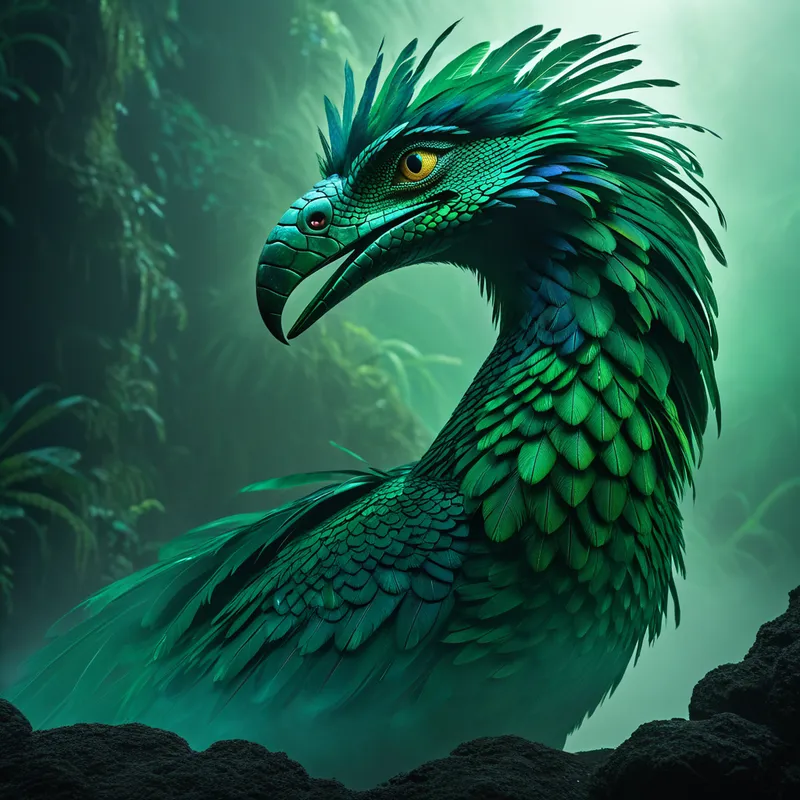
Tepeu and Gucumatz Myth Meaning & Symbolism
The primordial story of the Plumed Serpent and the Maker who, from the silent sea of potential, spoke the world and humanity into being through sacred word and vision.
The Tale of Tepeu and Gucumatz
In the beginning, there was only the sea. A vast, silent, and placid sea beneath an empty sky. No light pierced its depths, no sound broke its stillness. There was nothing that crawled, nothing that grew, nothing that breathed. Only the dark, dreaming waters, holding within their infinite black mirror the potential of all things yet unformed.
From this profound stillness, consciousness stirred. Not as a form, but as a presence. A knowing. They were Tepeu and Gucumatz. Where one thought ended, the other began. They were the Heart of Sky and the Heart of Earth, not yet separate, existing in the perfect unity of divine intent. They came together in the darkness, their council a vibration in the void, a first ripple upon the face of the deep.
“Let it be empty no longer,” their will declared, though no mouth spoke. “Let the conception arise. Let the germination begin.”
And so they spoke the First Word. It was not a sound heard by ears, but a shaping of reality itself. “Earth!” they said. And from the endless waters, the land surged forth—mountains and valleys, plains and forests, stone and soil—rising solid and sure. They commanded the rivers to run their courses and the trees to stretch their roots into the dark and their branches toward the light that now, at their command, blossomed in the sky. They called forth the Four Directions, giving order to the expanse, and placed the Wakah-Chan at the very center, its roots drinking from the underworld, its crown holding up the sky.
But the world, though beautiful, was silent. It had no one to speak their names, to offer gratitude, to keep the days. So Tepeu and Gucumatz shaped the first beings from the wet earth. They made the animals—the deer, the jaguar, the snake, the bird. “Speak our names! Praise us!” they urged. But the creatures could only bark, howl, hiss, and chirp. They could not name the gods. This creation was a failure.
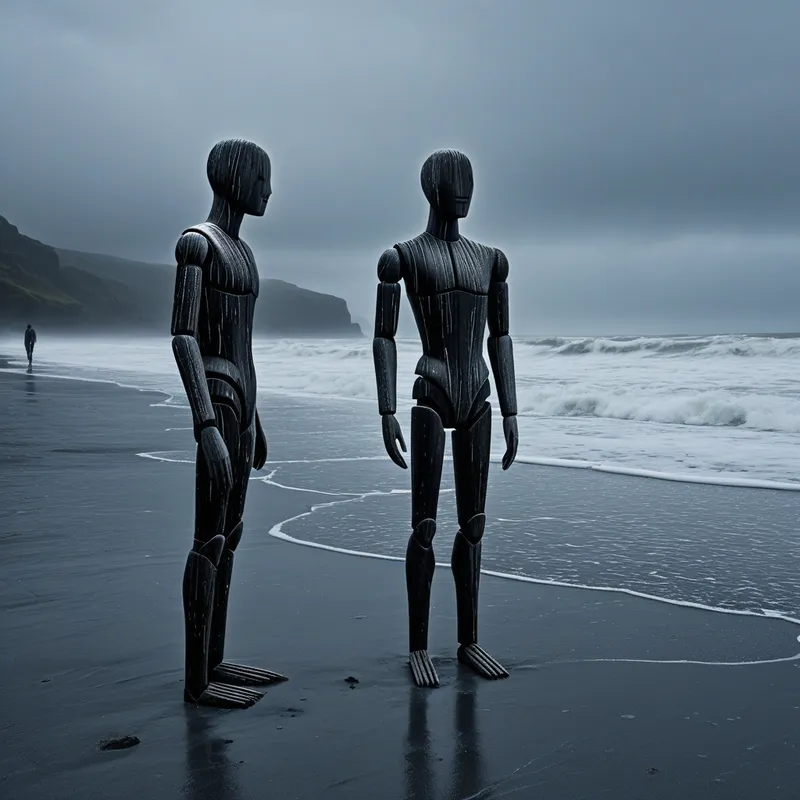
Undaunted, the makers tried again. From wood, they carved manikins. These could walk and talk and multiply. But they had no hearts, no minds, no memory. Their faces were blank, empty of feeling. They forgot their creators and wandered aimlessly. Seeing this hollow imitation of life, the gods sent a great resinous rain to dissolve them, and their tools and grinding stones rose up to destroy them. The world was swept clean once more.
Then, in their final and most sacred council, Tepeu and Gucumatz sought the true substance of life. They consulted the Xpiyacoc and Xmucane, the ancient seers. They gathered yellow corn and white corn from the Paxil. They ground the maize into fine meal nine times. With this sacred dough, the flesh of the earth itself, they formed the first true people. Four men were born, with sight so clear they could see to the ends of the universe and know all things at once.
Seeing this perfection, the gods grew uneasy. “They are too much like us. They see everything.” So they breathed a mist over the eyes of the first people, clouding their vision, making the distant and mysterious once more distant and mysterious. Now, they would have to seek, to remember, to dream. And from these first men, the first women were created. And so began the dawn of the true world, the world of the Maya, a world born from the silent sea, shaped by divine word, and perfected through sacred substance.
Cultural Origins & Context
This foundational narrative is the heart of the Popol Vuh, the sacred text of the K’iche’ Maya. Unlike many myths preserved solely through archaeology, the Popol Vuh was transcribed in the mid-16th century by K’iche’ nobles, using the Latin alphabet to preserve their ancestral knowledge in the face of colonial erasure. It is not merely a story but a “council book,” a repository of cosmology, theology, history, and law. It was likely recited by trained rememberers during ceremonial occasions, linking the community to the primordial time of origins. The myth of Tepeu and Gucumatz served to explain the nature of reality, humanity’s divine yet flawed origin, and the sacred contract between people and the gods, centered on sustenance (maize) and ritual remembrance. It established a cosmic order where creation is an ongoing, collaborative process between the divine and the material world.
Symbolic Architecture
At its core, this is a myth about the [emergence](/symbols/emergence “Symbol: A process of coming into being, rising from obscurity, or breaking through a barrier, often representing birth, transformation, or revelation.”/) of [consciousness](/symbols/consciousness “Symbol: Consciousness represents the state of awareness and perception, encompassing thoughts, feelings, and experiences.”/) from the unconscious, and the arduous creation of a [vessel](/symbols/vessel “Symbol: A container or structure that holds, transports, or protects something essential, representing the self, emotions, or life journey.”/) capable of holding it. The primordial sea is the undifferentiated psyche, the [collective unconscious](/symbols/collective-unconscious “Symbol: The Collective Unconscious refers to the part of the unconscious mind shared among beings of the same species, embodying universal experiences and archetypes.”/) in its potential state. Tepeu and Gucumatz represent the archetypal creative principle—thought (Tepeu, the sovereign maker) and dynamic [energy](/symbols/energy “Symbol: Energy symbolizes vitality, motivation, and the drive that fuels actions and ambitions.”/) (Gucumatz, the [feathered serpent](/symbols/feathered-serpent “Symbol: The Feathered Serpent represents a blend of wisdom, duality, and the interplay between the earthly and the spiritual.”/), uniting [earth](/symbols/earth “Symbol: The symbol of Earth often represents grounding, stability, and the physical realm, embodying a connection to nature and the innate support it provides.”/) and sky).
The first act of creation is not to make something, but to conceive of the possibility of something other than the void.
The failed creations are profound psychological statements. The animals represent instinctual [life](/symbols/life “Symbol: The symbol of ‘Life’ represents a journey of growth, interconnectedness, and existential meaning, encompassing both the joys and challenges that define human experience.”/), alive but without self-reflective consciousness. The wooden manikins symbolize a hollow [persona](/symbols/persona “Symbol: The social mask or outward identity one presents to the world, often concealing the true self.”/), a form that mimics [life](/symbols/life “Symbol: The symbol of ‘Life’ represents a journey of growth, interconnectedness, and existential meaning, encompassing both the joys and challenges that define human experience.”/) but lacks [soul](/symbols/soul “Symbol: The soul represents the essence of a person, encompassing their spirit, identity, and connection to the universe.”/), [heart](/symbols/heart “Symbol: The heart symbolizes love, emotion, and the core of one’s existence, representing deep connections with others and self.”/), and [memory](/symbols/memory “Symbol: Memory symbolizes the past, lessons learned, and the narratives we construct about our identities.”/)—a [life](/symbols/life “Symbol: The symbol of ‘Life’ represents a journey of growth, interconnectedness, and existential meaning, encompassing both the joys and challenges that define human experience.”/) of empty routine. The true creation, from maize, signifies that authentic being arises from a [synthesis](/symbols/synthesis “Symbol: The process of combining separate elements into a unified whole, representing integration, resolution, and the completion of a personal journey.”/): the raw substance of the earth (the [body](/symbols/body “Symbol: The body in dreams often symbolizes the dreamer’s self-identity, personal health, and the relationship they have with their physical existence.”/), the instinctual) must be ground, refined, and shaped (the process of culture, suffering, and introspection) by a unifying [vision](/symbols/vision “Symbol: Vision reflects perception, insight, and clarity — often signifying the ability to foresee or understand deeper truths.”/) (the gods). The clouding of perfect vision is not a [punishment](/symbols/punishment “Symbol: A dream symbol representing consequences for actions, often tied to guilt, societal rules, or internal moral conflicts.”/), but the necessary [condition](/symbols/condition “Symbol: Condition reflects the state of being, often focusing on physical, emotional, or situational aspects of life.”/) for the [human](/symbols/human “Symbol: The symbol of a human represents individuality, complexity of emotions, and social relationships.”/) [journey](/symbols/journey “Symbol: A journey in dreams typically signifies adventure, growth, or a significant life transition.”/). Omniscience negates seeking; obscured [vision](/symbols/vision “Symbol: Vision reflects perception, insight, and clarity — often signifying the ability to foresee or understand deeper truths.”/) creates the [space](/symbols/space “Symbol: Dreaming of ‘Space’ often symbolizes the vastness of potential, personal freedom, or feelings of isolation and exploration in one’s life.”/) for myth, art, love, and the slow, painful, beautiful process of understanding.
The Dreamer’s Resonance
When this mythic pattern stirs in the modern dreamer, it often signals a profound creative or existential crisis, a “dark sea” phase. One may dream of empty, featureless landscapes, of trying to speak but making only animal sounds, or of moving through life as a hollow, wooden puppet. These are somatic echoes of the failed creations.
The dream of grinding corn, of searching for a sacred substance, or of consulting ancient, wise figures points to the psyche’s attempt to find the true material for a new self. A dream of having vision clouded or limited, while initially frightening, can be the psyche enacting the necessary “mist” that forces a turn inward, from knowing everything to seeking what is truly meaningful. The presence of the Feathered Serpent in dream form—perhaps as a shimmering, wise, coiling energy—is a powerful sign of a unifying intelligence at work, weaving together instinct (serpent) and spirit (feathers) to birth a new psychic structure.
Alchemical Translation
The myth models the alchemical opus, the great work of individuation. The prima materia is the dark, watery chaos of the unexamined life or the shattered old self. The conjunction of Tepeu and Gucumatz is the inner marriage of Logos (ordering principle) and Eros (relating, connecting principle), without which creation is impossible.
To become human is not a given state, but a continual achievement of synthesis, ground from the substance of our experiences and baked in the fire of our attention.
The failed attempts are necessary stages. We must recognize our purely instinctual (animal) and our purely conformist (wooden) modes of being as insufficient. The “grinding” is the often-painful work of analysis, of breaking down complexes and ingrained patterns (the hard kernels of habit) into usable meal. The “nine grindings” speak to the depth and repetition required. The final form—the human of corn—is the Self, a being rooted in the earthly reality of the body and nourished by the spiritual sun, capable of both sustenance and offering. We are not born complete; we are spoken, shaped, and clouded into becoming. Our life’s purpose is to remember the divine substance we are made of, and to speak, through our living, the names of the creative forces that shaped us.
Associated Symbols
Explore related symbols from the CaleaDream lexicon:
- Water — The primordial, undifferentiated unconscious from which all forms of consciousness and creation first emerge, representing potential, chaos, and the womb of all things.
- Serpent — Embodies the earthly, instinctual, and cyclical wisdom of Gucumatz, representing the foundational energy and transformative power coiled at the root of creation.
- Sky — The realm of divine thought and order, the domain of Tepeu, representing the higher vision, structure, and expansive potential that meets the earth.
- Earth — The manifested, solid reality born from the word of the gods, representing the physical vessel, sustenance, and the ground of all being.
- Seed — The sacred maize from Paxil, representing the latent potential, the divine substance, and the genetic code of true humanity waiting to be germinated.
- Mountain — The Paxil, the Mountain of Sustenance, representing the sacred center, the place of revelation, and the source of the nourishing substance for creation.
- Vision — The perfect sight of the first humans, later clouded, representing omniscient consciousness and the necessary limitation that creates the quest for meaning.
- Word — The creative utterance of Tepeu and Gucumatz, representing the power of language, intent, and vibration to shape reality from the formless void.
- Order — The establishment of the Four Directions and the World Tree, representing the cosmic structure imposed on chaos, creating a livable, meaningful universe.
- Creator — The archetypal essence of Tepeu and Gucumatz in council, representing the primal, intelligent force that conceives, intends, and brings form into being.
- Corn — The sacred flesh of humanity, representing sustenance, the synthesis of heaven and earth, and the cyclical nature of life, death, and rebirth.
- Dream — The state of the primordial sea and the clouded vision of humanity, representing the realm of potential, unconscious process, and the source of true knowing.