Tengu Myth Meaning & Symbolism
The myth of the Tengu, a fearsome yet revered mountain spirit, embodies the paradox of the sacred trickster and the path from wild chaos to enlightened mastery.
The Tale of Tengu
Listen, and let the mountain wind carry the tale. In the deep, untamed heart of Yamabushi-no-Mori, where sunlight fractures into emerald shards and the air hums with the silence of ages, the mountains hold their breath. This is not a place for men, but for the old gods and the older things that dwell between the roots of the ancient cedars.
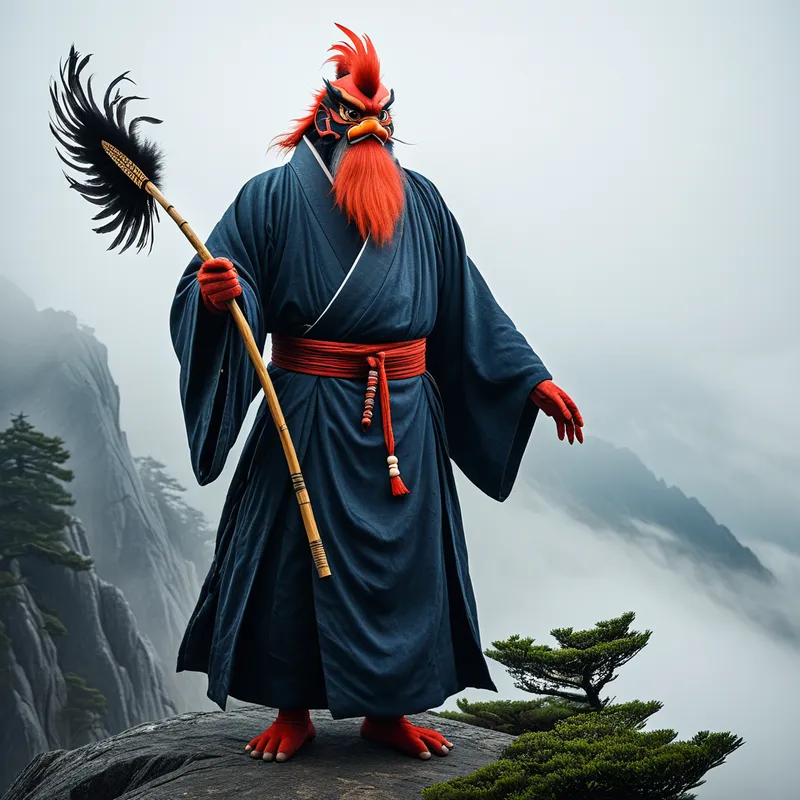
Here, in the realm above the clouds, the yamabushi come to seek the divine, their conch-shell horns echoing against stone. And here, they are met. Not by a gentle kami, but by a presence that cracks the stillness like thunder. A shadow darker than the forest floor detaches itself from a gnarled trunk. It stands tall, a figure of impossible contradiction: the robes of an ascetic monk, but the face of a crimson demon, with a proud, piercing gaze and a nose like a blade. This is the Tengu.
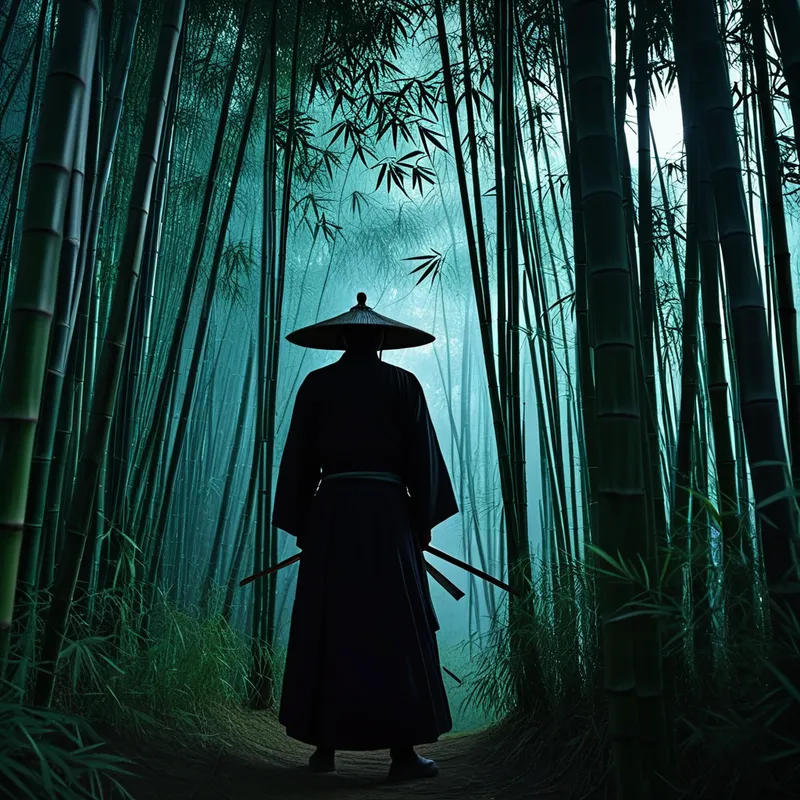
Some say he descends on a whirlwind, a tempest of black feathers and laughter that sounds like rocks grinding together. He is the master of misdirection. He leads the proud samurai, brimming with martial arrogance, deep into trackless ravines, only to abandon him at a cliff’s edge. He steals the sacred texts from the careless monk, not to burn them, but to hide them in an eagle’s nest, forcing a perilous climb of humility. He is the weaver of illusions, making a humble stream appear a raging torrent, a solid path crumble into mist.
But for the rare seeker—the one whose pride has been scoured away by the mountain’s harshness, whose heart holds not just discipline but a flicker of genuine awe—the Tengu’s nature shifts. The terrifying visage softens, not into kindness, but into a severe, focused intensity. He becomes the ultimate sensei. On a precipice overlooking the endless sea of clouds, he teaches. Not with gentle words, but with the silent language of the gale, the precise arc of a thrown leaf becoming a lethal strike, the patient stillness of a hunting hawk. He imparts the secret arts: of the sword that cuts the ego, of the wind-step that walks between worlds, of the fan that can summon storms or bring calm. He is the crucible. He breaks the man to remake the warrior; he shatters the novice to reveal the potential for a master. And when the lesson is complete, he vanishes as he came—not with a bow, but with a echoing, cawing laugh that is both mockery and blessing, swallowed by the eternal green dark of his mountain home.
Cultural Origins & Context
The Tengu is a being born from the collision and fusion of worlds. Its roots are ancient, likely drawing from Chinese folklore of celestial dogs (tian gou) that were omens of war, and from the indigenous kami of Japan’s forbidding mountains—wild, unpredictable, and powerful. As Mikkyō Buddhism traveled from the continent and melded with native Shinto mountain worship to form Shugendō, the Tengu found its definitive role.
It was the yamabushi themselves, those who ventured into the Tengu’s domain, who became its primary storytellers. Around monastic fires, tales were told not as mere folklore, but as cautionary parables and spiritual maps. The Tengu served a vital societal function: it was the personification of the mountain’s inherent danger and sacredness, a boundary guardian. It punished arrogance, spiritual laziness, and the misuse of power—particularly the pride of the warrior class and the corruption within monastic institutions. In medieval gunki monogatari, Tengu are often depicted abducting arrogant priests or misleading armies, acting as karmic agents. They were the shadow of the spiritual path, the ever-present test that separated the truly devoted from the merely professing.
Symbolic Architecture
Psychologically, the Tengu is a masterful representation of the [Shadow](/symbols/shadow “Symbol: The ‘shadow’ embodies the unconscious, repressed aspects of the self and often represents fears or hidden emotions.”/) [archetype](/symbols/archetype “Symbol: A universal, primordial pattern or prototype in the collective unconscious that shapes human experience, behavior, and creative expression.”/), but with a crucial, culture-specific twist. It is not merely a repository of denied darkness; it is the [Shadow](/symbols/shadow “Symbol: The ‘shadow’ embodies the unconscious, repressed aspects of the self and often represents fears or hidden emotions.”/) as a severe, demanding [teacher](/symbols/teacher “Symbol: The symbol of the teacher in dreams often represents guidance, wisdom, and the process of learning or self-discovery.”/). Its long [nose](/symbols/nose “Symbol: The nose often represents perception, intuition, and the ability to confront emotions and truths.”/) symbolizes an inflated ego, a probing intellect, and penetrating [insight](/symbols/insight “Symbol: A sudden, deep understanding of a complex situation or truth, often arriving unexpectedly and illuminating hidden connections.”/)—all qualities that can be monstrous in their untamed state but can be forged into tools of wisdom.
The Tengu embodies the [paradox](/symbols/paradox “Symbol: A contradictory yet true concept that challenges logic and perception, often representing unresolved tensions or profound truths.”/) of sacred [chaos](/symbols/chaos “Symbol: In Arts & Music, chaos represents raw creative potential, uncontrolled expression, and the breakdown of order to forge new artistic forms.”/). It is the necessary disorder that precedes and tests true order, the wildness that must be integrated, not eliminated, on the [path](/symbols/path “Symbol: The ‘path’ symbolizes a journey, choices, and the direction one’s life is taking, often representing individual growth and exploration.”/) to mastery.
The demon on the path is not an obstacle to be destroyed, but the gatekeeper who holds the key to the next stage of the journey. Its fury is the friction required for the alchemy of the self.
Its dual [nature](/symbols/nature “Symbol: Nature symbolizes growth, connectivity, and the primal forces of existence.”/)—destructive [trickster](/symbols/trickster “Symbol: A boundary-crossing archetype representing chaos, transformation, and the subversion of norms through cunning and humor.”/) and revered sensei—mirrors the dual [outcome](/symbols/outcome “Symbol: Outcome symbolizes the results of actions or decisions, often reflecting hopes, fears, and the consequences of choices.”/) of confronting one’s own [depths](/symbols/depths “Symbol: Represents the subconscious, hidden emotions, or foundational aspects of the self, often linked to primal fears or profound truths.”/): one can be driven mad by the encounter (the lost [samurai](/symbols/samurai “Symbol: The samurai represents discipline, honor, loyalty, and mastery in martial and spiritual arts, embodying the highest values of the warrior class.”/)), or one can submit to its harsh curriculum and emerge transformed (the disciplined ascetic). The [mountain](/symbols/mountain “Symbol: Mountains often symbolize challenges, aspirations, and the journey toward self-discovery and enlightenment.”/) itself is the symbolic [landscape](/symbols/landscape “Symbol: Landscapes in dreams are powerful symbols representing the dreamer’s emotional state, personal journey, and the broader context of life situations.”/) of this arduous inner process.
The Dreamer’s Resonance
When the image of the Tengu, or its atmosphere, arises in a modern dream, it signals a profound engagement with the psyche’s disciplinary faculty. This is not the gentle guidance of the inner sage, but the fierce, uncompromising confrontation with one’s own inflated self-image, laziness, or unearned pride.
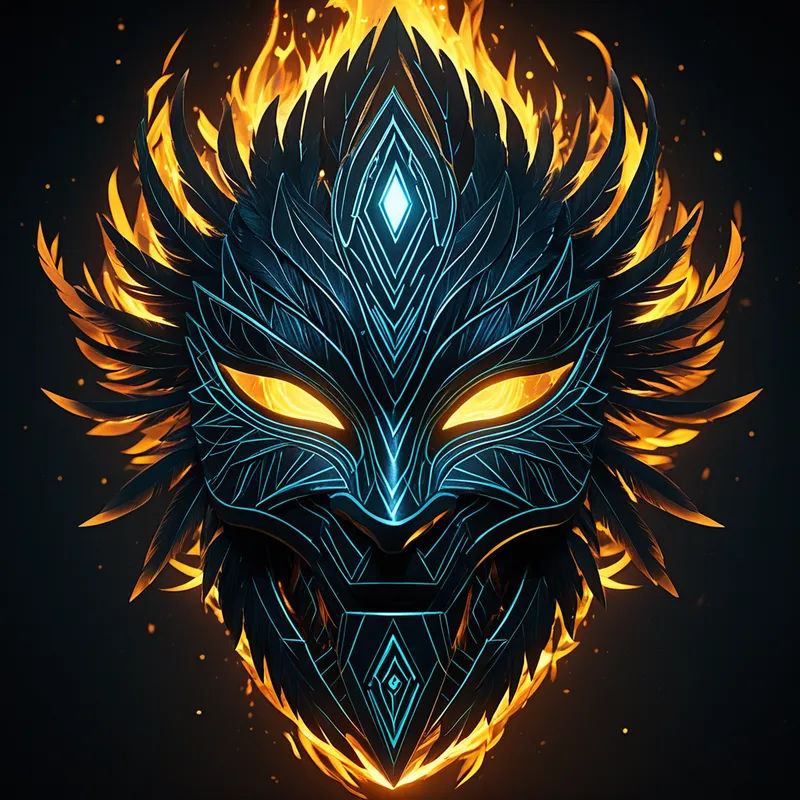
Somatically, one might dream of being chased by a crow-like being through a labyrinthine forest (anxiety, the feeling of being tested), of falling from a great height after a moment of hubris (the ego’s deflation), or of being forced to perform an impossible, precise task under a severe gaze (the pressure to refine a skill or aspect of character). Psychologically, this is the process of “shadow-boxing” in its most literal sense: coming face-to-face with the inner critic, the inner trickster, or the part of oneself that sabotages success out of fear of the responsibility that true mastery brings. The dream-Tengu appears when the psyche is ready for a harsh but necessary lesson in accountability and authentic power.
Alchemical Translation
The myth of the Tengu models the individuation process as a path of fierce refinement, a spiritual martial art. The initial state is the uninitiated ego, the samurai or monk who carries their title or robes as a shell of identity, filled with potential but also with latent arrogance or spiritual materialism. The Tengu’s abduction—the feeling of being lost, tricked, or stripped of one’s comforts—represents the necessary dissolution of this false self. The old identity is led astray into the trackless forest of the unconscious.
The subsequent training on the mountain peak is the core alchemical operation: transmutation through discipline. The chaotic, bird-like, tempestuous energy of the raw Shadow (the Tengu’s wild nature) is applied as the very fire and tool of transformation. The ego is not coddled; it is hammered on the anvil of extreme challenge. This is the forging of the “diamond body” of consciousness—a self that is resilient, precise, and aware precisely because it has acknowledged and integrated its own capacity for mischief, pride, and fury.
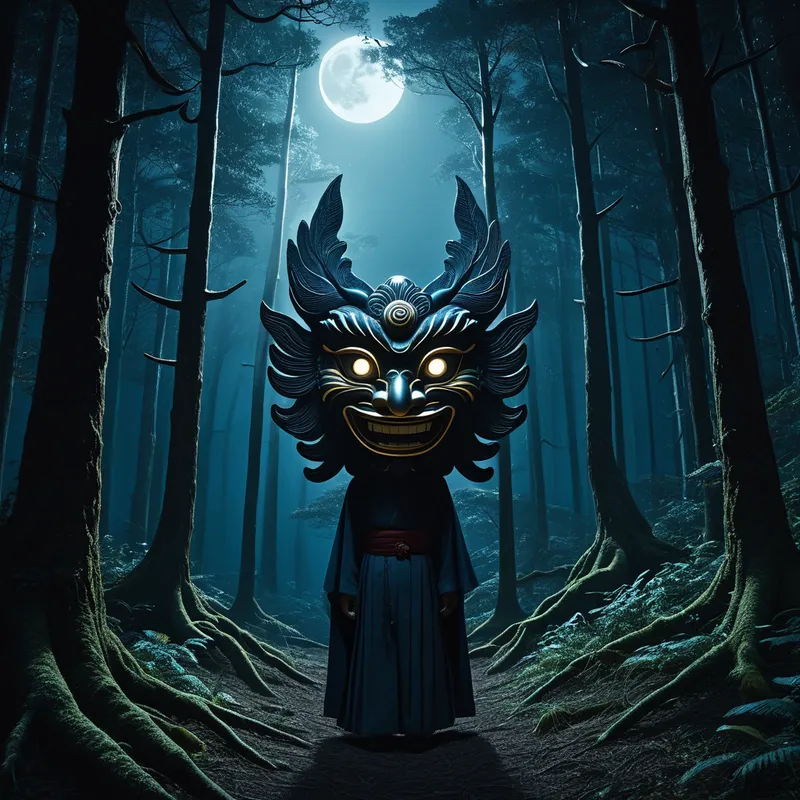
The goal is not to slay the demon, but to learn its secret name, to wear its mask not as a disguise, but as a hard-won aspect of one’s own authority.
The final, laughing disappearance of the Tengu signifies the moment this integrated power becomes your own. The external teacher vanishes because the lesson is internalized. The individual no longer projects their discipline or their shadow onto an external figure; they have become, in their own right, a master of their inner mountains and storms. They carry the Tengu’s fierce tranquility within.
Associated Symbols
Explore related symbols from the CaleaDream lexicon:
- Mountain — The sacred, challenging landscape of the inner journey and spiritual ascent, representing the arduous path to self-mastery and enlightenment that the Tengu guards.
- Forest — The deep, untamed, and often confusing realm of the unconscious mind, where the ego can become lost and where shadowy truths reside.
- Shadow — The direct psychological counterpart to the Tengu, representing the repressed, feared, or unintegrated aspects of the self that must be confronted.
- Bird — Symbolizes the Tengu’s connection to the sky, messengers, and a higher perspective, as well as its chaotic, crow-like or hawk-like nature.
- Mask — Represents the transformative power of adopting a role or facing a hidden aspect of the self; the Tengu’s face is itself a mask of fearsome wisdom.
- Wind — The invisible, powerful, and unpredictable force associated with the Tengu’s movement, spirit, and the breath of change and disruption.
- Trickster — The archetypal role of the Tengu as an agent of chaos that ultimately serves to break down rigidity and provoke necessary growth.
- Discipline — The harsh, refining fire of practice and austerity that the Tengu imposes as the necessary price for true power and knowledge.
- Pride — The primary flaw the Tengu punishes and seeks to cut away, representing the inflated ego that blocks spiritual progress.
- Master — The ultimate role the Tengu can assume for the worthy seeker, representing the severe but genuine guide on the path to enlightenment.
- Shinto Shrine — Represents the structured, reverent world of order and ritual from which the seeker ventures forth into the Tengu’s wild, sacred natural domain.
- Fear — The initial, visceral reaction to encountering the shadow-self or a profound challenge, which the Tengu myth teaches must be faced and traversed.