Tengri Siberian Sky God Myth Meaning & Symbolism
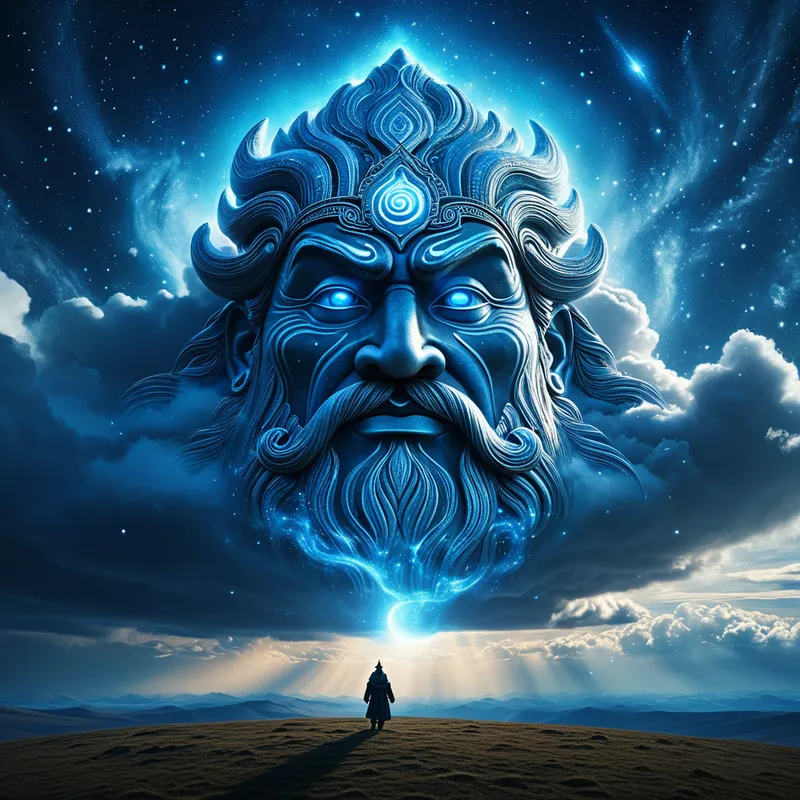
The eternal blue sky, Tengri, presides over all existence, a sacred covenant between the boundless heavens and the living soul of the earth.
The Tale of Tengri Siberian Sky God
Listen. Before the names of rivers, before the paths of the herds were etched into the earth, there was the Tengri. Not a god in a distant palace, but the Sky itself—the endless, breathing vault of blue by day, the fathomless, star-strewn cloak by night. It was the first eye that opened, the first breath drawn. From its silent, watchful expanse, all things were dreamed into being.
Beneath that vast gaze, the Yer-Sub, the moist, fertile Earth, stirred. She was not separate, but the other half of a sacred breath. The Sky Father, Tengri, poured down his light and his rains—his vital spirit, his kut. The Earth Mother, Yer-Sub, received it, and from her dark womb sprang the forests that whispered secrets, the mountains that scraped the belly of heaven, and the rivers that were silver veins of life. Their union was not a story of conquest, but of eternal covenant, a marriage of the boundless above and the nurturing below.
And in the space between, the People emerged. They were not placed upon the earth; they were born of it, children of this sacred marriage. Their first sight was the blue dome of Tengri; their first touch was the grass of Yer-Sub. They felt the wind, which was Tengri's breath, and they drank from springs, which were Yer-Sub's milk. But they were small, and the world was vast and filled with other spirits—the fierce masters of the taiga, the capricious lords of the rivers, the whispering ones in the stones.
A great silence fell, a distance. The People felt alone under the immense, silent sky. They knew the covenant existed, but they could not hear its terms. Then, a chosen one, a man with eyes that reflected stars, climbed the highest Mountain. He fasted until his body was light as a feather, he prayed until his voice became the wind itself. And there, at the roof of the world, where the air was thin and the stars felt close enough to touch, it happened.
The sky did not speak in words. It spoke in a bolt of pure, white Lightning that seared the vision into his soul. It spoke in the orderly march of the constellations—the Star Wolf, the Eagle, the Seven Elders. He saw the great Tree with its roots in the dark earth and its crown in the celestial blue. He understood. Tengri was not a king to be petitioned, but the very fabric of Order itself. His will was the turning of the seasons, the path of the sun, the destiny written in the stars. The covenant was not broken; it was eternal. To live was to participate in it—to honor the sky with uplifted eyes, to honor the earth with respectful steps, and to hold the sacred kut, the spirit given by heaven, as the truest essence of one's being.
The man descended, and he became the first Shaman. He did not bring commandments carved in stone, but a Dance, a drumbeat that mimicked the heart of the earth and the pulse of the stars. Through him, the People remembered. They raised their Stone cairns on high places. They looked to the Moon and the Sun, children of Tengri. They saw their Horse not as mere beast, but as a creature capable of carrying their spirit towards the sky. The silence was filled with meaning. The distance was bridged by a Journey of the soul, always upward, always seeking connection with the eternal blue that witnessed all.
Cultural Origins & Context
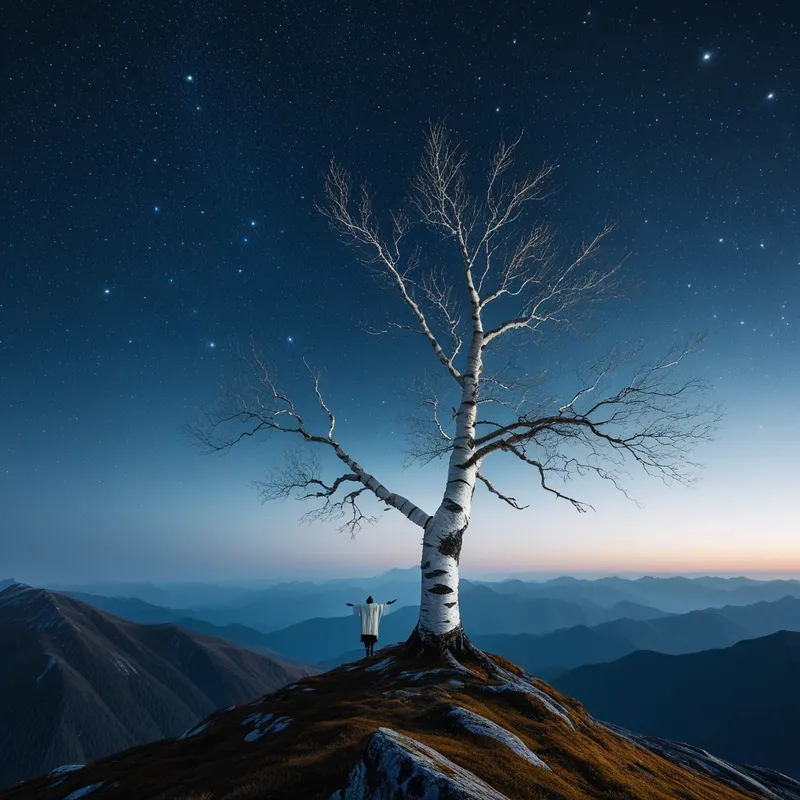
The myth of Tengri is the bedrock of what scholars term Tengrism, a spiritual worldview that permeated the nomadic and pastoral cultures across the Siberian steppes, Central Asia, and into the roots of empires like the Mongols and Turks. It was never a religion with a centralized dogma or scripture. Instead, it was the lived reality of peoples whose lives were literally defined by the sky above and the earth below.
The myth was carried on the wind, in the stories told around fires during the long, star-drenched nights. It was passed down by elders who could read the weather in the clouds and by shamans who served as the living bridges between the human community and the cosmic order of Tengri. Its societal function was profound: it provided a complete cosmological framework that explained existence, sanctioned leadership (rulers were seen as possessing the "mandate" of Tengri), and dictated a code of ecological and social ethics. To live in harmony with the will of Tengri was to live in balance—with nature, with the community, and with one's own destined path.
Symbolic Architecture
At its core, the myth of Tengri is a grand archetypal blueprint of consciousness itself. Tengri represents the transcendent function, the archetype of the Ruler. He is not a personal father-figure, but the impersonal principle of cosmic order, the boundless realm of spirit, and the ultimate context for all life.
The Sky does not command; it encompasses. Our task is not to obey, but to orient ourselves within its vastness.
The Yer-Sub is the necessary counterpart: the unconscious, the body, the matrix of all tangible life and instinct. The sacred marriage is the indivisible wholeness of the psyche—the Self in Jungian terms. The shaman's ascent is the ego's difficult journey toward awareness of this greater Self. The Tree is the spine of this psychic structure, connecting the deep, chthonic roots of the unconscious (instincts, memories) with the lofty crown of spirit (ideals, consciousness). The kut, the celestial spirit granted by Tengri, is the individual spark of the divine, the unique Soul and its Destiny.
The Dreamer's Resonance
When this myth stirs in the modern Dream, it often manifests as profound experiences of verticality and vastness. You may dream of standing on a high mountain, feeling simultaneously insignificant and central under an awe-inspiring, starry sky. You may dream of flying, of being a Bird or riding a Horse upwards, struggling against gravity. These are somatic metaphors for a psychological process: the ego's yearning to transcend its limited, earth-bound concerns and connect with a higher order of meaning.
Conversely, dreams of a suffocating, low, or oppressive sky may signal a feeling of being crushed by impersonal fate, by a "heaven" that feels like cold, deterministic law rather than benevolent order. The dream is asking: Where is your mountain? Where is your connecting Tree? The myth presents the solution not as escape, but as sacred alignment.
Alchemical Translation
The alchemical process modeled here is the transmutation of a life lived by accident into a life lived by design—by Destiny. The first matter is the primal, unconscious unity with nature (life in the valley). The nigredo, the darkening, is the painful feeling of separation, the "great silence" when one feels alone under a meaningless sky—a modern condition of existential anxiety.
The shaman's climb is the arduous work of individuation: leaving the collective valley, facing the solitary ascent of self-discovery (entering the Cave of one's own psyche). The lightning-strike vision on the peak is the illuminatio, a sudden, non-rational understanding of one's place within a vast, meaningful pattern.
The goal is not to become the sky, but to become a clear vessel through which its light can shine onto the specific patch of earth you have been given to tend.
The final stage is not remaining on the mountain, but the return. The alchemist, like the shaman, must bring the celestial blueprint—the recognized Soul and its purpose—back down into the realm of matter, into relationships, work, and community (Yer-Sub). This creates the true "sacred marriage" within the individual: a life where spirit informs action, where consciousness is grounded in being, and where one's personal journey contributes to the cosmic order witnessed by the eternal Tengri.
Associated Symbols
Explore related symbols from the CaleaDream lexicon:
- Sky — The supreme symbol of transcendence, cosmic order, boundless consciousness, and the ultimate context for all existence, representing the domain of Tengri.
- Earth — The embodied counterpart to the sky, representing the unconscious, the body, fertility, and the tangible world of manifestation, embodied by Yer-Sub.
- Mountain — The sacred axis mundi, the place of mediation and ascent where the human spirit climbs to meet the divine and receive illumination.
- Tree — The cosmic pillar connecting heaven, earth, and the underworld; a symbol of the individuating Self, with roots in instinct and branches in spirit.
- Lightning — The sudden, transformative flash of divine insight or power from the sky, breaking through ordinary consciousness to impart understanding.
- Eagle — The divine messenger and psychopomp, representing the soul's ability to soar to celestial heights and gain a transcendent perspective.
- Star — The fixed points of celestial order and fate within the sky, guiding destiny and representing the eternal, archetypal patterns governing life.
- Journey — The fundamental shamanic and psychological process of leaving the ordinary world to seek connection, knowledge, and one's destined role.
- Soul — The kut, the unique, immortal spark of celestial spirit granted by Tengri, which constitutes one's essential being and purpose.
- Destiny — The personal fate or calling written in the cosmic order, which one must discover and align with through the journey of life.
- Order — The fundamental principle of Tengri, representing the natural law, cosmic harmony, and the structured pattern underlying all of reality.
- Horse — The spiritual vehicle, representing the mobilized energy of the soul carrying the rider on their journey between the earthly and celestial realms.