Temu the Evenki Creator Myth Meaning & Symbolism
The Evenki myth of Temu, who wrestled the cosmic serpent to bring order from primordial chaos and create the world from its body.
The Tale of Temu the Evenki Creator
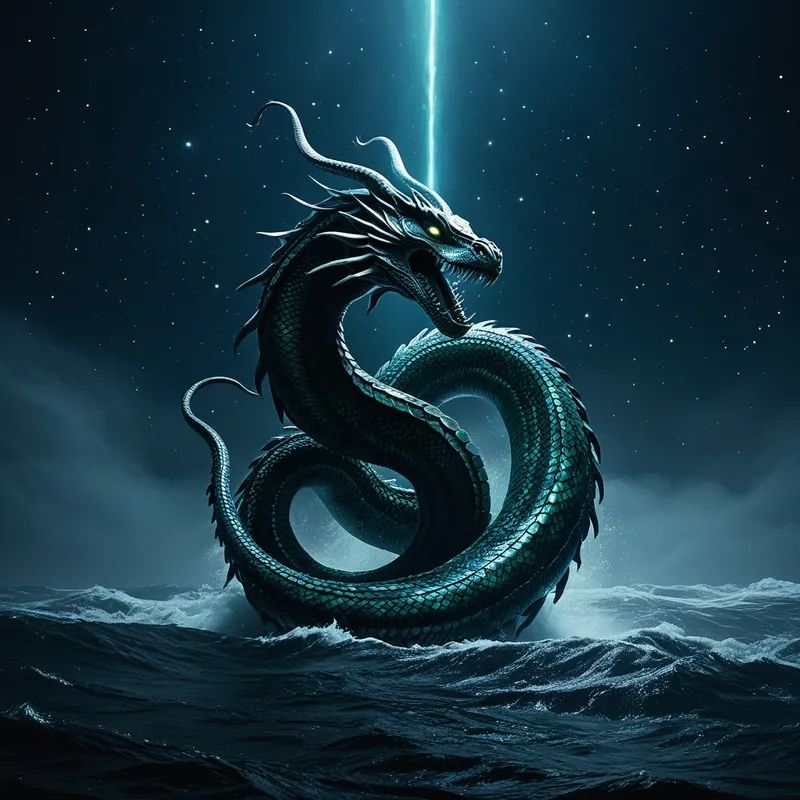
In the time before time, there was only the endless, dark water. No sun cut the gloom, no wind stirred the silence, no land broke the monotony of the deep. There was only the cold, black expanse, and in its depths, a great, coiled presence: a serpent of unimaginable size, the embodiment of primal, formless chaos. It slept, and in its sleep, the world was not.
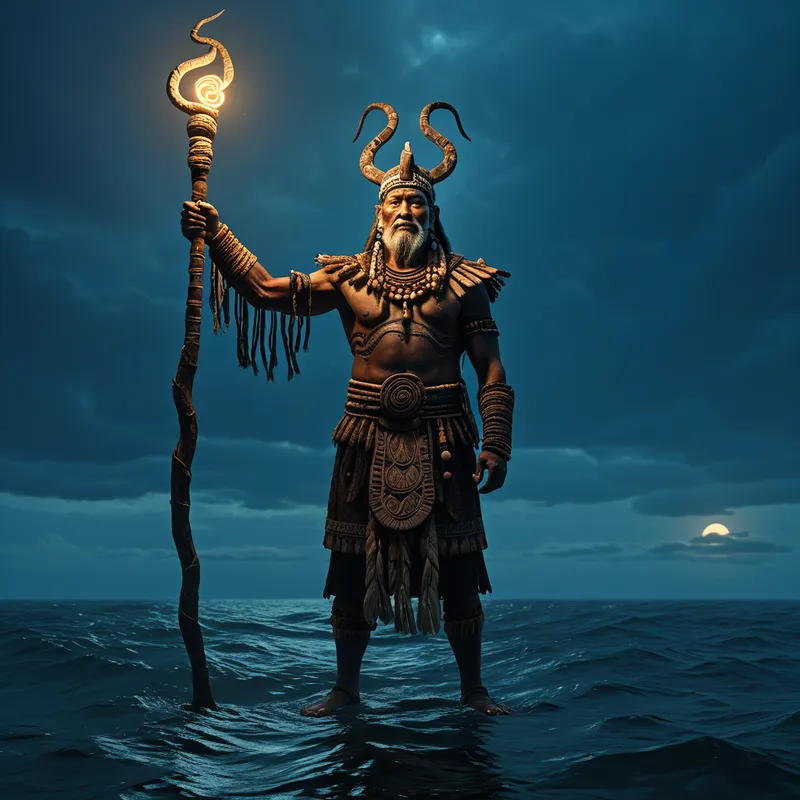
Then, from the void itself, consciousness stirred. He was Temu. He was not born; he was simply there, a point of will in the featureless dark. He looked upon the sleeping serpent and knew that within that chaotic flesh lay the potential for all things. But potential is a prison without action. So Temu, the first being, the first shaman, reached into the waters.
His hands found the serpent’s scales, cold and slick as polished stone. The beast awoke. Its single eye, a disc of pale fire, opened. The waters, once still, erupted into a maelstrom. This was the first conflict, the first motion. Temu did not seek to destroy the serpent, for he understood it was the substance of creation itself. He sought to master it, to wrestle its boundless, writhing energy into a shape that could hold meaning.
For ages unmeasured, they fought. Temu’s strength was the strength of purpose; the serpent’s was the strength of raw, untamed existence. They churned the dark waters into froth, their struggle the only event in the universe. Temu, grasping the colossal form, began to press it down, to stretch it out, to impose the idea of “above” and “below” upon its formless bulk.
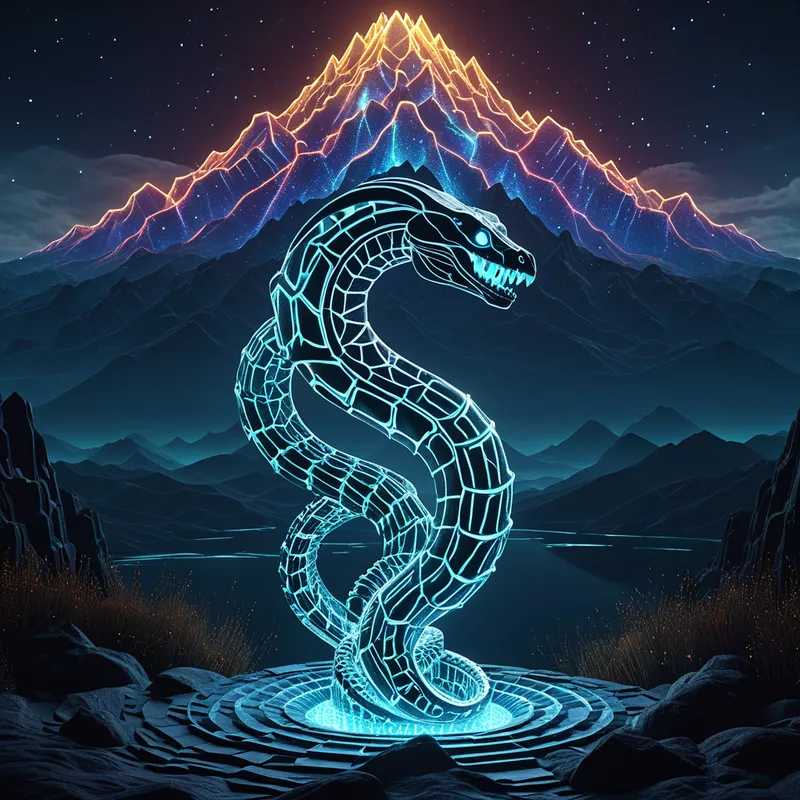
With a final, titanic effort, Temu forced the great serpent to the bottom of the waters. He pressed its body flat against the abyss. Where his hands and knees held it fast, mountains pushed up, forming the bony ridges of the earth. Where the serpent’s flesh was stretched taut, the vast plains and tundra unfolded. Its spine became the mountain ranges that divide the world. Its blood, released in the struggle, did not vanish. It flowed, becoming the first rivers, snaking through the newborn land, carrying the vital essence of the chaotic into the ordered.
The serpent’s skin, now the earth’s crust, grew cold. Moss and lichen, then grasses and mighty larch trees, sprang from it, a fur of life upon the conquered chaos. From its breath, caught and shaped by Temu’s will, came the winds. From its remaining spirit, scattered to the heavens, came the stars and the wandering spirits of the taiga. Temu stood upon the back of the vanquished chaos, now the living world, and the first dawn broke over a creation born from struggle.
Cultural Origins & Context
This myth originates from the Evenki people, whose vast territory stretches across the Siberian taiga. It is a shaman’s myth, passed down not in books but in the flickering light of campfires, in the rhythmic cadence of storytellers who were also spiritual intermediaries. The teller was often the shaman himself, using the story not merely as entertainment but as a sacred map of reality.
Its societal function was profound. It explained the origin of the rugged, river-cut landscape the Evenki traversed. It established a cosmology where order (Middle World) is not a given, but a hard-won achievement maintained atop a foundational layer of active, potent chaos. The myth justified the shaman’s role: like Temu, the shaman must confront and negotiate with chaotic spirit forces (illness, misfortune, the unpredictable elements) to re-establish balance and “create” health and harmony for the community. It taught that the world is alive, literally built from a conscious, subdued being, demanding respect and ritual negotiation.
Symbolic Architecture
The myth presents a fundamental psychic blueprint. Temu represents the emerging conscious ego, the first spark of individual will and differentiating perception. The primordial waters symbolize the undifferentiated unconscious—the state of potential where all things are merged and nothing is distinct. The great serpent is the archetypal force of chaos, the raw, unformed energy of the psyche and the world, which contains both creative potential and annihilating power.
Creation is not an act of making from nothing, but of wrestling meaning from the everything that already is.
The struggle is not a battle to the death, but a process of relation. Temu does not obliterate the serpent; he engages with it, masters its form, and transforms its substance. The serpent’s body becoming the world signifies that our ordered reality—our conscious life, our identity, our culture—is fundamentally constructed from and rests upon the very chaotic, instinctual forces we often fear or deny. The rivers of blood-as-water show that the vital, life-giving forces (emotion, passion, instinct) flow from this foundational struggle.
The Dreamer’s Resonance
When this myth activates in the modern psyche, it often manifests in dreams of titanic, elemental struggles. One may dream of wrestling a large, powerful animal (a bear, a large snake, a shadowy beast) in a vast, empty space or a dark sea. There is a somatic quality of immense exertion, of grappling with something that feels both foreign and intimately part of oneself.
Psychologically, this signals a profound process of psychic structuring. The dreamer is in a “Temu state.” Their conscious self (the dream ego) is engaging directly with a massive, chaotic complex from the unconscious—perhaps a raw talent, a buried trauma, a surge of creative impulse, or a dismantling life change that feels world-ending. The dream is the somatic and symbolic enactment of the effort to “press this chaos down,” to give it form, to create a new inner landscape from this struggle. The exhaustion felt upon waking is the fatigue of this primordial labor.

Alchemical Translation
The myth of Temu is a perfect allegory for the Jungian process of individuation—the journey toward psychic wholeness. The initial state is one of unconscious immersion (the dark waters). The call to consciousness is the arrival of Temu, the nascent ego aware of its separation and its task.
The nigredo, the blackening, is the terrifying confrontation with the serpent—the shadow, the chaos of the personal and collective unconscious. This stage feels like dissolution, a struggle where one’s known world is overturned. The albedo, the whitening, is the moment of mastery and transformation: pressing the chaos into form. Here, the raw material of one’s complexes, wounds, and instincts is consciously engaged and reshaped. The serpent’s body becoming the world is the rubedo, the reddening: the creation of a new, more expansive, and grounded conscious reality infused with the energy of what was once feared.
To individuate is to become the Temu of your own soul, building your conscious world not in spite of your inner chaos, but from its very substance.
For the modern individual, this translates to the hard, creative work of taking a formless life crisis, a burst of chaotic emotion, or a period of profound disorientation and, through conscious engagement (therapy, art, deep reflection, ritual), wrestling it into a new structure of meaning. One does not “defeat” their depression, grief, or rage; one learns its contours, contains its energy, and transforms it into the rivers of empathy, the mountains of resilience, and the fertile soil of a more authentic life.
Associated Symbols
Explore related symbols from the CaleaDream lexicon:
- Serpent — The primordial chaos and raw creative potential that must be engaged and shaped to form the foundation of the conscious world.
- Water — The undifferentiated, dark unconscious from which all consciousness emerges and upon which the created world precariously floats.
- Mountain — The enduring structure and stability formed from the subdued body of chaos, representing the achieved order of the psyche.
- River — The lifeblood and vital energy of the chaotic serpent, now channeled into nourishing, flowing pathways through the ordered world.
- Earth — The tangible reality and grounded existence created from the transformed substance of primal disorder.
- Creator — The archetypal force of conscious will and differentiation that initiates the struggle to bring form from formlessness.
- Chaos — The essential, fertile, yet terrifying state of unlimited potential that precedes and underlies all creation.
- Order — The hard-won structure and meaning imposed upon chaos, which requires constant maintenance and relationship with its source.
- Struggle — The essential, transformative engagement between conscious intent and unconscious force that is the engine of creation.
- Spirit — The animating essence released from the serpent, representing the myriad conscious forces (stars, winds, spirits) that inhabit the created world.
- Forest — The life that grows upon the conquered chaos, symbolizing the complex, living systems that emerge from foundational psychological order.
- Shadow — The personal and collective aspect of the chaotic serpent, the disowned parts of the self that must be wrestled with to build a whole personality.