Tempe Valley Rituals Myth Meaning & Symbolism
A sacred ritual born from Apollo's penance for slaying the serpent Python, cleansing the world of miasma in the pristine valley of Tempe.
The Tale of Tempe Valley Rituals
Hear now the tale not of a hero, but of a god’s remorse, and the valley that washed [the world](/myths/the-world “Myth from Tarot culture.”/) clean.
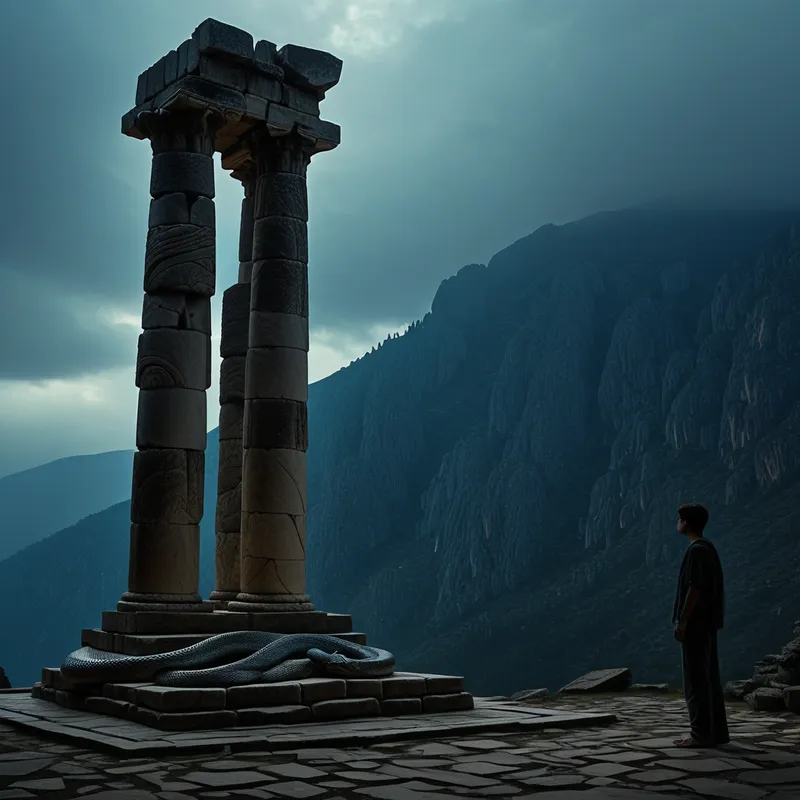
It began with a victory that tasted of ash. The young, blazing Apollo, still new to the terror and awe of his power, descended upon the dark slopes of Parnassus. His target was the great serpent, [Python](/myths/python “Myth from Greek culture.”/), a creature born of the primeval mud after [the great flood](/myths/the-great-flood “Myth from Biblical culture.”/), a [thing](/myths/thing “Myth from Norse culture.”/) of the old, chthonic earth that hissed prophecies from a fissure in the rock. With arrows that were shafts of pure, pitiless sunlight, Apollo slew the beast. [The earth](/myths/the-earth “Myth from Hindu culture.”/) shook with its death-throes. The god claimed the oracle for his own, and they called the place Delphi.
But as Python’s blood seeped into the sacred ground, a cold shadow fell upon Apollo’s radiant heart. He had killed, but this was no titan in open rebellion; this was a guardian, however monstrous, of a sacred place. The act carried a stain, a spiritual pollution the Greeks called miasma. The very air around Delphi grew heavy. The new god of prophecy found his own sanctuary tainted by his deed. The order he sought to impose was cracked at its foundation by the violence of its making.
For eight long years, the brilliant god wandered in a state of exile from his own essence, bearing the weight of the defilement. The world itself felt the discord. Finally, counsel came. He must seek purification. Not in a grand temple, but in the untouched womb of the earth itself: the Vale of Tempe.
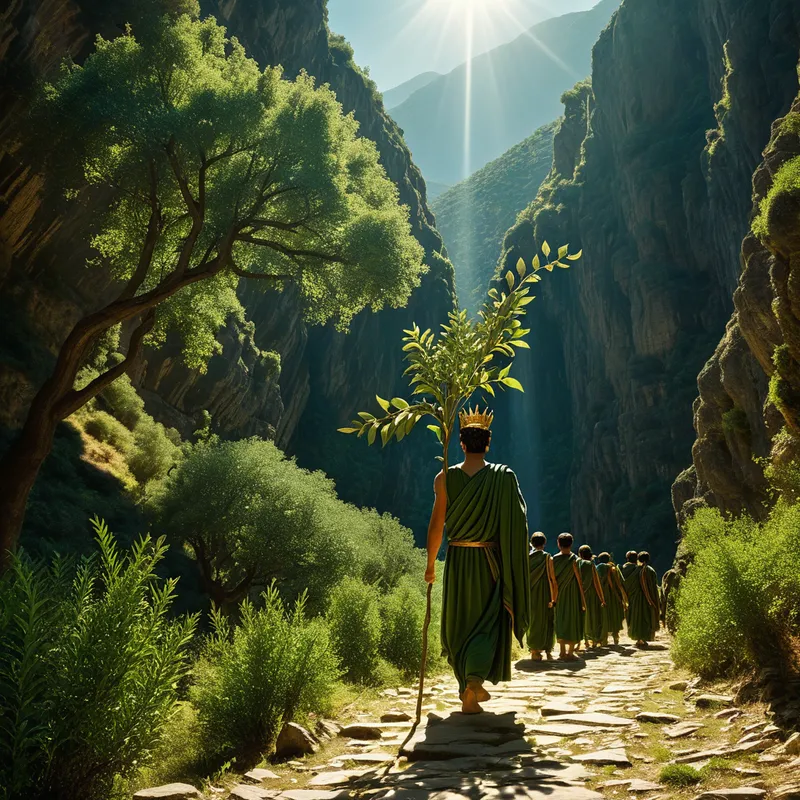
So Apollo journeyed north, to where [the river](/myths/the-river “Myth from Buddhist culture.”/) Peneios had carved a paradise between towering cliffs. Here, the world was still innocent. Laurel trees whispered in the breeze, and the [water](/myths/water “Myth from Chinese culture.”/) ran clear as divine thought. In this pristine temple of nature, the god of civilization performed the rites of the wild. He immersed himself in the cold, rushing waters of the Peneios. He gathered branches from the sacred laurel, the tree that would forever after be his symbol. And in his humility, he established a ritual not for himself alone, but for all who would come after.
When he was cleansed, he did not simply return. He forged a pathway of redemption. He ordained that every eight years, a sacred procession—the Stepterion—would retrace his journey. Chosen youths from Delphi would travel to Tempe. There, they would cut a sacred laurel bough, and with it in hand, become living vessels of the purifying power. They would return to Delphi, not as mere worshippers, but as the very agents of the world’s renewal, sweeping through the streets to cleanse the community of all accumulated miasma. The god’s personal penance became [the polis](/myths/the-polis “Myth from Greek culture.”/)’s periodic rebirth.
Cultural Origins & Context
The myth of the Tempe Valley Rituals is intricately bound to the historical reality of the Delphic cult. It is an aetiological myth of the highest order, providing a divine precedent and narrative backbone for the actual octennial festival known as the Stepterion. This was not merely a local tale but a central pillar in the Panhellenic identity of Delphi, the “navel of the world.”
The story was preserved and transmitted through the hymns sung at Delphi, likely the very Homeric Hymns that detail Apollo’s founding of his oracle. It served a critical societal function: it modeled the proper relationship between even the gods and the immutable laws of cosmic order (Dike). No one, not even the son of Zeus, was above the need for purification after shedding kindred blood. The myth thus legitimized Delphi’s complex purification laws and its role as a center for resolving blood guilt. It transformed a geographical journey (Delphi to Tempe) into a spiritual archetype: exile, purification, and triumphant return, a cycle essential for the health of both the individual and the community.
Symbolic Architecture
At its core, the myth maps the unavoidable psychological [crisis](/symbols/crisis “Symbol: A crisis symbolizes turmoil, urgent challenges, and the need for immediate resolution or change.”/) that follows a necessary but destructive act of creation or conquest. Apollo, the [archetype](/symbols/archetype “Symbol: A universal, primordial pattern or prototype in the collective unconscious that shapes human experience, behavior, and creative expression.”/) of light, reason, and form, must confront the [shadow](/symbols/shadow “Symbol: The ‘shadow’ embodies the unconscious, repressed aspects of the self and often represents fears or hidden emotions.”/) of his own [action](/symbols/action “Symbol: Action in dreams represents the drive for agency, motivation, and the ability to take control of situations in waking life.”/)—the chaotic, earthy [Python](/symbols/python “Symbol: The python represents both fear and fascination, as well as transformation through confronting one’s deeper issues.”/) he slew to establish his domain of conscious order.
The laurel gathered in Tempe is not just a plant; it is the symbol of transformation, where the pain of guilt is alchemized into the authority of hard-won wisdom.
The [valley](/symbols/valley “Symbol: A valley often symbolizes a period of transition or a place of respite between two extremes.”/) itself is a profound [symbol](/symbols/symbol “Symbol: A symbol can represent an idea, concept, or belief, serving as a powerful tool for communication and understanding.”/). Tempe represents the pristine, pre-conscious state of the [psyche](/myths/psyche “Myth from Greek culture.”/)—the untouched natural Self before the complications of [identity](/symbols/identity “Symbol: Identity represents the sense of self, encompassing personal beliefs, cultural background, and social roles.”/) and action. It is the retreat into the inner sanctum where one is stripped of titles and achievements, facing only the raw [truth](/symbols/truth “Symbol: Truth represents authenticity, honesty, and the quest for knowledge beyond mere appearances.”/) of one’s deeds. The eight years of [exile](/symbols/exile “Symbol: Forced separation from one’s homeland or community, representing loss of belonging, punishment, or profound isolation.”/) signify a full cycle of completion, a necessary [period](/symbols/period “Symbol: Periods in dreams can symbolize cyclical patterns, renewal, and the associated emotions of loss or change throughout life.”/) of fermentation and [incubation](/symbols/incubation “Symbol: A period of internal development, rest, or hidden growth before emergence, often associated with healing, creativity, or transformation.”/) before renewal can be authentic. The [ritual](/symbols/ritual “Symbol: Rituals signify structured, meaningful actions carried out regularly, reflecting cultural beliefs and emotional needs.”/) procession, then, is the conscious, deliberate act of re-integrating this purified essence back into the structured world of the [persona](/symbols/persona “Symbol: The social mask or outward identity one presents to the world, often concealing the true self.”/) and [community](/symbols/community “Symbol: Community in dreams symbolizes connection, support, and the need for belonging.”/), ensuring that order is maintained not through suppression, but through periodic, sacred cleansing.
The Dreamer’s Resonance
When this myth stirs in the modern dreamer, it often manifests as a profound sense of carrying a “stain” or a burden that logic cannot erase. You may dream of a beautiful, secluded natural place—a forest glen, a hidden beach, a quiet canyon—that calls to you with an almost painful intensity. The journey to get there in the dream feels arduous, a necessary exile. The act of cleansing in the dream might be literal (bathing in a river, washing hands) or symbolic (discarding a heavy object, burying something).
Somatically, this process correlates with the psychological and physical release of guilt, shame, or the residual energy of a past action you deemed necessary but violent (ending a relationship, leaving a job, setting a fierce boundary). The dream is initiating a liminal process, guiding you to your inner Tempe Valley—a psychic space where you can lay down the armor of your daily identity and allow the waters of the unconscious to wash away the accumulated miasma of life’s conflicts. The rising action is the feeling of burden; the resolution is the dream-image of purification and the gathering of a new, living token (the laurel) to bring back.

Alchemical Translation
The alchemy of the Tempe myth is the transmutation of guilt into responsibility, and of isolated exile into connected ritual. For the modern individual navigating individuation, the slaying of Python represents the crucial, often painful, act of differentiating the conscious self from the possessive grip of the unconscious—slaying the “dragon” of parental complexes, societal expectations, or addictive patterns to claim one’s own inner authority (the “oracle” of true self-knowledge).
The ritual is the conscious act of remembering that every victory creates a shadow, and every creation requires a commensurate act of sacred care to maintain wholeness.
The inevitable miasma is the depression, anxiety, or existential disquiet that can follow such a victory. The alchemical process demands the voluntary “exile”—a retreat into introspection, therapy, solitude, or art—to process the cost. The journey to Tempe is this deep, introspective work. The purification is not an erasure of the deed, but its integration; one accepts the full weight of one’s actions. The return with the laurel is the final stage: you re-enter your world not as the guilty conqueror, but as a purified healer. You bring back the “laurel”—the earned wisdom, the new creative practice, the compassionate insight—and use it to cleanse your own life and, by extension, your circle. The personal penance becomes a gift to the community, completing the cycle from psychic fracture to holistic, responsible power.
Associated Symbols
Explore related symbols from the CaleaDream lexicon: