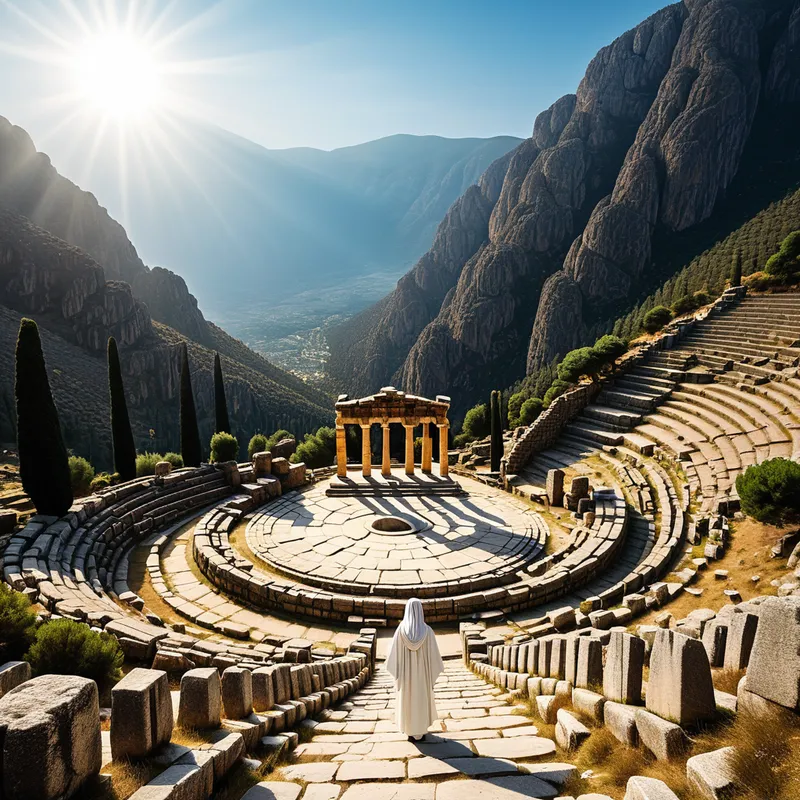
Temenos Myth Meaning & Symbolism
The myth of the sacred precinct, a hallowed space where the divine and human meet, creating a container for ritual, order, and profound psychological transformation.
The Tale of Temenos
Listen. Before the first stone was laid for the towering temple, before [the chorus](/myths/the-chorus “Myth from Theater culture.”/) sang its first hymn, there was a moment of terrifying, electrifying silence. It was not an empty silence, but a thick, potent one, heavy with the breath of a god. A shepherd, his skin smelling of sun and sheep, felt it first—a prickling on his neck, a pressure in the air that made his dog whine and crouch. [The wind](/myths/the-wind “Myth from Various culture.”/) died in the olive grove. The very earth beneath his feet seemed to hum.
He had stumbled not upon a place, but a presence. Perhaps it was where a thunderbolt of Zeus had seared [the earth](/myths/the-earth “Myth from Hindu culture.”/), leaving a scar of power. Perhaps it was where a nymph, fleeing the advance of a god, had been transformed into a spring, her spirit forever mingling with the bubbling [water](/myths/water “Myth from Chinese culture.”/). The location mattered less than the knowing. This spot was different. It was charged. It was other.
Driven by a awe that bordered on fear, the shepherd did not flee. Instead, he did the only [thing](/myths/thing “Myth from Norse culture.”/) that felt right. He cleared the brush with trembling hands. He gathered stones from the creek bed—not to build, but to mark. One by one, he placed them in a rough circle, a line between [the world](/myths/the-world “Myth from Tarot culture.”/) of his daily toil and this sudden, overwhelming slice of the divine. He poured the last of his water-skin onto a flat rock in the center, a meager offering. As the liquid darkened the stone, the oppressive pressure lifted, replaced by a profound, watchful calm. The boundary was set. The sacred had been acknowledged and contained.
Word traveled, carried on the tongues of poets and the intuition of priests. They came—the seekers of oracles, the bearers of vows, the sick in soul and body. They did not build a grand structure immediately. First, they refined the shepherd’s circle. They set boundary stones, horoi, with solemn ceremony. They declared the space within as abaton—not to be trodden upon carelessly. This was the birth of the temenos. It was not a building, but a relationship, a conversation etched into the landscape. [The temple](/myths/the-temple “Myth from Jewish culture.”/) would come later, a house for the god within this hallowed ground, but the temenos was the primal condition, the sacred agreement between heaven and earth.
Cultural Origins & Context
The concept of the temenos is woven into the very fabric of ancient Greek spirituality and social order. Its origins are prehistoric, emerging from the fundamental human need to negotiate with the unpredictable, numinous forces of the world. Before philosophy, there was ritual; before the city-state, the sacred enclosure.
These precincts were not merely religious sites but the psychological and civic anchors of the community. Every major sanctuary—Delphi, Olympia, Epidaurus—was, first and foremost, a temenos. The myths surrounding their foundation, like the tale of the shepherd, served as their charter stories, explaining their divine election. These stories were passed down through ritual re-enactment, local legend, and the works of poets like Pindar, who sang of the “inviolable groves” of the gods.
Societally, the temenos functioned as a container for the chaotic power of the divine, making it accessible and safe for human interaction. It was a place of asylum, of healing, of political oath-taking, and of pan-Hellenic games. It created a shared center, a literal common ground where the laws of the gods superseded the laws of men, establishing order (kosmos) within a designated slice of the wild (chaos).
Symbolic Architecture
Psychologically, the temenos is a master [symbol](/symbols/symbol “Symbol: A symbol can represent an idea, concept, or belief, serving as a powerful tool for communication and understanding.”/) of the container. It represents the necessary, conscious act of creating a bounded [space](/symbols/space “Symbol: Dreaming of ‘Space’ often symbolizes the vastness of potential, personal freedom, or feelings of isolation and exploration in one’s life.”/) within which transformation can occur. It is the [differentiation](/symbols/differentiation “Symbol: The process of distinguishing or separating parts of the self, emotions, or identity from a whole, often marking a developmental or psychological milestone.”/) of the sacred from the profane, the meaningful from the mundane, [the Self](/myths/the-self “Myth from Jungian culture.”/) from the undifferentiated swirl of the [psyche](/myths/psyche “Myth from Greek culture.”/).
The boundary does not deny the wild; it makes a clearing within it where the soul can be heard.
The act of marking the temenos symbolizes [the ego](/myths/the-ego “Myth from Jungian culture.”/)’s first, crucial [task](/symbols/task “Symbol: A task represents responsibilities, duties, or challenges one faces.”/) in the [individuation process](/symbols/individuation-process “Symbol: The psychological journey toward self-realization and wholeness, integrating conscious and unconscious aspects of personality.”/): setting limits. It is the declaration, “Here, in this space, I will attend.” The rough stones of the [shepherd](/symbols/shepherd “Symbol: A shepherd symbolizes guidance, protection, and the nurturing aspects of leadership, often reflecting the dreamer’s desire for direction or support.”/) are the initial, often clumsy, attempts at self-[reflection](/symbols/reflection “Symbol: Reflection signifies self-examination, awareness, and the search for truth within oneself.”/), at creating a psychic [distance](/symbols/distance “Symbol: Distance in dreams often symbolizes emotional separation, unattainable goals, or the need for personal space and reflection.”/) from overwhelming complexes or unconscious contents (the “[presence](/symbols/presence “Symbol: Presence in dreams often signifies awareness or acknowledgment of something significant in one’s life.”/)” of the god). The [altar](/symbols/altar “Symbol: An altar represents a sacred space for rituals, offering, and connection to the divine, embodying spirituality and devotion.”/) at the center is the nascent point of [consciousness](/symbols/consciousness “Symbol: Consciousness represents the state of awareness and perception, encompassing thoughts, feelings, and experiences.”/), the place of sacrifice and offering where [the ego](/myths/the-ego “Myth from Jungian culture.”/) relates to the larger, autonomous powers of the psyche.
The temenos is also a symbol of wholeness. It is a temenos-abaton—a sacred, entered place. To cross its [boundary](/symbols/boundary “Symbol: A conceptual or physical limit defining separation, protection, or identity between entities, spaces, or states of being.”/) is to step into a state of ritualized being, where different rules apply. This mirrors the psychological state of entering therapy, [meditation](/symbols/meditation “Symbol: Meditation represents introspection, mental clarity, and the pursuit of inner peace, often providing a pathway for deeper self-awareness and spiritual growth.”/), or any deep creative work: one steps out of chronological time ([chronos](/symbols/chronos “Symbol: Ancient Greek personification of time as a destructive, all-devouring force, representing inevitable change, decay, and the cyclical nature of existence.”/)) into meaningful time ([kairos](/myths/kairos “Myth from Global/Universal culture.”/)), where healing and re-ordering can take place.
The Dreamer’s Resonance
When the archetype of the temenos stirs in the modern dreamer, it often manifests as a profound somatic and spatial experience. The dream ego may find itself within a walled garden, a quiet room in a chaotic house, a circle of light in a forest, or even a transparent bubble. The key is the palpable feeling of sanctuary, safety, and separation.
This dream emerges at thresholds. It appears when the psyche is overwhelmed by the “profane” world—the chaos of life demands, identity diffusion, or emotional flooding. The dream is the psyche’s instinctual act of boundary-setting. The somatic sense is often one of relief, a deep exhale within the dream itself. Conversely, dreams where the temenos is violated—its walls crumbling, strangers intruding—signal a crisis of containment. The dreamer’s sense of Self is under siege, their inner sanctuary breached by unconscious forces or external pressures they feel powerless to keep out.
The process underway is one of incubation. The dream temenos is not a place of action, but of being. It is where the soul goes to rest, to be with itself, to allow the fragmented pieces of experience to settle and re-order away from the noise. It is the mind’s sacred grove, and its appearance is a direct message: it is time to create, or honor, a bounded space for your inner life.

Alchemical Translation
The myth of the temenos models the alchemical vas, the sealed vessel in which [the great work](/myths/the-great-work “Myth from Alchemical culture.”/) of psychic transmutation occurs. The individuation journey is not about endlessly expanding into chaos, but about consciously creating a vessel strong enough to hold the opposites warring within us.
The first work of the soul is not to journey outward, but to build a hearth. The fire of transformation will only burn where it is contained.
The modern individual begins this alchemy not by seeking a dramatic hero’s quest, but by performing the shepherd’s simple, courageous act: recognizing the “numinous” within—a disruptive emotion, a creative urge, a traumatic memory—and choosing not to flee or be consumed by it. Instead, we must build our boundary stones. This is the practice of ritual: the dedicated hour for journaling, the regular meditation seat, the therapeutic session, the walk in nature without a phone. These are the horoi of the modern temenos.
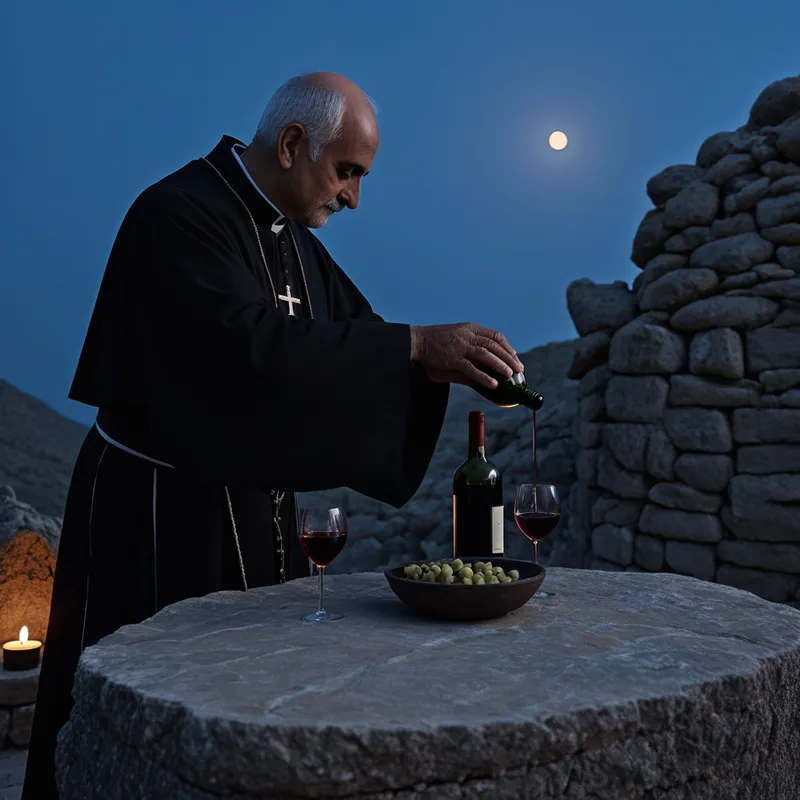
Within this consecrated space, the opus can begin. The libation poured onto the altar is the offering of our attention. In this container, rage can be witnessed without acting out, grief can be felt without drowning, and inspiration can be received without immediate, profane exploitation. The chaotic [prima materia](/myths/prima-materia “Myth from Alchemical culture.”/) of the psyche is given a place to settle, to separate, and eventually, to recombine into a new, more integrated substance—the philosopher’s stone of the realized Self.
The temple—the beautiful, structured identity we show the world—is built only after and only within the secure precinct. To build it on unconsecrated ground is to build on sand. The myth teaches that wholeness is not found in the endless expanse, but in the depth and integrity of the space we consciously, sacredly enclose.
Associated Symbols
Explore related symbols from the CaleaDream lexicon: