Tea Ceremony Vessels Myth Meaning & Symbolism
A myth where the spirit of tea, the alchemist, and the artisan collaborate to forge sacred vessels, transforming raw earth into a conduit for communion.
The Tale of Tea Ceremony Vessels
Listen. Before there were masters of the leaf, before there were quiet pavilions for contemplation, there was the raw earth and the silent longing within it. In the mist-shrouded peaks where the clouds taste of mineral and pine, there lived an artisan whose hands knew the memory of clay. He was a humble man, but his soul was a hollow vessel, echoing with a question he could not name.
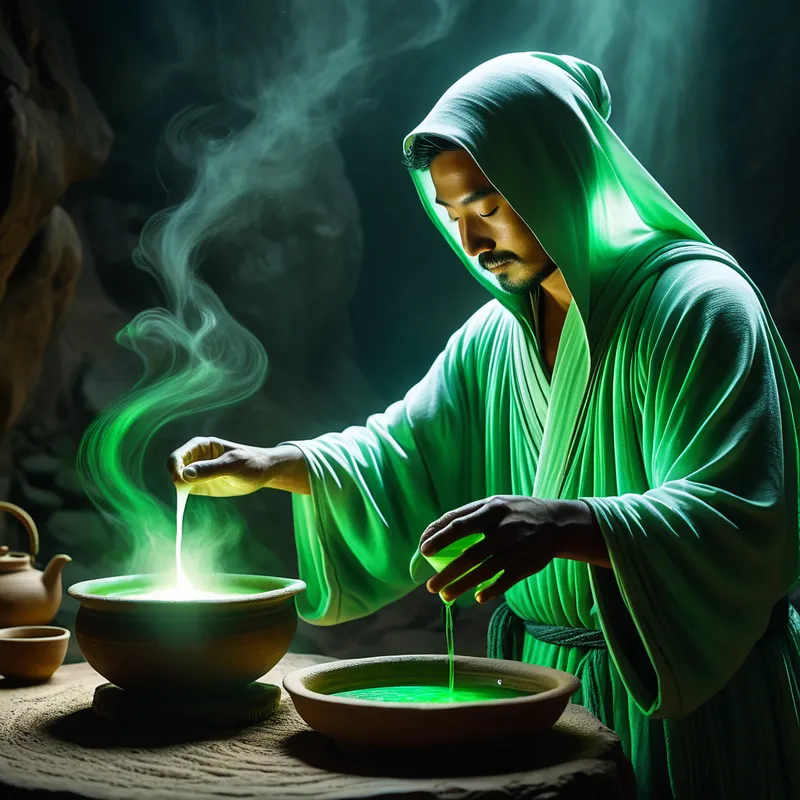
One evening, as he dug in the crimson clay beds of Yixing, he uncovered not just earth, but a pulse. The clay was warm, and when he held it, he heard a whisper like wind through ten thousand tea leaves. It was the voice of Cha Shen, the Spirit of Tea. She appeared not as a goddess of grandeur, but as a presence of profound stillness, her robes the green of new shoots and the white of first steam. "You seek form," she whispered, her voice the sound of a first infusion. "But form must be earned. It must survive the marriage of opposites."
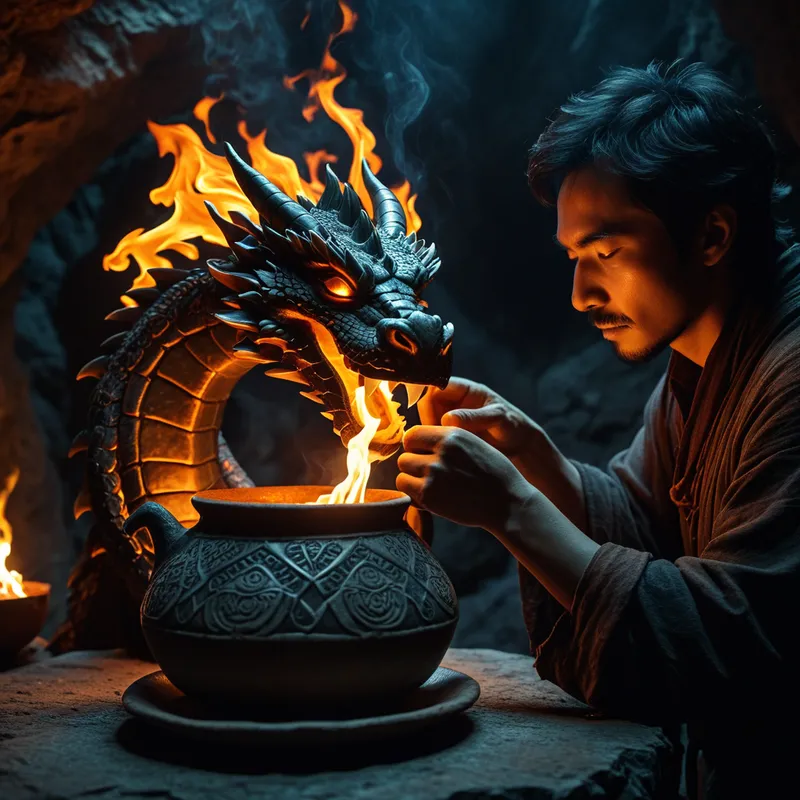
She led him deep into a mountain cavern, where the air throbbed with heat. There, in a chamber lit by the glow of subterranean fire, dwelled the Alchemist of the Crucible, a being whose body seemed forged from the furnace itself. "I am the keeper of the dragon's breath," he rumbled, gesturing to a great kiln shaped like a coiled serpent. "I offer transformation, but it is a trial by fire. Many shapes crack. Many dreams shatter. Will your vessel hold its intention?"
The artisan, his heart trembling yet resolved, presented the form he had shaped—a simple pot, a humble cup. The Alchemist took them, his eyes glowing like coals. "Intention is not enough," he said. "You must give it a soul." And from a pouch, the Spirit of Tea took a single, perfect tea leaf, placing it within the raw clay vessel. "This is the memory of the mountain, the patience of the plant, the promise of the steep. It is the guest who will one day arrive."
The Alchemist sealed the vessel and placed it into the maw of the dragon-kiln. For three days and three nights, the fire roared. The artisan kept vigil, hearing within the flames not destruction, but a fierce conversation—the scream of water fleeing the clay, the song of minerals fusing, the silent, steadfast prayer of the tea leaf within. He witnessed the alchemy: earth confronting fire, stillness meeting chaos, emptiness being forged into potential.
When the fires died to embers, the Alchemist drew forth the vessel. It was no longer mere clay. It had a patina of destiny, a warmth that came from within. The Spirit of Tea approached with a pitcher carved from mountain ice, filled with water from a hidden spring. With infinite care, she poured. The water, meeting the fired clay and the essence of the leaf within, did not simply fill the pot. It was received. It settled, it breathed, it changed. And when she poured from the pot into the cup, the air filled with an aroma that was the very scent of communion—of mountain, cloud, fire, and human hands.
The vessel was complete. Not by creation alone, but by a sacred triad: the Artisan's seeking hand, the Alchemist's transformative fire, and the Spirit's animating essence. It was born to be empty, so that it might be filled. Born to be still, so that it might facilitate flow.
Cultural Origins & Context
This is not a myth recorded in a single classic text like the Shan Hai Jing. It is a living, breathing narrative that emerged from the practice itself, woven by generations of tea masters, potters, and scholars during the Ming and Qing dynasties, when the tea ceremony evolved into a refined spiritual and artistic discipline. It was passed down in whispers across the lang, told as parable by masters to students, and encoded in the very philosophy of Dao and Li (ritual/propriety).
Its function was pedagogical and initiatory. For the artisan, it taught that a true vessel is not merely manufactured; it is midwifed through a collaborative ordeal. For the tea practitioner, it established that every object in the ceremony—the zisha hu, the gong dao bei, the pin ming bei—is a participant, a node in a circuit of energy. The myth sacralized the mundane, transforming craft into a cosmological act and etiquette into a ritual of deep reciprocity between human, element, and plant.
Symbolic Architecture
At its core, the myth maps the necessary components for the creation of a temenos—a sacred container. The Artisan represents the conscious ego, the part of us that feels a longing for purpose and seeks to give it form. His hollow feeling is the initial, necessary emptiness that precedes any true creation.
The vessel is first an emptiness that asks to be filled, then a form that asks to be used, and finally a memory that asks to be shared.
The Spirit of Tea, Cha Shen, symbolizes the anima mundi, the world soul, or the specific archetypal energy we wish to invite into our lives (be it peace, insight, or connection). She provides the "guest"—the content, the meaning, the animating principle. The Alchemist of the Crucible is the terrifying yet necessary force of the unconscious, the Self in its aspect as the transformer. His fire is the ordeal of psyche, the unavoidable suffering, doubt, and heat of confrontation that tests and tempers our initial intentions.
The tea leaf placed inside the vessel before firing is the crucial detail. It signifies that the sacred content must be integrated before the final transformation; our deepest values must be embedded in the structure of our being before it is tested by life's fires. The final act—the pouring of cool water into the fired vessel—is the hieros gamos, the sacred marriage of fire and water, spirit and matter, resulting in the "tea," which is the transformed substance of life itself, now ready to be shared.
The Dreamer's Resonance
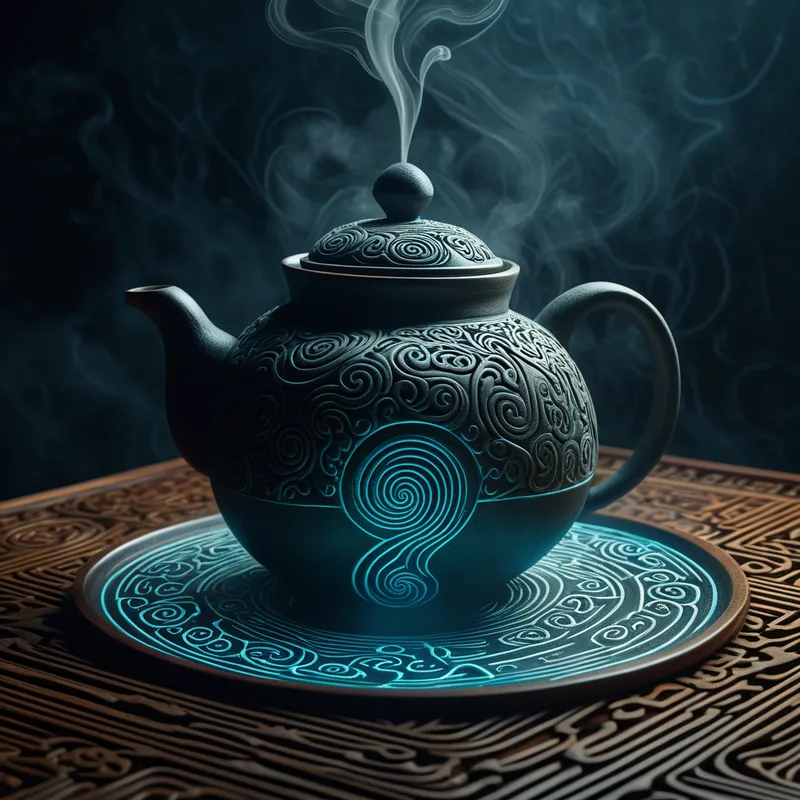
When this myth stirs in the modern dreamer, it often manifests in dreams of fragile yet significant containers: a cherished cup with a hairline crack, a pot that will not pour, or a vessel that changes shape in one's hands. Somatic sensations might include a feeling of being "fired up" with anxiety or a chilling emptiness in the chest—the raw clay before formation.
Psychologically, this dream pattern signals a process of containment development. The psyche is attempting to forge a stronger, more resilient structure to hold complex emotions or a new, fragile identity. The dream of a cracking vessel may reflect the fear of fragmentation under pressure, while the dream of successfully pouring from a perfect pot indicates a nascent ability to translate inner experience (the steeped leaf) into meaningful expression (the poured tea). The dream is an unconscious rehearsal for holding space—for oneself or for another.
Alchemical Translation
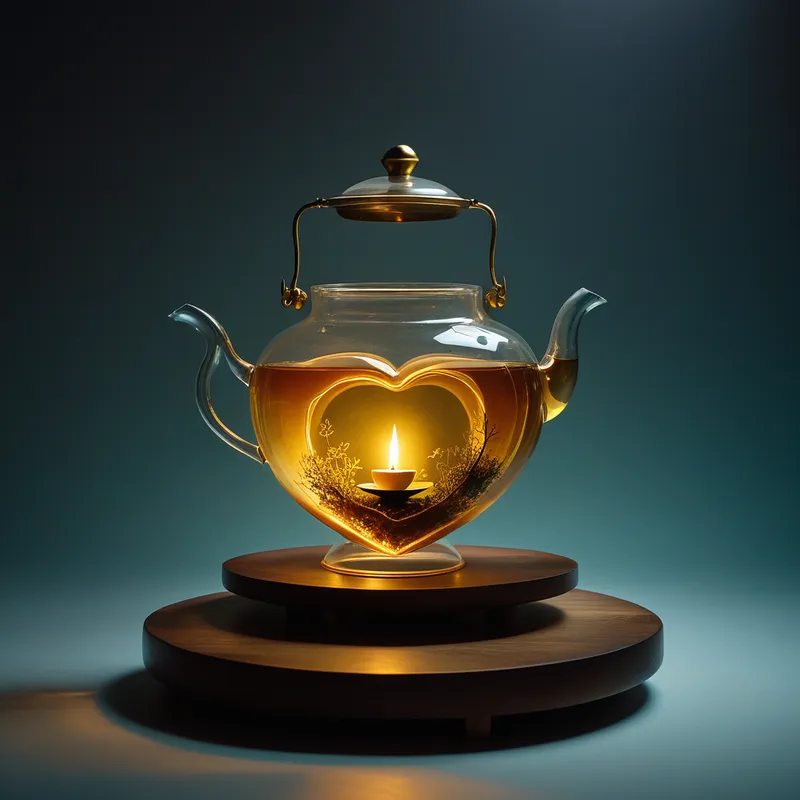
The myth of the Tea Ceremony Vessels is a master blueprint for the Jungian process of individuation—the forging of a personality that can contain opposites. The conscious ego (Artisan) must consciously collaborate with the guiding spirit of meaning (Cha Shen) and then willingly submit its forms to the ruthless, transformative fires of the unconscious (The Alchemist).
Individuation is not self-improvement; it is the kiln-firing of the soul. The ego provides the shape, the Self provides the fire, and what emerges is a vessel fit for a sacred purpose.
For the modern individual, this translates to any profound life transition. Starting a relationship, deepening a practice, or forging a new career path is the shaping of the clay. The inevitable crises, conflicts, and periods of intense stress are the firing. The "tea leaf" we must embed is our core intention or value—why we are doing this. Without it, the vessel, though perhaps aesthetically pleasing, will ring hollow when struck by life's trials. The final "pouring" is the moment of integration, where the transformed self can now receive and give freely, creating a circuit of nourishment. The vessel, once complete, is no longer the goal; it becomes the servant of the flow, the humble yet essential intermediary between the deep self and the world. It teaches that we are not here to be perpetually full, but to be worthy conduits.
Associated Symbols
Explore related symbols from the CaleaDream lexicon: