
Taylorism Myth Meaning & Symbolism
The myth of the Engineer who sought to perfect the world by measuring the soul, creating a kingdom of perfect motion where humanity was forgotten.
The Tale of Taylorism
Listen, and hear the tale of the Measured Kingdom.
In the Age of Smoke and Steel, when the world breathed through chimneys and thought with gears, there arose a prophet-engineer. His name was Frederick Winslow Taylor, and he walked not with kings, but with foremen. He saw the world as it was: a chaotic, weeping wound of wasted motion and spent breath. In every hammer swing, he heard a missed beat. In every worker’s shuffle, he saw a squandered inch.
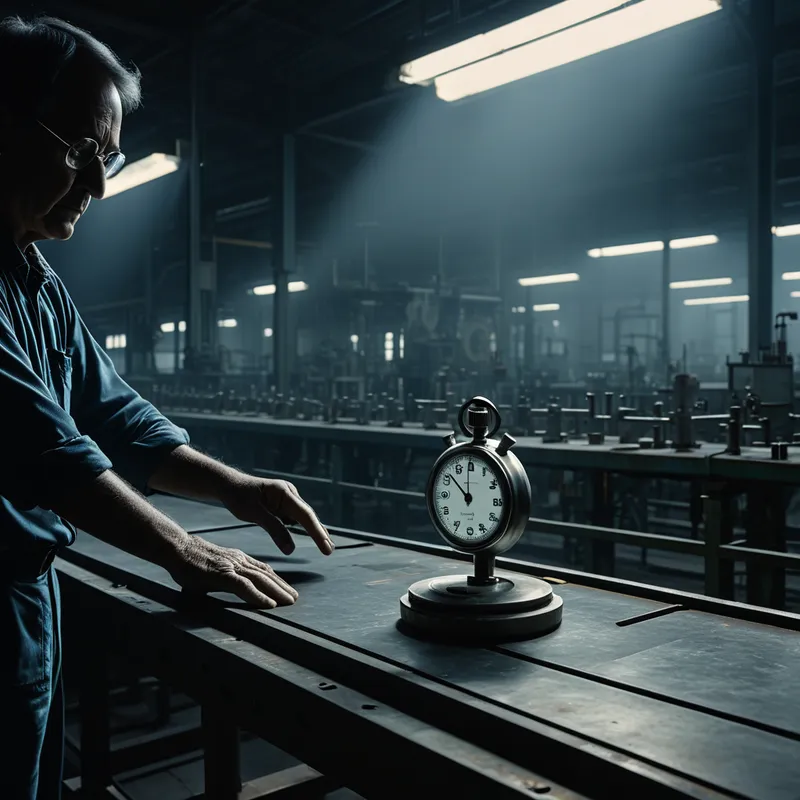
He carried a sacred instrument—a stopwatch—that did not merely tell time, but captured it. He would stand in the cathedral-like vastness of the steel mill or the rhythmic hell of the machine shop, his eyes not on the fiery ingots or the flying shrapnel, but on the dance of the laborer. He would dissect this dance into its constituent atoms: reach, grasp, move, position, release. He sought the One Best Way, the perfect sequence hidden within the flesh, waiting to be excavated like a vein of pure ore.
And he found it. He returned from his vigil with tablets of data, with cycle graphs that mapped the human spirit onto Cartesian grids. He went to the Lords of Production and proclaimed his vision: "I shall banish waste. I shall exorcise guesswork. I will make the human animal a perfect component in a greater machine. There will be peace, for there will be no deviation. There will be prosperity, for every motion will yield its maximum fruit."
The Lords were enthralled. They gave him dominion over the workshops of the world. Taylor’s disciples, the Time-Study Men, fanned out. They timed the pouring of molten iron, the tightening of bolts, the sweeping of floors. They issued their sacred scrolls: the Standard Practice Instruction Cards. The worker was no longer a craftsman with a soul and a secret knowledge; he became The Hand, The Brain, separated and optimized.
For a time, the kingdom flourished. Output rose like a tide. Smoke stacks stood as straight as commandments. The world was measured, predictable, clean. But a silence fell, deeper than any before. The song of the individual tool was gone, replaced by the metronomic thrum of The System. The worker’s knowledge, his knack, his intuitive rhythm—all were declared heresy and stripped away. The body moved with flawless efficiency, but the eyes that guided the hands grew hollow. The soul, unmeasured and unvalued, began to atrophy in its cage of perfect motion.
The myth does not end with a revolt or a thunderous collapse. It ends with a whisper, a pervasive, unanswered question hanging in the oil-scented air: What blooms in a field where every seed is planted at the same depth, at the same time, with the same measured space between? The kingdom of perfect motion was achieved, but at the cost of the very thing it sought to employ: the unpredictable, creative, wasteful, and glorious spark of the human spirit.
Cultural Origins & Context
This is not an ancient myth whispered around campfires, but a modern one enacted on factory floors and encoded in office manuals. It emerged from the heart of the late 19th and early 20th century American Industrial culture, a period of explosive growth, immense wealth, and profound social dislocation. The myth was passed down not by bards, but by managers, engineers, and business school professors. Its scriptures were technical papers, efficiency reports, and training films.
Its societal function was dualistic. On the surface, it promised a utopian resolution to the chaos of early industrialization: an end to conflict between labor and capital through the "objective" science of management. It offered a gospel of prosperity through rational control. Beneath this, however, it served a deeper, more mythic need: to impose order on a terrifyingly complex and rapidly changing world. It was an incantation against uncertainty. By reducing the messy, organic process of work to a series of controllable, measurable units, it created an illusion of dominion over the fundamental anxieties of existence—time, effort, and mortality itself.
Symbolic Architecture
At its core, the myth of Taylorism is a profound drama about the psyche's relationship with its own structure. The Engineer represents the hyper-developed, rational Logos principle. He is the part of us that desires absolute control, clarity, and predictability. He seeks to conquer the inner wilderness of instinct, emotion, and "wasteful" creativity.
The stopwatch is not a tool for telling time, but for consuming it. It transforms the flowing river of duration into discrete, ownable parcels.
The Hand symbolizes the dismembered psyche. The myth enacts a brutal psychic splitting: the intuitive, embodied knowledge (the craft) is severed from the executing body. This is the shadow of specialization—not just of labor, but of the soul's faculties. The cycle graph is thus a mandala of control, a geometric prison meant to contain the wild, dancing energy of life itself.
The ultimate symbol is The System—the perfect, self-sustaining machine. It represents the ego's inflation, the belief that consciousness can and should engineer the totality of the self and the world. Its tragedy is that in its quest for flawless operation, it must exclude the very elements that give life meaning: spontaneity, relationship, mystery, and the sacred inefficiencies of the heart.

The Dreamer's Resonance
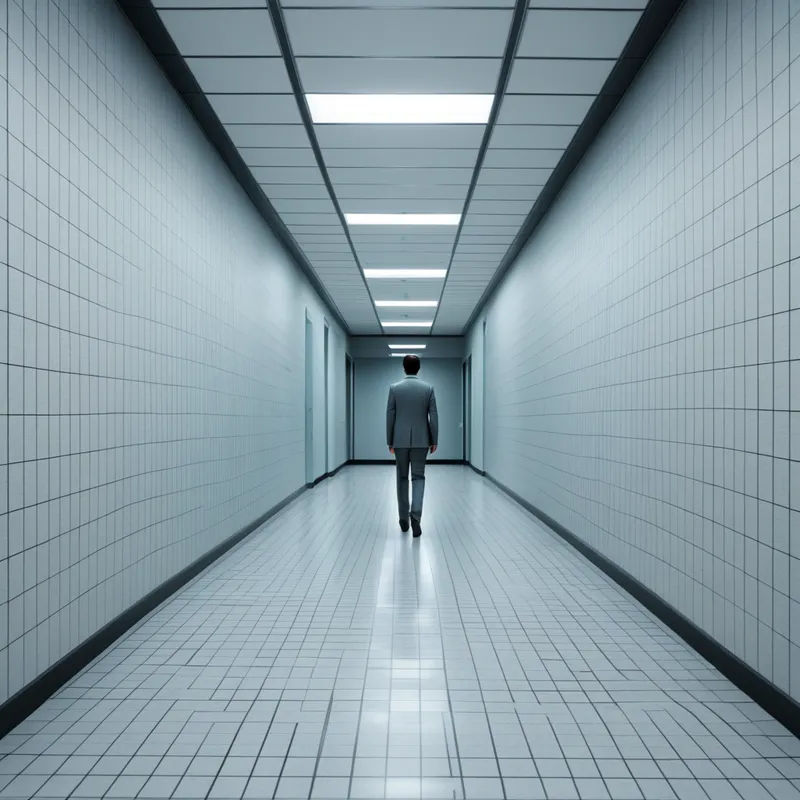
When this myth stirs in the modern dreamer, it rarely appears as factories or stopwatches. It manifests as the architecture of a trapped psyche. One may dream of endless, identical corridors (the standardized process), of being forced to perform a simple, meaningless task with excruciating precision (the time-study), or of a faceless authority figure recording one's every move (the internalized Time-Study Man).
Somatically, this can feel like a profound rigidity—a tightness in the neck and shoulders, the jaw clenched as if holding a prescribed position. Psychologically, it is the process of confronting the inner Manager. This is the psychic complex that demands maximum output from every minute, that berates the self for "wasted" time on rest, play, or unstructured thought. The dream is a signal from the soul that it is being forced into a production schedule, that its natural rhythms are being violated. The anxiety in such dreams is the anxiety of a spirit measured solely by its utility, screaming to be valued for its mere existence.
Alchemical Translation
The alchemical journey modeled by this myth is not one of embracing Taylorism, but of integrating its lesson to move beyond its tyranny. The initial stage, nigredo, is the blackening: the realization of one's own enslavement to internalized systems of efficiency, self-optimization, and relentless self-measurement. The ego, identified with the Engineer, must see the hollow kingdom it has built.
The albedo, or whitening, involves a conscious recovery of the dismembered Hand. This is the practice of re-inhabiting the body, honoring idle time, engaging in "wasteful" creativity without a goal, and reclaiming the intuitive knowledge that exists outside of data sets. It is the rehabilitation of the soul's craft.
The transmutation occurs when the stopwatch is not destroyed, but repurposed. It becomes a tool for observing one's own natural rhythms, not for imposing foreign ones.
The final stage, rubedo, is the reddening or golden dawn. Here, the conscious mind (the Engineer) and the embodied, intuitive soul (the Worker) are reconciled. One develops a personal system—a unique, organic structure that supports life rather than demanding its sacrifice. Order serves vitality, not the other way around. The individual becomes the true Ruler of their own inner kingdom, not by enforcing a rigid, universal standard, but by cultivating a wise and flexible order that allows for both productivity and poetry, for both efficiency and enigma. The triumph is not the perfect machine, but the whole human.
Associated Symbols
Explore related symbols from the CaleaDream lexicon: