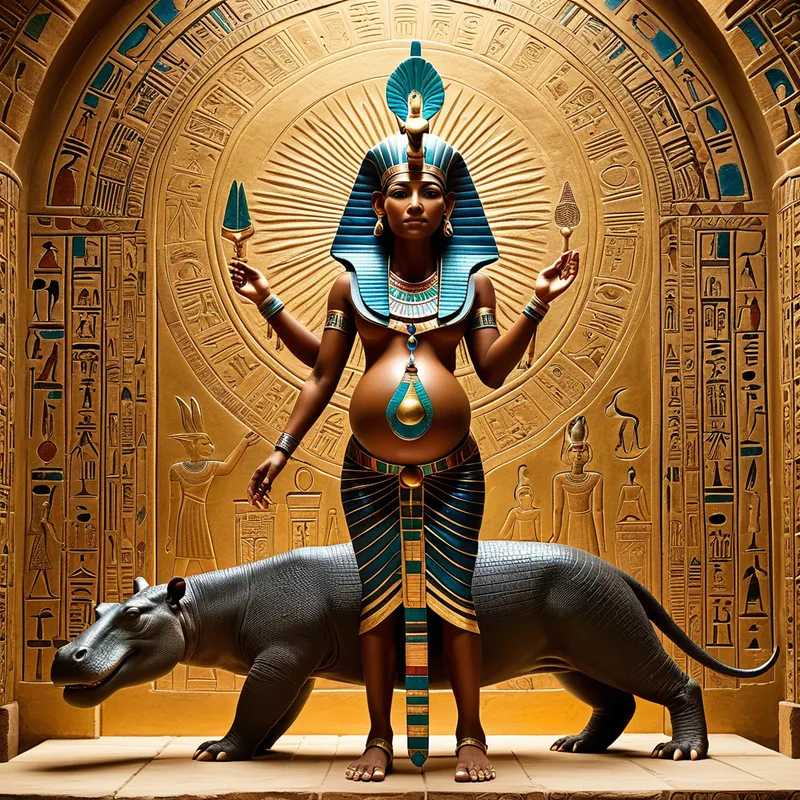
Taweret Myth Meaning & Symbolism
The story of the fearsome yet benevolent hippopotamus goddess who protects mothers and children, embodying the sacred chaos of creation and transformation.
The Tale of Taweret
Hear now the tale of the Great One, the Lady of the Horizon, she whose roar is the first cry of life and whose shadow is a sanctuary. In the time when the world was still wet from the waters of Nun, before the sun-god Ra had fully mastered his daily journey, there dwelled in the liminal marshes a power both terrifying and tender.
She was not born of the orderly pantheon that ruled from sun-baked temples. Her domain was the murky, fecund Nile, where lotus blossoms unfurled and crocodiles slept in the mud. Her form was a testament to the raw creativity of existence itself: the immense, rounded body of the river hippopotamus, heavy with the promise of life; the fierce, protective claws of the desert lioness; and the armored, watchful back of the primeval crocodile. Her name was whispered in the reeds: Taweret.
The people of the black earth knew her as a paradox. By day, the male hippopotamus was a demon of chaos, Seth's creature, who could capsize a reed boat with a snap of its jaws. But by night, in the hidden spaces where women labored to bring forth the future, she was present. Her image was painted on beds and carved into headrests. Her rounded belly, heavy and low, mirrored the shape of the pregnant woman. Her bared teeth, which could shatter bone, were not a threat to the mother, but a warning to any lurking demon or maleficent spirit that dared approach the sacred threshold of birth.
The story is not of a battle fought on a distant plain, but of a vigil kept in a small, lamplit room heavy with the scent of sweat and myrrh. The conflict was the silent, cosmic struggle between non-being and being, the perilous journey of a soul from the Duat into the land of the living. The rising action was each contraction, a wave of the primordial Nun itself. And in that charged darkness, Taweret stood guard. She did not fight with a spear, but with her sheer, immovable presence. She was the wall against chaos. She was the embodiment of the protective magic, the heka, that turned the most vulnerable moment into a fortress.
The resolution came not with a shout, but with a breath—a new, thin wail that pierced the stillness. Then, Taweret’s fearsome visage would seem, for a moment, to soften. The danger had passed; the guardianship was complete. The child was in the mother’s arms, and the goddess would retreat back into the amulet around the neck, the painting on the wall, waiting once more in the fertile, chaotic, life-giving dark.
Cultural Origins & Context
Taweret’s veneration sprang not from the state theology of pharaohs and cosmic order (ma'at), but from the intimate, domestic sphere. She was a goddess of the people, of the home, and of the women’s quarters. Her origins are likely pre-dynastic, rooted in the animistic awe of the hippopotamus, the mightiest creature of the Nile. Unlike the distant, celestial gods, Taweret’s power was immanent and immediate.
Her myth was passed down not through formal priestly recitations in Karnak, but through the oral traditions of midwives and mothers. Her story was told in gestures: the placement of a hippopotamus figurine in a room, the painting of her form with ochre on a pot sherd placed near the bed. She was a constant in the lifecycle. She was invoked during pregnancy, her clay figurines often found buried in house foundations as protective deposits. In death, she reappeared, her image on magical "wand" or "knife" artifacts made of hippopotamus ivory, used to cast a protective circle around mother and child, defending them from the spiritual dangers that mirrored the physical ones.
This deeply embedded, popular worship was eventually absorbed and formalized. She became associated with the northern sky, a protective constellation. She was linked to the god Khnum, who fashioned children on his potter’s wheel, and to the household god Bes, forming a potent triad of creation and protection. Thus, Taweret’s function was clear: to manage the sacred chaos of creation, to be the fierce guardian at the most perilous and transformative of all human thresholds.
Symbolic Architecture
Taweret is a masterful symbolic construct, a divine amalgamation that speaks directly to the psyche’s understanding of creation and protection. She is not a denial of danger, but an integration of it.
Her hippopotamus body symbolizes immense, primal, generative power. The hippopotamus is a creature of both water and earth, of the subconscious depths and the tangible world. Its maternal ferocity was legendary; to come between a mother hippo and her calf was to invite annihilation. Taweret harnesses this raw, biological, and territorial power for protection.
The lioness limbs connect her to the solar, fiery power of deities like Sekhmet. This is active, aggressive defense. The crocodile back, often belonging to the fearsome Sobek, represents an impenetrable armor and a connection to the ancient, reptilian instincts of survival. She does not eliminate these "dangerous" aspects of nature; she wears them as her own skin.
The true protector is not one who has never known fear, but one who has fashioned their armor from the very substance of their own perceived monsters.
Her constant attributes are the Sa, the knot of protection, and often the ankh, the key of life. Psychologically, Taweret represents the Complexio Oppositorum—the union of opposites. She is chaos and order, danger and safety, the wild animal and the nurturing mother. She embodies the understanding that creation is not a sterile, safe event. It is a tumultuous, risky, and profoundly powerful act that requires a guardian who is not afraid of the dark.
The Dreamer's Resonance
When the archetype of Taweret stirs in the modern dreamer’s psyche, it signals a profound interior process of gestation and impending birth. This is rarely a literal pregnancy, but a symbolic one. The dreamer may be on the threshold of bringing something new into the world: a creative project, a new identity, a healed part of the self, or a major life transition.
Dreams of hippopotami, especially in water, of hybrid creatures, or of feeling a powerful, non-human presence in a time of vulnerability can be her calling card. The somatic feeling is one of immense, almost overwhelming pressure and potential—a sense of being "heavy with purpose." There may be concurrent anxiety, the fear of the unknown outcome, of the "demons" of failure, judgment, or exposure.
Taweret’s appearance in dreams suggests the psyche is mobilizing its deepest, most instinctual resources for this inner birth. The dreamer is not being comforted with platitudes; they are being fortified. The message is that the very qualities they might perceive as awkward, ungainly, or even frightening—their raw emotional power, their defensive anger, their primal instincts—are being reconfigured into a protective circle around the nascent self. She appears when we must learn to protect our own vulnerability with a fierceness we did not know we possessed.

Alchemical Translation
The myth of Taweret provides a potent model for the alchemical process of psychic transmutation, central to individuation. The prima materia, the raw, chaotic stuff of the soul, is often experienced as our own unintegrated instincts, fears, and seemingly "monstrous" aspects—our inner chaos, our personal Seth.
The first stage is Recognizing the Chaos: Acknowledging the pregnant, potent, but frightening power within (the hippopotamus in the Nile).
The alchemical operation is Coniunctio Oppositorum (The Union of Opposites): This is Taweret’s very form. The process involves not expelling the dangerous crocodile (ruthlessness, survival fear) or the fierce lioness (righteous anger, assertiveness), but integrating them. We learn to let these aspects protect our core vulnerability and creativity, rather than letting them run amok or be repressed.
Individuation is the act of giving birth to the Self, and it requires a midwife who is acquainted with the shadows of the delivery room.
The Transmutation occurs at the threshold—the moment of labor. Here, the assembled "monsters" are alchemized into guardians. Personal history, trauma, and shadow are not discarded; their energy is redirected to form an impassable boundary against further psychic harm, allowing the new consciousness to emerge.
The final Coagulatio (the embodiment) is the successful "birth": the new attitude, the creative work, the more authentic life, now held in a psyche that has learned to protect itself from within. The individual becomes their own Taweret, a self-contained system where the raw materials of the soul are organized into a fierce, loving, and impregnable sanctuary for the continuing journey of becoming.
Associated Symbols
Explore related symbols from the CaleaDream lexicon: