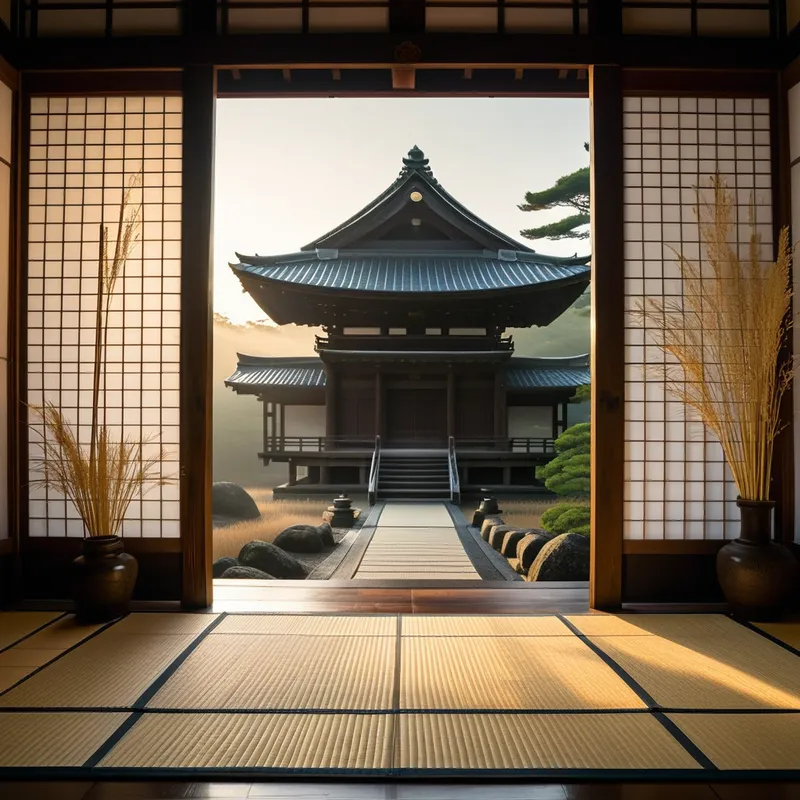
Tatami in Shinto Shrines Myth Meaning & Symbolism
A myth of the first tatami mat, woven from the breath of the kami to create a sacred boundary between the mundane and the divine.
The Tale of Tatami in Shinto Shrines
Listen, and let the silence of the shrine deepen. Before there were halls of wood and gates of vermilion, there was [the earth](/myths/the-earth “Myth from Hindu culture.”/)—raw, untamed, and humming with the presence of the kami. The people walked upon it, but their feet were heavy with the dust of [the world](/myths/the-world “Myth from Tarot culture.”/), the grime of toil, and the subtle stain of mortal thought. Their prayers, sincere as they were, rose from soiled ground and often scattered like leaves in a wind, unheard by the celestial ones.
The great Amaterasu-Ōmikami, whose light reveals all truth, saw this struggle. Her heart, vast as [the sky](/myths/the-sky “Myth from Persian culture.”/), held compassion for her children’s yearning. Yet, the divine realm of Takamagahara and the mortal world of Ashihara no Nakatsukuni were distinct. A bridge was needed, not of stone or wood, but of intention—a defined space where human vulnerability could meet divine grace without being consumed.
She summoned Hayanagi-no-Kami, the spirit of swift skill and delicate making. “The people seek a foothold in the sacred,” Amaterasu said, her voice the soft light before dawn. “They need a ground that is not ground, a piece of the world made conscious and clean.”
Hayanagi-no-Kami journeyed to the marshes where the igusa reeds grew tall, drinking deep of both earth and [water](/myths/water “Myth from Chinese culture.”/). He did not cut them with a blade of metal, but with a whispered prayer. He gathered them under the watchful eye of [Tsukuyomi-no-Mikoto](/myths/tsukuyomi-no-mikoto “Myth from Japanese culture.”/), whose silver light reveals purity. Then began the weaving. This was no ordinary craft. As his fingers flew, he breathed into each crossing of reed and binding of hemp the essence of harae—ritual purification. The mat began to form, not as a dead [thing](/myths/thing “Myth from Norse culture.”/), but as a living membrane.
With the final stitch, the first [tatami](/myths/tatami “Myth from Japanese culture.”/) lay upon the earth. It did not simply sit there; it activated. The air above it grew still and sharp. The chaotic energies of the land smoothed at its edges. It was a rectangle of perfect order, smelling sweetly of sun-dried grass and emptiness. It was an invitation and a declaration: Here, and nowhere else. This space is prepared. Step from the profane onto the sacred.
The people, guided by the priests, learned. They would cleanse their hands and mouth, approach the shrine, and pause at the edge of the tatami. With a collective breath of release, they would step up. The moment their feet touched the woven surface, a subtle shift occurred—the worries of the field, the calculations of [the market](/myths/the-market “Myth from Various culture.”/), the heat of anger, all seemed to drain away, absorbed and neutralized by the mat. Upon this prepared ground, their prayers became clear threads, rising unimpeded to the ears of the kami. The tatami was not a floor; it was the first and most fundamental altar.
Cultural Origins & Context
This foundational myth, passed down through the oral traditions of kannushi and ritualists, is less a story with a dramatic plot and more an etiological narrative explaining a core material reality of Shinto practice. Its origins are woven into the very fabric of Japan’s indigenous spirituality, which is profoundly animistic and place-specific. The myth formalizes the ancient understanding that sacredness (kami) is not everywhere equally; it must be invited, contained, and maintained through human ritual action.
The tatami, in its historical development from aristocratic bedding to standardized flooring in the shoin-zukuri style, always retained this aura of defined, purified space. In the shrine context, its function is paramount. The myth was told not to entertain, but to instruct. It taught that the act of preparing the space—sweeping, purifying, laying the mat—was as holy as the prayer itself. It societal function was to instill a somatic discipline of reverence. The feel of the tatami underfoot, its firm yet giving texture, its distinct smell, all became sensory cues triggering a psychological shift from the ordinary to the non-ordinary state of consciousness required for communion.
Symbolic Architecture
At its [heart](/symbols/heart “Symbol: The heart symbolizes love, emotion, and the core of one’s existence, representing deep connections with others and self.”/), the myth of the sacred tatami is a profound [meditation](/symbols/meditation “Symbol: Meditation represents introspection, mental clarity, and the pursuit of inner peace, often providing a pathway for deeper self-awareness and spiritual growth.”/) on the [psychology](/symbols/psychology “Symbol: Psychology in dreams often represents the exploration of the self, the subconscious mind, and emotional conflicts.”/) of the [boundary](/symbols/boundary “Symbol: A conceptual or physical limit defining separation, protection, or identity between entities, spaces, or states of being.”/). It symbolizes the [human](/symbols/human “Symbol: The symbol of a human represents individuality, complexity of emotions, and social relationships.”/) necessity to create conscious containers for experience. The untamed [earth](/symbols/earth “Symbol: The symbol of Earth often represents grounding, stability, and the physical realm, embodying a connection to nature and the innate support it provides.”/) represents the undifferentiated [psyche](/myths/psyche “Myth from Greek culture.”/)—potentially fertile but chaotic, containing both creative and destructive impulses without distinction.
The sacred tatami is the ego, not as a wall, but as a threshold. It is the consciously constructed platform from which the self can safely encounter the vastness of the unconscious, the kami within.
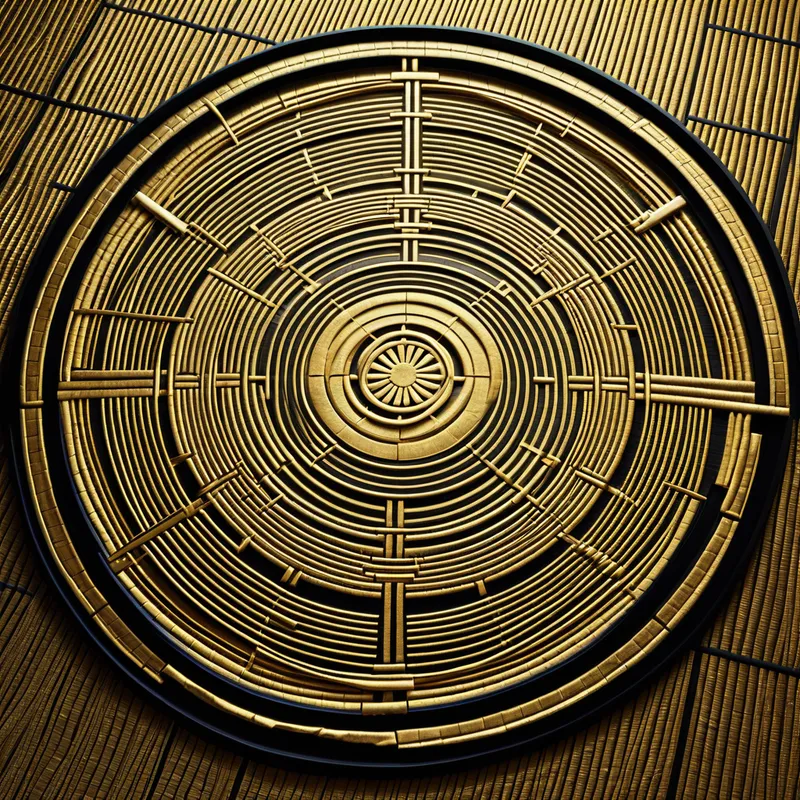
The weaving process is key. The vertical and horizontal reeds symbolize the [intersection](/symbols/intersection “Symbol: An intersection symbolizes the crossroads of decision-making, presenting choices and the potential for change.”/) of the celestial and the earthly, [spirit](/symbols/spirit “Symbol: Spirit symbolizes the essence of life, vitality, and the spiritual journey of the individual.”/) and matter. The binding represents the integrating function of [consciousness](/symbols/consciousness “Symbol: Consciousness represents the state of awareness and perception, encompassing thoughts, feelings, and experiences.”/), which gathers disparate elements of [life](/symbols/life “Symbol: The symbol of ‘Life’ represents a journey of growth, interconnectedness, and existential meaning, encompassing both the joys and challenges that define human experience.”/) and self into a coherent, functional whole. This created [rectangle](/symbols/rectangle “Symbol: The rectangle symbolizes stability, order, and structure, representing the physical and metaphorical boundaries in life.”/) is a [temenos](/myths/temenos “Myth from Greek culture.”/)—a sacred precinct. Psychologically, it represents the need for [ritual](/symbols/ritual “Symbol: Rituals signify structured, meaningful actions carried out regularly, reflecting cultural beliefs and emotional needs.”/), routine, and deliberate practice to create a stable inner [space](/symbols/space “Symbol: Dreaming of ‘Space’ often symbolizes the vastness of potential, personal freedom, or feelings of isolation and exploration in one’s life.”/) from which one can face the contents of the unconscious (the divine/the [shadow](/symbols/shadow “Symbol: The ‘shadow’ embodies the unconscious, repressed aspects of the self and often represents fears or hidden emotions.”/)) without being overwhelmed. It is not about keeping things out, but about creating a defined here from which to engage with the there.
The Dreamer’s Resonance
When this myth pattern surfaces in modern dreams, it often manifests as dreams of thresholds, clean rooms, or specific, textured floors. To dream of standing at the edge of a tatami mat, unable to step onto it, may signal a feeling of spiritual or psychological unpreparedness. The dreamer may be facing a profound inner truth or a necessary life transition but feels “soiled” by guilt, shame, or unresolved conflict. The pristine mat highlights their perceived impurity.
Conversely, to dream of freely walking upon a vast, peaceful tatami expanse suggests a successful integration. The dreamer has established a stable, purified center within themselves from which to operate. A dream of a tatami mat becoming unravelled or dirty is a powerful somatic alarm. It indicates a collapse of personal boundaries, a violation of one’s sacred space, or a regression into psychic chaos where the conscious structure can no longer contain the emerging contents. The body in the dream may feel heavy, stuck, or acutely aware of the texture beneath the feet, pointing to a somatic process of grounding or its failure.
Alchemical Translation
The myth models the individuation process as a sacred craft. The initial state is one of undifferentiated existence, where the individual is subject to every passing wind of emotion and external demand—the “soiled ground.” The call to individuation is Amaterasu’s compassion: the innate pull of [the Self](/myths/the-self “Myth from Jungian culture.”/) toward wholeness.
The alchemical work is the weaving. The raw materials—our memories, experiences, instincts (the reeds from the marshy unconscious)—must be gathered with respect (prayer, not violence). The act of weaving is the arduous, patient work of analysis, reflection, and conscious living. We bind our disparate parts with the thread of attention and intention.
The finished tatami is the achieved personality—a resilient, purified structure that provides a base for the final, ongoing operation: the transcendent function. It is the platform for the meeting of the ego and the Self.
Stepping onto this inner tatami is the moment of active engagement with the numinous. It is the daily practice of meditation, journaling, or creative work done from a centered, prepared state. The struggle in the myth is not a battle against a monster, but the disciplined struggle to create and maintain this clear space amidst the entropy of life. The [triumph](/myths/triumph “Myth from Roman culture.”/) is the moment of clear prayer—the unimpeded dialogue between the individual consciousness and the guiding, transpersonal center of the psyche. The tatami does not become the destination; it becomes the sacred ground from which the endless journey of becoming is continually launched.
Associated Symbols
Explore related symbols from the CaleaDream lexicon: