Tamoi the Grandfather Creator Myth Meaning & Symbolism
The myth of the primordial Grandfather who shaped the world from the primal waters, establishing order, culture, and the sacred breath of life for all beings.
The Tale of Tamoi the Grandfather Creator
In the time before time, there was only the Great Water, Ine Wabu, dark, deep, and dreaming. It held all things within it, but nothing was separate. There was no above, no below, only a silent, waiting fullness.
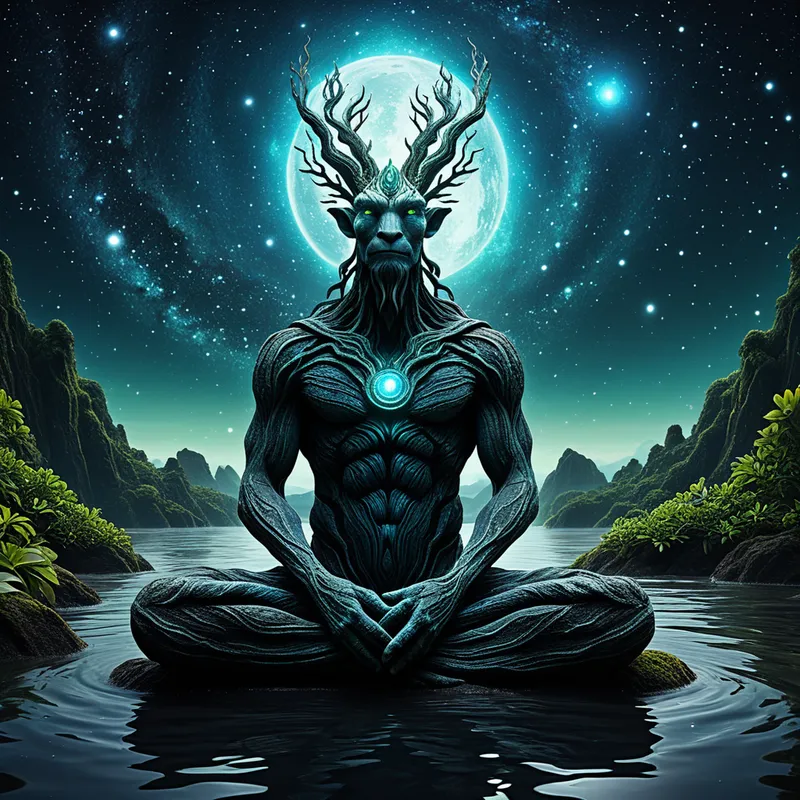
And within that watery dark, Tamoi stirred. He was not born; he was. Ancient beyond telling, his form was both like a great, gnarled tree and like a man of immense age, his skin the texture of stone and river clay, his eyes holding the patient light of the first stars yet to be placed. He was the Grandfather of All.
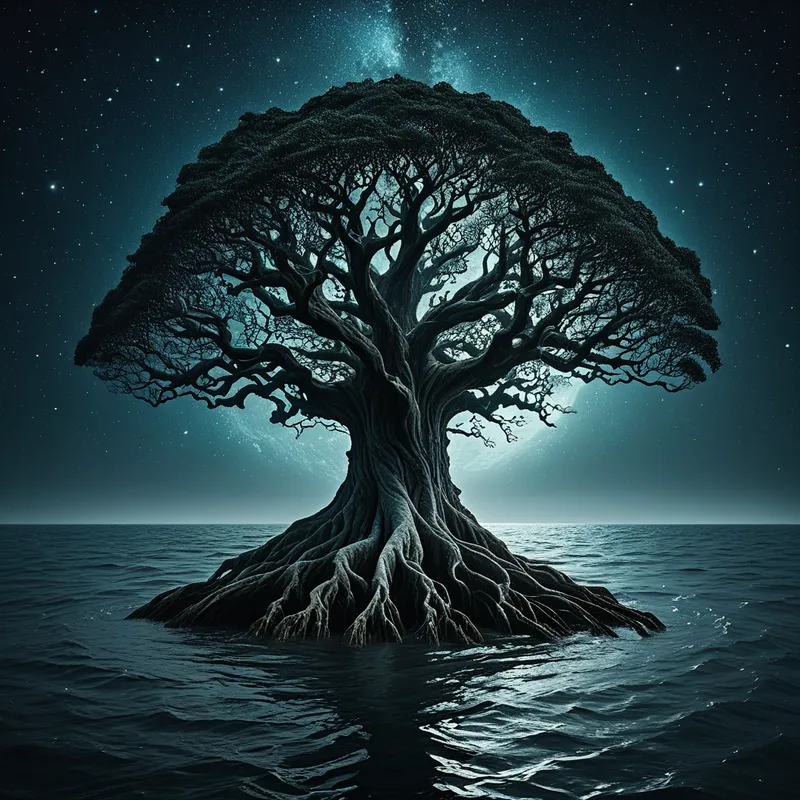
Tamoi looked upon the featureless Ine Wabu and felt a stirring in his vast heart—not loneliness, but a knowing of purpose. A song began within him, a low, resonant hum that vibrated through the waters. He raised his hands, and where his fingers traced, substance gathered. He scooped the primal clay from the depths and began to shape. First, he made the Gaia Do’u, the back of the great turtle, firm and steady. He planted the first seeds upon it, which grew instantly into the towering Watora’i, its roots drinking deep, its branches pushing upward.
But the world was silent and still. Tamoi took a deep breath, a breath drawn from the very essence of potential, and blew across the waters. His breath became the first wind, Wakan. It stirred the leaves of the Watora’i into a whisper, and the whisper carried across the new land. From the mud of the riverbanks now taking shape, Tamoi formed figures. With immense care, he shaped their forms, and then, leaning close, he breathed his own Wakan into them. They coughed, sputtered, and opened their eyes—the first people.
He showed them the fruits of the forest, the courses of the rivers, the paths of the animals he had also dreamed into being. He taught them the songs that would call the rain and give thanks for the hunt. He established the first Kuaña, the way of balance. His work was not one of command, but of gentle instruction, of a grandfather teaching his grandchildren how to live in the home he had made for them.
When his work was complete, and the world hummed with life, rhythm, and relationship, Tamoi did not ascend to a distant sky. Instead, he walked to the deepest part of the first forest, where the roots of the Watora’i were oldest. There, he sat down, and slowly, his form began to change. His body became one with the great trunk; his hair and beard became hanging vines and moss; his watching eyes became the dappled light that filters through the canopy. He did not die. He became the forest itself, the silent, watchful presence in the heart of things, the Grandfather who is in every leaf, every stone, every breath of wind that carries his ancient song.
Cultural Origins & Context
The myth of Tamoi belongs to several Indigenous peoples of the Amazon basin, including the Sateré-Mawé and other Tupi-Guarani speaking groups. It is a foundational narrative, a cosmogony that explains the origin of the world not as a violent conquest, but as a deliberate, artistic, and pedagogical act. Traditionally, this story was not written but carried in the oral tradition, told by elders and shamans (pajés) during sacred ceremonies or in the communal house (maloca).
Its function was multifaceted: it was a map of the cosmos, a moral charter establishing the principles of ecological and social balance (Kuaña), and a spiritual technology. By recounting Tamoi’s acts, the community ritually reaffirmed their connection to the created order and their responsibility within it. The myth encoded the understanding that humans are not overlords of nature, but younger kin, born from the same clay and animated by the same sacred breath as all other beings. The teller and the listener participated in the ongoing act of creation by remembering it.
Symbolic Architecture
At its core, the myth of Tamoi is a profound [allegory](/symbols/allegory “Symbol: A narrative device where characters, events, or settings represent abstract ideas or moral qualities, conveying deeper meanings through symbolic storytelling.”/) for the [emergence](/symbols/emergence “Symbol: A process of coming into being, rising from obscurity, or breaking through a barrier, often representing birth, transformation, or revelation.”/) of [consciousness](/symbols/consciousness “Symbol: Consciousness represents the state of awareness and perception, encompassing thoughts, feelings, and experiences.”/) from the unconscious. Ine Wabu, the primal waters, represent the undifferentiated, potential-filled state of the unconscious psyche—the “nothing” that contains “everything.”
Tamoi is the archetypal principle of order itself, the first act of attention that draws a distinction in the void.
His shaping of the land from the waters symbolizes the psyche’s fundamental [task](/symbols/task “Symbol: A task represents responsibilities, duties, or challenges one faces.”/): to create stable structures (the ego, [identity](/symbols/identity “Symbol: Identity represents the sense of self, encompassing personal beliefs, cultural background, and social roles.”/), culture) from the fluid [material](/symbols/material “Symbol: Material signifies the tangible aspects of life, often representing physical resources, desires, and the physical world’s influence on our existence.”/) of instinct and [archetype](/symbols/archetype “Symbol: A universal, primordial pattern or prototype in the collective unconscious that shapes human experience, behavior, and creative expression.”/). The Watora’i is the [axis](/symbols/axis “Symbol: A central line or principle around which things revolve, representing stability, orientation, and the fundamental structure of reality or consciousness.”/) mundi, the central organizing principle of the psyche that connects different levels of [awareness](/symbols/awareness “Symbol: Conscious perception of self, surroundings, or internal states. Often signifies awakening, insight, or heightened sensitivity.”/). Most crucially, the gift of Wakan is the infusion of [spirit](/symbols/spirit “Symbol: Spirit symbolizes the essence of life, vitality, and the spiritual journey of the individual.”/) into matter, of conscious [energy](/symbols/energy “Symbol: Energy symbolizes vitality, motivation, and the drive that fuels actions and ambitions.”/) into inert form. This is the [moment](/symbols/moment “Symbol: The symbol of a ‘moment’ embodies the significance of transient experiences that encapsulate emotional depth or pivotal transformations in life.”/) of animation, where a mere [pattern](/symbols/pattern “Symbol: A ‘Pattern’ in dreams often signifies the underlying structure of experiences and thoughts, representing both order and the repetitiveness of life’s situations.”/) becomes a living [soul](/symbols/soul “Symbol: The soul represents the essence of a person, encompassing their spirit, identity, and connection to the universe.”/).
Tamoi’s final transformation is the ultimate symbolic act. He does not rule from afar but immanently becomes the [system](/symbols/system “Symbol: A system represents structure, organization, and interrelated components functioning together, often reflecting personal or social order.”/) he created. This represents the goal of a mature psyche: not to be a tyrannical ego controlling the unconscious, but to achieve a state where consciousness is so integrated with the deeper layers of the psyche that the self is experienced as part of the larger, living fabric of being.
The Dreamer’s Resonance
When this mythic pattern stirs in the modern dreamer, it often signals a profound process of inner re-creation or re-orientation. One might dream of vast, calm, dark oceans—a sense of being adrift in potential without form. The appearance of an immensely old, wise figure (not necessarily human) who begins to organize the dreamscape—drawing land from water, causing light to separate from dark—points to the activation of the Senex archetype in a positive, creative form.
Somatically, this can feel like a deep, settling breath after a period of chaos or depression, a literal “inspiration.” Psychologically, it is the process of the psyche attempting to ground itself, to find a new foundational principle or value (Gaia Do’u) after a dissolution of old structures. The dreamer is not being rescued by an external savior; they are experiencing, from within, the primordial function that builds a habitable inner world from the raw materials of experience and emotion. Resistance to this figure can manifest as dreams of tsunamis or sinking, the ego’s fear of being re-absorbed by the unconscious it is trying to structure.
Alchemical Translation
The individuation journey modeled by Tamoi is not one of heroic battle, but of patient, artistic cultivation. The alchemical prima materia is the chaotic, water-like state of psychic confusion or crisis (Ine Wabu). The first stage, nigredo, is not a violent blackening here, but the acknowledgement and acceptance of this formless, fertile dark.
The work of the modern Tamoi is to have the courage to sit with the chaos and begin to hum the first song of order—to make one conscious choice, to establish one daily ritual, to shape one clear thought from the emotional clay.
This is the albedo, the whitening, where distinct forms emerge. The planting of the Watora’i represents the cultivation of a central, nourishing value or practice that connects our daily life (roots) to our spiritual aspirations (branches). The infusion of Wakan is the critical phase where we animate our creations with genuine spirit and purpose, not just empty habit. We must breathe life into our own shaped clay.
The final transmutation, the rubedo, is Tamoi’s dissolution into the forest. This is the achievement of the philosopher’s stone: the realization that the “creator” is not separate from the “creation.” The ego, having performed its necessary work of structuring, learns to decentralize itself. It discovers that true Self is not the shaper alone, but the entire living, breathing ecosystem of the psyche—the integrated whole of conscious and unconscious, order and wildness, person and world. One becomes the grounded, watchful presence within one’s own life.
Associated Symbols
Explore related symbols from the CaleaDream lexicon:
- Grandfather — The archetype of primordial wisdom, patient creation, and benevolent authority who shapes order from chaos and establishes the foundational laws of existence.
- Water — Represents the primal, undifferentiated state of the unconscious, the source of all potential and the medium from which all distinct forms are born.
- Creator — The active, shaping principle within the psyche that differentiates, gives form, and instills conscious purpose into the raw materials of being.
- Tree — Symbolizes the axis mundi, the central, living structure that connects all realms of experience and provides stability and nourishment to the nascent world.
- Earth — The formed and grounded reality, the stable foundation of the ego and the physical world, shaped from the fluid unconscious and made habitable.
- Breath — The animating spirit, consciousness, and vital force (Wakan) that transforms inert matter into living soul, distinguishing mere existence from ensouled life.
- Order — The principle and process of imposing meaningful structure, rhythm, and relationship onto chaos, establishing the conditions for life and culture to flourish.
- Forest — The complex, living, and immanent manifestation of the creator’s essence, representing the integrated, ecological whole where all individual beings exist in interconnected balance.
- Seed — The primordial potential and first thought from which the entire differentiated world grows, containing the complete pattern of life within the formless dark.
- Circle — The wholeness of the creative process, from undifferentiated potential through formation and animation, and back to immanent unity with the creation.