Tambora and the Sky Darkness Myth Meaning & Symbolism
A myth of a mountain's sacrifice to restore light, born from the memory of a catastrophic 1815 eruption that plunged the world into darkness.
The Tale of Tambora and the Sky Darkness
Listen, and hear the tale of the time the sun forgot its path, and the world held its breath in ash.
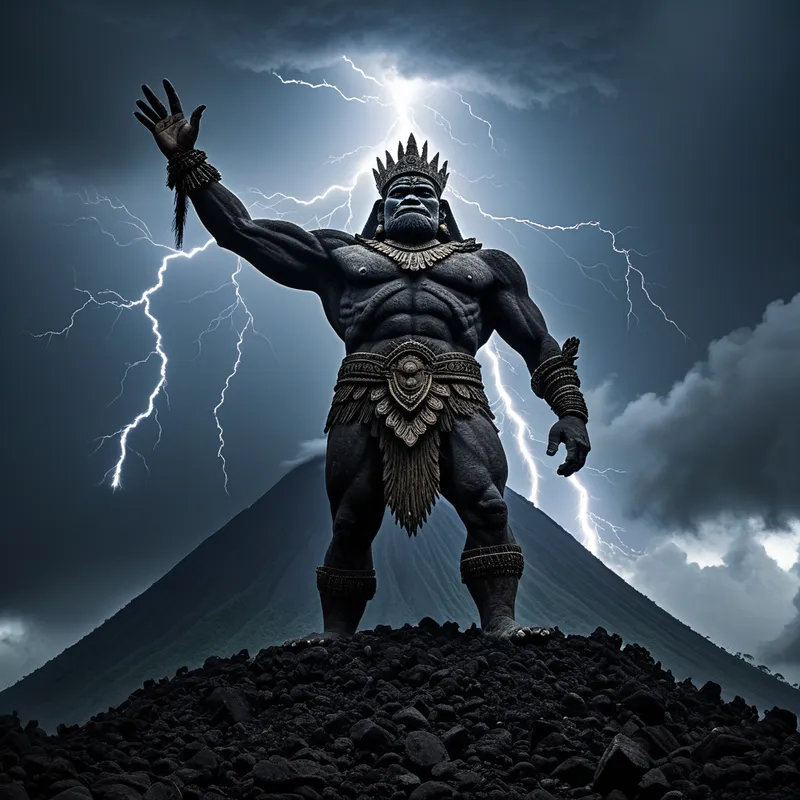
In the days when the world was younger, and the islands of the archipelago were jewels strung on a sapphire sea, there stood a mountain named Tambora. It was not merely rock and soil; it was a being of immense, slumbering power, a pillar that held up the corner of the sky. Its slopes were lush, its valleys teemed with life, and its people, the Tau Samawa, lived in its generous shadow, believing the mountain’s deep rumblings to be the contented sighs of the earth.
But in the heart of the mountain, a great discontent stirred. The stories whisper of an imbalance—a cosmic offense, a broken adat between the realms of earth and sky. Perhaps the sky grew arrogant, hoarding its light and rain. Perhaps the earth grew restless, its fiery blood boiling with neglected potency. The harmony was fractured.
Then, the mountain awoke. It began not with a sudden violence, but with a deep, mournful groan that vibrated through the bones of every creature. The air grew thick and hot, carrying the scent of burnt stone. For days, the mountain wept tears of fire, painting the night in terrifying hues. The people watched, their prayers rising like smoke, but the mountain’s anguish was too profound.
On the fateful day, the summit of Tambora did not explode—it unmade itself. With a sound that tore the fabric of silence, the mountain sacrificed its own crown. A column of ash and rock, darker than the deepest night, punched through the heavens. It spread like a bruise across the sky, a vast, choking shroud that swallowed the sun. Day became a dim, copper twilight; night became an absolute void, starless and cold.
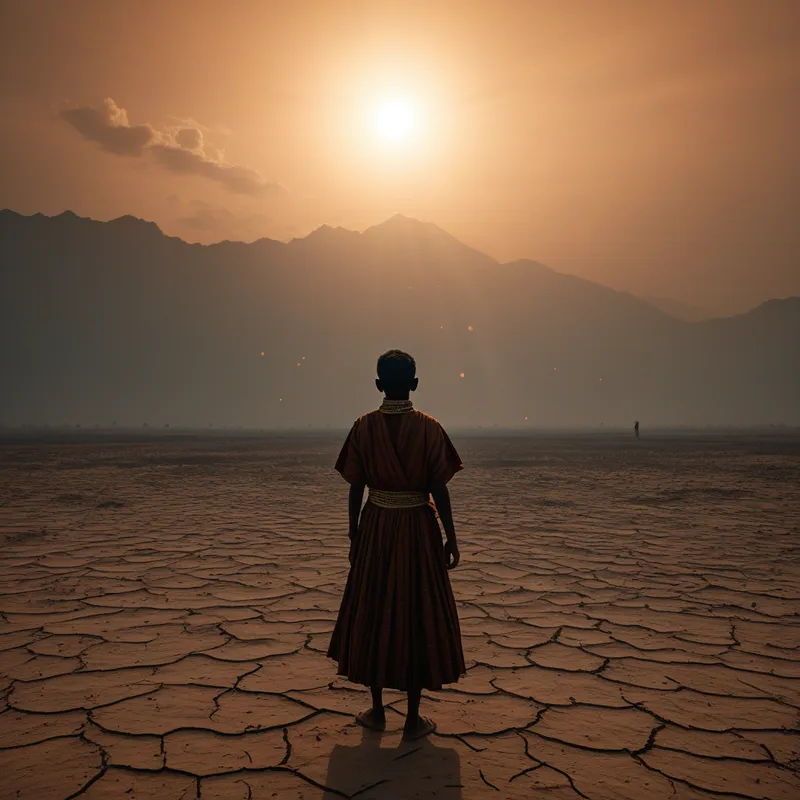
The Sky Darkness fell. It was not mere night; it was an entity of absence. Crops withered in the eerie half-light. A coldness, unnatural for these equatorial lands, seeped into the world. The sun and moon were ghosts behind the veil. The world was plunged into a year without summer, a perpetual, silent dusk where time itself seemed lost.
And here lies the heart of the myth: this was not a punishment, but a terrible, necessary recalibration. The mountain, in its cataclysmic act, had taken the world’s imbalance into itself and expelled it into the sky. It sacrificed its form, its vitality, and the lives upon its slopes, to become the conduit for a reset. The darkness was the womb of this painful rebirth.
Slowly, grain by grain, the ash began to settle. The first sliver of true sunlight that pierced the gloom was seen not as a return, but as a new creation. The mountain, now a shattered, gaping caldera, stood silent. It had given its body to cleanse the sky. The light that returned was earned, a fragile gift born from unimaginable loss. The people understood: Tambora was not a destroyer, but a tragic hero who had traded its majesty for the return of cosmic order.
Cultural Origins & Context
This myth is rooted not in ancient, misty antiquity, but in a specific, cataclysmic historical event: the 1815 eruption of Mount Tambora, the most powerful volcanic eruption in recorded human history. The event was so profoundly traumatic and globally disruptive—causing the “Year Without a Summer” and famines across the Northern Hemisphere—that it demanded a story to contain its incomprehensible scale.
The myth emerged from the oral traditions of the surviving Tau Samawa and neighboring cultures. It is a prime example of mythogenesis in real time, where a historical catastrophe is processed through the existing cosmological framework. Storytellers and elders wove the observable facts—the darkness, the cold, the loss—into the pre-existing understanding of mountains as spiritual beings and custodians of balance. The myth served critical societal functions: it provided an explanation for the unexplainable, offered a narrative of meaning where there was only chaos, and encoded a warning about the consequences of disrupting natural and spiritual harmony (adat). It transformed a geological event into a theological and moral lesson, ensuring the memory and its teachings would be passed down.
Symbolic Architecture
At its core, the myth is a profound [allegory](/symbols/allegory “Symbol: A narrative device where characters, events, or settings represent abstract ideas or moral qualities, conveying deeper meanings through symbolic storytelling.”/) for the cost of cosmic and psychological [equilibrium](/symbols/equilibrium “Symbol: A state of balance, stability, or harmony between opposing forces, often representing inner peace or external order.”/). Tambora symbolizes the Self in its most monumental form—a [structure](/symbols/structure “Symbol: Structure in dreams often symbolizes stability, organization, and the framework of one’s life, reflecting how one perceives their environment and personal life.”/) of immense potential and [stability](/symbols/stability “Symbol: A state of firmness, balance, and resistance to change, often represented by solid objects, foundations, or steady tools.”/) that contains a volatile, creative/destructive core (the fiery libido or unconscious). The Sky Darkness represents the necessary descent into the unconscious, a nigredo or dark [night](/symbols/night “Symbol: Night often symbolizes the unconscious, mystery, and the unknown, representing the realm of dreams and intuition.”/) of the [soul](/symbols/soul “Symbol: The soul represents the essence of a person, encompassing their spirit, identity, and connection to the universe.”/) that must be endured for transformation.
The hero is not the one who conquers the darkness from without, but the one who becomes the vessel for the darkness, allowing it to pass through them to restore light.
The [eruption](/symbols/eruption “Symbol: A sudden, violent release of pent-up energy or emotion from beneath the surface, often representing transformation or crisis.”/) is not a random act of violence, but a deliberate, self-sacrificial release. The [mountain](/symbols/mountain “Symbol: Mountains often symbolize challenges, aspirations, and the journey toward self-discovery and enlightenment.”/) “speaks” its [truth](/symbols/truth “Symbol: Truth represents authenticity, honesty, and the quest for knowledge beyond mere appearances.”/) in the only [language](/symbols/language “Symbol: Language symbolizes communication, understanding, and the complexities of expressing thoughts and emotions.”/) powerful enough: total, cataclysmic [expression](/symbols/expression “Symbol: Expression represents the act of conveying thoughts, emotions, and individuality, emphasizing personal communication and creativity.”/). This symbolizes the [moment](/symbols/moment “Symbol: The symbol of a ‘moment’ embodies the significance of transient experiences that encapsulate emotional depth or pivotal transformations in life.”/) when repressed psychic [material](/symbols/material “Symbol: Material signifies the tangible aspects of life, often representing physical resources, desires, and the physical world’s influence on our existence.”/)—a lifetime of ignored imbalances, unexpressed rage, or collective [trauma](/symbols/trauma “Symbol: A deeply distressing or disturbing experience that overwhelms the psyche, often manifesting in dreams as unresolved emotional wounds or psychological injury.”/)—can no longer be contained and must erupt into [consciousness](/symbols/consciousness “Symbol: Consciousness represents the state of awareness and perception, encompassing thoughts, feelings, and experiences.”/), often with devastating personal consequences. The resulting “darkness” is the [period](/symbols/period “Symbol: Periods in dreams can symbolize cyclical patterns, renewal, and the associated emotions of loss or change throughout life.”/) of depression, [confusion](/symbols/confusion “Symbol: A state of mental uncertainty or disorientation, often reflecting internal conflict, lack of clarity, or overwhelming choices in waking life.”/), and [disintegration](/symbols/disintegration “Symbol: A symbol of breakdown, loss of form, or fragmentation, often reflecting anxiety about personal identity, control, or stability.”/) that follows such a psychic [eruption](/symbols/eruption “Symbol: A sudden, violent release of pent-up energy or emotion from beneath the surface, often representing transformation or crisis.”/). The myth assures us that this darkness is not an end, but a chaotic, [fertile ground](/symbols/fertile-ground “Symbol: Fertile ground symbolizes potential, growth, and the promise of new beginnings, reflecting a state where life can thrive.”/) from which a new, more authentic order can slowly emerge.

The Dreamer’s Resonance
When this mythic pattern stirs in the modern dreamer, it often manifests as dreams of apocalyptic weather, personal cataclysm, or being buried alive. One may dream of a familiar, nurturing landscape (the “home” of the ego) suddenly transforming into a threatening, erupting volcano. Or they may dream of an endless, silent twilight, where the sun is perpetually obscured.
Somatically, this can correlate with feelings of immense internal pressure, sudden bouts of feverish energy followed by profound exhaustion, or a sense of being “clouded over” and unable to think clearly. Psychologically, the dreamer is likely at a breaking point where an old structure of the personality—a long-held belief, a defining role, a repressed memory—is becoming untenable. The unconscious is signaling that a controlled release is no longer possible; a major eruption of affect or insight is imminent. The dream is both a warning of the coming storm and an archetypal map for navigating it: this destruction is in service of a greater balance. The dreamer is being asked to identify what “mountain” in their psyche is preparing to sacrifice its current form.
Alchemical Translation
The individuation process modeled here is the Via Cataclysmica—the path of necessary catastrophe. It contradicts the gentle, incremental models of growth. For some spirits, and for some deeply entrenched complexes, only a volcanic level of transformation will suffice.
The first stage is the Accumulation of Pressure, corresponding to the mountain’s restless groaning. In life, this is the period of increasing anxiety, somatic symptoms, and a feeling that “something has to give.” The ego feels the rumblings but often tries to silence them.
The eruption itself is the Shattering of the Persona. The carefully constructed summit of who we pretend to be is violently removed. This is an involuntary, often humiliating, exposure of the raw, chaotic core. Values, relationships, and self-image may be obliterated in this “ashfall.”
The Sky Darkness is the crucial, passive stage of Putrefactio. The old light is gone; the new has not yet dawned. This is the liminal space of depression, grief, and meaningless waiting. The alchemical work here is to not flee the darkness, but to endure it, to let the ash of the old self settle. It is a time for absolute honesty in the void.
The caldera—the gaping wound left after the eruption—is not a sign of defeat, but the new, sacred container for the soul. It is where the deep lake of the unconscious can now collect, visible and integrated.
Finally, the Return of Light is not a return to the old day, but the dawn of a new consciousness. The ego, having been shattered and humbled by the Self’s eruption, is reconstituted on a broader, sturdier foundation. The individual now lives with the knowledge of the abyss within them, the creative-destructive fire, and this knowledge brings a sober, hard-won wisdom. They have learned that sometimes, one must become the cataclysm to be made whole.
Associated Symbols
Explore related symbols from the CaleaDream lexicon:
- Mountain — The monumental, stable Self that contains a volatile core; represents enduring strength, spiritual aspiration, and the site of catastrophic transformation.
- Sky — The realm of consciousness, order, light, and spiritual law; its darkening signifies the eclipse of the ego by the unconscious.
- Fire — The primal, transformative energy of the unconscious psyche; creative and destructive libido that must be released to prevent total implosion.
- Darkness — The nigredo or chaotic, fertile state of the unconscious after a psychic structure has been dissolved; a necessary womb for rebirth.
- Sacrifice — The central act of the myth; the voluntary or involuntary surrender of a prized form (the mountain’s summit, an ego identity) for the restoration of a greater balance.
- Ash — The residue of the old self after the psychic eruption; a symbol of mourning, fertility, and the blank slate from which new life grows.
- Light — The regained consciousness after the ordeal; not merely the absence of darkness, but a new, earned understanding of illumination.
- Earth — The ground of being, the physical and instinctual realm that rebels when its laws are violated; the source of the transformative pressure.
- Chaos — The raw, unformed state unleashed by the eruption; not mere disorder, but the primal material from which a new order is compelled to arise.
- Order — The cosmic and psychological harmony that the cataclysm ultimately serves; the myth teaches that order is sometimes forged in the crucible of chaos.
- Shadow — The repressed, volcanic content of the personal and collective unconscious that, when ignored, builds toward a catastrophic eruption.
- Rebirth — The ultimate promise of the myth; the new life, perspective, and world that can only emerge after the old one has been utterly transformed by fire and darkness.