Tama-nui-te-ra the Great Sun Myth Meaning & Symbolism
A myth of cosmic rebellion where the hero Māui captures the Sun to slow its passage, bringing balance and life to the world.
The Tale of Tama-nui-te-ra the Great Sun
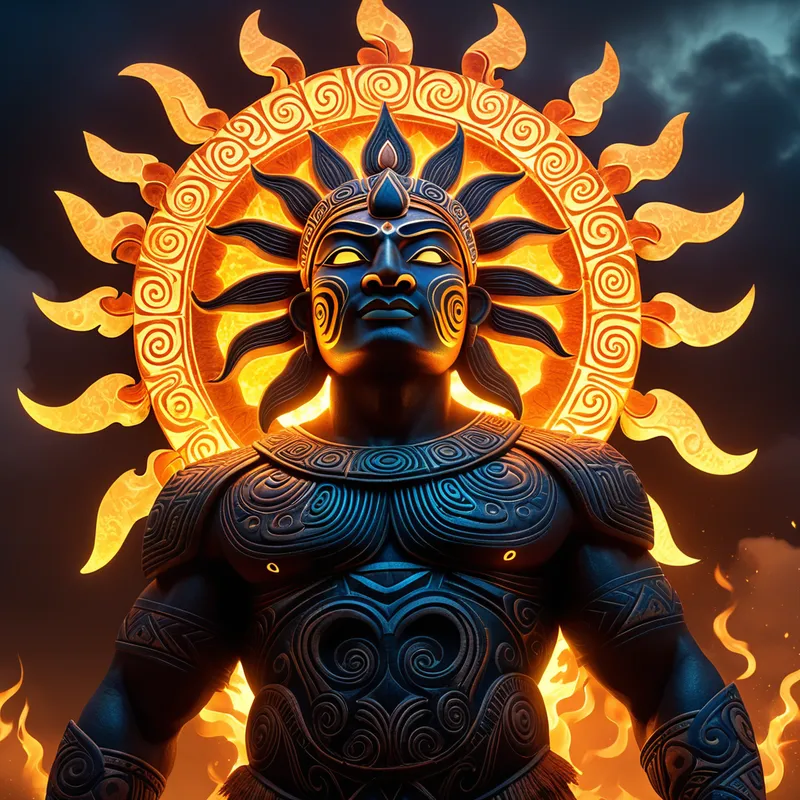
In the time before time, when the world was young and raw, the days raced by in a frantic, blinding blur. Tama-nui-te-ra soared across the sky with a selfish haste, his fiery legs carrying him from horizon to horizon in the space of a breath. Life below was a desperate, shadowed struggle. Plants withered before they could fruit. People shivered, their food uncooked, their work unfinished, forever chasing the fleeting light. The world lay gasping under a tyranny of speed.
Then came Māui, the last-born, the clever one, he who had fished up islands from the deep. He saw the suffering of his mother and his people. He heard their sighs carried on the short, hot wind. A great resolve hardened within him. “We must tame the Sun,” he declared, his voice quiet but firm as stone. “We must teach Tama-nui-te-ra to walk slowly, so that all may live.”
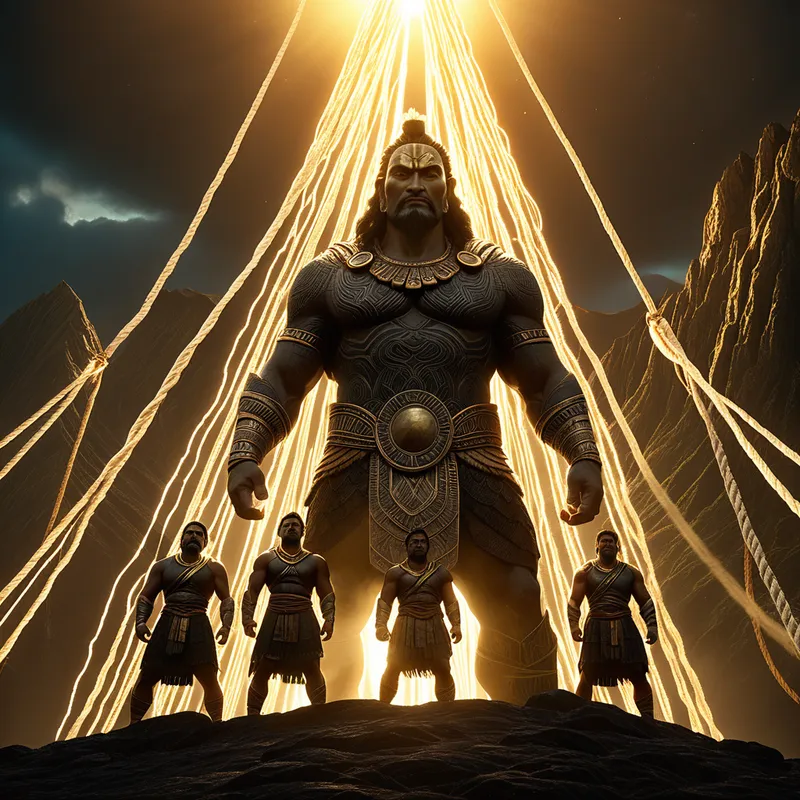
His brothers scoffed, fearing the Sun’s scorching wrath. But Māui was persuasive. From the strong, supple fibers of the harakeke, they plaited great, powerful ropes—not one, but many, each spell-strengthened with karakia, with sacred chant. They journeyed to the very pit where the Sun slept, a vast crater in the east, its edges smoldering with the promise of dawn.
They waited in the profound, cool dark before light. As the first searing limb of the Sun heaved over the rim, they cast their ropes. The fibers smoked and hissed but held fast, woven with purpose. They snared one leg, then another, binding the furious, radiant god as he roared, a sound that shook the foundations of the sky. Flames lashed out, but Māui stood firm, his sacred jawbone weapon raised not to strike, but to threaten.
“Now you will listen,” Māui commanded, his figure silhouetted against the struggling dawn. “You will travel slowly, giving your warmth to the kumara in the ground, to the children on the shore, to the old ones by the fire. You will give us time.”
Tama-nui-te-ra, bound and helpless, felt the unyielding strength of the ropes, the greater strength of the will behind them. In that moment of capture, a pact was forged. The Sun, in his great power, yielded. He agreed to the new, measured pace. The brothers, with reverence now replacing their fear, loosened the bonds—but not all. Some ropes remained, invisible tethers of agreement, ensuring the Sun’s steady, generous journey.
And so, dawn broke not with a sprint, but with a stately, glorious stride. Light poured, rich and lasting, across the land. For the first time, there was a true day—long, golden, and full of possibility. The hero had not slain the god; he had negotiated with the cosmos itself, and won life for all.
Cultural Origins & Context
This myth is part of the vast, oceanic body of knowledge known to the Māori as pūrākau. These stories were not mere entertainment; they were the living textbooks of cosmology, history, ethics, and survival. The tale of Māui and the Sun was told by tohunga and elders, often during the long nights, their voices weaving the narrative into the consciousness of the people.
Its function was multifaceted. On a practical level, it explained the reliable cycle of seasons and the length of the day, reinforcing the importance of agriculture (like the cultivation of kumara, which requires sustained sunlight). On a societal level, it celebrated the values of ingenuity (mātauranga), communal effort, and the audacity to improve one’s world. Most profoundly, it situated humanity not as passive victims of nature, but as active participants in a reciprocal relationship with the atua, the gods. The world’s order was not a given; it was an achievement, a hard-won treaty maintained through respect and understanding.
Symbolic Architecture
At its [heart](/symbols/heart “Symbol: The heart symbolizes love, emotion, and the core of one’s existence, representing deep connections with others and self.”/), this is a myth about the imposition of conscious order upon primal, unconscious force. Tama-nui-te-ra represents raw, undifferentiated [energy](/symbols/energy “Symbol: Energy symbolizes vitality, motivation, and the drive that fuels actions and ambitions.”/)—the brilliant, but chaotic, fire of [life](/symbols/life “Symbol: The symbol of ‘Life’ represents a journey of growth, interconnectedness, and existential meaning, encompassing both the joys and challenges that define human experience.”/) and instinct that, left unchecked, burns too fast and consumes itself. He is the unstoppable drive, the brilliant [idea](/symbols/idea “Symbol: An ‘Idea’ represents a spark of creativity, innovation, or realization, often emerging as a solution to a problem or a new outlook on life.”/) that flashes and vanishes before it can be made real.
The hero’s task is not to extinguish the divine fire, but to build a hearth for it.
Māui is [the principle](/symbols/the-principle “Symbol: A fundamental truth, law, or doctrine that serves as a foundation for a system of belief, behavior, or reasoning, often representing moral or ethical standards.”/) of the ego-[consciousness](/symbols/consciousness “Symbol: Consciousness represents the state of awareness and perception, encompassing thoughts, feelings, and experiences.”/), the [human](/symbols/human “Symbol: The symbol of a human represents individuality, complexity of emotions, and social relationships.”/) will that dares to confront this overwhelming power. His ropes are not weapons of destruction but tools of [relationship](/symbols/relationship “Symbol: A representation of connections we have with others in our lives, often reflecting our emotional state.”/)—the constraints of culture, [ritual](/symbols/ritual “Symbol: Rituals signify structured, meaningful actions carried out regularly, reflecting cultural beliefs and emotional needs.”/), law, and conscious [intention](/symbols/intention “Symbol: Intention represents the clarity of purpose and direction in one’s life and can symbolize motivation and commitment within a dream context.”/) that shape raw potential into sustainable form. The binding is not a [punishment](/symbols/punishment “Symbol: A dream symbol representing consequences for actions, often tied to guilt, societal rules, or internal moral conflicts.”/) but a tempering. The resulting “slowness” is the [space](/symbols/space “Symbol: Dreaming of ‘Space’ often symbolizes the vastness of potential, personal freedom, or feelings of isolation and exploration in one’s life.”/) where growth happens, where thought matures, where culture is built. It is the [difference](/symbols/difference “Symbol: Difference symbolizes diversity, change, and the contrast between ideas or people.”/) between a flash of [lightning](/symbols/lightning “Symbol: Lightning symbolizes sudden insights or revelations, often accompanied by powerful emotions or disruptive change.”/) and the steady, life-giving light of the sun.
The sacred [mountain](/symbols/mountain “Symbol: Mountains often symbolize challenges, aspirations, and the journey toward self-discovery and enlightenment.”/) where the Sun is bound is the [axis](/symbols/axis “Symbol: A central line or principle around which things revolve, representing stability, orientation, and the fundamental structure of reality or consciousness.”/) mundi, the fixed point where [heaven](/symbols/heaven “Symbol: A symbolic journey toward ultimate fulfillment, spiritual transcendence, or connection with the divine, often representing life’s highest aspirations.”/) and [earth](/symbols/earth “Symbol: The symbol of Earth often represents grounding, stability, and the physical realm, embodying a connection to nature and the innate support it provides.”/) negotiate. The entire [drama](/symbols/drama “Symbol: Drama signifies narratives, emotional expression, and the exploration of human experiences.”/) models the psychic move from a state ruled by impulsive, archetypal energies to one where the conscious mind can engage with those energies, creating a life-sustaining [rhythm](/symbols/rhythm “Symbol: A fundamental pattern of movement or sound in time, representing life’s cycles, emotional flow, and universal order.”/).
The Dreamer’s Resonance
When this myth stirs in the modern dreamer, it often signals a profound confrontation with a “runaway” force within the psyche. To dream of a speeding, blinding light or a frantic, unproductive rush may reflect the tyranny of Tama-nui-te-ra—a career burning too fast, a passion consuming all else, an anxiety that shortens every moment into panic.
Conversely, to dream of binding a brilliant, dangerous, or radiant figure speaks to the somatic process of integration. The dream-ego is gathering its resources (the brothers, the ropes) to face a core, powerful energy. There is often a felt sense of immense effort, of heat and resistance, in the body. This is the psyche’s attempt to “slow the sun”—to take a chaotic talent, a overwhelming emotion, or a compulsive drive and negotiate a new relationship with it. The goal felt in the dream is not annihilation, but a tense, awe-filled truce that allows for longer, more fertile “days” in one’s inner world.

Alchemical Translation
In the alchemy of individuation, this myth perfectly models the stage of coagulatio—the fixing of the volatile spirit into a usable, solid form. The fiery, mercurial Tama-nui-te-ra is the spiritus mundi, the world spirit that is brilliant but useless in its fugitive state.
The modern individual’s journey mirrors Māui’s quest. We first experience a divine discontent—the feeling that our inner “days” are too short, that our creative or vital energies flash and disappear without yielding substance. The “harakeke ropes” we must plait are the disciplines of attention: mindfulness, therapy, artistic practice, ritual. These are the strong fibers of conscious effort woven together to create a binding agency.
The negotiation with the captured god is the central act of psychic adulthood. It is the moment we stop being victims of our own nature and become its stewards.
The confrontation is the inner work of holding space for a powerful complex—be it rage, genius, or grief—without being destroyed by it or repressing it. The “jawbone” we wield is the truth of our own limits and our need. The resolution is the sacred agreement: the energy agrees to serve the larger psyche, and consciousness agrees to honor and give space to the energy. The liberated, regulated Sun that then rises is the transformed libido—the same fiery life force, now become the reliable source that illuminates the whole landscape of the self, allowing the slow, sure growth of the soul’s garden. We achieve not by killing our demons, but by asking them to walk more slowly, so we can learn their names.
Associated Symbols
Explore related symbols from the CaleaDream lexicon:
- Sun — The central symbol of radiant consciousness, vital force, and the divine self, which must be tempered from a blinding flash into a sustaining light.
- Hero — Embodied by Māui, representing the audacious aspect of the ego that confronts overwhelming archetypal powers for the benefit of the whole community.
- Rope — Symbolizes the bonds of culture, intention, and conscious effort that shape raw, chaotic energy into usable, life-giving form.
- Journey — Represents the quest to the sun’s pit, the necessary voyage to the source of a problem in the deep, mythic east of the psyche.
- Sacrifice — The Sun’s sacrifice of its unchecked freedom for the greater good, modeling the compromise required for cosmic and psychic order.
- Order — The ultimate goal of the myth: the establishment of tikanga, the right rhythm and balance that allows life to flourish.
- Fire — The primal, transformative, and dangerous element that the Sun embodies, representing both creative and destructive potential.
- Light — The gift won by the binding, representing clarity, consciousness, growth, and the illuminated path of a purposeful life.
- Mountain — The sacred, unmovable place where the binding occurs, symbolizing the stable center of the self where divine negotiations happen.
- Shadow — The inevitable companion of the slowed sun, representing the acknowledged and necessary darkness that gives definition and depth to the light.