Talking Stick Myth Meaning & Symbolism
A sacred object that transforms chaos into council, teaching that true power lies in listening and that every voice holds a fragment of the world's soul.
The Tale of the Talking Stick
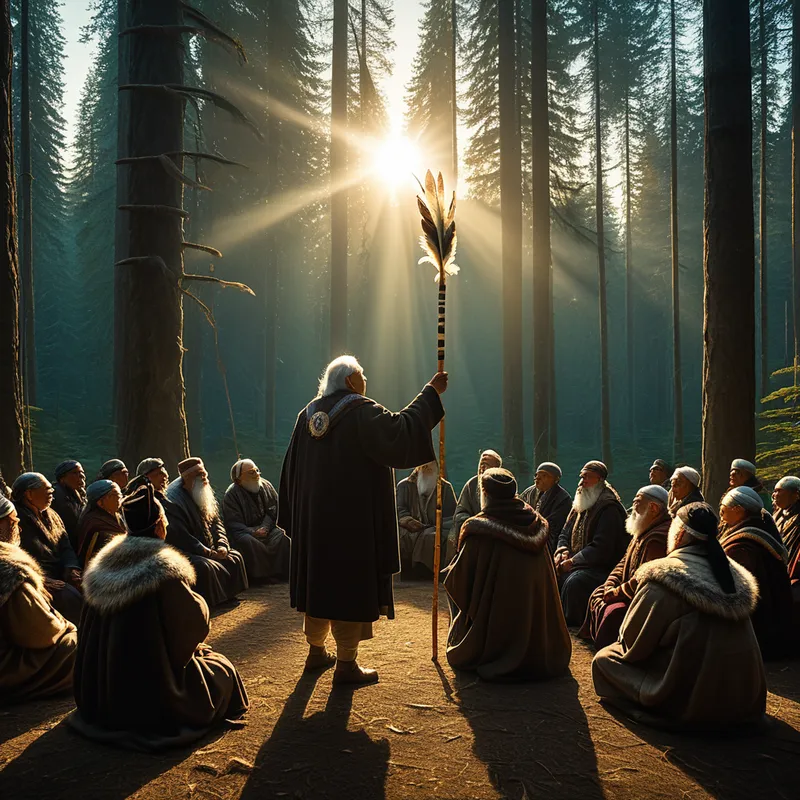
Listen. In the time before time, when words were arrows and hearts were fortresses, the people gathered. They came to the great council fire not as one people, but as many voices clashing like storm winds. The chief spoke, but his words were lost beneath the grumbling of the warriors. The grandmothers offered wisdom, but their soft tones were drowned by the shouts of the young hunters. Each person held their truth like a weapon, and in the circle, there was only noise—a cacophony of need, fear, and pride that choked the sacred fire’s light.
The air grew thick with the heat of unsaid things. Arguments spiraled. Old wounds, salted by fresh words, bled anew. The council, meant to weave the people together, was unraveling them. Despair settled like a cold fog. How could they decide the path for the people when no path could be heard? How could they see with one eye when every eye was clouded with its own storm?
Then, from the edge of the firelight, an elder rose. His name is not remembered, for his act was greater than his name. He did not shout. He did not plead. In silence, he walked to a young aspen that stood sentinel at the clearing’s edge. With a prayer on his breath, he cut a straight branch. He returned to the circle, and by the fire’s glow, he began to work. His knife peeled the bark, revealing the pale, honest wood beneath. He wrapped a strip of wolf fur for courage to speak true. He tied the feather of a great eagle for wisdom to see far. He strung beads of red clay and blue stone. He was not making a weapon. He was making a vessel.
When he was finished, he held the staff before the people. The firelight danced on its carvings and played in the down of the feather. The noise died, not from command, but from wonder.
“This,” the elder said, his voice a soft river in the sudden quiet, “is a new law. It is a simple law. When you hold this stick, the circle belongs to your voice. Your words are sacred. All others will do only one thing: they will listen with their whole spirit. When your heart is empty of its truth, you will pass the stick. And you will, in turn, listen.”
He placed the stick in the hands of the loudest warrior. The man, who moments before had been shouting, now felt the weight of the wood, the softness of the fur. He opened his mouth, and his anger fell away. What emerged was not a boast, but a fear—a fear for his children’s safety. He passed the stick. The next speaker, a woman who had been silent, spoke of the barren hunting grounds. Then a young one spoke of a dream. The stick traveled. With each pass, the fortress walls around each heart crumbled. Words became threads, and listening hands began to weave. By the time the stick returned to the elder, the council fire burned bright and clear, reflecting not a collection of separate faces, but the single, attentive face of a people truly hearing itself for the first time.
Cultural Origins & Context
The story of the Talking Stick, or speaking staff, is not the property of a single tribe but a profound practice that emerged independently among numerous First Nations across the continent, including the Coastal Salish, Plains tribes, and others. It was not merely a story told to children at bedtime; it was a living, procedural myth enacted in the most critical spaces of community life—the council circle.
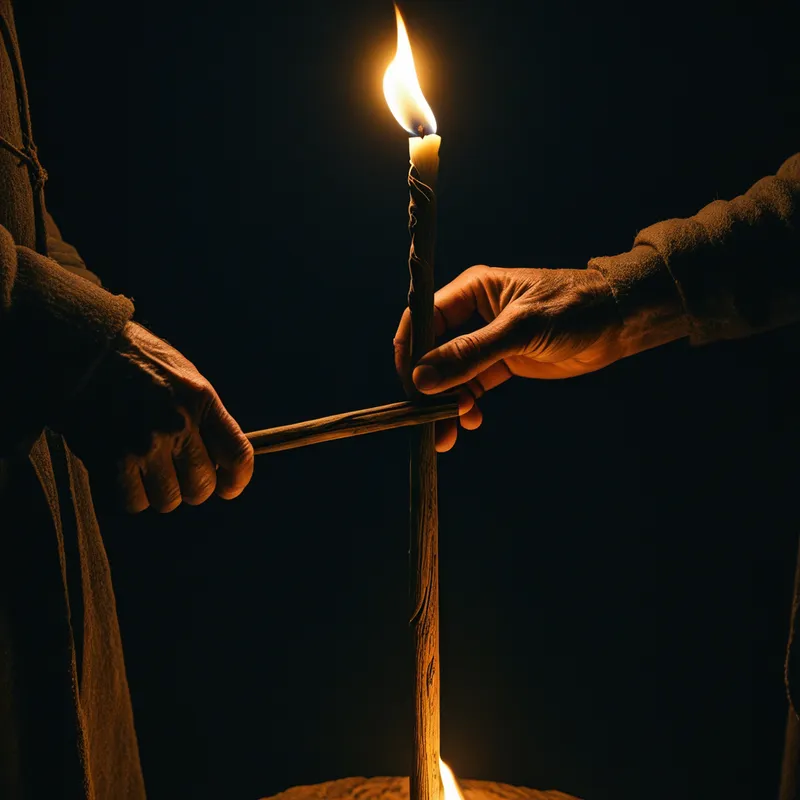
Its transmission was oral and experiential. Elders would explain the sacred responsibility of the stick to the young, but the true teaching came from sitting in the circle, feeling the weight of silence when another held the stick, and the terrifying, liberating weight of it in one’s own hands. Its societal function was foundational: it was a technology of peace and a ritual of democracy long before the word was coined. It transformed governance from a contest of wills into a ceremony of mutual respect. It ensured that wisdom could flow from the quiet grandmother as surely as from the charismatic chief, that the vision of the dreamer was given space beside the report of the hunter. The stick was the physical anchor for a spiritual principle: that for a community to be whole, it must hear all its parts.
Symbolic Architecture
The Talking Stick is a perfect symbolic organism, each element a conscious invocation of a psychic function.
The wooden staff itself, often from a tree like aspen or cedar, is the axis mundi of the council. It is the World Tree in miniature, connecting the speaker (the human realm) to the earth (from which the tree grew) and the sky (toward which it points). It grounds speech in reality and responsibility.
The stick is not a scepter that commands, but a root that connects. It reminds us that all speech emerges from the common ground of being.
The eagle feather represents the spirit, clarity, and the high perspective of truth. It asks the speaker to rise above petty grievances and see the broader pattern. The fur or hide, often from a wolf, buffalo, or deer, symbolizes the animal nature—our instincts, passions, and courage. It grants the holder the bravery to voice vulnerable truths. The beads, carvings, and paints are the unique history and identity of the person and the people; they are the individual soul’s contribution to the collective tapestry.
Psychologically, the myth represents the triumph of the Ego as mediator over the Ego as tyrant. In the chaotic council, every ego is inflated, shouting its monologue. The stick facilitates a sacred displacement: to hold it is to temporarily carry the mantle of the Self, the totality of the community’s psyche. One speaks not for one’s small self, but from one’s place within the great Self of the circle. The act of passing it is an act of trust, releasing one’s temporary centrality back into the circulatory system of the whole.

The Dreamer’s Resonance
When this myth pattern surfaces in modern dreams, it rarely appears as a literal council. Instead, one might dream of being in a meeting where one’s voice is physically swallowed by the air, or of holding a mysterious object that suddenly makes everyone fall silent. One might dream of a precious, ornate microphone that only works when held with absolute sincerity, or of a wand that doesn’t cast spells, but compels profound listening.
These dreams signal a critical psychological process: the somatic and psychic struggle to find one’s authentic voice within a collective (be it family, work, or society) and the concurrent, often more challenging, need to develop the capacity for deep reception. The dreamer is at a crossroads between the chaos of unexpressed truth (the shouting council) and the order of integrated expression (the ritual of the stick). The anxiety in the dream is the friction of this transition. The body may feel heavy (the weight of the stick) or the ears may feel acutely sensitive (the burden of listening). The dream is an invitation from the unconscious to institute an inner council—to give each conflicting inner voice (the inner critic, the wounded child, the ambitious driver) its turn to speak, held in the container of one’s own witnessing awareness.
Alchemical Translation
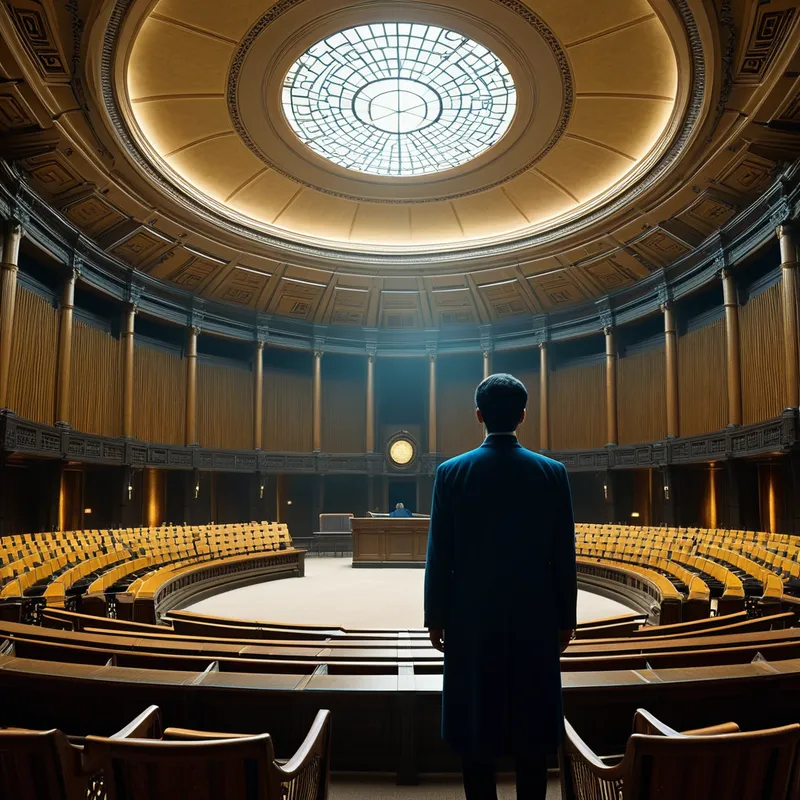
The alchemical process modeled here is the transmutation of psychic chaos (the massa confusa) into ordered, conscious relationship (the lapis or philosopher’s stone of the integrated self). The raw materials are our fragmented, often warring, internal parts and our projections onto others. The fire is the heat of conflict and emotion. The vessel is the ritual container—the “council circle” of our own psyche or our relationships.
The first operation is surrendering the monopoly of the ego. The shouting warriors represent egoic positions that demand sole authority. The stick’s law forces a caput mortuum—a “death of the head”—where the ego must relinquish control to a higher principle of order.
Individuation is not about speaking louder than all your inner voices, but about creating a silent, sacred space where each can be heard into truth.
The second operation is sacred listening (audition). This is the receptive, feminine principle often neglected in the pursuit of “finding one’s voice.” Alchemically, this is the dissolution of rigid forms in the aqua permanens, the permanent water of empathetic attention. To truly listen to another (or an inner other) is to allow their truth to alter your own composition.
The final operation is integration (coagulatio). As the stick travels, truths are not debated but witnessed. They begin to relate, to form a new compound understanding. In the individual, this is the conscious relationship between complexes. In the community, it is the birth of a collective wisdom greater than the sum of its parts. The Talking Stick does not create agreement; it creates a unus mundus—a one world—where difference is not a threat but a necessary ingredient in the wholeness of the soul, both personal and communal. The stick itself, passed from hand to hand, becomes the rotating axis of this newly ordered world, a humble tool that performs the ultimate magic: turning noise into meaning, and a crowd into a council.
Associated Symbols
Explore related symbols from the CaleaDream lexicon: