
Tala the Star Goddess Myth Meaning & Symbolism
The myth of Tala, goddess of stars, born from divine conflict to become a guide for souls, embodying hope, destiny, and the inner light of consciousness.
The Tale of Tala the Star Goddess
In the time before time, when the world was a canvas of unbroken black, there existed only the great waters and the first breath of the sky. From this primordial silence, the supreme deity Bathala willed the first light into being—the glorious, burning Araw. His radiance was fierce and proud, a golden king who claimed the day. To temper his heat, Bathala drew forth the cool, silver essence of reflection and mystery—Buan. She was his sister, his opposite, a queen of tides and secrets.
But between these two titans of light and dark, a terrible rivalry festered. Araw, in his arrogance, believed the sky was his alone to command. Buan, in her serene power, knew the rhythm of the cosmos required balance. Their conflict was not of clashing swords, but of competing radiances, a celestial war that left the newly formed earth below in a state of perpetual, chaotic twilight. Plants withered, creatures hid, and the first humans huddled in fear, unable to navigate a world without a true night or a steady day.
Bathala, witnessing the suffering his children had caused, was filled with a profound sorrow. His breath became a sigh that stirred the fabric of the void. From the very substance of his disappointment and his love, from the fragments of light that had shattered in Araw and Buan’s strife, he gathered a new essence. He did not create another rival sun or moon. Instead, he crafted something gentle, something myriad.
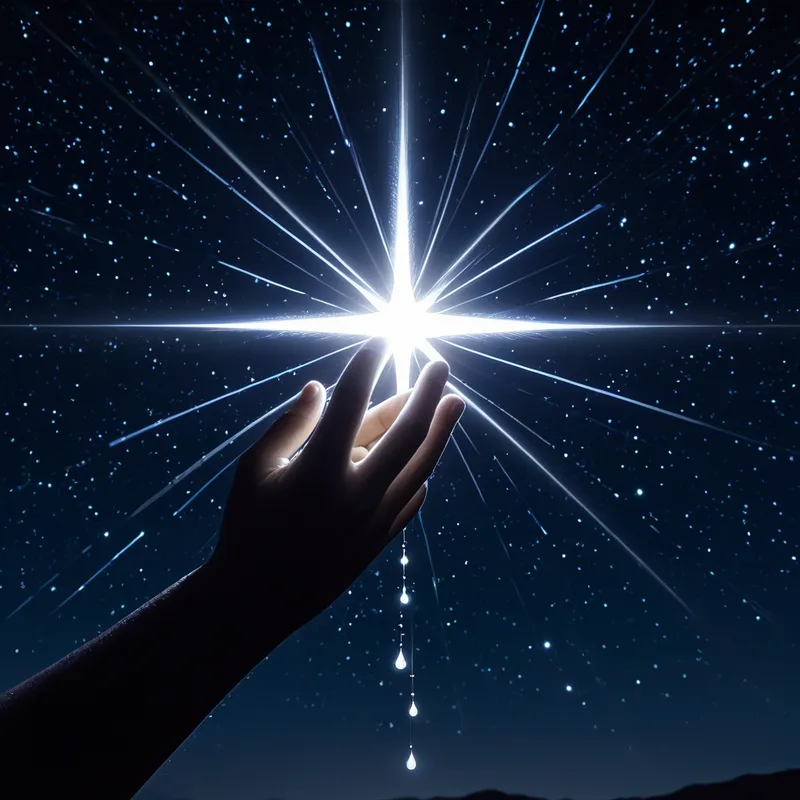
Into the vast, empty cloak of the sky, Bathala breathed. And where his breath touched the darkness, a single, soft point of silver-white light ignited. Then another. And another. He scattered them like seeds of hope, each one a tiny, perfect ember of peaceful light. He named this constellation of his compassion Tala.
Tala did not roar like Araw or pull like Buan. She glimmered. She was not one, but many—a community of lights in the lonely dark. Her first and most sacred duty was to the lost. She positioned her brightest children into patterns—the Balatik, the Moroporo—so that fishermen on the dark seas and travelers in deep forests could find their way home. But her deepest magic was for the soul. When a life on earth reached its end, it was Tala’s gentle light that descended. She would meet the departing spirit and guide it safely across the great river to the ancestral realm of Macà, ensuring it would not wander forever in the shadows. Thus, Tala became the bridge between worlds, the silent watcher, the promise in the darkness that one is never truly lost.
Cultural Origins & Context
The myth of Tala finds its roots in the pre-colonial belief systems of the Tagalog and Kapampangan peoples of Luzon. These narratives were not written in codices but lived in the oral tradition, passed down through generations by the babaylan and the lakan. Stories were told under the very stars they described, during communal gatherings, weaving practical astronomy with spiritual cosmology.
Tala’s myth served multiple societal functions. On a practical level, it encoded vital navigational knowledge; the constellations named in her story were real guides for maritime and agricultural calendars. On a spiritual level, it provided a comforting cosmology of death and destiny, framing the afterlife not as a fearful unknown but as a journey under a benevolent, familiar light. She represented order in the cosmos—a divine resolution to the chaos of primordial conflict—and her presence affirmed that even the smallest light has a purpose in the grand design.
Symbolic Architecture
Tala is not merely a celestial body; she is a psychological event. Born from conflict, she symbolizes the emergent consciousness that arises from reconciling opposites. Araw (the conscious ego, active and assertive) and Buan (the unconscious, reflective and mysterious) in endless strife create a dysfunctional psyche. Tala is the third thing, the transcendent function that emerges not by choosing a side, but by integrating their essences into a new, guiding principle.
She is the light that is born not from the absence of darkness, but from the conscious relationship with it.
Her multiplicity is key. She is not a singular, overwhelming “answer” but a constellation of insights, memories, and guiding principles—the inner compass points of a mature psyche. Each star can be seen as an archetypal image or a core value that, when connected, forms a map of one’s soul. Her role as psychopomp, guiding souls to the afterlife, translates psychologically as the inner function that guides conscious awareness into the depths of the unconscious (Macà) and back again, facilitating the integration of shadow material and ancestral wisdom.
The Dreamer’s Resonance
When the pattern of Tala emerges in modern dreams, it often signals a profound process of orientation and soul-guidance. One might dream of finding a specific constellation in a chaotic sky, of following a single star through a dark forest, or of stars aligning to form a path on water. Somatically, this can correlate with a release of tension in the spine and chest—a literal feeling of “finding one’s backbone” or having a “weight lifted.”
Psychologically, this dream motif arises during times of existential confusion, grief, or major life transitions. The dreamer is navigating their own inner darkness, having lost the familiar “sun” of old identities or the “moon” of emotional certainties. The appearance of the star or constellation is the psyche’s innate wisdom asserting itself, creating inner landmarks. It is the dreamer’s own guiding function coming online, offering direction not through a blinding revelation, but through a persistent, quiet glimmer of intuition or recalled purpose. It is the soul building its own mythology to navigate the night.

Alchemical Translation
The myth of Tala models the alchemical process of individuation—the journey toward psychic wholeness. The initial state is nigredo, the black, chaotic sky of unresolved inner conflict (the warring aspects of self). The fierce, solar consciousness and the deep, lunar unconscious are at odds, creating a stagnant inner life.
Bathala’s sorrowful breath represents the conscious ego’s recognition of this inner deadlock and its suffering—a necessary moment of humility and surrender. The act of creation that follows is the albedo, the whitening. From the shattered fragments of the old, rigid identities (Araw’s pride, Buan’s isolation), a new substance is distilled: the silver of Tala. This is the birth of the Self as an organizing, guiding center.
The individuated psyche does not eliminate darkness; it learns to place stars within it.
The final stage is the conscious cultivation and arrangement of these stars—the integration of insights into a working personal mythology (the constellations). One becomes both the navigator and the sky. The ultimate “work” is to then extend this inner starlight outward, to become a guide for others in their darkness, completing the cycle from internal reconciliation to compassionate service. One transforms from a battleground of opposites into a living constellation of meaning.
Associated Symbols
Explore related symbols from the CaleaDream lexicon:
- Star — The core symbol of Tala herself, representing individual points of consciousness, guidance, hope, and the fragmented yet beautiful nature of the emerging Self.
- Goddess — Tala embodies the divine feminine as a creator, guide, and compassionate psychopomp, representing nurturing authority and celestial wisdom.
- Sky — The vast, dark canvas of the unconscious mind and potentiality, within which the guiding lights of consciousness (stars) must be placed and organized.
- Journey — The essential narrative of the myth, reflecting both the physical journey of guided souls and the internal journey of individuation through psychic darkness.
- Light — Not the overwhelming light of the sun, but the gentle, persistent light of stars, symbolizing insight, clarity, and hope that coexists with darkness.
- Bridge — Tala’s function as the psychopomp, creating a safe passage between the conscious world and the unconscious spirit world (Macà), or between different states of being.
- Destiny — The constellations as fixed points in the soul’s sky, representing one’s unique calling, fate, or the inherent pattern one is meant to realize.
- Spirit — The souls that Tala guides, representing the non-material essence of the individual that requires connection to a larger, cosmic order.
- Dream — The realm where Tala’s guidance often manifests for modern individuals, a personal night sky where the psyche’s own constellations become visible.
- Ocean — The primordial waters over which Tala’s stars guide fishermen, symbolizing the deep, unknown, and emotional unconscious that must be navigated.
- Order — The resolution Tala brings to celestial chaos, representing the psychological need to find or create meaningful structure and patterns within inner experience.
- Rebirth — The journey Tala facilitates to Macà is not an end, but a transition, mirroring the psychic rebirth that follows the integration of unconscious contents.