Takhi Wild Horse Spirit Myth Meaning & Symbolism
A myth of the last wild horse, embodying the untamed spirit of the steppe and the eternal struggle between primal freedom and the bonds of the world.
The Tale of Takhi Wild Horse Spirit
Listen. Listen to the wind that has crossed ten thousand miles of grass. It carries a story older than the first felt tent, older than the first bowstring’s twang. It is the story of the last wild breath, the spirit that refused the halter.
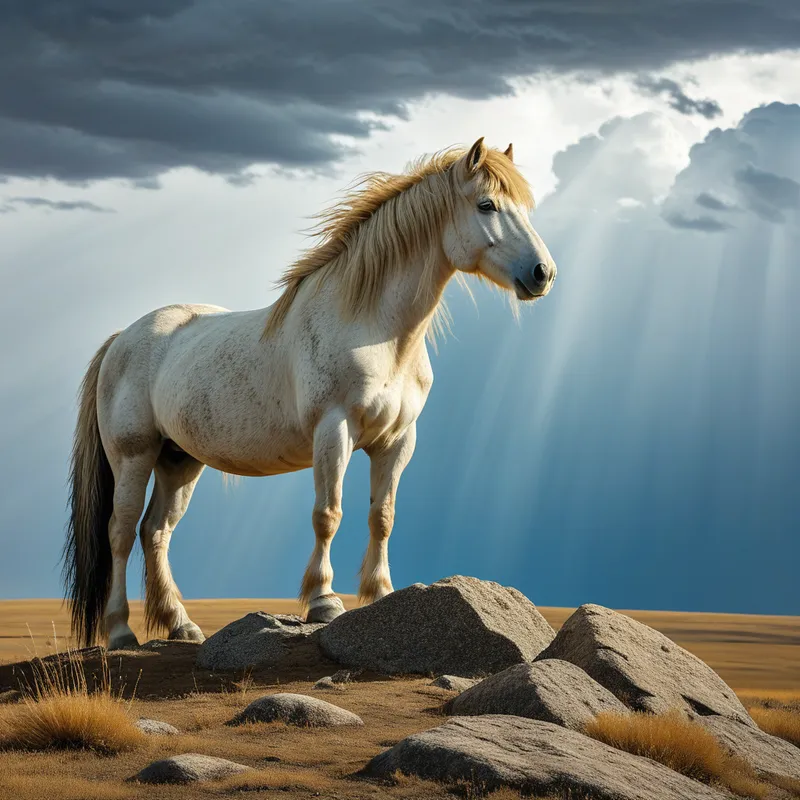
Before time was counted in years, when the world was raw and the sky pressed close to the earth, the spirit of the open land took a form. It was not a god to be worshipped in temples, nor a demon to be feared in the dark. It was a presence—a pounding of hooves on the hardpan, a snort of steam in the frozen air, a shadow that flowed across the hills faster than the clouds. This was the Takhi. Its coat was the color of the tawny earth after rain, its mane and tail the grey of winter smoke. Its eyes held the deep, knowing darkness of the Tengri itself.
For ages, the Takhi ran with the wind, its spirit inseparable from the boundless steppe. It knew no master. Its law was the migration of the seasons, its song the whistle of the wind through grass. Humans saw it, and in their hearts, a deep longing stirred—a memory of a freedom they had traded for fire and tribe. They tried to approach, to offer grain and gentle words. But the Takhi would only watch from a ridge, then vanish like mist before the sun. It was the untamed soul of the world itself.
Then came a turning. A great shadow fell upon the land, not of cloud, but of a different kind of order. Fences of ambition were dreamed. Corrals of civilization were built. A powerful Khan, whose dominion stretched far, looked upon the Takhi and saw not a spirit, but a resource unconquered. He declared, “Let the wild thing be brought to heel. Let its strength serve our carts, its speed carry our messages. Its wildness will be shaped into utility.”
His finest riders, on the fastest domesticated horses, gave chase. They chased the Takhi across the steppe, through valleys and over mountains. But the Takhi was a ghost of the open land. It would tire the pursuers’ mounts, then disappear into a canyon or a swirling blizzard, as if the land itself hid its child. The chase became an obsession, a years-long contest between the will to possess and the essence of freedom.
The climax came at the edge of the world, where the grasslands crumbled into a sheer precipice overlooking a roaring river far below. The Khan’s riders, relentless, had finally cornered the small, defiant herd. There was no more steppe to run to. The lead stallion, the embodiment of the Wild Horse Spirit, stood at the precipice. It looked back at the approaching riders, at the ropes in their hands, at the world of fences they represented. It did not see capture. It saw the end of an era.
With a scream that was neither of fear nor anger, but of profound, final refusal, the stallion leaped. Not to escape, but to choose. The herd followed, a cascade of tawny and grey flowing over the edge, not falling, but flowing into the mist of the canyon below. The riders reached the edge and saw only the swirling fog and heard only the river’s eternal roar. The Takhi was gone. But as the wind rose, some swore they heard the distant thunder of hooves, not on earth, but within the wind itself. The spirit had not died. It had simply refused the world that sought to bind it, returning its form to the wild, unbounded essence from which it came.
Cultural Origins & Context
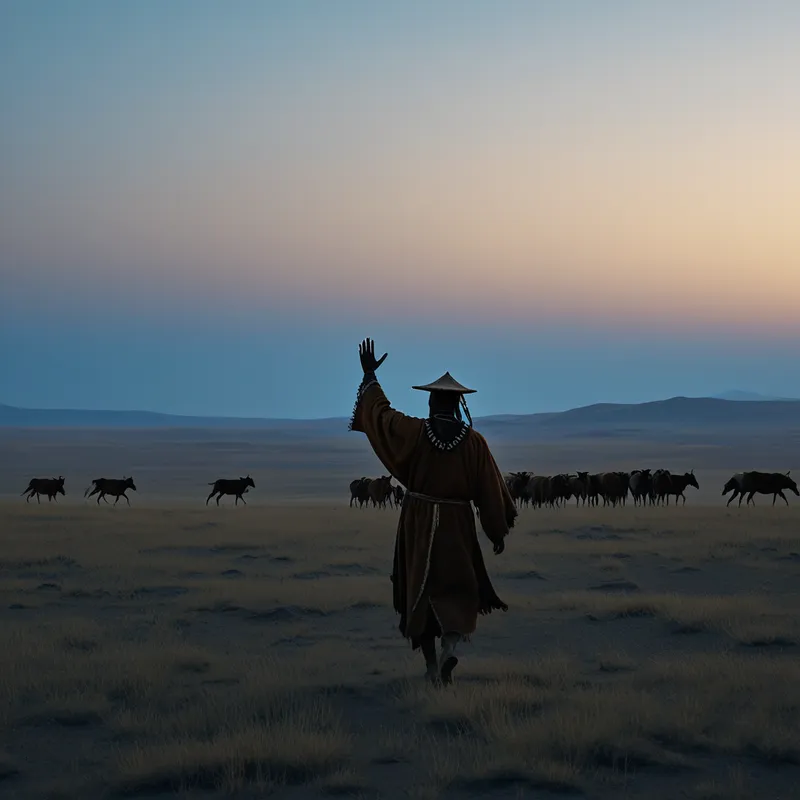
This narrative is not found in a single, canonical text but is woven into the oral tapestry of Mongolian pastoral culture, deeply intertwined with the ecological reality of the Takhi or Przewalski’s horse. As the last surviving subspecies of wild horse, its near-mythic status arises from a genuine historical relationship. Mongolian herders, whose lives were symbiotically linked to their domesticated horses, viewed the Takhi with a mixture of awe, respect, and a touch of melancholy. It represented the “before-time,” the original, untamed state of the horse before its partnership with humanity.
The myth was likely perpetuated by shamans (Böö) and elder storytellers around night fires. Its function was multifaceted. Ecologically, it served as a cautionary tale against greed and the complete domination of nature. Psychologically and socially, it reinforced a core cultural value: a reverence for fierce independence and spiritual freedom (Hiimori), even as the society itself was highly structured. The Takhi Spirit became a living symbol of the wild, autonomous soul that exists at the heart of the Mongolian worldview, a necessary counterpart to the disciplined cohesion of the tribe.
Symbolic Architecture
The myth of the Takhi Wild Horse [Spirit](/symbols/spirit “Symbol: Spirit symbolizes the essence of life, vitality, and the spiritual journey of the individual.”/) is a profound map of a fundamental psychic conflict. The Takhi is not merely an animal; it is the [archetype](/symbols/archetype “Symbol: A universal, primordial pattern or prototype in the collective unconscious that shapes human experience, behavior, and creative expression.”/) of the untamed Self in its pure, pre-cultural form.
The wild horse does not rebel against a specific master; it is the living principle of rebellion against the very concept of mastery.
The boundless steppe represents the unlimited potential of the unconscious, the field of all that is possible before [consciousness](/symbols/consciousness “Symbol: Consciousness represents the state of awareness and perception, encompassing thoughts, feelings, and experiences.”/) draws its boundaries. The Khan and his riders symbolize the organizing, civilizing principle of the ego-[consciousness](/symbols/consciousness “Symbol: Consciousness represents the state of awareness and perception, encompassing thoughts, feelings, and experiences.”/)—necessary for building a [life](/symbols/life “Symbol: The symbol of ‘Life’ represents a journey of growth, interconnectedness, and existential meaning, encompassing both the joys and challenges that define human experience.”/) in the world, but prone to [inflation](/symbols/inflation “Symbol: A dream symbol representing feelings of diminishing value, loss of control, or expansion beyond sustainable limits in one’s life or psyche.”/), believing it can and should assimilate everything into its [structure](/symbols/structure “Symbol: Structure in dreams often symbolizes stability, organization, and the framework of one’s life, reflecting how one perceives their environment and personal life.”/) of control.
The [chase](/symbols/chase “Symbol: Dreaming of a chase often symbolizes avoidance of anxiety or confrontation, manifesting as fleeing from something threatening or overwhelming in one’s waking life.”/) is the lifelong [tension](/symbols/tension “Symbol: A state of mental or emotional strain, often manifesting physically as tightness, pressure, or unease, signaling unresolved conflict or anticipation.”/) between these two forces within the individual: the [soul](/symbols/soul “Symbol: The soul represents the essence of a person, encompassing their spirit, identity, and connection to the universe.”/)’s yearning for absolute authenticity and freedom, and the psyche’s need for [adaptation](/symbols/adaptation “Symbol: The process of adjusting to new conditions, often involving psychological or physical change to survive or thrive.”/), order, and [relationship](/symbols/relationship “Symbol: A representation of connections we have with others in our lives, often reflecting our emotional state.”/). The [precipice](/symbols/precipice “Symbol: A steep cliff edge representing a critical boundary between safety and danger, often symbolizing life transitions, fear of the unknown, or existential risk.”/) is the critical [juncture](/symbols/juncture “Symbol: A critical point of decision, transition, or convergence where paths, choices, or timelines meet, demanding action or reflection.”/), the existential [crisis](/symbols/crisis “Symbol: A crisis symbolizes turmoil, urgent challenges, and the need for immediate resolution or change.”/). [Assimilation](/symbols/assimilation “Symbol: The process of integrating new experiences, identities, or knowledge into one’s existing self, often involving adaptation and transformation.”/) into the ego’s world (capture) means the [death](/symbols/death “Symbol: Symbolizes transformation, endings, and new beginnings; often associated with fear of the unknown.”/) of that wild essence. The leap, therefore, is not suicide, but a radical act of psychic [integration](/symbols/integration “Symbol: The process of unifying disparate parts of the self or experience into a cohesive whole, often representing psychological wholeness or resolution of internal conflict.”/). The spirit refuses to be made into a content of the conscious mind (a tamed animal) and instead returns to its [source](/symbols/source “Symbol: The origin point of something, often representing beginnings, nourishment, or the fundamental cause behind phenomena.”/), becoming a permanent, dynamic [aspect](/symbols/aspect “Symbol: A distinct feature, quality, or perspective of something, often representing a partial view of a larger whole.”/) of the [background](/symbols/background “Symbol: The background in a dream can reflect context, environment, and underlying influences in the dreamer’s life.”/) psyche—the wind, the spirit of the land. It becomes an internal compass pointing always toward freedom.
The Dreamer’s Resonance
When the Takhi Wild Horse Spirit gallops into modern dreams, it heralds a profound somatic and psychological process. It often appears when the dreamer feels trapped—by societal expectations, a confining job, a stagnant relationship, or their own rigid self-concept. The dream may feature a wild horse that is elusive, cornered, or magnificently free.
Somatically, this can manifest as a restlessness in the body, a feeling of being “caged” in one’s own skin, or conversely, a thrilling sense of expansion in the chest and limbs when imagining open spaces. Psychologically, it signals the uprising of the Shadow—not the dark shadow of repressed malice, but the golden shadow of disowned vitality, passion, and instinctual wisdom. The dream is an urgent missive from the deep Self: a part of you is being sacrificed for adaptation, and it is dying. The confrontation at the cliff’s edge in the dream mirrors an inner crossroads: continue to suppress this wildness (and risk psychic numbing), or find a way to let it “leap” into a new form of expression that doesn’t mean destruction.
Alchemical Translation
The myth models the alchemical process of separatio and sublimatio in service of individuation. The initial state is a psychic unity where the wild spirit roams free, but in potential conflict with the developing ego (the Khan’s growing domain). The chase is the necessary separatio—the conscious differentiation of this wild, instinctual Self from the ego’s identity. The ego wants to possess and use it (“tame it”), which would be a false, oppressive integration.
True integration is not possession, but sacred relationship. The wild spirit cannot live in your stable; you must learn to meet it on the open steppe of your own soul.
The leap from the cliff is the critical act of sublimatio—the spirit volatilizes, transforms from a concrete content (a horse to be caught) into a pervasive, guiding principle (the wind, the spirit of the land). For the modern individual, this translates to a profound inner shift. It is the moment one stops trying to “manage” their deepest creativity, wild joy, or non-conformist truth and instead allows that force to become the very ground of their being. The struggle ceases to be about “controlling my temper” or “scheduling my inspiration,” and becomes about living from a center that honors that wildness as its core wind. The individual no longer has a wild spirit; they are inhabited by it, guided by it. The Takhi’s fate teaches that the untamed Self cannot be made adjunct to the persona; it must be recognized as the sovereign, invisible force that gives the persona its authentic life and direction.
Associated Symbols
Explore related symbols from the CaleaDream lexicon:
- Horse — The universal symbol of instinctual power, vitality, and the journey of the body; in this myth, it is the specific vessel of untamed, pre-cultural spirit.
- Spirit — The non-corporeal essence of life and consciousness; the Takhi’s ultimate transformation from physical herd to eternal wind embodies the spirit’s refusal to be materialized.
- Wilderness — The psychic and physical landscape of the unbounded, uncategorized, and free; the essential homeland of the Takhi Spirit.
- Journey — The eternal chase across the steppe represents the lifelong psychic journey of negotiating between freedom and adaptation.
- Freedom — The core thematic drive of the myth, depicted not as a political ideal but as an ontological state of being beyond possession.
- Wind — The element into which the Takhi transforms, symbolizing an invisible, pervasive, and untouchable force that can yet be felt and heard.
- Mountain — The precipice edge as the place of ultimate decision and transformation, the threshold between one state of being and another.
- Sacrifice — The herd’s leap is not a defeat but a willing sacrifice of physical form to preserve spiritual essence, a supreme act of integrity.
- Rebellion — The myth is a pure archetype of rebellion against any force that seeks to fully domesticate the soul’s core nature.
- Shadow — The Takhi represents the golden shadow—the disowned, potent, and vital aspects of the self that the conscious ego fears or deems impractical.
- Sky — The domain of Tengri, representing the vast, impersonal cosmic order that witnesses and ultimately encompasses the wild spirit’s defiance.
- Wildfire — A force of nature that is destructive yet renewing, cleansing the land of old growth; akin to the Takhi’s spirit, which burns away illusions of control to allow for psychic renewal.