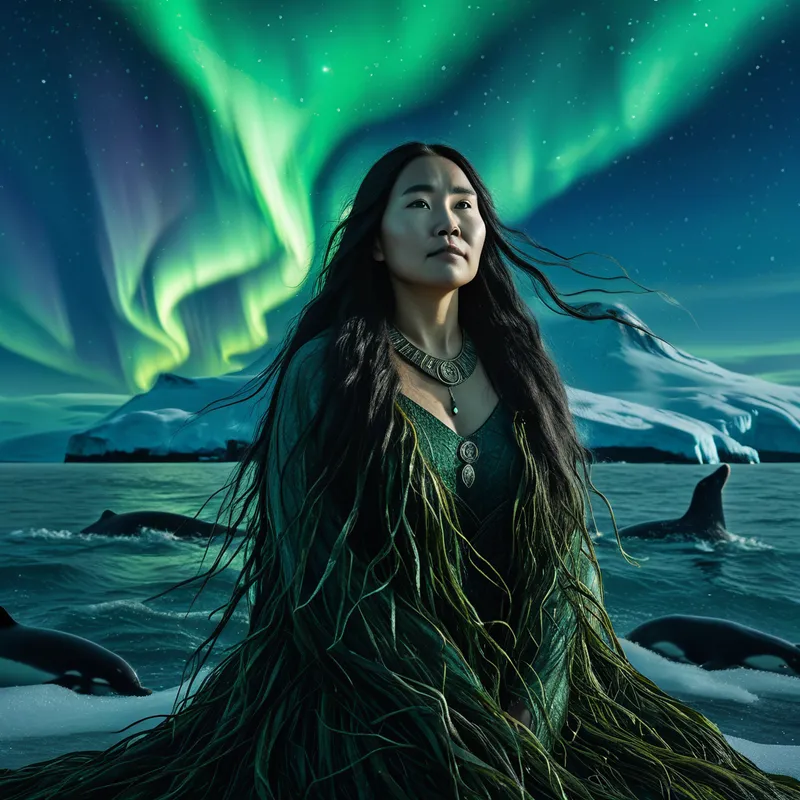
Takannaaluk Myth Meaning & Symbolism
The myth of Takannaaluk, the Sea Mother, tells of betrayal, descent, and ultimate transformation, governing the cycles of life and death in the sea.
The Tale of Takannaaluk
In the time before memory, when the world was ice and breath, there lived a woman of great beauty and kindness. She was known to all, a being of the land who loved the people. But she was betrayed. Her own father, in a act of unspeakable darkness, took her as his wife, cloaking his deed in the long night of winter. From this violation, a child was born.
Consumed by shame and a fury that froze the very air in her lungs, the woman seized her father-husband. With a strength born of absolute despair, she tore off his fingers. One by one, they fell to the floor of their snow-house, where they writhed and transformed into the first seals and walruses, creatures of blubber and soulful eye. Her rage was a blizzard. She grabbed her child, and fled from the world of humans, from the sight of the sun and the familiar paths of the tundra.
She ran to the very edge of the known world, where the solid land gives way to the whispering, hungry void of the sea. Without a glance back, she plunged into the black, icy waters. She sank, and sank, and sank, past the realm of light, down to the silty floor of the world. There, in the perpetual dark and crushing pressure, she made her home. Her beautiful hair became tangled with kelp and the bones of lost things. Her sorrowful eyes became the only light in the deep. The child she brought with her clung to her back.
In her descent, she was transformed. She was no longer the woman of the land. She became Takannaaluk, “the terrible one down there.” She became Sedna. The child on her back grew into a fearsome spirit-dog, her guardian and companion in the abyss.
And there she sits, at the root of the sea. The seals, walruses, and whales—the children of her vengeance—now dwell with her in a great pool beside her dwelling. When the people on the ice above grow hungry, when the hunt fails and the children cry, the angakkuq, the shaman, must undertake a perilous journey. His soul must fly down, down through the layers of sea and spirit, to find her dwelling. He must find Takannaaluk, her hair matted and filthy with the sins and broken taboos of humanity, which flow down to her like a constant, choking stream.
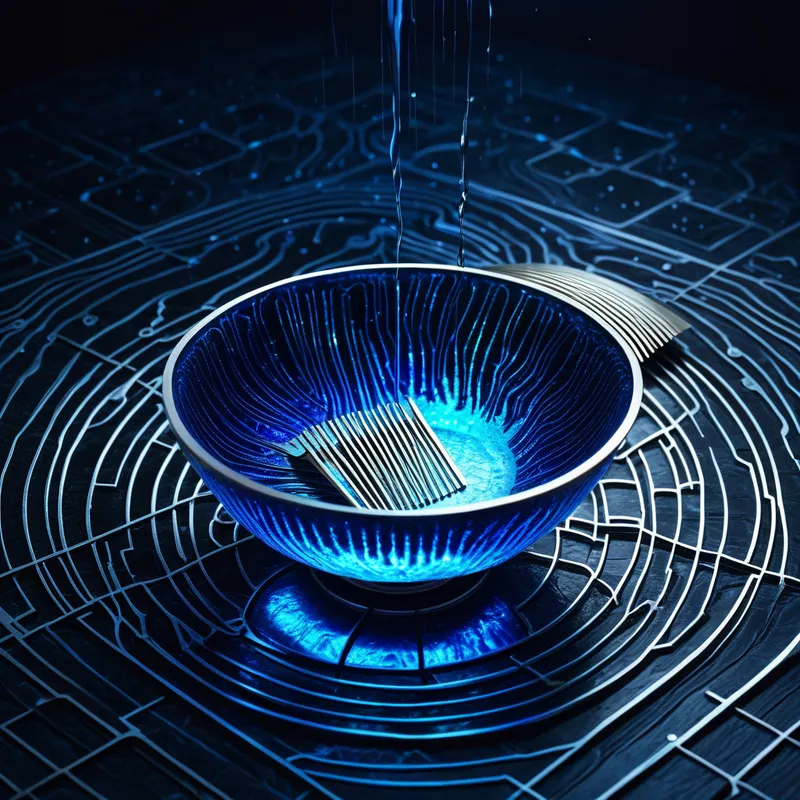
The shaman must take a comb, a humble tool of order and care, and with great tenderness and courage, he must comb the filth from her long, heavy hair. He must soothe her anger, apologize for the broken laws, and calm the storm of her grief. Only when she is comforted, when her hair is clean and she is appeased, will she release her children, the sea mammals. She will send them swimming upward, offering themselves to the hunters, so that the people may live. Her wrath withholds life; her grace bestows it. This is the eternal cycle, written in ice and blood and deep, dark water.

Cultural Origins & Context
This is not a story told for mere entertainment around the qulliq, the stone lamp. It is the foundational myth of survival for the Inuit peoples of the Arctic regions, from Greenland to Alaska. The myth of Takannaaluk is the central pillar of a spiritual ecology, a narrative that explains the origin of sea game and dictates the moral and ritual relationship between humans and the non-human world.
The story was traditionally the domain of the angakkuq. In a culture with no written word, the shaman was the living library, the psychologist, and the mediator. He would recite the myth during communal gatherings and, most crucially, re-enact its central drama during spiritual crises. When game was scarce, it was believed that Takannaaluk was angered by human transgression—a broken taboo, disrespect for an animal’s spirit, or social discord. The shaman would enter a trance, his soul journeying to her abyss to perform the ritual combing, thereby restoring balance and ensuring the community’s survival. The myth thus functioned as social regulator, environmental ethic, and theological doctrine, all woven into one profound, living narrative.
Symbolic Architecture
The myth of Takannaaluk is a masterclass in symbolic [depth](/symbols/depth “Symbol: Represents profound layers of consciousness, hidden truths, or the unknown aspects of existence, often symbolizing introspection and existential exploration.”/), mapping the psyche’s [relationship](/symbols/relationship “Symbol: A representation of connections we have with others in our lives, often reflecting our emotional state.”/) with the terrible, creative power of the unconscious.
The greatest trauma births the greatest source of sustenance; the deepest wound becomes the wellspring of life.
Her descent is not a [punishment](/symbols/punishment “Symbol: A dream symbol representing consequences for actions, often tied to guilt, societal rules, or internal moral conflicts.”/), but a transformation. The personal [trauma](/symbols/trauma “Symbol: A deeply distressing or disturbing experience that overwhelms the psyche, often manifesting in dreams as unresolved emotional wounds or psychological injury.”/) of [betrayal](/symbols/betrayal “Symbol: A profound violation of trust in artistic or musical contexts, often representing broken creative partnerships or artistic integrity compromised.”/) and incest forces her out of the collective [human](/symbols/human “Symbol: The symbol of a human represents individuality, complexity of emotions, and social relationships.”/) world (the ego’s domain) and into the chaotic, formless [depths](/symbols/depths “Symbol: Represents the subconscious, hidden emotions, or foundational aspects of the self, often linked to primal fears or profound truths.”/) of the unconscious (the sea). There, what was personal and horrific becomes transpersonal and numinous. Her fingers, severed in violence, become the first sea mammals—a stunning [image](/symbols/image “Symbol: An image represents perception, memories, and the visual narratives we create in our minds.”/) of how fragmented parts of the self, when accepted into the depths, can be reborn as sources of vitality and nourishment.
Her [hair](/symbols/hair “Symbol: Hair often symbolizes identity, power, and self-expression, reflecting how we perceive ourselves and how we wish to be perceived by others.”/), perpetually soiled by human misdeeds, symbolizes the psychic [connection](/symbols/connection “Symbol: Connection symbolizes relationships, communication, and bonds among individuals.”/) between the conscious world and the unconscious. Our unresolved complexes, our “sins” and ignored shadows, are not erased; they accumulate in the deep, tangling and angering the [source](/symbols/source “Symbol: The origin point of something, often representing beginnings, nourishment, or the fundamental cause behind phenomena.”/) of our own vitality. The [shaman](/symbols/shaman “Symbol: A spiritual mediator who bridges the human and spirit worlds, often through altered states, healing, and guidance.”/)‘s comb represents the act of conscious [attention](/symbols/attention “Symbol: Attention in dreams signifies focus, awareness, and the priorities in one’s life, often indicating where the dreamer’s energy is invested.”/), of psychic hygiene. It is not a battle, but a patient, respectful act of ordering the chaotic contents that flow between the levels of psyche.
The Dreamer’s Resonance
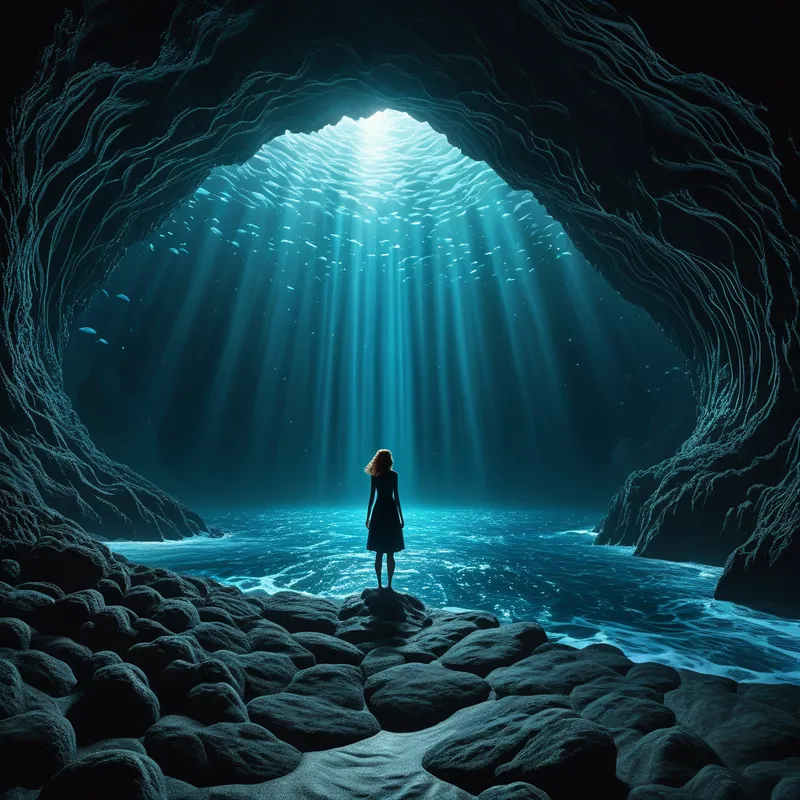
When this myth stirs in the modern dreamer, it often signals a profound encounter with the Great Mother in her dual aspect: the nourishing and the terrible. Dreams of drowning in dark water, of being pulled into a sinkhole, or of encountering a powerful, angry, or sorrowful feminine figure in a basement, cave, or deep body of water are somatic echoes of Takannaaluk’s realm.
The psychological process is one of necessary descent. The ego is being called, often through a crisis (betrayal, loss, depression), to relinquish its sunny, controlled surface life and acknowledge what has been repressed—the shame, the rage, the grief that lives “down there.” The dreamer may feel they are “in over their head” or “sinking.” This is not a call to annihilation, but to alchemical incubation. The dream ego is being prepared for a shamanic task: to go down into its own murky depths, not to fight the tangled, filthy aspects of the self, but to care for them. To comb them out. To make peace with the terrible mother who holds the keys to one’s own vitality.
Alchemical Translation
The individuation journey modeled by Takannaaluk is not one of heroic conquest, but of sacred reconciliation. The modern individual is both the betrayed woman and the starving community, both the angry goddess and the journeying shaman.
Individuation is the process by which one learns to become the tender comb for one’s own tangled soul, transforming the waste of trauma into the food of spirit.
The first alchemical stage is nigredo, the blackening. This is the betrayal and the plunge—the experience of psychological catastrophe that shatters the old identity. The individual descends into the mare tenebrosum, the dark sea of depression, confusion, and raw, unprocessed emotion. This is Takannaaluk making her home in the abyss.
The second stage is albedo, the whitening, the washing. This is the shaman’s work. It is the slow, patient, often painful process of therapy, introspection, shadow-work, or creative expression—the “combing.” It involves facing the matted filth of one’s past, one’s complexes, and one’s brokenness, not with disgust, but with the respectful attention of the angakkuq. The goal is not to eliminate these aspects, but to clean them, to see them clearly, to understand their origin and their power.
The final stage is rubedo, the reddening, the return of life. When the inner Takannaaluk is appeased, when the tension between conscious and unconscious is eased, new life is released. What was once a traumatic memory or a shameful complex becomes a source of depth, compassion, and creativity—the “sea mammals” that nourish the conscious personality. The individual does not return to the old “land” as the same person, but emerges as one who governs the flow between depth and surface, who understands that their vitality is directly tied to their willingness to tend the sacred, terrible source within.
Associated Symbols
Explore related symbols from the CaleaDream lexicon:
- Ocean — The vast, unconscious psyche itself, the realm of the primordial mother, containing both life-giving nourishment and terrifying depths.
- Mother — The archetypal Great Mother in her dual aspect: the nourishing source of all life and the terrible devourer who demands respect and ritual.
- Sacrifice — The original betrayal and the subsequent offering of the sea mammals; represents the necessary loss or suffering that precedes transformation and the renewal of life.
- Wound — The profound trauma of betrayal that forces the descent, which becomes the very site of numinous power and creative potential.
- Journey — The shaman’s soul-flight to the abyss, modeling the inward, perilous psychic journey required to reconcile with the deepest parts of the self.
- Ritual — The act of combing, a precise, reverent procedure that restores balance, symbolizing the conscious practices needed to maintain psychic and ecological order.
- Shadow — The filth in Takannaaluk’s hair, representing the repressed sins, shames, and broken taboos of the individual and collective that must be integrated.
- Rebirth — The transformation of severed fingers into seals and the cyclical release of game, symbolizing how fragments of a shattered self can be reconstituted into new, vital forms.
- Healing — The soothing act of the shaman, which is not a cure that erases the wound, but a reconciliation that transforms its relationship to the whole system.
- Grief — The foundational emotion of the Sea Mother, the vast, cold sorrow that must be acknowledged and tended for life to flow again.