Taiko Drums Myth Meaning & Symbolism
A myth where the gods use thunderous drumming and wild dance to lure the sun goddess from a cave, restoring light and order to a darkened world.
The Tale of Taiko Drums
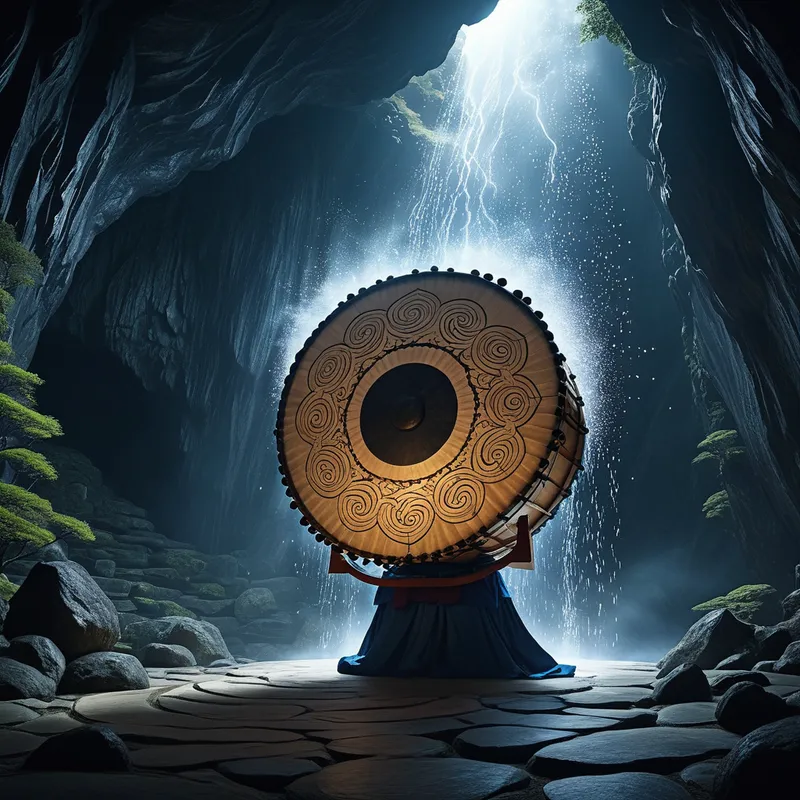
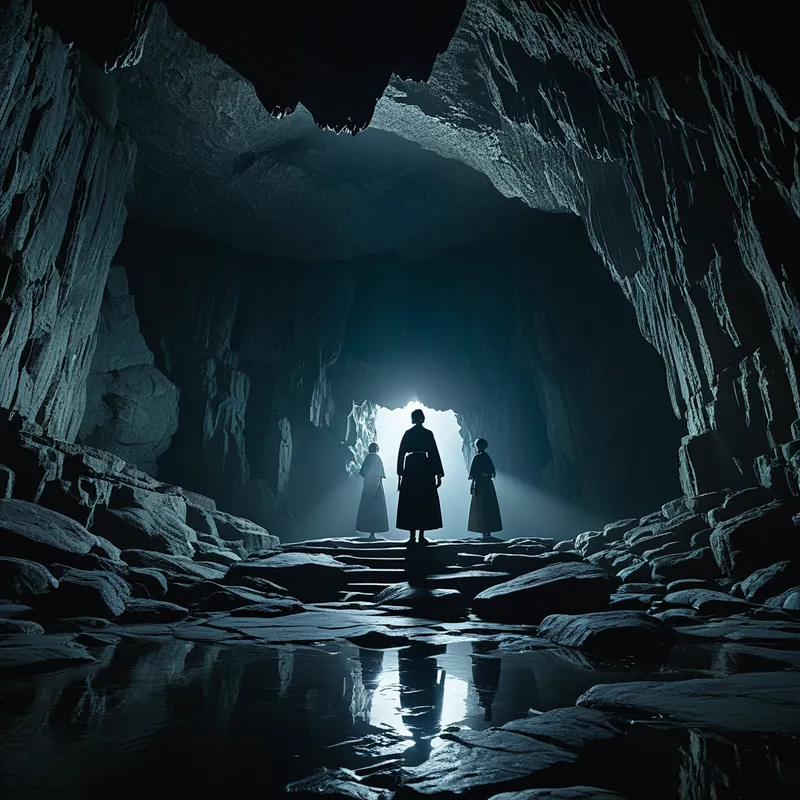
Listen, and feel the earth tremble. In the time when the world was young and the kami walked close to the land, a great shadow fell. Amaterasu-Ōmikami, she who fills the heavens with light, was gone. Her brother, the storm kami Susanoo-no-Mikoto, had wrought such havoc in his rage and grief that the heavens themselves wept. In terror and profound insult, the Sun Goddess retreated into the Ama-no-Iwato, a celestial cave of stone, and sealed the entrance with a mighty rock. The world was plunged into an endless, silent night. Cold crept into the bones of the kami. Life ceased its growth. Despair, thick and heavy, settled over all creation.
The eight million kami gathered on the banks of the Ama-no-Yasukawa, their divine forms dimmed. Whispers of eternity in the dark flitted between them. Then, the wise kami Omoikane spoke. A plan was forged not from force, but from irresistible allure. They would create a celebration so vibrant, so full of chaotic, joyous life, that the curious Sun could not help but peer out.
The Ame-no-Uzume-no-Mikoto stepped forward. Upon an upturned tub, she began to stamp her feet. Don… don… don… The sound was deep, a primal heartbeat echoing in the void. It was not yet a song, but a pulse. Then, faster. She began to dance, a wild, ecstatic dance that shook the stars. Her robes loosened, her spirit unleashed in a sacred frenzy of life asserting itself against the stillness of death.
The other kami watched, and felt the rhythm enter their own spirits. They began to clap, to shout, to laugh with a force that shook the very roots of the sakaki trees. They brought forth barrels and hollow logs, striking them with all their might. The separate thumps coalesced into a thunderous, rolling rhythm—the first great taiko. This was no mere noise; it was the sound of the world insisting on being alive. It was the heartbeat of creation itself, drummed back into existence against the enclosing dark.
Inside her stony womb, Amaterasu heard it. First, a faint vibration through the rock. Then, a rhythmic thunder that spoke of revels she was not part of. A laughter so full it seemed to defy her absence. Curiosity, a spark in the dark, flickered within her. What could possibly be so joyful in a world I have abandoned? Peering through a crack she made in the seal, she saw the reflection of her own dazzling light in the Yata-no-Kagami, held aloft by the kami. For a moment, she was transfixed by this new, brilliant “deity.”
In that moment of wonder, the strong kami Ame-no-Tajikarao seized the rock door and flung it aside. Light, pure and healing, flooded the universe once more. The taiko’s roar reached a crescendo of triumph. The dance of Uzume became a dance of all creation, welcoming back its soul. The rhythm did not cease; it settled into the fabric of the world, a perpetual reminder that from chaos and darkness, life and order are drummed into being.
Cultural Origins & Context
This myth, central to the Kojiki and Nihon Shoki, is far more than a simple etiological tale for the sunrise. It is the foundational drama of Shinto cosmology, explaining the restoration of balance (wa) through communal, ritual action. Historically, it legitimized the divine ancestry of the Imperial line (descended from Amaterasu) and sanctified the three Imperial Regalia—the mirror, the jewel, and the sword.
The myth was performed, not just recited. It served as the sacred precedent for kagura, the ritual dances and music offered to the kami at shrines. The figure of Ame-no-Uzume is considered the first miko (shrine maiden) and the progenitor of these arts. The taiko drum, therefore, is not merely an instrument; it is a ritual technology, a direct echo of the divine percussion that saved the world. Its function in festivals (matsuri) is to purify the space, attract the kami, and unify the community in a single, shared rhythm—re-enacting the very gathering at the Ama-no-Iwato.
Symbolic Architecture
At its core, the myth maps the psyche’s confrontation with profound withdrawal and depression (the hidden sun) and the non-rational, somatic tools required for its return.
The Ama-no-Iwato is the archetypal cave of the unconscious, a place of retreat where the luminous conscious self (Amaterasu) hides after a traumatic insult (Susanoo’s chaos). It is a state of introversion so deep it blots out the light of the world.
The drumbeat is the first language, older than words. It is the call of the body and the tribe to a soul that has forgotten how to feel.
Ame-no-Uzume’s dance represents the transformative power of embodied, ecstatic expression. She does not argue with the darkness; she dances upon it. Her “obscene” or uninhibited dance symbolizes the necessity of shadow integration—owning the wild, chaotic, and instinctual parts of the self to create a compelling force for life.
The Taiko Drum itself is the symbol of the collective heartbeat and the rhythmic ordering of chaos. Its sound is vibration, the primal creative force. It does not describe joy; it instantiates it. Psychologically, it represents the rhythmic, persistent application of life-affirming action (therapy, art, community) against the inert weight of despair.
The Mirror (Yata-no-Kagami) is the symbol of self-reflection and objective consciousness. Amaterasu is lured out not by seeing the world, but by seeing her own radiant essence reflected back at her. This is the moment of recognition, where the Self sees its own value and is drawn back into engagement.
The Dreamer’s Resonance
When the Taiko myth stirs in modern dreams, it signals a profound somatic and psychological process underway. To dream of a giant, resonant drum in a dark place is to experience the unconscious activating a primordial call to awakening.
The dreamer may feel the vibrations in their chest—a somatic echo of the dream drum syncing with their own heartbeat. This is the psyche attempting to re-establish its fundamental rhythm, which has been disrupted by grief, burnout, or trauma (the “storm of Susanoo”). Dreaming of trying to find the source of a deep, rhythmic sound in a labyrinth or cave suggests a search for one’s own hidden vitality. Dreaming of a wild, ecstatic dance, especially one that feels socially transgressive, mirrors Uzume’s role: the unconscious is urging the dreamer to express repressed energies, to use the body to shake loose a paralyzed spirit.
These dreams often occur during periods of deep introversion or depression, when the conscious ego has “retreated into the cave.” The drum in the dream is the compensatory symbol from the deep psyche, insisting that the path out is not through analytical thought alone, but through rhythm, movement, and communal resonance.
Alchemical Translation
The myth models the complete arc of psychic transmutation, or individuation. The initial state is one of wounded order (Amaterasu’s rule) shattered by unintegrated chaos (Susanoo’s outburst), resulting in a paralyzed, darkened psyche.
The Nigredo (The Blackening): This is the world in darkness, the soul in the cave. It is a necessary, if painful, dissolution where old identities and certainties are broken down.
The Alchemical Operation: The solution is not a heroic, singular effort, but a communal, creative ritual. The ego (the individual kami) must surrender to a process larger than itself. The “work” is the drumming and the dance—the persistent, rhythmic engagement with life (therapy, creative practice, physical exercise) even when no light is visible.
Individuation is not a silent meditation toward a static light; it is a thunderous, communal drumming to summon the light from within the darkness.
The Albedo (The Whitening) & Rubedo (The Reddening): The appearance of the mirror represents the moment of insight, where the Self recognizes its own inherent value. This is the whitening, the illumination. The final pulling forth of the sun and the triumphant celebration is the rubedo—the full integration, where the conscious self is restored, not to its old naive state, but now conscious of and resilient to the chaotic forces within. The restored light is wiser, having known the dark.
For the modern individual, the myth teaches that awakening from a personal “dark age” requires the “taiko” of disciplined, rhythmic action, the “dance” of authentic, perhaps unconventional, self-expression, and the “mirror” of honest self-reflection. We do not think our way out of the cave. We drum, we dance, and in the midst of that sacred noise, we catch a glimpse of our own light, and are pulled back into the world.
Associated Symbols
Explore related symbols from the CaleaDream lexicon: