Taegeuk the Great Ultimate Myth Meaning & Symbolism
The story of the primordial unity from which all duality—light and dark, heaven and earth—emerges, embodying the cosmic dance of creation.
The Tale of Taegeuk the Great Ultimate
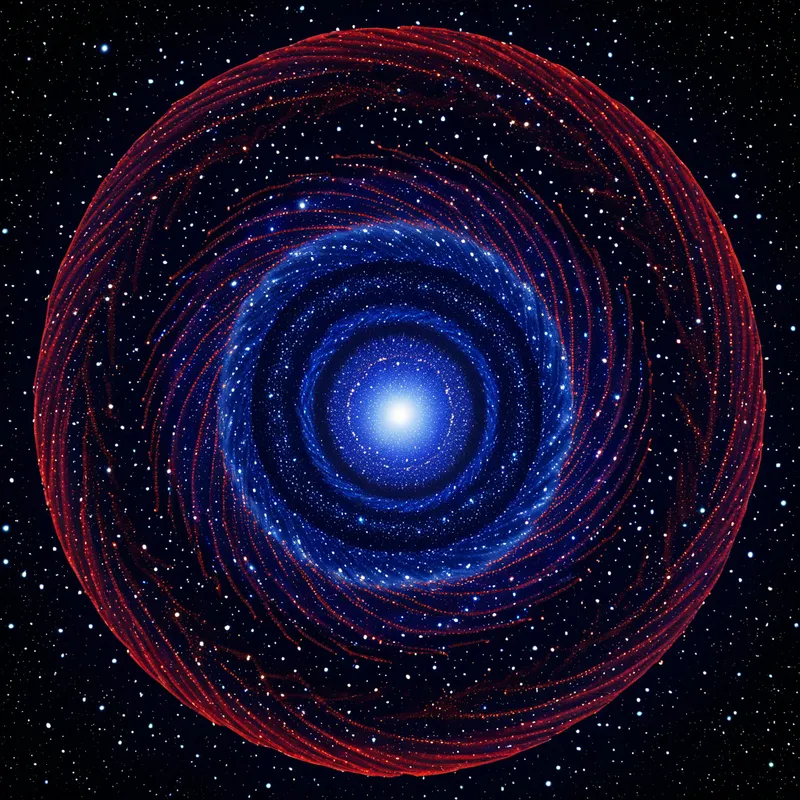
Listen. Before the mountains rose their spines against the sky, before the rivers learned their songs, there was a silence so profound it was a kind of sound. In that silence, there was a presence. Not a god as you might imagine, with a face and a will, but a condition of being. The ancients called it Taegeuk, the Great Ultimate.
It was a perfect, boundless sphere of potential, containing within its seamless heart all that ever would be: light and shadow, movement and stillness, the breath before the cry. It was the cosmic egg, the womb of ten thousand things, dreaming of itself. Within this luminous stillness, a tension grew—not a conflict, but a longing. The One dreamed of the Other. The stillness yearned for a dance.
And so, from its own serene center, a vibration began. A single, resonant note that was also a pulse. The sphere, in an act of profound generosity, began to turn upon itself. This rotation was the first action, the first differentiation. From this gentle, inevitable motion, the essence within began to separate. Not a violent tearing, but a graceful unfolding, like a lotus petal opening to the dawn.
From the luminous heart of the One flowed two streams of primordial essence. One was bright, active, ascending—this was Yang. It surged upward, becoming the clear, vaulting dome of heaven, the heat of the sun, the vigor of the mountain peak. The other was dark, receptive, descending—this was Yin. It flowed downward, becoming the fertile, yielding earth, the depth of the valley, the coolness of the moonlit stream.
They were not enemies, these two. They were lovers, siblings, two sides of the same breath. Where Yang expanded, Yin gathered. Where Yin rested, Yang stirred. Their endless, circling dance around the silent, central void—the Mu—was the first rhythm of the cosmos. From the interplay of their movements, the five elemental breaths—Ohaeng—were born, and from these, the ten thousand things of the world took shape: the tiger in the forest, the grain in the field, the human heart seeking its own center.
The Great Ultimate did not vanish. It became the pattern, the invisible axis around which the celestial dance eternally turns. It is the silence at the center of the storm, the unity remembered in every parting, the whole that holds the opposites in a sacred, generative embrace.
Cultural Origins & Context
The concept of Taegeuk is the philosophical cornerstone of Korean cosmology, deeply embedded through the influence of Taoism and Neo-Confucianism on the Korean peninsula, particularly during the Joseon era. It is not a myth told of a singular hero on a specific night, but a living, breathing cosmological framework passed down through scholars, artists, and philosophers.
It was articulated in texts, debated in royal academies, and visualized in the most potent of national symbols: the Taegeukgi. Here, the swirling red and blue Taegeuk sits at the center, surrounded by four of the eight Pal-gwae, representing heaven, earth, fire, and water. This flag is not merely a political emblem but a portable temple, a daily reminder of the cosmic order and the ideal of balance that should govern a nation and an individual’s life. The myth was lived through rituals aligning human activity with celestial patterns, through medicine based on balancing Yin and Yang energies, and through an aesthetic that valued harmonious proportion and natural flow.
Symbolic Architecture
At its core, the myth of Taegeuk is a map of [consciousness](/symbols/consciousness “Symbol: Consciousness represents the state of awareness and perception, encompassing thoughts, feelings, and experiences.”/) itself. It describes the primordial state of the psyche before the [birth](/symbols/birth “Symbol: Birth symbolizes new beginnings, transformation, and the potential for growth and development.”/) of the ego—a state of unconscious wholeness where all opposites are contained without conflict.
The Great Ultimate is the Self before it knows itself as “I,” the undifferentiated totality of the psyche from which the dance of consciousness emerges.
Yang symbolizes the active principle: the thrust of consciousness, [logic](/symbols/logic “Symbol: The principle of reasoning and rational thought, often representing order, structure, and intellectual clarity in dreams.”/), extroversion, and [daytime](/symbols/daytime “Symbol: Daytime often symbolizes clarity, awareness, and the active aspects of life, contrasting with night, which represents the unconscious.”/) [clarity](/symbols/clarity “Symbol: A state of mental transparency and sharp focus, often representing resolution of confusion or attainment of insight.”/). Yin symbolizes the receptive principle: the unconscious, [intuition](/symbols/intuition “Symbol: The immediate, non-rational understanding of truth or insight, often described as a ‘gut feeling’ or inner knowing that bypasses conscious reasoning.”/), introversion, and nighttime [mystery](/symbols/mystery “Symbol: An enigmatic, unresolved element that invites curiosity and exploration, often representing the unknown or hidden aspects of existence.”/). Crucially, the myth insists that neither is superior; each contains the seed of the other, represented by the small dot of opposite color within each half of the swirling [symbol](/symbols/symbol “Symbol: A symbol can represent an idea, concept, or belief, serving as a powerful tool for communication and understanding.”/). Conflict is not the end state; it is the [friction](/symbols/friction “Symbol: Friction represents resistance, conflict, or the necessary tension required for movement and transformation in dreams.”/) necessary for generation. The void at the center, the Mu, is perhaps the most profound [symbol](/symbols/symbol “Symbol: A symbol can represent an idea, concept, or belief, serving as a powerful tool for communication and understanding.”/). It is the fertile [emptiness](/symbols/emptiness “Symbol: Emptiness signifies a profound sense of void or lack in one’s life, often related to existential fears, loss, or spiritual quest.”/), the unknowable ground of being from which all [differentiation](/symbols/differentiation “Symbol: The process of distinguishing or separating parts of the self, emotions, or identity from a whole, often marking a developmental or psychological milestone.”/) springs and to which it all ultimately returns. It represents the transcendent function, the psychic [space](/symbols/space “Symbol: Dreaming of ‘Space’ often symbolizes the vastness of potential, personal freedom, or feelings of isolation and exploration in one’s life.”/) where opposites are reconciled into new forms.
The Dreamer’s Resonance
When this myth stirs in the modern unconscious, it often manifests in dreams of profound duality or sought-after unity. A dreamer may find themselves trying to reconcile two warring factions within a single dreamscape, or feel torn between two equally powerful choices. They may dream of a spinning wheel, a vortex, or a mandala that both fascinates and terrifies.
Somatically, this can feel like a tension at the very core of one’s being—a pulling sensation between expansion and contraction, between speaking out and staying silent. It is the psychological process of holding tension. The dream is not offering a quick solution, but presenting the raw material of the psyche’s own Taegeuk. The dreamer experiencing this pattern is at a threshold where a previously held, rigid identity is beginning to soften, allowing for the emergence of its long-repressed opposite. The anxiety of the dream is the birth pang of a more complex self.
Alchemical Translation
The individuation process, the journey toward psychological wholeness, is perfectly modeled by the myth of Taegeuk. We begin in a state of unconscious unity with the world (the Great Ultimate). Then comes the inevitable division: we develop an ego (Yang), which separates from the unconscious matrix (Yin). This creates the fundamental duality of our lived experience—conscious vs. unconscious, persona vs. shadow, good vs. bad.
The alchemical work is not to destroy one half in favor of the other, but to initiate the sacred rotation, to set the opposing forces into a creative dance around the central core of the Self.
The modern individual’s “struggle” is the friction of these opposites. The “triumph” is not victory of one over the other, but the achievement of a dynamic equilibrium. This is the coniunctio oppositorum—the sacred marriage. It involves acknowledging the shadow (the Yin within our conscious Yang), honoring the logos in our feeling (the Yang within our unconscious Yin), and, most importantly, learning to tolerate the emptiness, the Mu, at the center of our conflicts. In that silent, non-grasping space, a third, transcendent option can emerge—one that contains and transcends the duality, leading to a rebirth of the personality that is both more individual and more connected to the cosmic whole.
Associated Symbols
Explore related symbols from the CaleaDream lexicon:
- Circle — The perfect, boundless form of the Great Ultimate, representing wholeness, eternity, and the cyclical nature of all existence from which duality spirals forth.
- Sky — The pure manifestation of the Yang principle, representing consciousness, clarity, ascension, and the limitless realm of potential and spirit.
- Earth — The embodied form of the Yin principle, representing the unconscious, fertility, grounding, and the receptive container that gives form to heavenly potential.
- Dance — The eternal, generative movement between Yin and Yang; the dynamic process of life itself, where opposition creates rhythm, relationship, and beauty.
- Void — The central Mu of the Taegeuk, the fertile emptiness that is the source of all being and the silent witness to the cosmic dance.
- Light — The active, illuminating force of Yang, representing consciousness, awareness, and the creative spark that initiates differentiation from the primordial unity.
- Shadow — The necessary counterpart to light, representing the Yin, the unconscious, the unknown, and all that is repressed yet contains its own generative power.
- Seed — The Great Ultimate itself, containing within its undifferentiated state the complete blueprint for the entire cosmos and the potential for all life and form.
- Order — The harmonious pattern that emerges from the dance of opposites, representing the cosmic principle of balance and the structured reality born from primordial chaos.
- Chaos — The undifferentiated, potent state of the Great Ultimate before rotation; not disorder, but the limitless potential from which all order is born.
- Rebirth — The continuous process enacted by the Taegeuk’s rotation, where the interaction of opposites constantly generates new forms, mirroring the psyche’s endless journey toward renewal.
- Soul — The individual manifestation of the cosmic pattern, a microcosm containing its own swirling Taegeuk of opposites striving for, and remembering, its original unity.