Table of the Gods Myth Meaning & Symbolism
A myth of divine hospitality where a mortal king's hubristic attempt to test the gods leads to his ruin and the establishment of cosmic law.
The Tale of the Table of the Gods
Hear now a tale not of a hero’s glory, but of a king’s fatal pride, a story whispered in the rustling leaves of the [sacred groves](/myths/sacred-groves “Myth from Celtic culture.”/) of Sipylus. In an age when the boundary between mortal and divine was thin as morning mist, there lived [Tantalus](/myths/tantalus “Myth from Greek culture.”/), King of Lydia. He was no ordinary man. His veins carried the [ichor](/myths/ichor “Myth from Greek culture.”/)-diluted blood of the Titans, for he was the son of Zeus himself. This lineage was his blessing and his curse, for it planted in his heart a seed of unbearable arrogance.
His wealth was legendary, his palace a marvel, and his favor with the gods was a spectacle for all to see. He dined with them on Olympus, partaking of ambrosia and nectar, listening to the secrets of the cosmos that hummed between their words. But a worm of doubt gnawed at Tantalus. Were the gods truly all-knowing? Was their divine perception as infallible as men believed? A terrible, blasphemous thought took root: he would test them. He would stage the ultimate transgression to probe the limits of their sight.
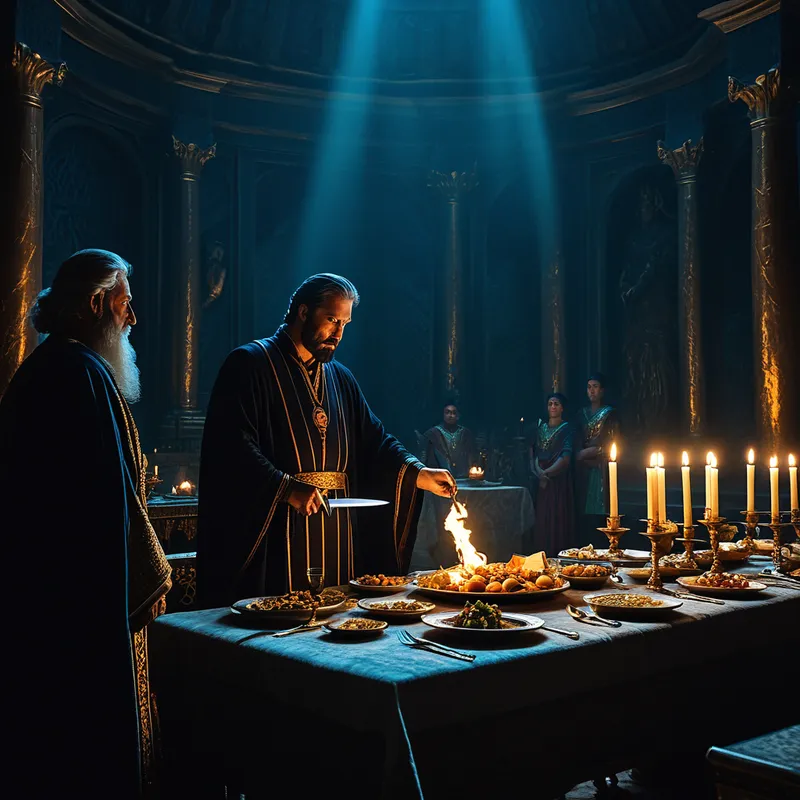
He invited the Olympians to a feast in his own hall, a supreme honor. The air was thick with the scent of roasting meats and myrrh. The gods arrived, their presence making the very stones of the palace hum. Then, Tantalus presented his main course. He had slaughtered his own son, the noble [Pelops](/myths/pelops “Myth from Greek culture.”/), butchered his flesh, and boiled it into a rich stew, serving it upon a table of finest cedar and gold. A silence, colder than the depths of [Tartarus](/myths/tartarus “Myth from Greek culture.”/), fell over the hall. The horror was palpable, a physical weight.
All but one deity recoiled. The goddess Demeter, distraught over the recent abduction of her daughter [Persephone](/myths/persephone “Myth from Greek culture.”/), was numb with grief. Absentmindedly, she consumed a piece of the shoulder. The other gods, their divine knowledge immediate and absolute, saw the atrocity for what it was. Zeus, in a wrath that shook the foundations of [the earth](/myths/the-earth “Myth from Hindu culture.”/), commanded [Hephaestus](/myths/hephaestus “Myth from Global/Universal culture.”/) to gather the butchered pieces of the boy. [The divine smith](/myths/the-divine-smith “Myth from Various culture.”/) reassembled the body in a cauldron of boiling [water](/myths/water “Myth from Chinese culture.”/). Where the shoulder was missing, consumed by Demeter, a flawless piece of gleaming ivory was fashioned and set in its place. Pelops was restored to life, more beautiful than before, bearing the ivory scar as a testament.
But for Tantalus, there would be no restoration. His crime was against [Xenia](/myths/xenia “Myth from Greek culture.”/) itself, the cosmic bond between host and guest, protected fiercely by Zeus. His punishment was eternal, poetic, and exquisitely cruel. He was cast into the darkest pit of [the underworld](/myths/the-underworld “Myth from Greek culture.”/), standing in a clear pool that reached his chin, beneath a fruit-laden tree. Yet, whenever he bent to drink, the water receded into the earth. Whenever he reached for the succulent fruit, a wind would blow the branches just beyond his grasp. He was tantalized—forever near satisfaction, forever denied. The Table of the Gods, the ultimate offering, had become the instrument of his eternal starvation.
Cultural Origins & Context
This harrowing myth is primarily preserved in the works of later poets like Pindar and the tragedians, and in the compendiums of mythographers like Apollodorus. It functioned as a foundational cautionary tale within the complex religious and social fabric of ancient Greece. At its core, it served to reinforce the sanctity of xenia, a social code so vital it was under the direct protection of Zeus Xenios. To violate hospitality was to attack the very order of civilization.
The myth also explores the dangerous liminal space occupied by heroes and kings who claimed divine ancestry. Tantalus’s proximity to the gods bred not reverence, but a fatal hubris—hubris—the ultimate sin in the Greek worldview. His story was a stark reminder that no matter how favored, the mortal who sought to equal or deceive the gods would be shattered by them. It was a narrative tool to explain the origins of both a ritual (the ivory shoulder of Pelops was said to be preserved and venerated) and a natural phenomenon (the “Tantalus” stone in Mount Sipylus was said to be the petrified king). It passed from bard to bard, from tragedian to citizen, as a dark mirror held up to human ambition.
Symbolic Architecture
The myth is a dense symbolic [architecture](/symbols/architecture “Symbol: Architecture in dreams often signifies structure, stability, and the framing of personal identity or life’s journey.”/) built upon the pillars of transgression, [perception](/symbols/perception “Symbol: The process of becoming aware of something through the senses. In dreams, it often represents how one interprets reality or internal states.”/), and consequence. The [Table](/symbols/table “Symbol: Tables in dreams often symbolize stability, social interactions, and a platform for discussions, negotiations, or decisions in our waking life.”/) itself is the central [symbol](/symbols/symbol “Symbol: A symbol can represent an idea, concept, or belief, serving as a powerful tool for communication and understanding.”/). It represents the [plane](/symbols/plane “Symbol: Dreaming of a plane often symbolizes a desire for freedom, adventure, and new possibilities, as well as transitions in life.”/) of communion, the sacred [space](/symbols/space “Symbol: Dreaming of ‘Space’ often symbolizes the vastness of potential, personal freedom, or feelings of isolation and exploration in one’s life.”/) where the [human](/symbols/human “Symbol: The symbol of a human represents individuality, complexity of emotions, and social relationships.”/) and the divine may meet under the strict laws of xenia. Tantalus does not merely set a [table](/symbols/table “Symbol: Tables in dreams often symbolize stability, social interactions, and a platform for discussions, negotiations, or decisions in our waking life.”/); he profanes it, turning a [symbol](/symbols/symbol “Symbol: A symbol can represent an idea, concept, or belief, serving as a powerful tool for communication and understanding.”/) of [connection](/symbols/connection “Symbol: Connection symbolizes relationships, communication, and bonds among individuals.”/) into one of ultimate [separation](/symbols/separation “Symbol: A spiritual or mythic division between realms, states of being, or consciousness, often marking a transition or loss of connection.”/) and sacrilege.
The table of communion, when defiled, becomes the altar of exile.
The Feast is the offered gift, which in its perversion—the flesh of his son—symbolizes the consumption of one’s own future, the destruction of [lineage](/symbols/lineage “Symbol: Represents ancestral heritage, family connections, and the transmission of traits, values, and responsibilities across generations.”/) and [legacy](/symbols/legacy “Symbol: What one leaves behind for future generations, encompassing values, achievements, possessions, and memory.”/) for the sake of a selfish, intellectual vanity. Tantalus sacrifices his own progeny to test an abstract principle. Pelops, killed and reborn with an [ivory](/symbols/ivory “Symbol: A precious material from elephant tusks, symbolizing purity, luxury, and mortality due to its source and value.”/) part, becomes a symbol of the scarred wholeness that follows [trauma](/symbols/trauma “Symbol: A deeply distressing or disturbing experience that overwhelms the psyche, often manifesting in dreams as unresolved emotional wounds or psychological injury.”/). He is the part of [the self](/myths/the-self “Myth from Jungian culture.”/) that can be restored after a great violation, yet is forever marked, carrying the “[ivory](/symbols/ivory “Symbol: A precious material from elephant tusks, symbolizing purity, luxury, and mortality due to its source and value.”/)” of divine intervention and unnatural repair.
Finally, the [Punishment](/symbols/punishment “Symbol: A dream symbol representing consequences for actions, often tied to guilt, societal rules, or internal moral conflicts.”/) of Tantalus is the ultimate symbol of the insatiable [psyche](/myths/psyche “Myth from Greek culture.”/). The eternal [hunger](/symbols/hunger “Symbol: A primal bodily sensation symbolizing unmet needs, desires, or emotional voids. It represents craving for fulfillment beyond physical nourishment.”/) and thirst are not for [food](/symbols/food “Symbol: Food in dreams often symbolizes nourishment, both physical and emotional, representing the fulfillment of basic needs as well as deeper desires for connection or growth.”/) and drink, but for the divine [favor](/symbols/favor “Symbol: ‘Favor’ represents the themes of acceptance, goodwill, and the desire for approval from others.”/) and secret [knowledge](/symbols/knowledge “Symbol: Knowledge symbolizes learning, understanding, and wisdom, embodying the acquisition of information and enlightenment.”/) he once possessed and arrogantly tested. He is condemned to live forever in the [presence](/symbols/presence “Symbol: Presence in dreams often signifies awareness or acknowledgment of something significant in one’s life.”/) of what he desires most, experiencing the [agony](/symbols/agony “Symbol: Intense physical or emotional suffering, often representing unresolved pain, internal conflict, or profound transformation.”/) of its perpetual withdrawal. It is the [psyche](/myths/psyche “Myth from Greek culture.”/) trapped in a [loop](/symbols/loop “Symbol: The loop symbolizes cycles, repetition, and the possibility of closure or a return to beginnings in one’s life experiences.”/) of unfulfillable desire.
The Dreamer’s Resonance
When this myth stirs in the modern unconscious, it rarely appears as a literal banquet. Instead, one may dream of preparing a crucial meal for esteemed guests only to find the food is spoiled or inedible. Or of reaching for a vital document or object on a table that endlessly slides away. The somatic feeling is one of profound anxiety, shame, and frustrated longing—a “tantalizing” sensation in the body.
Psychologically, this dream pattern signals a confrontation with one’s own “Tantalus complex”: a deep-seated hubris or a profound testing of a sacred boundary. The dreamer may be, in their waking life, exploiting a relationship, betraying a deep trust to “see if they can get away with it,” or using something precious (their creativity, a relationship, their integrity) as a mere test subject for their own ego. The dream is the psyche’s revelation of the inevitable consequence: a self-created hell of isolation and unmet need. It marks the point where ambition has curdled into self-sabotage, where the desire for god-like certainty leads to a human wasteland.

Alchemical Translation
The alchemical journey modeled here is not one of successful individuation, but a stark map of the [nigredo](/myths/nigredo “Myth from Alchemical culture.”/)—the blackening, the putrefaction—that occurs when the process is hijacked by [the ego](/myths/the-ego “Myth from Jungian culture.”/). Tantalus begins in a state of inflated privilege (the [prima materia](/myths/prima-materia “Myth from Alchemical culture.”/) of divine favor). His “experiment” is a false alchemy, an attempt to transmute divine connection into personal omnipotence through an act of horrific violence against the innocent, child-like potential (Pelops).
The psyche’s attempt to steal fire from the gods always risks consuming one’s own house.
The true alchemical process is initiated not by Tantalus, but by the gods—the symbolic Self. The reconstitution of Pelops in the cauldron is the albedo, the whitening, the cleansing and repair performed by a consciousness higher than the ego. The ivory shoulder represents the synthetic, transcendent function that emerges from the disaster—a gift from the Self (via Demeter’s unconscious participation and Hephaestus’s craft) that replaces what was lost with something both artificial and sublime. It is the new, resilient structure of the personality that can form after a catastrophic inflation has been punished and dissolved.
For the modern individual, the myth does not invite us to identify with Tantalus’s crime, but to recognize the Tantalus-within: the part that would sacrifice connection, love, or innocence on the altar of pride, control, or cynical testing. The path of individuation requires us to instead identify with Pelops—to allow the shattered parts of ourselves, broken by our own or others’ hubris, to be gathered and reconstituted by the healing, crafting powers of the deep Self. We must accept the “ivory scar,” the mark of our trauma and our redemption, and step away from the barren pool of eternal, ego-driven want. We must learn to receive at the true table, not profane it.
Associated Symbols
Explore related symbols from the CaleaDream lexicon: