Swayamvara Myth Meaning & Symbolism
A sacred ritual where a princess chooses her husband from assembled suitors, a crucible of destiny where divine skill and inner worth triumph.
The Tale of Swayamvara
Hear now the tale of the choosing, the Swayamvara, where fate is not decreed but declared, where destiny hangs not on a star but on the strength of a single, true heart.
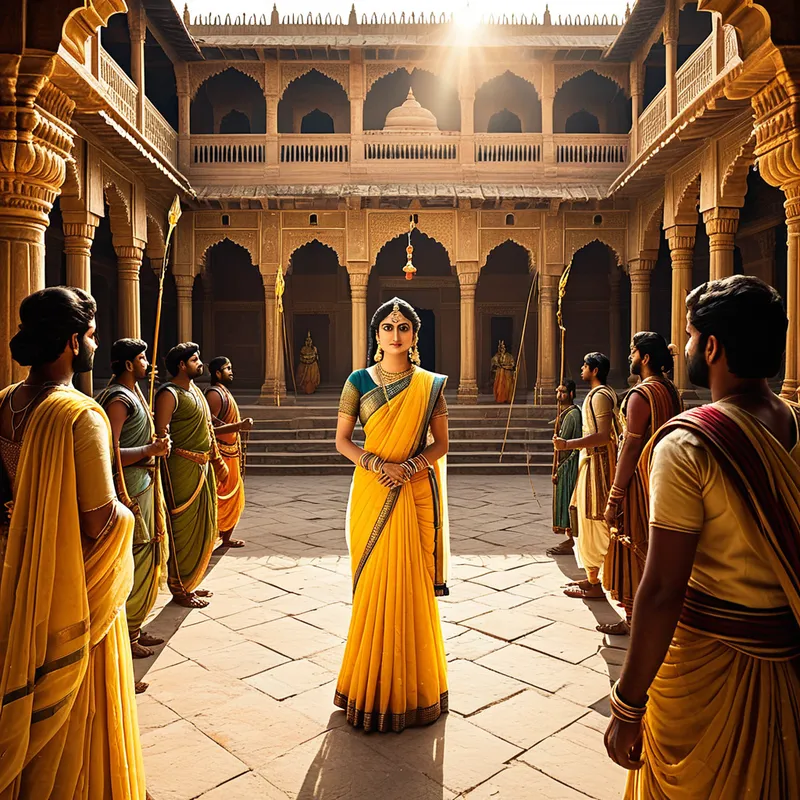
The air in the city of Kampilya was thick with the scent of champaka flowers and the murmur of a thousand voices. Kings had come from the corners of [the earth](/myths/the-earth “Myth from Hindu culture.”/), their elephants caparisoned in gold, their armies glittering like rivers of steel on the plains. They came for one reason: Draupadi, daughter of King Drupada, whose beauty was said to rival the dawn and whose spirit burned with a fire that could forge or consume empires. Today, she would exercise her swayam—her own will—to choose her husband.
The royal arena was a spectacle of raw power and fragile pride. Thrones of sandalwood and ivory held monarchs whose names were legends: Drona’s son Ashwatthama, the mighty Duryodhana, the venerable Dushasana, and the proud King of Anga, [Karna](/myths/karna “Myth from Hindu culture.”/). Their eyes, hungry and calculating, followed Draupadi as she entered, a vision in silk of sunset hues, a garland of never-fading [lotus](/myths/lotus “Myth from Hindu culture.”/) blossoms in her hands.
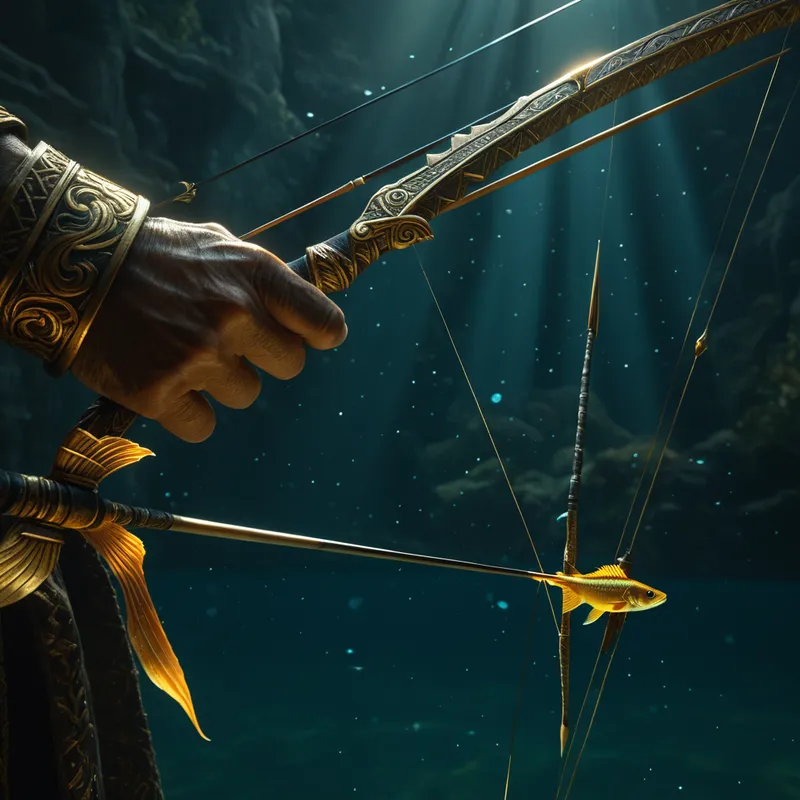
At the center of the arena stood the test: a massive bow, black as a moonless night, crafted by the gods themselves. Beside it, a contraption of polished brass and crystal held a target—a tiny, golden fish—that rotated ceaselessly high above. To win her hand, a suitor must string the bow, then, looking only at the fish’s reflection in a pan of dark oil below, pierce its eye with a single arrow. One by one, the kings of the earth approached. Muscles strained, veins bulged, but the bow lay inert, a slumbering dragon of divine lineage. Some could not lift it; those who did could not bend it. The air grew heavy with the scent of crushed ambition.
Then, from the shadows of the commoners’ gallery, a figure emerged. He was dressed as a Brahmin, simple and unadorned. A ripple of disdainful laughter swept through the royal pavilion. But Draupadi watched, her breath catching. [The stranger](/myths/the-stranger “Myth from Biblical culture.”/) walked to the bow with a stillness that silenced the crowd. His fingers touched the dark wood, not with force, but with recognition. In one fluid, impossible motion, he strung it. The twang of the cord was the sound of destiny snapping into place.
He took an arrow, dipped its tip in the oil, and looked down, his gaze fixed not on the distant, spinning target, but on its perfect, inverted reflection in the dark pool. [The world](/myths/the-world “Myth from Tarot culture.”/) held its breath. The bow sang, the arrow flew—a streak of light and purpose. A chime, pure and clear, echoed as the golden fish was struck cleanly through the eye. The arrow had found its mark without ever looking at it directly.
In the stunned silence, Draupadi rose. She walked past the thrones of gold, past the scowls of fallen pride, and placed the garland around the neck of the humble Brahmin. He was Arjuna, the greatest of warriors, in disguise. In that moment, choice and destiny became one. The true king was revealed not by his crown, but by his connection to the divine instrument of his fate.
Cultural Origins & Context
The Swayamvara is not merely a plot device from the Mahabharata or Ramayana; it is a deep-seated social and narrative archetype from the Vedic and epic periods. Historically, it functioned as a prestigious method of alliance-making among Kshatriya clans, where a princess’s choice could elevate a worthy warrior, forge powerful political bonds, or avert war. It was a public ritual that transformed marriage from a transactional arrangement into a sacred drama of meritocracy.
The stories were passed down by Sutas and traveling poets, recited in royal courts and village squares alike. The Swayamvara of Draupadi or Sita served a crucial societal function: it reinforced the ideal that sovereignty—both of a kingdom and of [the self](/myths/the-self “Myth from Jungian culture.”/)—is earned through demonstrated virtue, skill (guna), and alignment with dharma. It was a narrative crucible that separated the entitled from the worthy, teaching that true authority comes not from birthright alone, but from the ability to fulfill a sacred challenge.
Symbolic Architecture
At its core, the Swayamvara is a myth of the conscious confrontation with [destiny](/symbols/destiny “Symbol: A predetermined course of events or ultimate purpose, often linked to spiritual forces or cosmic order, representing life’s inherent direction.”/). Every element is a profound [symbol](/symbols/symbol “Symbol: A symbol can represent an idea, concept, or belief, serving as a powerful tool for communication and understanding.”/).
The [Princess](/symbols/princess “Symbol: The symbol of a princess embodies themes of power, privilege, and feminine grace, often entailing a journey of self-discovery.”/) (Draupadi, Sita) represents not just a person, but the ultimate value—[Shakti](/myths/shakti “Myth from Hindu culture.”/) (divine feminine power), sovereignty, the [soul](/symbols/soul “Symbol: The soul represents the essence of a person, encompassing their spirit, identity, and connection to the universe.”/) (Atman), or the complete [life](/symbols/life “Symbol: The symbol of ‘Life’ represents a journey of growth, interconnectedness, and existential meaning, encompassing both the joys and challenges that define human experience.”/) one is meant to live. She is the prize of existence, waiting to be claimed by the right [aspect](/symbols/aspect “Symbol: A distinct feature, quality, or perspective of something, often representing a partial view of a larger whole.”/) of the self.
The Bow is the [instrument](/symbols/instrument “Symbol: An instrument symbolizes creativity, communication, and the means by which one expresses oneself or influences the world.”/) of destiny, the specific, often daunting, life-[task](/symbols/task “Symbol: A task represents responsibilities, duties, or challenges one faces.”/) or vocation (svadharma) that one must master. It is divinely crafted, meaning it is inherent to the [structure](/symbols/structure “Symbol: Structure in dreams often symbolizes stability, organization, and the framework of one’s life, reflecting how one perceives their environment and personal life.”/) of [reality](/symbols/reality “Symbol: Reality signifies the state of existence and perception, often reflecting one’s understanding of truth and life experiences.”/) and the individual’s [psyche](/myths/psyche “Myth from Greek culture.”/). It cannot be wielded by brute force or ego, but only through [harmony](/symbols/harmony “Symbol: A state of balance, agreement, and pleasing combination of elements, often associated with musical consonance and visual or social unity.”/) with its [nature](/symbols/nature “Symbol: Nature symbolizes growth, connectivity, and the primal forces of existence.”/).
The target is not the goal you stare at, but the reflection of your purpose in the dark pool of your unconscious attention.
The Impossible Task (shooting the fish by its [reflection](/symbols/reflection “Symbol: Reflection signifies self-examination, awareness, and the search for truth within oneself.”/)) symbolizes the indirect [path](/symbols/path “Symbol: The ‘path’ symbolizes a journey, choices, and the direction one’s life is taking, often representing individual growth and exploration.”/) to fulfillment. It teaches that the object of desire (the fish/[kingdom](/symbols/kingdom “Symbol: A kingdom symbolizes authority, belonging, and a sense of identity within a larger context or community.”/)/self-realization) cannot be grasped directly by the conscious, grasping ego. One must look into the reflective [depths](/symbols/depths “Symbol: Represents the subconscious, hidden emotions, or foundational aspects of the self, often linked to primal fears or profound truths.”/)—the unconscious, [intuition](/symbols/intuition “Symbol: The immediate, non-rational understanding of truth or insight, often described as a ‘gut feeling’ or inner knowing that bypasses conscious reasoning.”/), or humble focus—to achieve the goal. It is [the law](/symbols/the-law “Symbol: Represents external rules, societal order, moral boundaries, and the tension between personal freedom and collective structure.”/) of Nishkama [Karma](/myths/karma “Myth from Hindu culture.”/) in narrative form.
The Disguised [Hero](/symbols/hero “Symbol: A hero embodies strength, courage, and the ability to overcome significant challenges.”/) (Arjuna as a Brahmin, Rama as an ascetic [prince](/symbols/prince “Symbol: A prince symbolizes nobility, leadership, and aspiration, often representing potential or personal authority.”/)) represents the essential, inner self stripped of outer titles and social masks. The [hero](/symbols/hero “Symbol: A hero embodies strength, courage, and the ability to overcome significant challenges.”/) must often become “nobody” to prove he is the true “somebody.” The [triumph](/myths/triumph “Myth from Roman culture.”/) reveals that worth is intrinsic, not conferred.
The Dreamer’s Resonance
When the Swayamvara pattern stirs in the modern unconscious, it often manifests in dreams of profound choice and tests of worthiness. You may dream of standing before a great assembly, tasked with an impossible feat—solving an unsolvable puzzle, performing a Herculean act of strength, or making a monumental decision with countless eyes upon you.
Somatically, this can feel like a tightening in the chest, a weight of expectation, or conversely, a surge of focused calm. Psychologically, this dream signals a crossroads where [the ego](/myths/the-ego “Myth from Jungian culture.”/) is being challenged to prove its mettle not to the outer world, but to the inner Self. The “suitors” in the dream are often fragmented aspects of your own psyche—the inner critic, the people-pleaser, the arrogant [persona](/myths/persona “Myth from Greek culture.”/), [the shadow](/myths/the-shadow “Myth from Jungian culture.”/)—all vying for control of your life’s direction. The dream is the psyche’s ritual arena, forcing a confrontation: will you identify with the proud kings who fail, or can you access the humble, focused archetype of the true hero within?
Alchemical Translation
The Swayamvara models the alchemical process of psychic individuation—becoming who you are inherently meant to be. The ritual is [the opus](/myths/the-opus “Myth from Alchemical culture.”/), [the great work](/myths/the-great-work “Myth from Alchemical culture.”/).
First, the Call to the Arena: Life presents a crisis, a vocation, or a deep longing that demands a response. This is the princess issuing her challenge. The conscious ego (the various suitors) must assemble and present itself.
Second, the Confrontation with the Instrument: You must engage with your specific dharma, your bow. This stage involves recognizing your unique gifts and the daunting responsibility they entail. Many “suitors” fail here—the ego attempts to use willpower, manipulation, or borrowed identity, but the bow remains unmoved.
Individuation requires that you become nobody, so that you may become somebody entirely your own.
Third, the Descent and Reflection: The crucial alchemical stage. The ego, having failed, must be stripped of its pretensions (the hero’s disguise). You must look down into the “dark oil”—the [nigredo](/myths/nigredo “Myth from Alchemical culture.”/) of the unconscious, your fears, flaws, and hidden depths. Here, in humble reflection, you find the true image of your goal, not as an object of conquest, but as a point of alignment.
Finally, the Release and Union: When the arrow is loosed from this place of integrated consciousness, it finds its mark effortlessly. This is the albedo and [rubedo](/myths/rubedo “Myth from Alchemical culture.”/). The garland is placed—the conscious ego (the hero) is united with the soul (the princess). Sovereignty over your own life is achieved. You have not won something external; you have performed the act that reveals what and who you have always been. The Swayamvara thus becomes an eternal internal ritual, a reminder that our deepest choices are always a matter of proving our worth, not to the world, but to the silent, waiting truth within our own being.
Associated Symbols
Explore related symbols from the CaleaDream lexicon: