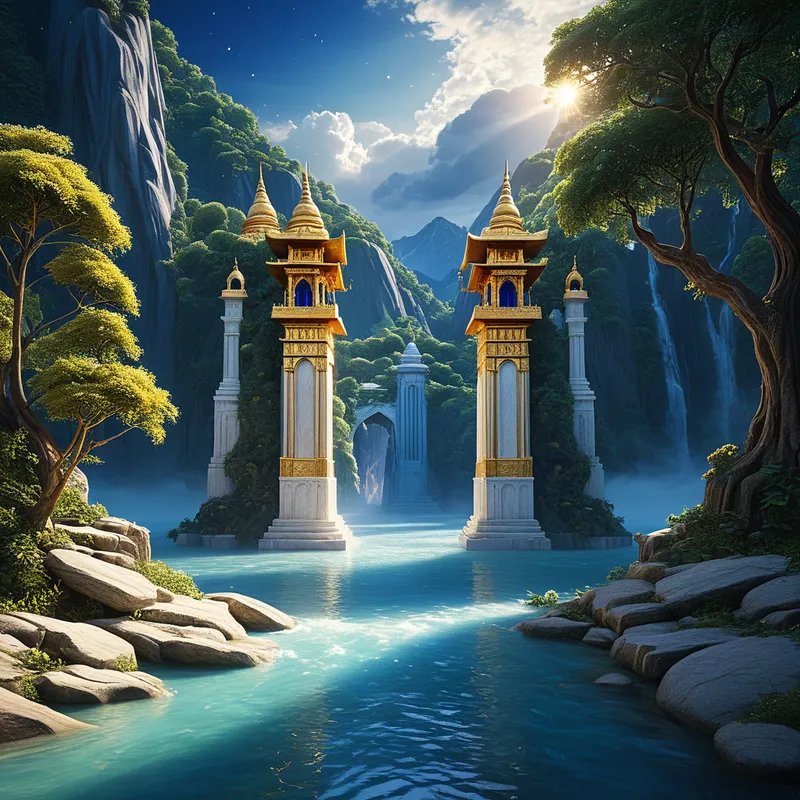
Svarga Myth Meaning & Symbolism
The celestial realm of Svarga is a temporary paradise of pleasure and virtue, a luminous reward that reveals the soul's deeper longing for ultimate liberation.
The Tale of Svarga
Listen. Beyond the seven seas, beyond the vault of the sky where the sun-chariot rests, there lies a realm untouched by sorrow. They call it Svarga. Its gates are not of iron, but of solidified dawn. Its guardian is not a beast, but Indra, whose thunderbolt is sheathed in peace here, and whose eyes hold the calm of eternal noon.
This is the reward. For the king who ruled with his heart as his scepter, for the sage whose silence became a bridge to the divine, for the warrior who fell with honor staining the earth—for them, the path opens. The Devas descend. The air parts like a curtain of silk, and the Vimana awaits, humming with a music older than time. The journey is a forgetting—the weight of the body, the ache of the years, all dissolved in the ascent through layers of light.
He arrives. The scent is the first baptism: a thousand immortal blossoms, the perfume of the Kalpavriksha, the incense of contentment. The sound is the second: the gentle cascade of the Mandakini, the soft laughter of the Apsaras, the eternal, harmonious strains of the Gandharvas. He walks the Nandana gardens, where fruits satisfy every hunger and flowers bloom at a mere glance. He is clothed in light, fed on ambrosia. Every desire is met, not by effort, but by the very atmosphere of the place. Time stretches, sweet and endless. He is a guest in the palace of the gods, where every pleasure is perfected, and every virtue finds its celebration.
But listen closer. Even in this symphony, there is a faint, haunting note. The Apsaras smile, but their eyes hold the memory of all the souls who have danced here before. The nectar satisfies, yet a subtle thirst remains—not of the body, but of the soul. The king, now a deity among deities, walks to the edge of the cloud-terrace. He looks down, past the swirling mists, towards the distant, turning wheel of the world he left behind. A strange longing stirs, quiet but undeniable. It is the whisper of the story not yet finished, the echo of a call from beyond even this perfect heaven. The bliss of Svarga is absolute, but it is not final. It is a chapter of sublime rest, written in gold and perfume, awaiting the turn of the page.
Cultural Origins & Context
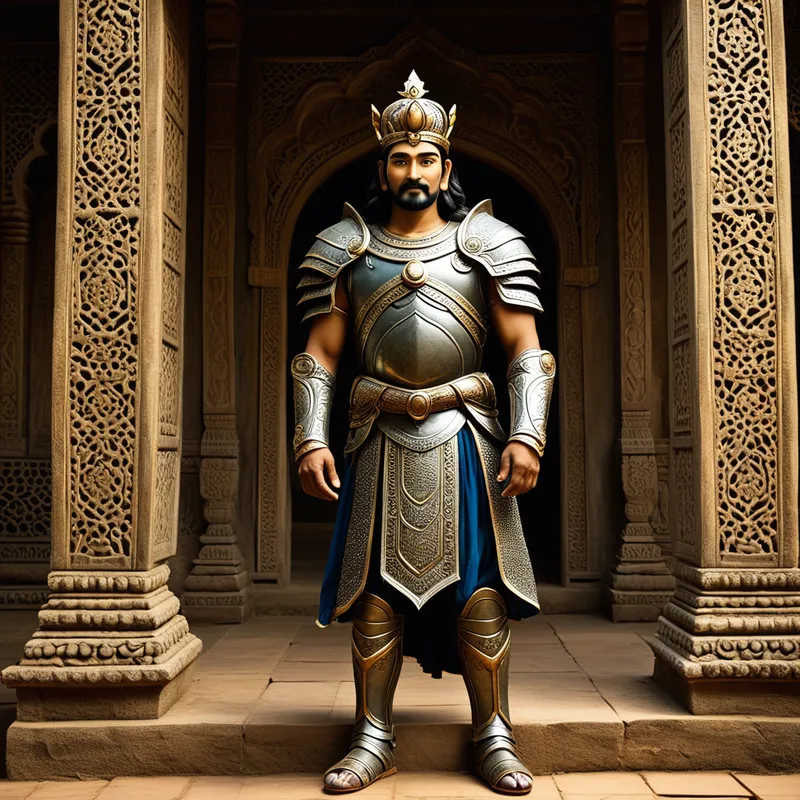
The concept of Svarga is woven into the earliest strands of Hindu thought, appearing in the Vedas as the bright, fatherly sky, the domain of Indra and the Adityas. It was not merely a fantasy, but a foundational social and cosmological ideal. This myth was the shared breath of a culture, passed down by the chanting priests (Hotri), elaborated upon by the bards of the epics like the Ramayana and Mahabharata, and systematized by the law-givers in texts like the Dharmashastras.
Its societal function was profound. Svarga served as the ultimate validation of Dharma—the righteous life. It answered the human cry for justice, promising that virtuous action (Karma) would be rewarded in a tangible, glorious afterlife. It provided a cosmological career path for kings, warriors, and householders, motivating social order and sacrificial duty. Yet, even in its glorification, it was always framed within a larger, more demanding spiritual hierarchy. The sages and philosophers who refined the myth placed Svarga as a temporary station, a sublime rest stop on the longer journey toward Moksha. It was a cultural dream of perfect order and pleasure, but one that ultimately pointed beyond itself.
Symbolic Architecture
Psychologically, Svarga is not a place, but a state of consciousness. It represents the pinnacle of the ego’s achievement—the fully realized, perfectly ordered, and pleasurably satiated self. It is the “golden palace” the psyche builds when it successfully navigates the trials of life, integrates its shadows, and masters its domain.
Svarga is the soul’s magnificent, gilded cul-de-sac. It is the reward for a life well-lived according to the script, where every desire finds its object and every virtue its applause.
Its symbols are archetypal. The wish-fulfilling trees (Kalpavriksha) symbolize the ego’s fantasy of omnipotent will, where thought instantly manifests reality. The celestial rivers are the flow of psychic energy, now perfectly channeled and sweet. The Apsaras and Gandharvas represent the harmonious, aesthetic functions of the psyche—beauty, art, and pleasure in their most refined forms. Yet, the core teaching of the symbol is its impermanence. Svarga is a realm of merit, and merit, like any psychological capital, can be exhausted. This is the myth’s profound depth: it validates the human striving for perfection and happiness, while simultaneously revealing its ultimate insufficiency for the soul that seeks not just reward, but truth.
The Dreamer’s Resonance
When this myth stirs in the modern unconscious, it rarely appears as a straightforward heavenly vision. More often, it manifests as dreams of eerie, perfect success. The dreamer may find themselves in a stunning, empty mansion they have “earned,” feeling a hollow pride. They may receive a prestigious award to the sound of silent applause, or achieve a long-sought goal only to be met with a profound sense of “Is this all?”
These are the somatic whispers of the Svarga complex. The psyche is signaling that it has reached a plateau. The ego has constructed its paradise—a successful career, a curated life, social admiration, mastered skills—and has now bumped against its walls. The feeling is one of blissful stagnation, a comfort that borders on entrapment. There is no conflict, no desire, and thus, no growth. The dreamer is experiencing the psychological “exhaustion of merit.” The soul, having enjoyed the rewards of its conscious efforts, begins to feel the quiet ache for a purpose beyond pleasure, a calling beyond order. It is the prelude to a necessary fall, or rather, a conscious choice to leave the gilded cage and venture into the unknown territories of the deeper Self.
Alchemical Translation
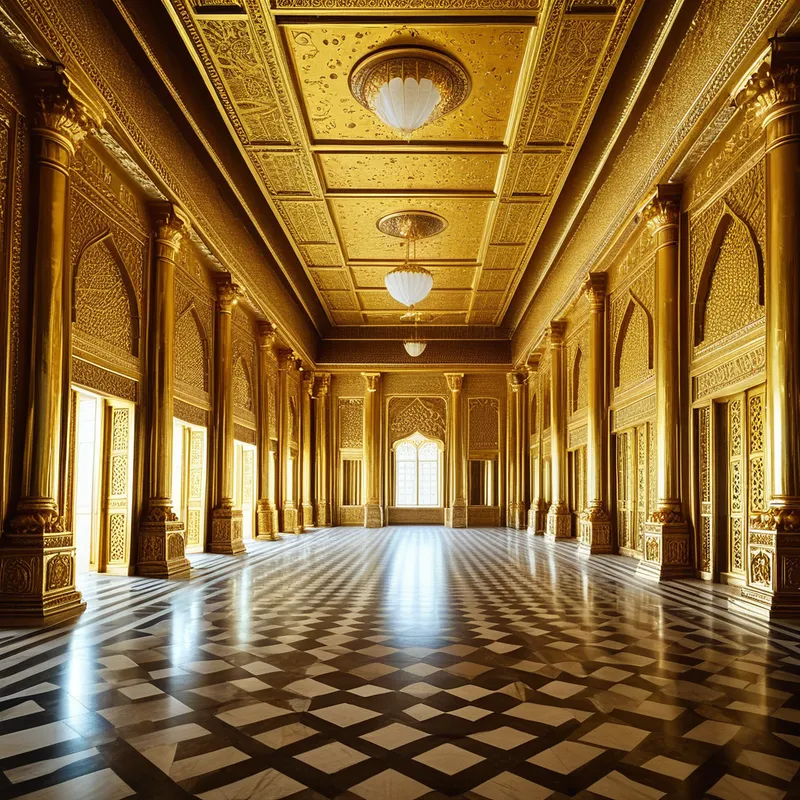
The journey through the Svarga myth models a critical phase in the alchemy of individuation: the confrontation with the perfected persona. The first alchemical stage is the hard work of nigredo and albedo—facing one’s shadow and purifying the ego. Svarga is the dazzling result: the citrinitas, the yellowing or golden dawn, where the personality achieves a brilliant, integrated form. One becomes the “ruler” of one’s own well-ordered psychic kingdom.
The most perilous illusion is not failure, but a success so complete it masquerades as the final goal. Svarga is that sublime illusion, the ego’s masterpiece.
The alchemical work, however, demands the final stage: rubedo, the reddening. This is the sacred discontent, the “longing from the cloud-terrace.” It is the realization that even the most golden paradise is a state of being-contained. True psychic transmutation requires shattering this container—not through destruction, but through transcendence. The soul must willingly relinquish its hard-won heavenly identity, its role as the virtuous king in the court of the gods, to become a pilgrim again. This is the move from Svarga to Moksha, from the ruler archetype to the sage. It is the understanding that the ultimate reward is not a place of rest, but the freedom to dissolve into the boundless, dynamic mystery from which all worlds, even heavenly ones, are born. The myth, therefore, is an eternal map: it honors the climb to the peak, but its deepest wisdom is in the instruction to not build your home there, but to keep walking, into the sky itself.
Associated Symbols
Explore related symbols from the CaleaDream lexicon: