Suzumushi Myth Meaning & Symbolism
A grieving mother's spirit becomes a bell cricket, her sorrowful song a hauntingly beautiful elegy that bridges the worlds of the living and the dead.
The Tale of Suzumushi
Listen. When [the world](/myths/the-world “Myth from Tarot culture.”/) grows hushed and the last blush of twilight bleeds into the deep indigo of night, a sound begins. It is not a sound of this earth, not wholly. It is a chime of pure silver, a tear turned to crystal, a single, piercing note that hangs in the cool autumn air. Chin-chirorin. This is the song of the Suzumushi, and its tale is one woven from the very threads of human sorrow.
In a time when [the moon](/myths/the-moon “Myth from Tarot culture.”/) walked closer to [the earth](/myths/the-earth “Myth from Hindu culture.”/), there lived a woman. Her name is lost to the whispering reeds, but her story is etched in the song of the insect. She was a mother, and her love for her child was as deep and quiet as a forest pool. But fate, that weaver of cruel patterns, took her child from her. The loss was a winter that settled in her bones, a silence that swallowed the sun. No lamentation could hold the shape of her grief; it was a vast, soundless sea within her.
Night after night, she would wander to the place where memory was most vivid—a quiet garden, a particular stone, [the shadow](/myths/the-shadow “Myth from Jungian culture.”/) of a pine. The world of the living grew faint to her, its colors dull. Her heart, heavy with unshed tears and unspoken words, became a vessel for a profound longing—not just for [the child](/myths/the-child “Myth from Alchemy culture.”/), but for a language to bridge the impossible chasm between the realm of the living and the Yomi. She prayed not to the great kami of the mountains, but to the small, hidden spirits of the earth, to the coming autumn, to the very essence of transition itself.
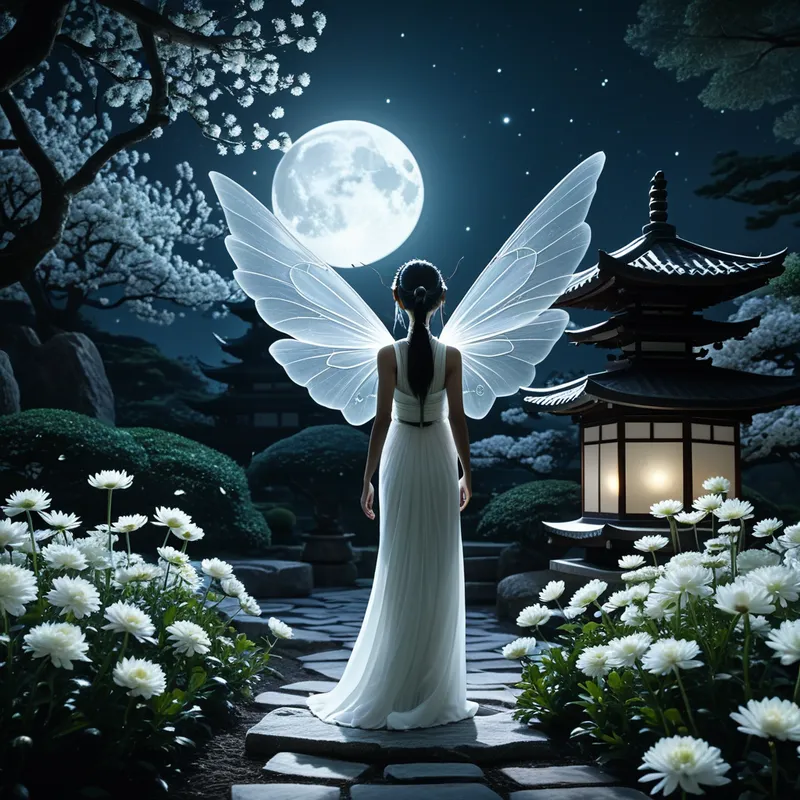
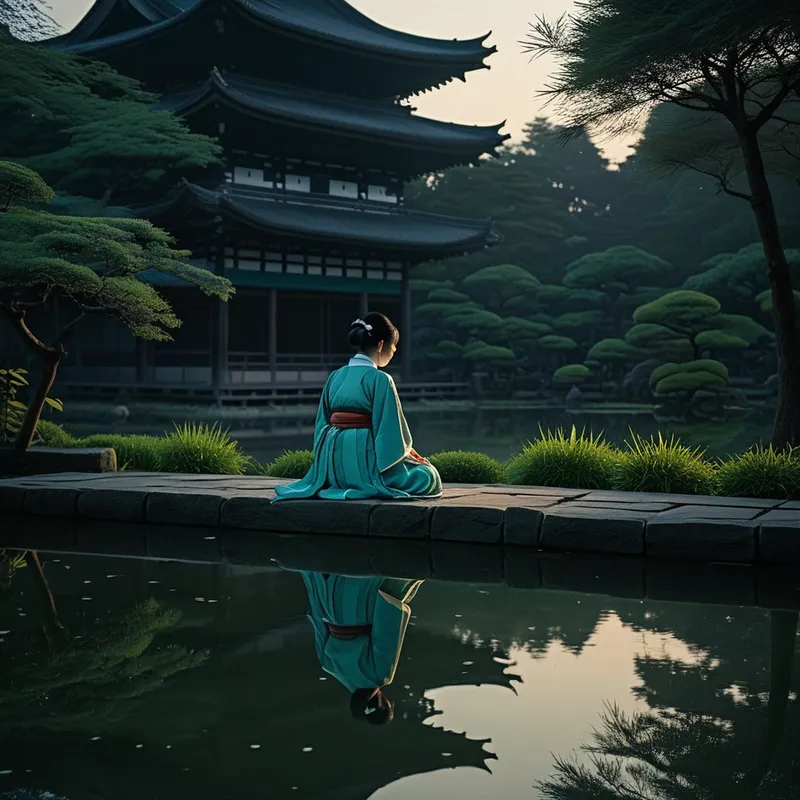
One evening, as the first true chill of autumn touched the air, she knelt by a bed of fading kikyō (bellflowers). Her sorrow finally overflowed, not as a wail, but as a sigh so deep it seemed to stir the roots of the world. And as she exhaled, her form began to shimmer, not with light, but with a delicate, moonlit transparency. Her robes dissolved into fragile, veined wings. Her voice, trapped for so long, distilled into a single, perfect tone at the base of her throat. Her human self unraveled and was rewoven by the spirit of the season itself.
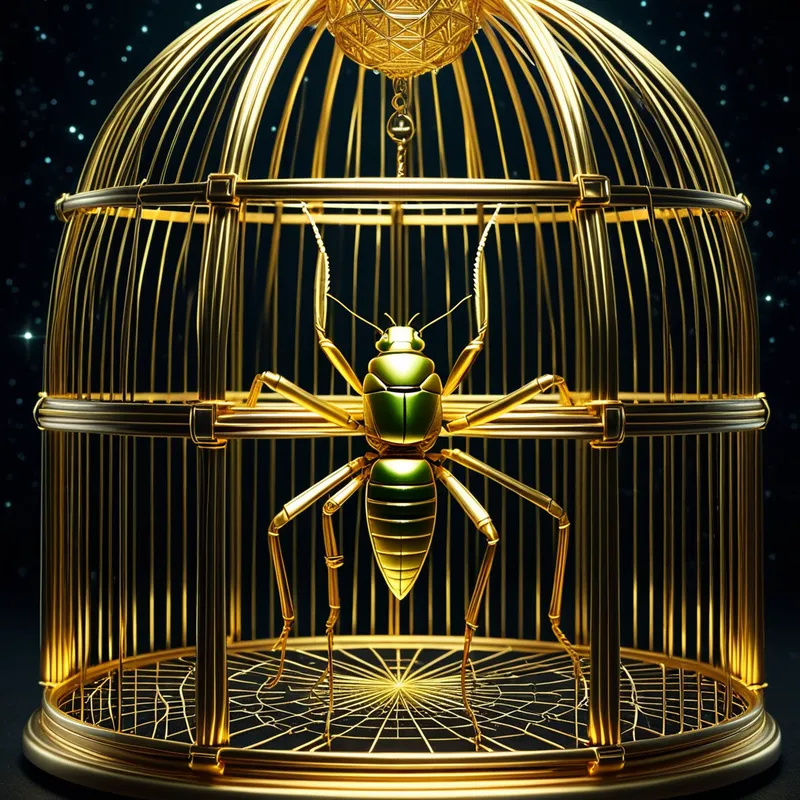
Where the woman once knelt, now a small, elegant cricket remained. Her body was the color of polished night, and from her rose a song—chin-chirorin. It was not a cry of pain, but its alchemical transformation. It was the echo of a lullaby, the vibration of a remembered touch, the pure frequency of love persisting beyond form. She became the Suzumushi, the Bell Cricket. Her song did not call her child back—that bridge was forever closed—but it became a new bridge. A bridge of memory, a signal flare of enduring connection sent out into the lonely night, assuring all who heard it that love does not end; it changes its language.
Cultural Origins & Context
The myth of the Suzumushi is not housed in a single, canonical text like the Kojiki. Instead, it is a folkloric motif that breathes within the interstitial spaces of Japanese culture—in [haiku](/myths/haiku “Myth from Japanese culture.”/) and waka, in Noh theater’s evocative allusions, and in the oral traditions passed down by grandmothers on verandas as autumn deepened. Its primary habitat is the poetic imagination of the Heian and Edo periods, where the melancholic beauty of [mono no aware](/myths/mono-no-aware “Myth from Japanese culture.”/)—the poignant awareness of the [impermanence](/myths/impermanence “Myth from Buddhist culture.”/) of things—was a supreme aesthetic and spiritual value.
The cricket’s song was a staple of the “autumn grasses” (akikusa) theme in poetry, a natural symbol that triggered a complex emotional response. It was a sound of beauty, yet it heralded the dying of the year. Storytellers and poets wove narratives around this sound, personifying it to give voice to a universal human experience: inconsolable grief. The tale functioned as a cultural container for profound loss, particularly the loss of a child, which in the strict social structures of historical Japan often had to be borne in silent dignity. The myth gave that silence a beautiful, public voice. It transformed private agony into a shared, seasonal phenomenon, allowing listeners to hear in the cricket’s chime not just an insect, but the enduring presence of all lost loves.
Symbolic Architecture
The Suzumushi is a master [symbol](/symbols/symbol “Symbol: A symbol can represent an idea, concept, or belief, serving as a powerful tool for communication and understanding.”/) of psychic [alchemy](/symbols/alchemy “Symbol: A transformative process of purification and creation, often symbolizing personal or spiritual evolution through difficult stages.”/). It represents the transformation of raw, paralyzing [emotion](/symbols/emotion “Symbol: Emotion symbolizes our inner feelings and responses to experiences, often guiding our actions and choices.”/) into a work of soulful art. The woman does not “get over” her [grief](/symbols/grief “Symbol: A profound emotional response to loss, often manifesting as deep sorrow, yearning, and a sense of emptiness.”/); she becomes it, in the most literal and profound sense. Her humanity is not erased but transmuted.
The most profound healing is not the removal of pain, but its metamorphosis into a new organ of perception.
The [cricket](/symbols/cricket “Symbol: The cricket often represents good luck, joy, and the arrival of change, bringing feelings of harmony and tranquility.”/)’s [body](/symbols/body “Symbol: The body in dreams often symbolizes the dreamer’s self-identity, personal health, and the relationship they have with their physical existence.”/) symbolizes the [vessel](/symbols/vessel “Symbol: A container or structure that holds, transports, or protects something essential, representing the self, emotions, or life journey.”/)—the new, limited, yet exquisite form that can hold the uncontainable. Its song is the essence—the distilled [truth](/symbols/truth “Symbol: Truth represents authenticity, honesty, and the quest for knowledge beyond mere appearances.”/) of the experience, now communicable. This is the shift from being drowned by the “complex” (Jung’s [term](/symbols/term “Symbol: The term often represents boundaries, defined concepts, or experiences that have a specific meaning in a given context.”/) for a core emotional wound) to carrying it consciously. The Suzumushi does not lament to the world; she sings for it, offering her transformed sorrow as a gift of [beauty](/symbols/beauty “Symbol: This symbol embodies aesthetics, harmony, and the appreciation of life’s finer qualities.”/) and recognition. Furthermore, the [cricket](/symbols/cricket “Symbol: The cricket often represents good luck, joy, and the arrival of change, bringing feelings of harmony and tranquility.”/) is a [creature](/symbols/creature “Symbol: Creatures in dreams often symbolize instincts, primal urges, and the unknown aspects of the psyche.”/) of [the threshold](/myths/the-threshold “Myth from Folklore culture.”/) ([limen](/myths/limen “Myth from Roman culture.”/)), singing at [dusk](/symbols/dusk “Symbol: A transitional period between day and night, symbolizing liminality, reflection, and the merging of opposites in artistic and musical contexts.”/) and in [autumn](/symbols/autumn “Symbol: A season symbolizing transition, harvest, and decay, representing life’s cycles between abundance and decline.”/)—times of transition. It becomes a [psychopomp](/myths/psychopomp “Myth from Greek culture.”/) not for souls, but for feelings, guiding unbearable emotion from the inner land of the dead into the living world of shared experience.
The Dreamer’s Resonance
When the pattern of the Suzumushi emerges in modern dreams, it signals a deep, somatic process of grief transmutation at work. One might not dream of a cricket, but of a forgotten room in one’s house where a beautiful, haunting music box plays by itself. Or of a lost object—a locket, a letter—that begins to emit a soft, clear light and a resonant hum. The dreamer may feel a profound sadness within the dream, yet it is a sadness that feels clean, sharp, and strangely beautiful, not muddy and overwhelming.
Psychologically, this dream motif suggests the unconscious is initiating the final stage of a mourning process. The heaviness of the affect (the emotional charge) is being “sublimated”—not in the Freudian sense of repression, but in the alchemical sense of being lifted (sublimare) into a higher form. The [psyche](/myths/psyche “Myth from Greek culture.”/) is attempting to find a “song” for a loss that has perhaps been wordless for years. It is [the Self](/myths/the-self “Myth from Jungian culture.”/)’s instinct to create meaning from pain, to forge a connection between the isolated island of one’s private sorrow and the mainland of the human collective. The dream is an invitation to find one’s own chin-chirorin—perhaps through art, writing, ritual, or simply through a new, more conscious relationship to the memory.

Alchemical Translation
The individuation journey modeled by the Suzumushi myth is not one of heroic conquest, but of sacred surrender. It is the path of the caregiver turned inward. The modern individual faces a similar crucible: an experience of loss, failure, or trauma that threatens to define and dissolve them. [The ego](/myths/the-ego “Myth from Jungian culture.”/)’s first response is often fight, flight, or freeze—to rage against the loss, to numb it, or to become stuck in it.
The alchemical instruction here is to do none of these. It is to kneel by the bellflowers. It is to fully inhabit the desolation without resistance, to allow the ego-structure itself to be dissolved by the truth of the feeling. This is the [nigredo](/myths/nigredo “Myth from Alchemical culture.”/), the blackening, the utter dissolution. From this state, something new can be born—not a replacement for what was lost, but a new faculty of the soul.
The spirit does not console by returning what was taken, but by revealing that the wound itself can become a mouthpiece for a deeper truth.
The transmutation occurs when we stop asking “Why did this happen to me?” and begin to ask “What song has this pain placed inside me?” The product of this inner work is not “happiness” in a conventional sense, but authenticity and connection. One becomes a vessel for a specific, hard-won wisdom. Like the Suzumushi, the individuated person carries a unique note within them, forged in darkness, that contributes to the symphony of the human experience. They no longer just bear their history; they sing it, and in that song, they find both their freedom and their deepest belonging.
Associated Symbols
Explore related symbols from the CaleaDream lexicon: