Suzumebachi Myth Meaning & Symbolism
A mythic hornet, born from divine wrath, becomes a guardian spirit, embodying the sacred duty to protect the vulnerable with fierce, transformative power.
The Tale of Suzumebachi
Listen now, and hear the hum that predates the temple bell, the vibration that stirs the still air of the ancient mountains. This is not merely the story of an insect, but of a heart’s fury forged into a sacred vow.
In a time when the kami walked closer to the earth, in a village cradled by cedar forests, there lived a woman named Sayo. Her life was the quiet rhythm of the loom and the hearth, her joy centered on her young son, a boy of bright laughter. One autumn, when the maple leaves bled crimson, a band of ruthless brigands descended from the high passes. They came with steel and fire, and in the chaos, Sayo’s son was taken—a life extinguished to sate their casual cruelty.
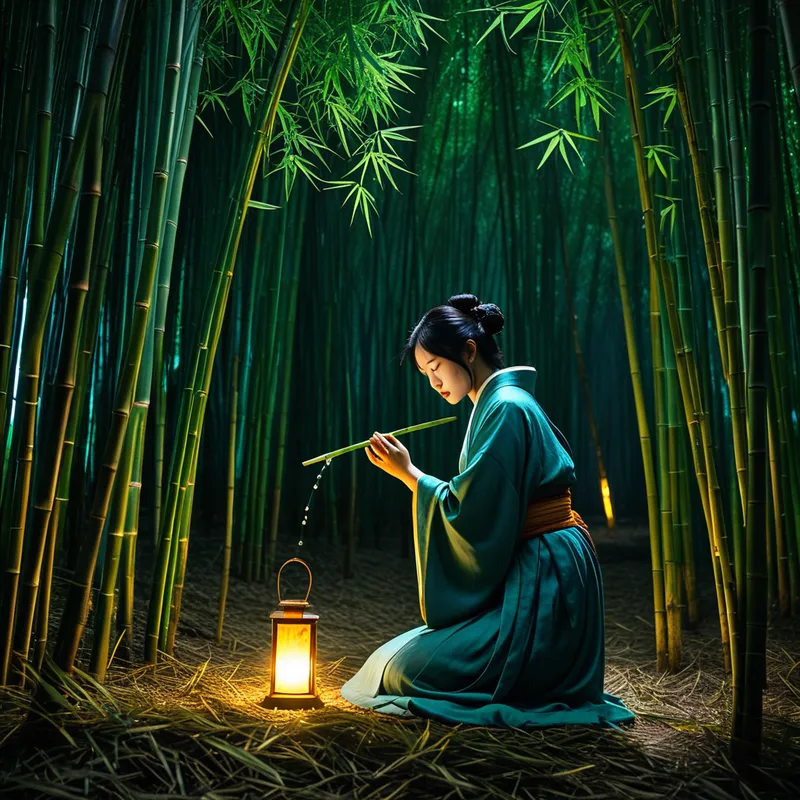
The village elders offered prayers to kami, but Sayo’s grief was a torrent that no ritual could channel. It curdled within her, a silent scream that turned the air around her heavy. She fled to a secluded grove sacred to the mountain spirit, and there she wept until her tears dried to salt and her voice was a ragged whisper. But her grief did not dissipate; it condensed, sinking into the very soil where she knelt.
“Hear me,” she rasped, not to any named god, but to the raw principle of the earth itself. “If the strength of men fails, if the compassion of the gods is silent, then let my sorrow become a different kind of power. Let it become a guardian that never sleeps, a wrath that strikes without hesitation to protect those who cannot protect themselves.”
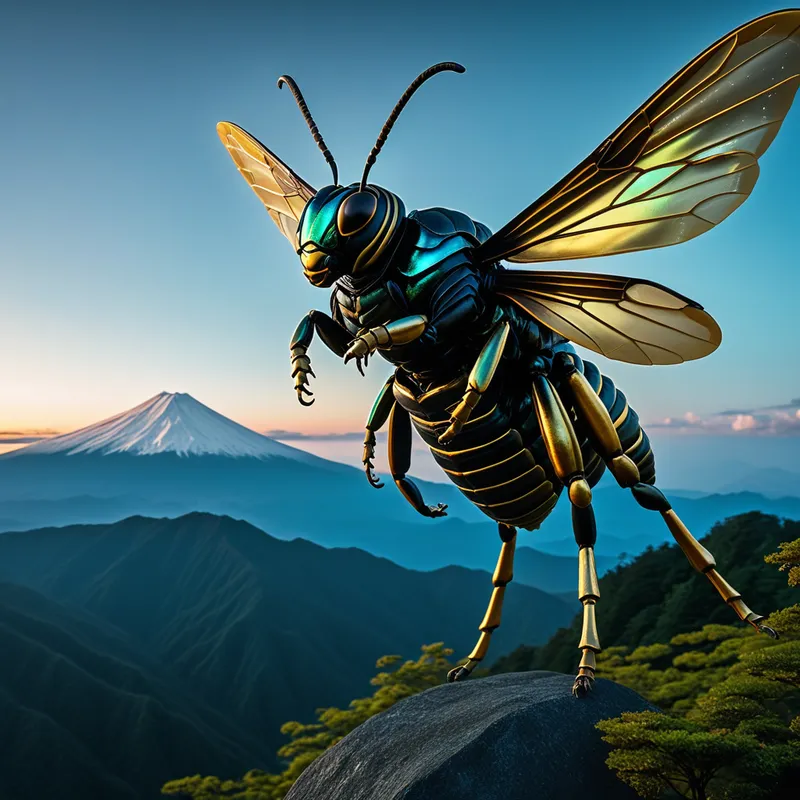
As the last word left her lips, she breathed out her spirit into the earth and became still as stone. The grove fell silent. Then, from the exact spot where her tears had fallen, the soil cracked. Not with a sprout, but with a resonant drone. From the fissure emerged a form unlike any natural creature: a hornet of immense size, its carapace the black of a starless midnight banded with the gold of a vengeful sun. Its wings thrummed with the sound of a thousand looms, and in its faceted eyes burned the condensed fire of a mother’s love and rage. This was Suzumebachi, the first of its kind.
It did not seek the brigands for petty revenge. Instead, it took to the skies, a new law written on the wind. It patrolled the forest paths leading to the village. When wolves threatened the shepherds, Suzumebachi drove them back with a fury that shook the trees. When sickness threatened the children, its mere presence near a home seemed to purify the air. It became the village’s unspoken protector, a living manifestation of the boundary between safety and peril. The people learned to respect its hum—a sound that was not a threat, but a promise: Here, the vulnerable shall be shielded. Here, sacred rage stands watch.
Cultural Origins & Context
The figure of Suzumebachi as a mythic entity is woven from several threads in the Japanese cultural tapestry. While the giant hornet (Vespa mandarinia japonica) is a very real and feared creature in rural Japan, its elevation to a protective spirit speaks to a deep animist worldview central to Shinto. In this framework, any potent natural force or being—a waterfall, an ancient tree, a formidable animal—can be a vessel for kami, a spiritual presence.
This specific narrative pattern, of a profound human emotion transforming into a natural guardian, resonates with local folk tales (mukashibanashi) often told by village elders. These stories served a crucial societal function beyond entertainment: they explained the presence of dangerous wildlife within a sacred cosmology, instilling respect rather than mere fear. To understand the hornet was to understand it as part of a moral and spiritual ecology. The tale likely originated in mountainous regions where human settlements were precarious, and the message was clear: even the most terrifying forces in nature could be aligned with the community’s survival, provided the community lived with respect and acknowledged the sacred debt owed to such powers.
Symbolic Architecture
At its core, the myth of Suzumebachi is an alchemical narrative of emotional transmutation. The raw, human material—Sayo’s unbearable grief and rage—does not vanish or get healed in a conventional sense. Instead, it is subjected to the crucible of the sacred earth and transformed. It changes state from a passive, consuming emotion into an active, focused principle.
The most profound protection often springs not from untroubled benevolence, but from a love that has fully tasted the bitterness of loss and chosen to become a shield.
Sayo’s transformation represents the ultimate sacrifice: the dissolution of the individual self for a collective function. Suzumebachi is no longer “Sayo”; it is the essence of her protective intent, stripped of personal identity. Psychologically, this symbolizes the moment a personal wound is depersonalized and repurposed. The hornet itself is a perfect symbol of this: a creature whose sting delivers transformative pain (even death), yet whose entire social hive structure is built around the fierce, unconditional defense of its young and its queen. It embodies paradoxical unity: terrifying power in absolute service to vulnerability.
The Dreamer’s Resonance
When the pattern of the Suzumebachi myth stirs in the modern unconscious, it often manifests in dreams of formidable guardianship or terrifying personal power. One might dream of a humming, geometric swarm that forms a protective barrier around a child or a vulnerable aspect of oneself. Alternatively, the dreamer may become the hornet—feeling a terrifying, buzzing potency in their own body, often accompanied by anxiety about wielding such force.
Somnatically, this process correlates with the activation of the sympathetic nervous system—the “fight” response—but in a context of protective, not predatory, intent. The psyche is wrestling with the integration of its own “sting”: the capacity for righteous anger, for setting fierce boundaries, for saying “no” with finality. The dream asks: What vulnerable part of you or your life requires this kind of fierce, uncompromising defense? And are you willing to let your personal grief or rage be alchemized into a power that serves a purpose greater than your own suffering?
Alchemical Translation
The individuation journey modeled here is not the classic hero’s quest to slay a dragon, but the caregiver’s journey to become the dragon—or the hornet—on behalf of what one holds sacred. It is the translation of victimhood into stewardship.
The first stage is Calcination: Sayo’s life is burned to ash by the fire of loss. All identity is reduced to pure, painful emotion. The second is Dissolution: her plea to the earth represents the surrendering of this calcified grief back into the primal, unconscious matrix (the soil). Here, in the nigredo or blackening, the material is broken down. The third is Coagulation: the emergence of Suzumebachi. The dissolved elements re-solidify, but in a new, exalted (rubedo) form. The personal “I” is gone, replaced by a functional archetype—the Protector.
Individuation is not about becoming perfectly whole and serene; it is about becoming responsibly powerful, learning to wield the fragments of our brokenness as tools for a sacred craft.
For the modern individual, this myth instructs us not to spiritually bypass our “negative” emotions like rage or profound grief, but to submit them to a transformative process. What in your life feels like a destructive sting? Can that energy be redirected? Can your personal boundary become a communal border? The myth suggests that our deepest wounds, when consciously offered up to something greater than our ego, can crystallize into our most potent gifts—not as healed scars, but as living, humming armor, forever on guard for the sake of a world more vulnerable than we once were.
Associated Symbols
Explore related symbols from the CaleaDream lexicon: