Surya Myth Meaning & Symbolism
The story of the Sun God Surya, whose unbearable brilliance was tempered to sustain life, revealing the alchemy of consciousness and cosmic order.
The Tale of Surya
Listen. Before time was measured, there was only the One. And from the One, a thought of separation, a desire for manifestation, and thus, the cosmos was breathed into being. Among the first and most magnificent of these breaths was Surya. He was not merely a ball of fire in the sky; he was consciousness itself made visible, the eye of the universe, the sovereign of the heavens.
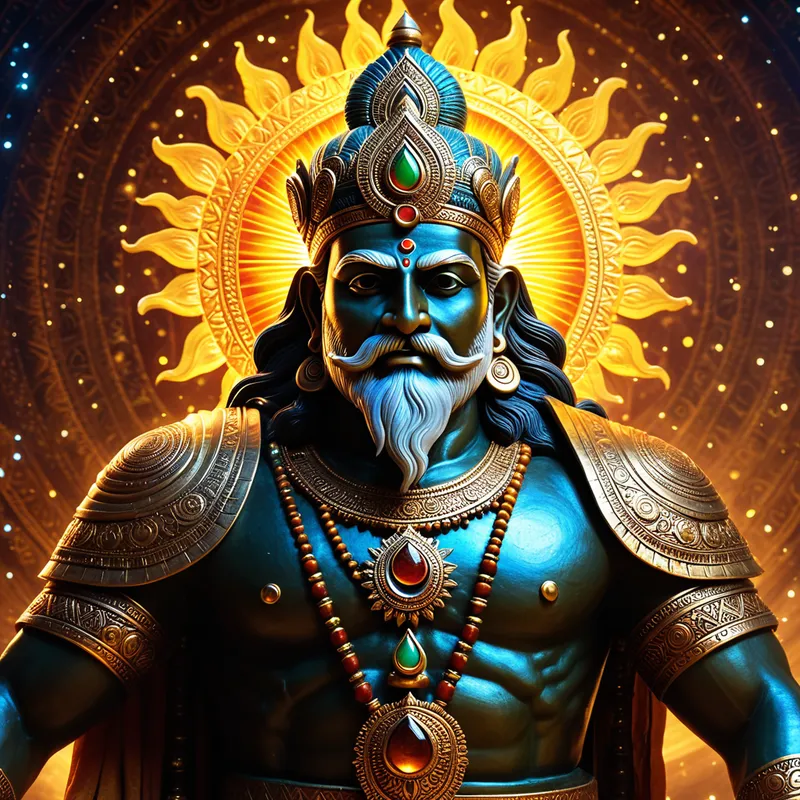
He was born of the cosmic law, Dharma, and ascended to his throne in the sky. His form was unbearable to behold—a being of pure, undifferentiated radiance. His light was truth itself, but truth in its raw, unmediated state. It scorched the earth. It bleached the colors from the world. The very gods, his kin, could not gaze upon him without shielding their eyes. His wife, Saranyu, the exquisite dawn, could not bear his proximity. His brilliance was a solitude, a tyranny of pure being that allowed for no other.
Saranyu, in her despair, created a shadow-self, a likeness named Chhaya, and fled into the hidden realms. Surya, unknowing, lived with Chhaya, and from their union came a son, Shani, whose gaze would one day carry the weight of cold, judgmental time. But the cosmos was out of balance. Life withered under the unrelenting gaze. The world cried out for not just light, but for warmth; not just truth, but for livable day.
The gods convened in desperation. Their king, Indra, could not command him. The wise Vishnu could not contain him. The solution came not from force, but from craft. They approached Vishvakarma, the maker of all things. "Father," they pleaded, "the Sun burns too fiercely. You must temper him, or all creation will be undone."
Vishvakarma understood. He did not seek to diminish Surya, but to make him sustainable. He invited Surya to his celestial workshop, a place where form meets intention. "Great Deva," said the artisan, "your splendor is absolute. But for the world to receive your gift, it must be filtered through the lens of matter." And so, Vishvakarma placed Surya upon his divine lathe. With tools spun from the fabric of reality, he began to shave away the excess of Surya's luminosity.
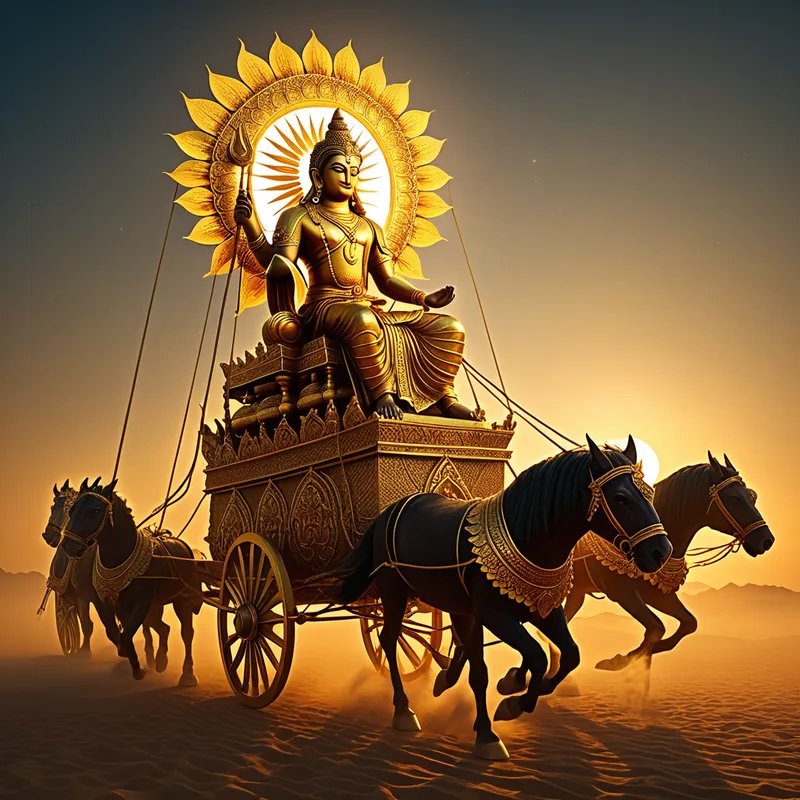
Shavings of brilliant light fell from the lathe, cooling as they fell. From them were born mighty weapons: Sudarshana Chakra, the trident of Shiva, the lance of Kartikeya. The very substance of Surya's unbearable radiance became the tools of cosmic order. When Vishvakarma was finished, Surya remained magnificent, a king in a chariot drawn by seven green horses—the seven rays of the visible spectrum, the seven days of the week. But now, his light was filtered. It was golden, not white. It warmed, it nurtured, it revealed color instead of obliterating it.
He rose the next dawn, and the world sighed in relief. The plants turned their faces to him. The rivers sparkled. Saranyu, in her distant hiding, saw the change—the harsh lord replaced by a benevolent king. Balance was restored. Surya, diminished in raw power, became infinitely more potent in his role. He became the Sakshi, the impartial witness, the giver of life, the marker of time, the remover of darkness—both without and within.
Cultural Origins & Context
The myth of Surya is woven into the earliest strands of Indian thought, appearing in the Vedas, most prominently in the Rigveda. Here, he is Savitar, the stimulator, the vivifier. He was not just a natural phenomenon to be described, but a cosmic principle to be invoked through ritual and hymn (mantra). The Gayatri Mantra, perhaps the most revered verse in Hinduism, is a direct meditation on Surya's illuminating power.
The story of his "filing down" finds its detailed narrative in later Puranic literature, such as the Vishnu Purana and the Markandeya Purana. These texts served as the "folk encyclopedia" of their time, transmitted orally by storytellers and priests (pandits) and enacted in temple rituals and festivals like Chhath Puja. The myth functioned on multiple levels: it explained the nature of the sun's manageable light, established Surya's role as the linchpin of the cosmic order (Dharma), and provided a theological framework for the importance of balance, sacrifice, and transformation—even for a god.
Symbolic Architecture
At its core, the myth of Surya is an allegory for the journey of consciousness from a state of undifferentiated, absolute potential into a form that can engage with and sustain a manifested world.
The raw light of pure consciousness is blinding; it must be broken into the spectrum of experience to create the world of color, form, and relationship.
Surya represents the Self in its most primordial state—absolute, sovereign, but isolated. His unbearable brilliance symbolizes a truth or an awareness that is too potent to be integrated directly. It is the genius that burns out its vessel, the spiritual insight that shatters the psyche, the ideal so pure it cannot tolerate the messy reality of life.
The act of Vishvakarma filing down Surya is the alchemical process of individuation. It is the necessary sacrifice of raw, omnipotent potential for the sake of relationship and creation. The shavings that become divine weapons signify that nothing is lost in true transformation; the surrendered power is reconstituted into tools (discernment, will, discipline) that serve the cosmic order.
Saranyu's flight represents the soul's (Atman) instinctive retreat from an overwhelming, unintegrated spiritual force. The resulting shadow-union with Chhaya and the birth of Shani illustrate the consequences of unmediated brilliance: it gives birth to cold, rigid, saturnine structures—harsh discipline, crippling judgment, the weight of unprocessed time.
The Dreamer's Resonance
When this myth stirs in the modern unconscious, it often manifests in dreams of blinding or scorching light. One may dream of a lightbulb that cannot be turned off, a sun that fills the entire sky, or an internal light so intense it feels painful or isolating. Somatic sensations might include feelings of overheating, restlessness, or a sense of being "too much" for one's environment.
Psychologically, this signals a critical phase where a nascent consciousness or a powerful insight (a creative idea, a spiritual awakening, a moment of profound self-realization) is emerging with such force that it threatens to destabilize the dreamer's existing psychic structure. The ego feels "scorched" by the proximity to the Self. The dream is a cry from the psyche for a "Vishvakarma"—for a mediating, crafting principle that can help translate this raw potential into a sustainable form of energy. It is the tension between the desire to shine with absolute authenticity and the biological and social need to adapt that light for connection and nourishment.

Alchemical Translation
For the individual, the myth of Surya maps the path from brilliant, ego-centric potential to wise, life-serving authority—the journey of the Ruler archetype. The immature Ruler is the tyrant: the unyielding idealist, the perfectionist who burns out themselves and others, the person whose "light" of truth or talent is expressed without compassion or context.
The alchemical lathe is the crucible of lived experience, where the hard edges of our absolute ideals are worn down by friction with reality, revealing a more durable, useful shape.
The "filing down" is the often-painful process of adaptation and sacrifice. It is learning to communicate a complex insight simply. It is tempering righteous anger into effective advocacy. It is channeling raw creative fury into a disciplined practice. It is allowing our relationships to sand down our sharp corners, not to diminish us, but to make us capable of true intimacy. The "shavings" that fall away are not lost; they become our skills, our boundaries, our unique "weapons" for navigating the world.
The ultimate goal is not to become dim, but to become a regulated source. To move from being a blinding star to a life-giving sun. This is the mature Ruler: one who provides warmth, clarity, and order not through tyrannical force, but through consistent, filtered radiance. They become the Sakshi within their own psyche—the impartial, illuminating consciousness that observes without judgment, warms without burning, and guides the inner chariot across the sky of one's life with diurnal reliability. In doing so, they no longer merely hold light; they become a vessel through which the light of consciousness itself sustains the world they inhabit.
Associated Symbols
Explore related symbols from the CaleaDream lexicon: