Surtr's Fire Myth Meaning & Symbolism
The fire giant Surtr emerges at Ragnarök to engulf the world in cleansing flame, a necessary end that makes way for a new, green earth.
The Tale of Surtr's Fire
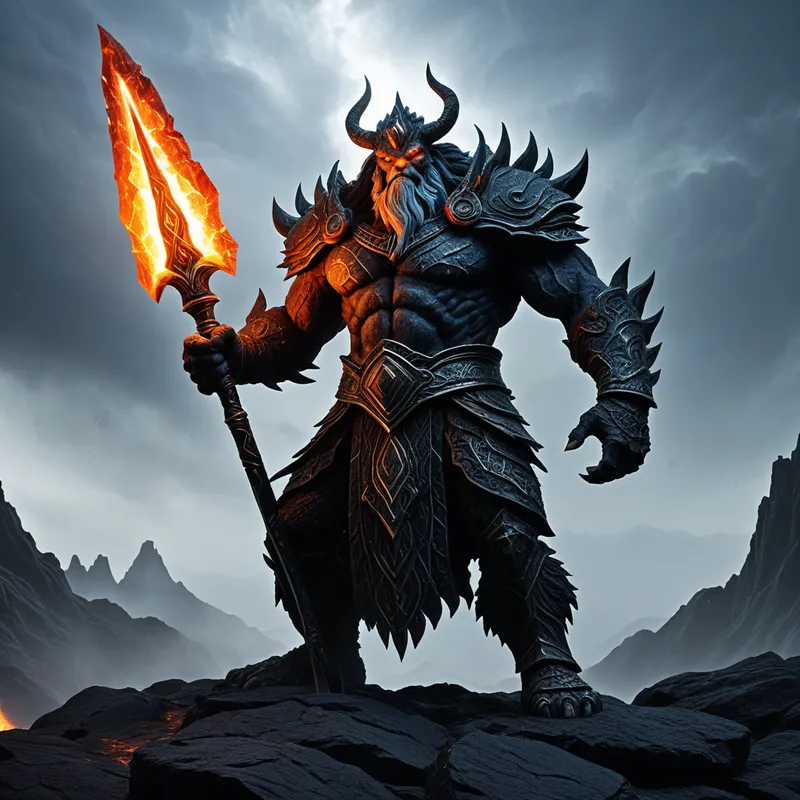
Listen, and hear of the doom that sleeps in the south, beneath a sky that has forgotten the sun. In the realm of Muspelheim, where rivers are molten stone and the air shimmers with a heat that predates the gods, he waits. His name is Surtr, the Black One. He is ancient, older than Odin’s first thought, a being of primordial flame and unyielding stone. In his hand rests a sword brighter than any sun, a weapon that has never known a scabbard, for its light and heat are eternal.
For ages, he guards the borders of his blazing home, a silent sentinel at the edge of creation. But he waits for a sign. He waits for the shivering of the Yggdrasil, for the howling of bound wolves and the crowing of rust-red roosters. He waits for the breaking of all bonds.
And when that time comes—when Fimbulwinter grips the world in its dead, white fist and brother turns sword against brother—the earth itself will groan. The great wolf Fenrir will slip his chain. The sea will boil as the Jörmungandr rises. And from the south, a glow will stain the horizon, not of dawn, but of ending.
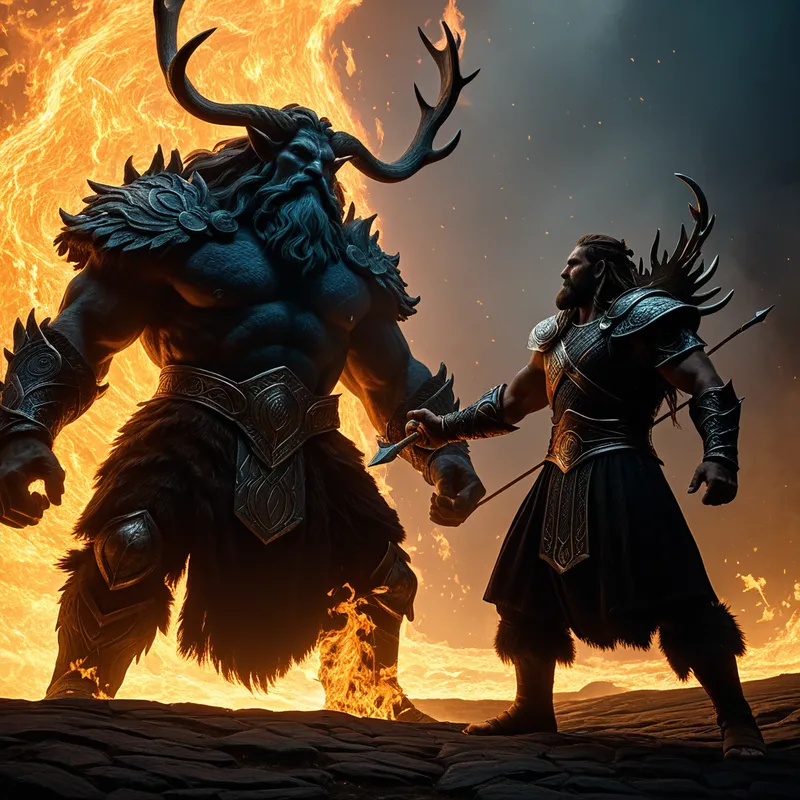
Then Surtr will move. He will march forth with all the sons of Muspel, and the sound will be the cracking of continents. He will come to the plain of Vígríðr, where the gods make their last, glorious stand. There, the shining god Freyr, who once gave away his sword for love, will face the Black One with only an antler. It is a battle already written in ash. Freyr will fall.
But Surtr’s purpose is not just war; it is consummation. He will turn from the field of slain gods and walk across the trembling earth. He will reach the Bifröst, and with one step, the brilliant bridge will shatter and burn, its colors swallowed by his fire. And then, he will unleash his flame.
He will set the world ablaze. Not a fire of hearth or forge, but the fire of the universe’s first breath. It will roar through every root of Yggdrasil, lick the halls of gods and the homes of men, burn the sky and boil the sea. It will consume all things—the glorious and the vile, the mighty and the meek. The earth will sink beneath the waves, a blackened cinder, silent under a smoke-choked sky.
And when the last ember of the old world dies, when Surtr’s fire has spent itself and the Black One returns to the embers of his home… then, from the deep, the waters will recede. A new earth will rise, impossibly green and fresh. The sun’s daughter will take her place in a clean sky. And life, whispered from surviving seeds, will begin again. Not because of the gods, but after them. Made possible by the all-consuming fire.
Cultural Origins & Context
This apocalyptic vision is preserved primarily in two Old Norse poems: the prophetic Völuspá (The Seeress’s Prophecy) and the descriptive Vafþrúðnismál (The Lay of Vafþrúðnir), found within the Poetic Edda. These were not scriptures, but oral traditions, memorized and recited by skalds and possibly ritual specialists. They were told in the longhouses of Scandinavia and Iceland, the firelight flickering on intent faces as the bard spoke of a final, world-ending fire.
The myth functioned as more than just a spectacular “end times” story. In a culture that viewed the cosmos as cyclical and inherently fragile, besieged by frost giants and chaotic forces, Ragnarök—with Surtr as its ultimate agent—provided a narrative framework for understanding destiny, courage, and entropy. It taught that even the gods are subject to fate (ørlög), and that true heroism lies in facing a doomed fight with resolve. The myth validated a worldview where destruction was not a meaningless accident, but a necessary, pre-ordained phase in the order of things, making way for renewal. It was a story that stared into the abyss of total loss and found, not despair, but a terrible, cleansing logic.
Symbolic Architecture
Surtr is not merely a monster. He is the embodiment of the unstoppable, transformative force that exists outside and before the established order. He is the archetypal Conflagration, the purging fire that reduces complex structures to their essential elements.
He represents the psychological truth that for the new to be born, the old must utterly pass away. Not reformed, but dissolved.
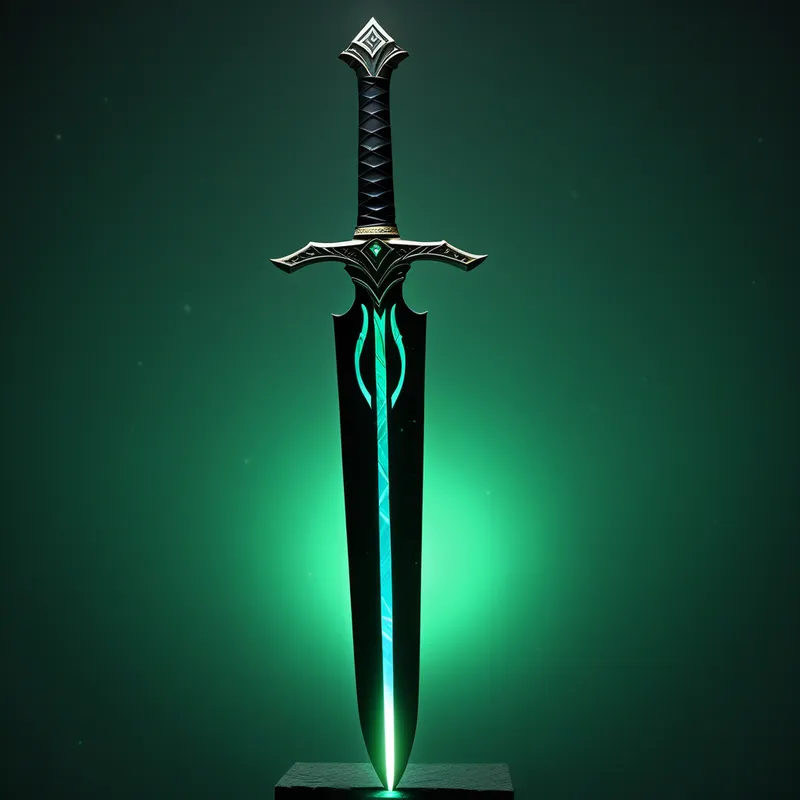
His fire is the antithesis of the controlled, creative hearth-fire of the home or the forge of the smith-god. It is raw, cosmic energy. Symbolically, Surtr’s realm, Muspelheim, existed before the world was made in the Ginnungagap; his fire is thus a return to primordial potential, the blank slate. The sword he wields is a symbol of absolute, decisive severance—it cuts not flesh, but epochs. His defeat of Freyr, the god of fertility and peace, is poignant: the gentle, life-nurturing principle cannot withstand the onslaught of absolute transformation. It must first be sacrificed to the flame.
In the grand architecture of the myth, Surtr is the executor of a cosmic cycle. He is the agent of Ragnarök, which is not merely an “end” but a resolution. The accumulated corruption, the broken oaths, the entropy of the age—all are fuel for his cleansing flame. His action, though destructive, is impersonal and complete. He does not rule the new world; he merely makes its emergence possible by reducing the old one to ash, the ultimate fertilizer.
The Dreamer's Resonance
When Surtr’s fire erupts in the modern dreamscape, it rarely appears as a literal giant. Instead, the dreamer may experience uncontrollable wildfires consuming a familiar landscape, the sudden, catastrophic collapse of a building that represents their life, or being trapped in an overwhelming, purifying heat. Somatic sensations often accompany these dreams: a feeling of intense, almost feverish heat in the body, or a profound, shaking anxiety as of standing before an inevitable cataclysm.
Psychologically, this dream pattern signals that a deep, structural psychic process is underway. The ego’s carefully constructed world—its identities, commitments, and self-narratives—has become untenable. It may be riddled with unconscious “broken oaths” (self-betrayals, lived lies) or paralyzed by an inner “Fimbulwinter” of depression and stagnation. The psyche, in its wisdom, is mobilizing its own Surtr. The dream is not a prophecy of literal doom, but an enactment of a necessary, inner apocalypse.
The terror in the dream is real, for the ego rightly perceives its own dissolution. Yet, the therapeutic question upon waking is not “How do I stop the fire?” but “What, in my life or self, has become so rigid, so inauthentic, or so burdensome that it must be burned away for something new to live?” The dream of Surtr’s fire marks the painful but vital process of ego-death preceding renewal.
Alchemical Translation
In the alchemical journey of individuation—the process of becoming one’s whole, authentic self—Surtr’s fire represents the dreaded but essential stage of calcinatio and solutio: reduction to ash and dissolution. This is the “dark night of the soul,” where all the persona’s gold is revealed as gilded lead and must be thrown into the furnace.
The alchemical maxim “Solve et Coagula” (Dissolve and Coagulate) finds its ultimate expression here. You cannot rebuild on a cracked foundation; you must first return it to dust.
For the modern individual, this translates to those profound life crises that obliterate our former sense of self: the devastating loss, the failed career, the shattered relationship, the diagnosis, the burnout that feels like a total psychic incineration. In these moments, we are not the gods fighting nobly on Vígríðr; we are the very world that is burning. Our ego, like Asgard, is under assault by a force that feels alien and all-powerful.
The work, then, is not to fight the fire, but to understand its necessity. What outdated version of you is being consumed? What attachments, ambitions, or self-concepts are fueling the flames? The individuating psyche must learn to differentiate between what is truly Self and what is merely structure. The fire burns the latter to liberate the former.
The myth’s final promise is the green earth rising from the water. Psychologically, this is the emergence of a new, more authentic personality structure, not built from the ego’s old blueprints, but organically growing from the core of the true Self, fertilized by the ashes of what was destroyed. Surtr’s fire, in the end, is not an enemy, but the most radical and faithful servant of rebirth. It clears the ground so the seed, dormant all along, can finally meet the sun.
Associated Symbols
Explore related symbols from the CaleaDream lexicon: